
I was recently thinking about a couple things in our community.
They have to do with the urge for revenge.
There’s one person who runs an organization. They do a great job, but they’re sort of petty, right? They collect slights. They practice not-so-covert revenge.
There’s another one who hates someone who runs an organization. That hate takes up a lot of their time and they’ve enlisted—slowly—a whole crew of other people who they’ve convinced to feel the same.
I bet you might see this in your own neighborhood or maybe even your own family. Maybe even your own heart, right?
It’s pretty easy to want revenge, especially when people have been absolute horrors to you or your family. Or even when they just keep annoying you because they chew their beets too loudly and never shut the toilet lid.
The problem is that revenge and that feeling of grievance is addictive and it’s bad for your brain.
Damn it, right?

On the July 16 episode of the Science of Happiness podcast, James Kimmel Jr., an assistant clinical professor at the Yale School of Medicine, talks about his quest to understand revenge and what it actually does to us, specifically our brains.
Kimmel has his own harrowing childhood experiences with bullies that led to their escalating violence and the death of his pet and the bombing of his family’s mailbox before he chased after his bullies, gun in hand, following them and cornering them at one of their farms. In the dark of night, with them standing in the headlights of his own vehicle, unarmed, he made a choice. He chose not to shoot. He chose to go home.
It made him think about a lot of things throughout his growing up and it also made him eventually study revenge.
He said,
“So it turns out your brain on revenge looks like your brain on drugs, and that's not a metaphor. You know, neuroscientists have been able to put people inside of fMRI brain scanners, PET scanners, give them a grievance, that is a reason to feel victimized, and then an opportunity to retaliate and see what happens inside their brains when they do. And what they see is that the two areas of the brain that are most closely linked to the go circuitry of addiction, that is the motivation, the craving, the pleasure, this is called the nucleus accumbens and the dorsal strata. These two areas of the brain actually activate when you first experience the pain of a grievance. The grievance activates a different area of the brain called the brain's pain network, the anterior insula. That seems to cue the desire for revenge in the reward circuitry. And then the last piece of the puzzle is your prefrontal cortex. That's the stop circuitry that's supposed to be your cost-benefit circuitry that enables you to weigh decisions and consequences before you take a step, and that area seems to be shut down for revenge seeking.”
He talks about how people sometimes can’t resist the urge for vengeance.
And eventually? That urge hurts you or others.
“So if you have this urge and you have an inability to resist it, and it starts hurting you or other people, then you generally qualify as having what the rest of us commonly call an addiction, or you might. And doctors in addiction medicine are not afraid of calling it addiction at all, 'cause that's what their patients are calling it, and that's what we all understand,” he explained.
At the same time, social scientists have been looking into common links among the motivation for violent crime.
“And the one universal answer is, oh, surprise, revenge seeking,” he explained. “It's the perception of being wronged that motivates somebody to wanna hurt another person, which gives true meaning and real validation to the concept that many people have probably heard, which is hurt people hurt people, right?”
He calls it the world's deadliest addiction.
The detox, he said, is forgiveness.
“It actually neurobiologically reverses the circuitry that is activated after a grievance for revenge,” he explains.
It’s more than that, too.
Kimmel says, “So what early studies have been showing is that when you forgive, if you put somebody in an fMRI brain scanner, you give them a grievance and an opportunity to forgive instead of retaliate, it shuts down, it stops the brain's pain network, that anterior insula. So forgiveness actually is being shown to stop pain. That is an enormous neurobiological benefit from what we've long thought of as, you know, some sort of soft spiritual practice. The other thing that it does is it seems to shut down that pleasure and reward circuitry of addiction. So that ghost circuitry that I was telling you about, that is shut down. And then the other thing that forgiveness does is it activates or reactivates the prefrontal cortex, that decision-making executive function and self-control circuitry.”
So, how do you get to that place?
The Better Good suggests the practice in the image below.
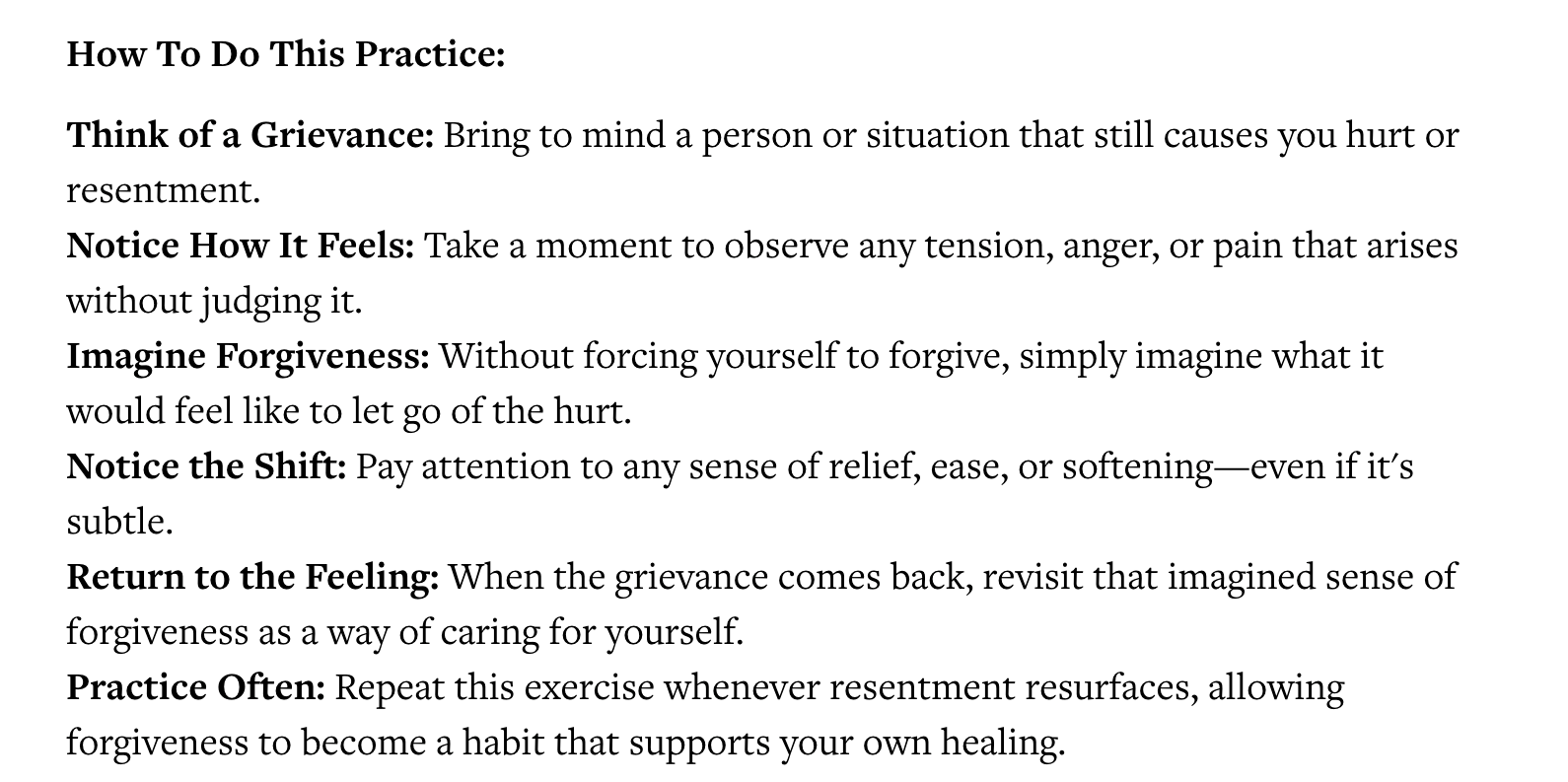
The Science of Revenge: Understanding the World's Deadliest Addiction and How to Overcome It.
Links to the podcast and Greater Good
This blog/newsletter/Substack/whatever will always be free to read now, but it’s also part of how I pay my mortgage.
If a paid subscription is way too big an ask, I’m always thankful for help buying dog treats.
Or, honestly, just sharing that this Substack exists is super cool.
I usually send these emails twice a week.
*My WRITE BETTER NOW posts also come one to two times a week if you sign up for them, too, which you should.
And COMFORTING is where I just have no filter at all and am totally schmaltzy is here. That’s once a week or so.
Note: I will not be terribly, perfectly, grammatically correct.
Comments
Nothing yet. Say the first thing.
Sign in to join the conversation.