
I was talking to a friend today who wants to write something long—a novel or a graphic novel or a comic—but he worried about sustaining it, of not just writing for two hours and then giving up because he got bored.
I’ve been thinking a lot about keeps readers interested in reading a novel and not throwing it in a toilet and how that relates to what keeps writers wanting to write a novel.
Most of the time, when we talk about this, we talk about characters and having characters that the reader is interested in.
That’s super important.
Then there’s plot, which is basically the sequence of events in a novel.
Also, super important.
There’s one element we don’t talk about a lot about and that’s tension.
First, super quickly, when you start a novel. Most people do what’s outlined in this lovely Reedsy graphic.
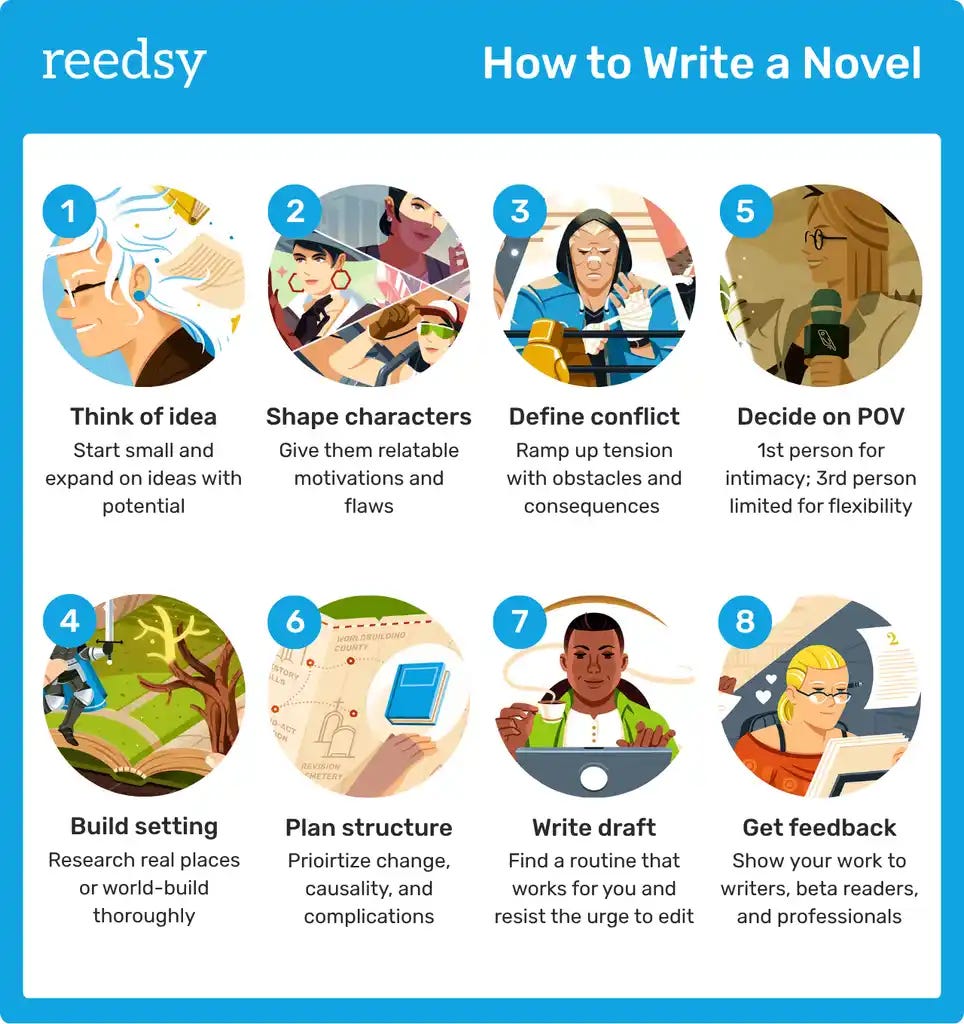
Not all of us do it this way. I don’t outline. I tend to just write with no filters and no plan. This isn’t always true, but I’m super easily bored so I like to be surprised by what happens as I write.
My point here is just that there’s no one right way to write. You get to do you. You get to create your art, your story, the way you want.
Eight steps. Twenty-three steps. Five.
There is so much advice out there about how to start your novel that it can feel pretty overwhelming. That’s because there is no one way to start a novel. Anyone who tells you that there is? They’re lying to you and probably trying to sell something.
It’s okay to sell things like coaching and books and advice and services.
It’s not so okay to pretend like there is only one way to do art.
The common piece of all these ways to start your novel is just this: you have to actually put words on a page at some point.
That’s it.
Oh, and you have to make stuff up.
In the rest of this post, I’m going to give you a quick debrief of a couple of methods and then talk about tension.
Author, editor, writing coach (more titles than I have space for) Jerry Jenkins has a pretty well thought out method of 23 steps that includes multiple prewriting steps. These are all linked to his website and are from his words.
Now, this might feel overwhelming, maybe? For some of us. Or it might not be how our brains work. That’s totally okay.
This site connects writers to professionals (editors, marketers, formatters and designers) vetting the professionals and getting a cut on all the fees, which is pretty brilliant.
Their list with links is a bit thinner than Jenkins’ and also has a section about hiring a professional. Though I am a professional who has been hired a lot (I’ve helped over 1,000 writers now), you do not need to hire a professional to help you with your book. I didn’t. Tons of people don’t. But it’s an option when you feel lost or just when you like to learn and build with others.
This is directly from Reedsy’s blog, which has a ton of good information.
“How to write a novel in 13 steps:
Self-Publishing School also has a great rundown of the steps. Those are from here and directly excerpted with links below.
“Here are the steps for how to write a novel:
Some of us (often me as I disclosed up there) just write. We figure out the novel on the page as we write it. Maybe we hear a line of dialogue (“He wants to know why it happens”) or maybe we see an image (Girl crying near a toilet, Mom standing the the threshold) or maybe we have a question (How could someone do something so cruel?), but it inspires us to write and type on the page.
This is often called the Pantser method because rather than plotting, you’re writing by the seat of your pants.
We don’t outline. We don’t make a logline. We just write for the joy of writing and discovery. This is an awesome way to be in the flow, but it’s also an awesome way to have to revise a lot for structure and nuance.
It’s my favorite way, honestly, because when my books form like this they tend to be deeper and more passionate.
Over on Medium, Michelle Richmond has ten steps that I love, which you should check out if you can.
The whole article is super interesting, but I’m just going to excerpt her first step because it links in a bit to the JUST DO IT METHOD.
She writes,
“1. Forget the outline. Start with situation.
“Outlines are fine unless they derail you. I’ve seen it again and again: writers who end up spinning their wheels for years, beholden to a failed outline. The good thing about an outline is that it gives you direction. The bad thing about an outline is that it limits your novel’s possibilities and may cause you to get hopelessly stuck.
“For the first fifty pages, at least, write your novel without an outline. Start with a situation and see where it goes. It works for Stephen King, who explains in his essential writing guide, On Writing: A Memoir of the Craft:
I believe plotting and the spontaneity of real creation aren’t compatible. A strong enough situation renders the whole question of plot moot. The most interesting situations can usually be expressed as a what-if question.
A teacher shared the “what-if” advice back when I was an undergraduate at The University of Alabama, and it has served me well ever since, providing a starting point for all of my novels:
“What if a couple receives a wedding gift that promises to help them achieve a lasting marriage…with some rather serious caveats? (The Marriage Pact)
“What if a child goes missing on a beach while in the care of her soon-to-be stepmother? (The Year of Fog)
“What if an FBI agent in the aftermath of personal tragedy moves home to discover her small Northern California town has become a Silicon Valley suburb on steroids, obsessed with an annual exam called The Wonder Test?
“Once you have the situation and some words on the page, if you want more structure to your process, you can create a scene list, mapping out some of the key scenes you want to write.”
Richie Billing is a writer with a podcast and classes and books and a blog. On that blog, he says,
“The best way to create tension in writing is to introduce conflicts or obstacles for your characters. These obstacles could be other characters, such as your villain or antagonist. They could also be internal barriers, like mental health problems. Or they could be physical conflicts like a blood-thirsty dragon.
Foreshadowing this conflict is a key part of building tension. Dropping hints of what may come can hook the reader and keep them wanting more.”
So, how do you do that?
You want your character to want something. You want the reader to care whether or not the character gets it or not. And then you want there to be obstructions that prevent that goal from being easy for your character.
Foreshadowing is just a hint of what’s going to happen.
Billings calls foreshadowing “the promise of conflict,” and I like that. It’s a big tease, right? It can also be the promise of resolution.
New York Editors actually blogs about four levels of tension here.
“TENSION WITHIN THE PROTAGONIST
As you introduce the protagonist into your story, there should be both internal conflict and conflict with some external force (whether that’s an antagonist, a series of unfortunate problems, etc.).
TENSION BETWEEN THE CHARACTERS
Show what each of the characters anticipate in every scene. What’s left unsaid between the characters?
TENSION AT EVERY SCENE
Answer the questions, what is at stake for the characters in this scene? What could go wrong? What could go right?
Create a sense of anticipation with every scene. No only should every scene move the story forward, it should also increase the tension within the protagonist in some way.
TENSION WITHIN THE OVERALL STORY
There should be an element of anticipation in the overall story also. This will most likely be resolved after the climax. However, other layers of tension, such as that between or within characters, can stretch the entire scope of the story and be resolved towards the end.
*OPTIONAL LAYER: TENSION WITH THE NARRATOR
This one won’t apply to every story, but for those of you using an unreliable narrator, you can develop a sense of tension and conflict between the narrator and the reader. Can I trust this narrator? Why don’t things add up? Who can I trust in this story?”
They suggest that to build tension, you should:
1. Shorten up your words.
2. Shorten up your sentences.
3. Build that tension over time to make your reader ponder what might happen, so sprinkle in tension-building tidbits and moments, facts and correlatives
4. Color code things to see if it’s working. I do this a lot when I talk to people about scene layering. But it’s basically you make up a color for aspects of story (senses, emotion, setting, action, reaction, exposition, dialogue) and see if your page is all one color. If it’s all one color? It’s not good.
5. Remember that conflict and tension aren’t quite the same thing. Conflict is a force working against your goals (see Billings above), but tension is an emotional connection between the reader and the character where the reader cares that your heroic firefighter might get eating by zombie gerbils.
Fiction writer and coach and editor, Rachel Grosvenor suggests those colors should be:
Conflict (do you see a trend?)
Cliffhangers
Varying tension
Creating a ticking clock (they have to do this by this time or the gerbils will rule the world)
There are a lot of suggestions out there, and you see some overlap, right?
You want the reader to go after something and you want the reader to care whether or not the character gets it.
You want to not have everything be high tension all the time. So you want to have it go up and down.
You want to have conflict (see above) that matters.
You want to vary sentence structure, paragraph length, white space and even use different word choices to imply that tension.
All that tension? It’s a huge part (I almost wrote HUG part.) of what keeps us reading. We want to have stakes and root for the characters when they go after they want. You can write and write and write and have a super cool character and a plot that makes sense, but it’s the tension that tends to make a novel something gasp worthy. And theme. And mood. Ah! So many elements, but right now, maybe think about that tension.
This blog/newsletter/Substack/whatever will always be free to read now, but it’s also part of how I pay my mortgage.
If a paid subscription is way too big an ask, I’m always thankful for help buying dog treats.
Or, honestly, just sharing that this Substack exists is super cool.
I usually send these emails twice a week.
*My WRITE BETTER NOW posts also come one to two times a week if you sign up for them, too, which you should.
And COMFORTING is where I just have no filter at all and am totally schmaltzy is here. That’s once a week or so.
Note: I will not be terribly, perfectly, grammatically correct.
Comments
Nothing yet. Say the first thing.
Sign in to join the conversation.