
If you were born between 1954 and 1964, you have probably spent most of your life thinking you were part of the “Baby Boomer” generation. But if you are anything like me, you might have looked at your older cousins and thought that you did not have all that much in common with them. Your childhood, teen years, and college years were markedly different.
I have cousins who went to Woodstock. I was too young to go. They were worried about being drafted and going to Vietnam. I was in elementary school and junior high during the height of the anti-war protests. When I finished college and was ready to join the workforce, the booming post-World War II economy they enjoyed was winding down. Yet for years, everyone born between 1946 and 1964 was lumped together into one group, called Baby Boomers.
Enter Generation Jones.
The concept of “Generation Jones” originated in 2000, when Jonathan Pontell used it to describe the roughly 49 million Americans born between 1954 and 1964. It’s a generational subset that bridges the early, classic Baby Boomers who were born from 1946 to 1953, and Generation X born between 1965 and 1980.
Where did the name come from? Pontell cited two key ideas behind the phrase:
First, it comes from the classic American slang term “jonesing,” which means having a deep craving or yearning for something. Our early years were spent in a time of great cultural and economic promise that turned out to be harder to achieve as we entered adulthood. We watched early Boomers ride the wave of post-war prosperity and cultural influence. We were left craving the stability and ease we had been promised as kids.
Second, it touches on the familiar phrase “keeping up with the Joneses.” It is a nod to the quiet anonymity of being caught between two massive, noisy demographic cohorts while we worked to build an identity of our own.
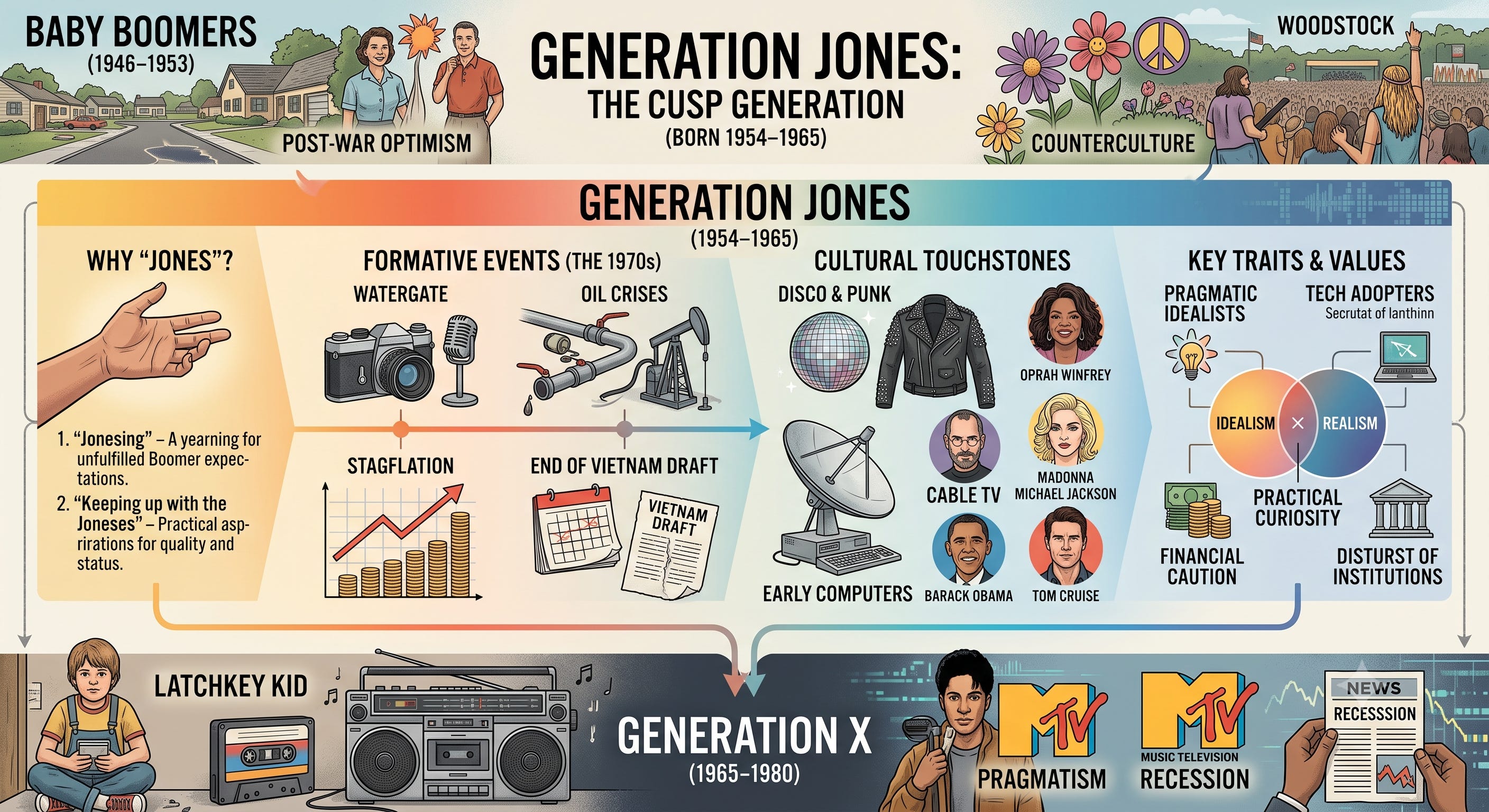
Demographers grouped everyone born over an 18-year span as a single generation because birth rates were high. But the cultural influences for early Boomers and Generation Jones were different.
When people talk about the “Boomer era,” they usually mean the 1960s. Early Boomers came of age alongside the Civil Rights movement, the Beatles on The Ed Sullivan Show, anti-war marches, and counterculture idealism. Sure, I remember being aware of a lot of that, but it was mostly through an older cousin who often came over to babysit.
For those of us in Generation Jones, our formative years happened in the 1970s and early 1980s.
Our soundtrack was not psychedelic rock. It was classic rock, disco (unfortunately), punk, and the early days of MTV. Instead of 1960s utopian idealism, our teenage and young adult years were shaped by Watergate, the Iran hostage crisis, gas rationing, and the Cold War. That gave us a different mindset. Early Boomers were often defined by grand social idealism; Generation Jones developed practical skepticism.
The difference in economic timing is perhaps the biggest difference between the two groups.
Early Boomers stepped into young adulthood during one of the greatest economic expansions in modern history. Good-paying jobs were plentiful, starter homes were genuinely affordable, and long-term corporate loyalty with a solid pension was standard practice.
Generation Jones walked into a completely different economic neighborhood. As we entered the workforce in the late 1970s and early 1980s, we were hit with severe stagflation, high unemployment, energy crises, and double-digit mortgage interest rates. When I graduated college as a journalism major, the country had an unemployment rate of 7.6%. Jobs were hard to find. Car loan rates were between 13 and 16%.
As we were trying to enter the workforce, we saw the widespread arrival of corporate downsizing and layoffs. We realized early on that job security was far from guaranteed. That hard truth taught us to be pragmatic, resourceful, and deeply self-reliant. We did not expect a free pass; we learned how to pivot and hustle. We had to.
Another defining trait of Generation Jones is our relationship with technology. We are the ultimate bridge generation.
We grew up in a purely analog world of rotary phones, vinyl records, rabbit-ear televisions, and card catalogs at the library. But because we were still relatively young when personal computers, cable TV, VCRs, and the internet arrived, we adapted to them with ease. For example, I was 20 years old when the Apple II personal computer arrived.
Unlike older friends and relatives who sometimes felt intimidated by new technology, and Gen Xers, who had more tech available in their younger years, we straddled both worlds. We remember how to fix things with our hands and write a proper letter, but we are just as capable of navigating smartphones, streaming devices, and online platforms. We have always had to adapt to changing tools, and that adaptability serves us well every single day.
Understanding the distinction between Baby Boomers and Generation Jones is not just a trip down memory lane. It matters tremendously right now as we navigate our 60s and look toward the next two or three decades.
For years, self-proclaimed aging experts and marketers have tried to sell us a one-size-fits-all retirement dream. They fill television commercials with gray-haired couples sitting passively on park benches, strolling on beach boardwalks, or playing lawn games in gated retirement villages. They assume that hitting 65 means stepping out of the arena and living a quiet, predictable life.
That is not our life. For one thing, retirement ages and eligibility to collect Social Security have crept up. We tend to be healthier in our 60s and 70s than previous generations. And we are not ready to retire or fade into the background.
Many of us are continuing to work, launching second careers, turning our experience and passions into small businesses, diving into creative arts, or picking up new skills simply for the joy of learning.
We still have that persistent “jonesing” spirit—that deep desire to live intentionally, make every day count, and do things on our own terms. And sadly, some of us still live to keep up with the Joneses, though I think that number gets smaller every day.
Whether you are a proud member of Generation Jones or just someone enjoying life after 60, one thing is certain: we are still here and are not ready to go anywhere we don’t want to go.
No posts
Comments
Nothing yet. Say the first thing.
Sign in to join the conversation.