
Note: This is part 4 of the series, click on the link to read Part 1, Part 2 and Part 3.
Dear reader, I owe you a reason for harping on and on about fuel problems and solutions. It’s because the northern hemisphere flying weather is improving by the day, so I’m rushing to highlight the fuel nasties that befall the unwary. We are half way through the series and I have plenty more stories about pilots falling into fuel traps. And after that a whole lot more about the thrills and spills of our magical life in the air.
jim
Leon was the friend of one of my pupils at Phalaborwa – that dusty mining town on the edge of South Africa’s famous Kruger National Park.
He has bought a Tiger Moth from a guy who lives 30 miles inside the park. It is my job to collect the aircraft and fly it back to Phalaborwa with Leon as a passenger. Although he has bought the Tiger he has never flown, or even sat in one before.
We take off from Letaba in the heat of the afternoon. The stifling air is red with dust from the feet of elephant and buffalo. I climb into a cooler, clearer atmosphere and level off before asking Leon if he wants to fly. Of course he does.
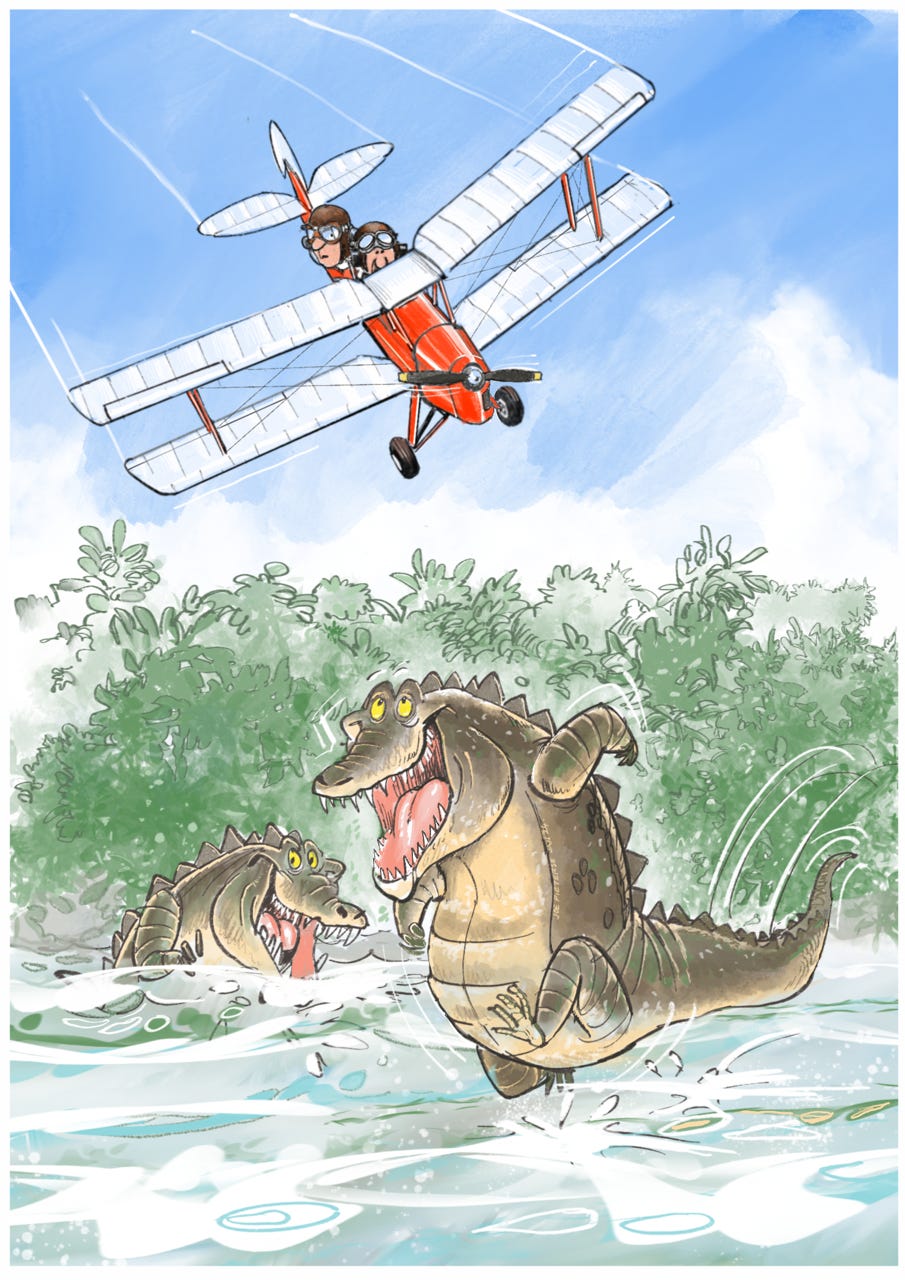
All is fine for a while but then he complains that the aircraft is trying to lose height. I tell him to trim back. He says that he has done that but it makes no difference. I bid him trim some more, and cast a beady eye on the duplicate trim lever in my cockpit. Nothing happens. He says he is trimming – and I say he is not. I decide to give him step-by-step instructions in this simple process, “you see the big lever next to your left leg? OK, now if you… Oh shit.”
The engine has stopped.
I tell Leon that I have control, and glance round for a landing field. We can make it to the lush green banks of the Letaba river – which is thick with hippo and crocodile – or there are a number of open patches between the thorn bushes. A landing should be no problem, but trekking through the bush amongst lions, snakes, elephants and buffalo holds little appeal.
A Tiger is a simple beast
I turn my attention inside the cockpit. A Tiger is a simple beast – there are no electrics, apart from the mag switches on the outside of the fuselage – both are ‘on’. The mixture richens itself automatically when you close the throttle. Carb-heat is also automatic. There’s only one tank – so I don’t need to check fuel selection, but habit takes my hand to the fuel cock which is out of sight below the panel. To my amazement it is switched off. I push it into the ‘on’ position and wait…and wait… and start thinking of buffalo again. Finally the engine, which has been windmilling, starts to splutter and cough. Eventually it gathers energy and becomes a healthy roar.
It’s easy to re-construct what happened. Because it was not a training flight I gave Leon no briefing, neither did I show him round the cockpit. When he thought he was trimming, he was actually switching the fuel off – both controls being near his left leg.
There are two lessons: always brief everyone, crew or passengers, who has access to any controls; and, if the engine just suddenly dies, without warning or unpleasant noises, it is almost certainly a fuel problem.
Piper Navajo/Chieftain
You know how certain aircraft are associated with certain types of accident? Mention a wheels-up, and a C210 springs to mind. The early ones were guaranteed to disappoint at some stage when you selected gear down.
Mention an aircraft on its back with a broken nose wheel, and we know it’s a training Cessna. That little wheel from a supermarket trolly was designed for taxying only – not for students whose instructors have encouraged them to approach at 15 mph faster than book figure.
Mention a twin that has had both engines croak within minutes of each other and you must be talking about a PA-31 Navajo. Their fuel gauges are inveterate liars.
But why should this be? Hell, airplanes are enormously expensive things, and they have unbelievably expensive fuel gauges – surely one should expect some degree of accuracy – particularly when such gauges claim to predict the life-expectancy of all on board.
Even the cheapest car has gauges will tell you pretty accurately how far you can go on the remaining fuel. Why can’t airplanes do the same?
That’s an excellent question. There are several reasons why aircraft gauges are generally not to be trusted with your The main one is strangely wing design.
As the wings are the best place to store the fuel, then the shape of the tanks must largely conform to the shape of the wings.
Now, ideally you want a fuel tank to be pretty much the shape of a shoe box facing fore-and-aft with the float for the gauge slap in the middle. This would read correctly in level flight but also in both a climb and a descent.
The fuel goes where the ball goes
It will also read correctly when you bank in a turn. The thing to remember is that the fuel goes where the ball goes. So in any turn – even in a steep turn the fuel will stay in the middle of the tank – as long as you have the ball in the middle – which of course you always do – don’t you.
So the shoe-box tank is ideal, but it doesn’t fit nicely into a wing. So if we turn it sideways and stretch it out so it fits along the main spar it should hold plenty of gas – which is what we want. We also need to curve it down a bit to make it fit into the shape of the airfoil.
Older airfoils had the main spar (and maximum thickness) fairly far forward so the fuel tanks had to sit behind the spar.
Then the designers decided that a more symmetrical, laminar-flow airfoil, with the spar further back, made a better aerodynamic shape. This left a bigger space ahead of the spar so that’s where the tank had to go.
No real problems so far, but we haven’t reckoned on dihedral – the way the wings slope upward towards the tip. This causes a monstrous nonsense – particularly on low wing aircraft that need more dihedral for lateral stability.
This means you end up with a long almost sausage-shaped tank is tipped in towards the fuselage.
Have a look at the diagram and you will understand the difficulty. On the Navajo the fuel gauge problem is so bad that even a dip-stick is pretty useless – it only gets wet if the tanks are more than ¾ full.
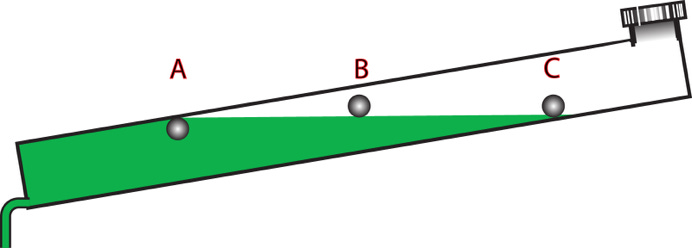
The diagram shows a tank that’s half full – it’s an exaggerated view of what fuel gauge designers have to cope with.
If they place the float in position A the gauge will show full – even when the tank is less than half.
If they place it in position B the gauge will read correctly in the mid-range. But it will show full when the tank is nothing like full, and it will show empty when there is still plenty of fuel.
Position C will give empty readings even when the tank is way over half.
Finally, it’s absolutely no use looking in the tank, or dipping it, unless the tank is almost full.
Time to get your hands blue
Guys and girls, there’s nothing I can do about saving your lives from my home in South Africa, it’s up to you to understand your aircraft’s peculiarities.
If you are an instructor this is for you:
Should you TELL your students about the fuel system? – NO.
Should you SHOW your students what the manual says – NO.
Should you INVOLVE them by showing them every little detail of the airplanes fuel system? Of course you should – that’s your job and your responsibility to them and their pax and their friends and family.
Better still, see if your local AME will show them round his workshop and let them get their hands all blue and smelling of avgas.
Yes, I know I am making a huge fuss about this. It’s because fuel is the aircraft’s life blood which indirectly makes it ours as well.
Next time I’ll tell you more true stories about fuel problems – and particularly about how to stay safe when flying Cessna singles with their notoriously dodgy fuel systems.
Next time we are going to look at even more ways the fuel system can disappoint.
Three Stay Alive tips:
1. Never trust aircraft fuel gauges. You knew that – but now you know why.
2. If you have flying a pax brief them on everything – even if they are not really crew
3. If the engine stops without warning - that’s right – it’s almost certainly fuel, so try that first.


Comments
Nothing yet. Say the first thing.
Sign in to join the conversation.