
You might think that’s a bit silly – surely all instructors are equal. They have to pass the same exams and flight tests.
No, my friend, they are far from equal – some are excellent, some are okayish, and some are plain bad. Okayish isn’t good enough. Would you be happy with an okayish brain surgeon?
It really is that important.
But this is a bit of a bugger because you have absolutely no idea how to judge them. When you start flying you don’t know how to pick a good one. It’s like picking a decent watch out of 20, when none of them has a price tag. We simply don’t know enough about watches, or instructors, to select a goodie, or to spot a dud.
So it’s very lucky I am here to hold your hand and help you make the decision.
First, we’ll look at some general options, and in two weeks we’ll move on to specifics.
Greybeards
Conventional wisdom says pick a greybeard – someone who has been around the block, has years of experience, flying all types of aircraft in all types of weather, and has thousands of instructing hours.
Generally, this is an excellent starting point. Greybeards are often career instructors – they have the experience and knowledge to be at the top of the pile, and they instruct because they love it. They are not in transit – they are not building hours towards an airline job. And they are not going to leave the school halfway through your training.
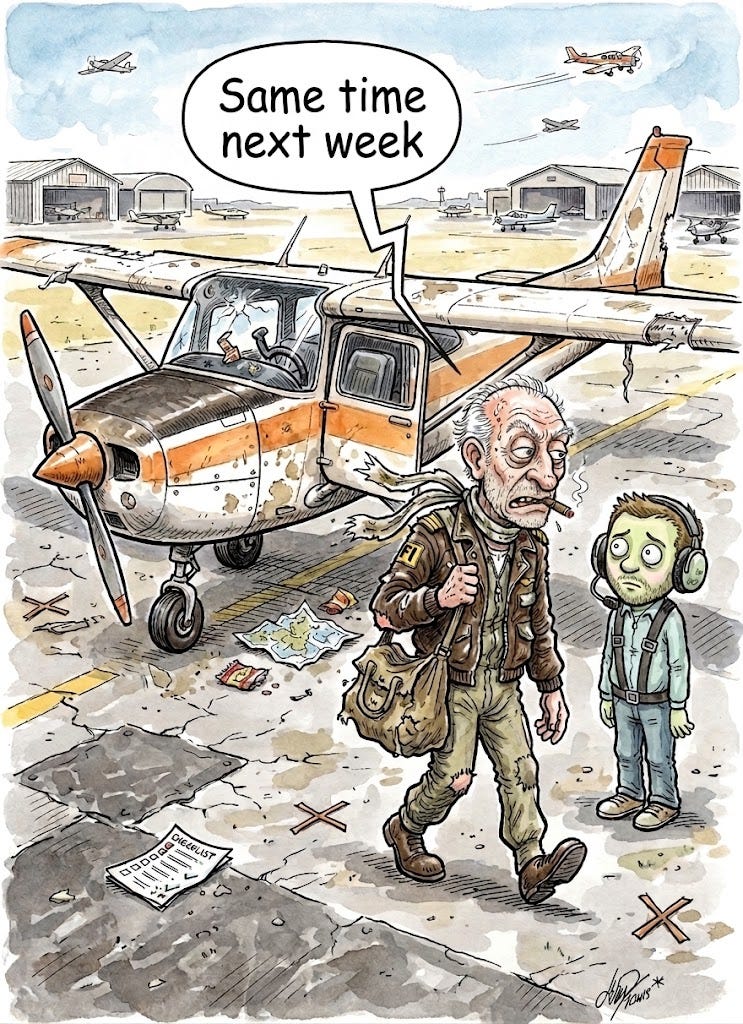
But some greybeards are just sacks of potatoes. They are bored – and it shows. They do little more than protect the airframe from your clunky handling.
These ones seldom give real instruction. They are happy to do circuit after circuit with the ball out of the middle. The only time they chirp is to prevent bloodshed. Then they will mutter, “I’ve got her” or, “Do that again and I’ll cut you out of my will.”
You need to know why the landing didn’t go as planned, and how to improve the next one, but the potato instructor is too damn lazy to tell you.
You can spot the lazy ones – they are still fresh at the end of the day, and they shouldn’t be. Instructing well takes it out of you – it’s a hell of a lot of fun, and hugely rewarding, but it’s hard work.
Females
Many of the top instructors are female. With each fresh intake of students at my flying school, I had to pair my instructors with the new arrivals. Sometimes there was initial resistance from guys who were allocated to female instructors. But it nearly always turned into a huge success. After a couple of hours there was no way the guys wanted to change instructors.
But not always. I had one female instructor – a German, who I will call Lottie – who was too much of a perfectionist.
Lottie loved her students and was determined to make each one into a perfect pilot. But you just can’t do that – particularly at the beginning of their training. They would come back from a session of circuits and bumps looking as if they’d been in a sauna. Lottie would have spent the whole lesson criticizing each little error. On the downwind leg, she demanded that everything – height, heading, airspeed, pre-landing checks and radio procedures – was exactly right.
I had another German instructor who did the same. Both failed to embrace the golden rule of all instructing – give praise where it’s due. It’s such an easy concept. We are all flattery-powered machines. One word of genuine praise, given immediately, will have a student lapping at your feet for weeks.
I have found that females tend to do things by the book. This is a huge plus. Flying is a disciplined occupation – you do it right or you are likely to die. I have also found that females don’t generally want to take shortcuts, to be smart-arsed, and to do things their own way.
One of the best instructors I ever met was June somebody, I’ve forgotten her second name. June flew for a flying school at Jandakot, in Perth. She was the company’s aerobatic instructor – calm, unflappable, precise – and she was 75 years old.
If you can find a female instructor who is not too Germanic, and has a few grey hairs, you’re probably on to a good thing.
I wonder if you remember Patty Wagstaff – Google her. She is a flying instructor with her own school and in 1996, she was the top-scoring pilot at the World Aerobatics Championship. That’s right – she beat all the men in the world.

Young instructors
Don’t be put off by youngsters – what they lack in experience they often make up in enthusiasm. If you are doing your PPL, your frustrations are still very fresh in these young instructors’ memories. They were also struggling to land an aeroplane not long ago, so they know how you feel. I would rather have an enthusiastic young instructor than an experienced potato.
But there are a couple of riders. Older pupils often don’t click with young instructors. No one wants to be bossed around by a pimple-pusher who is younger than his own kids. Also, young instructors are usually not great for advanced training – night flying, instrument flying, and particularly multi-engine flying – which can be dangerous in inexperienced hands.
Airline pilots
Okay, I’m going out on a limb here. Three of the best instructors I know are, or were, airline pilots. But I’m afraid they are the exceptions rather than the rule.
Permit me some generalizations. A 20,000-hour airline pilot who has 500 hours of civvy instruction can be a very dangerous animal. Both he and you are inclined to be blinded by the greyness of his beard and his total hours.
You may need to look on him as a 500-hour pilot with attitude. Hell, I’m not ingratiating myself with my airline pilot buddies, am I?
Last year I wrote an accident report about an airline pilot who bounced a Seneca and then stuffed the nose into the ground, destroying the aircraft. What he did was drastically wrong on any light aircraft.
Airline pilots have a lot to teach us when it comes to procedural flying, but they may be poor ab-initio instructors, who are weak on VFR procedures and visual nav.
Ex-military pilots
These guys have had some of the best training in the world, so they have the potential to be excellent instructors. And many of them are – particularly for aerobatics, map reading, formation flying, instrument training, tailwheel conversions and precision flying.
But I wouldn’t always recommend them for ab-initio training. Military instructors are not known for their good nature and tolerance of errors. They’re accustomed to using strict discipline to train only the best selected students. In short, they can’t be relied on for patience and understanding.
Just for fun, here are a couple of extracts from a pupil’s training file. The instructor was an ex-military pilot. “The pupil should try to familiarize himself with the concept of left and right.” “The pupil sets himself remarkably low standards, and continually fails to meet them.”
In the military, errors are rewarded by punishment rather than encouragement. In fairness, some students do perform well when there’s a heavy hand behind them. If you are one of these then seek out a military instructor.
Multiple instructors
This is your worst possible option for initial training. Some flying schools argue that each new instructor will teach you something new. This might be true, but it comes at a terrible price:
No one is responsible for your overall progress and, frankly, no one gives a damn.
Harsh words, you might think, but let me explain. First, it’s encouraged by the flying schools because it makes scheduling so much easier. Instructors have days off, they get sick and they take leave. They also have other pupils. It’s much easier for the guy or girl at the desk to simply schedule you to fly with the most available instructor. And, think about this, maybe the most available one is so available because nobody else wants him.
If you don’t have your “own” dedicated instructor who does 90% of your training, imagine half-a-dozen artists all working on one landscape painting. They may all be good, but the result will be a terrible mess.
The picture may be improved slightly if the occasional colleague peers over the artist’s shoulder and makes the odd suggestion. But only one artist is responsible for the final product – your own dear instructor.
An instructor can’t put an hour’s heart and soul into a pupil he may never see again. He can’t know how well the student has absorbed previous lessons, particularly emergency procedures, and he doesn’t want to waste the flight by repeating them just to see if the student is up to scratch.
If the school can’t guarantee you will have your own dedicated instructor for 90% of the course, move on to another school that cares.
Next time I’ll tell you about the characteristics and qualities of a good instructor. That should help you select the right person.
And after you’ve picked the right instructor, and a good school, you have to put your back into it and be the ideal student. And I’ll tell you how to do that, and how to get the best out of your brilliant instructor.


Comments
Nothing yet. Say the first thing.
Sign in to join the conversation.