
Consider two statues of man: one as a Greek god, the other as a deformed medieval monstrosity. Both are metaphysical estimates of man; both are projections of the artist’s view of man’s nature; both are concretized representations of the philosophy of their respective cultures.
-Ayn Rand
In any list of great literary works, Leo Tolstoy’s War and Peace (1869) will usually be near the top. The novel is inspired by firsthand accounts, documents, and Tolstoy’s personal wartime experience during the Crimean War and gives painstaking detail to the 1812 French invasion of Russia. More than 150 characters in the book are named by their real names. Tolstoy goes pains to make things as realistic as possible. Consequently, War and Peace is a foundational novel for the genre of realism.
As Dostoevsky put it:
The objectivity and realism impart wonderful charm to all scenes, and alongside people of talent, honour and duty [Tolstoy] exposes numerous scoundrels, worthless goons and fools… as far as I see it, only one writer excels in this, Count Lev Tolstoy.
This is all well and good. But does War and Peace deserve the accolades? What if realism, and by extension Tolstoy’s entire body of work, is actually the worst thing to happen to literature in all of history?
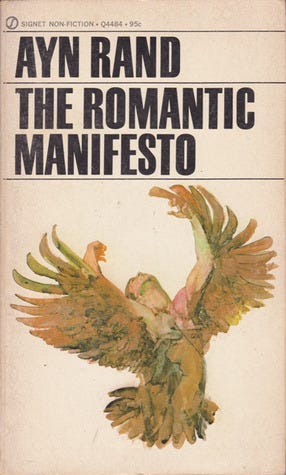
Ayn Rand’s The Romantic Manifesto (1969), published exactly one hundred years after War and Peace, decides to ask this question. Among many other claims, Rand explains that Tolstoy’s realism is:
Not “merely mistaken, but evil”
“The most boring literary duty I ever had to perform”
An “unsanitary backyard”
The Romantic Manifesto tries to prove that art is Romantic or art is nothing. There is good, there is evil. There is the right way and the wrong way. Art must show the audience an ideal state for humanity. Not a flawed one.
The Romantic Manifesto poses a simple question to build a case against realism: is it better to believe in heroes and legends or see the world as it really is?
Art is the expression and product of philosophy, it is the first to mirror the vacuum at the base of culture and the first to crumble. -Ayn Rand
The Romantic Manifesto arrived in the autumn of the hippie movement. The contrarian tone echoes Joan Didion’s Slouching Toward Bethlehem, published a year before in 1968. It’s an essay collection mostly from Rand’s The Objectivist, a periodical that ran from 1966 to 1971.
Rather than delusional hippies, The Romantic Manifesto goes after the genre of realism in modern culture. Rand has two main contentions with realism: art should be objective, not subjective and realistic art must necessarily regress to the mean of the human experience. Making art based on everyday struggles, in Rand’s opinion, shows the “retrogression of an adult mind to the state of a mewling infant.” Realists should stop whining about subjective, collective experience and get a belief system.
Romanticism showcases humanity’s grand promise, an “atmosphere of man intoxicated by the discovery of freedom… with unlimited roads opening in all directions and no barriers set to their unleashed energy.”
Romanticism serves us with the ideal image as inspiration, even if it’s unattainable, unrealistic. The art is aspirational. Realism is an excuse to whine about how things are instead of how things should be. The art is representational. To put it another way, I was constantly reminded of the difference between dark fantasy (George R.R. Martin, almost every modern fantasy author today) and high fantasy (Arthurian legends, R.A. Salvatore). I wrote about that here.
Rand is worried, in her condescending way, that realism encourages people to see the world in grays. When art shows a gray world, the audience becomes gray in turn. We’ve probably all felt that in reading any contemporary fiction. There are often more tragedies than triumphs, almost by design. Because, at some point, we decided suffering was more relatable than heroics. This is the great sin of realism, according to Ayn Rand. The art must represent mediocrity because to be “real” something must be common, must be average. The average experience is the realistic one. Thus, the collective (average mediocrity) replaces the objective (aspirational morality). The real world is full of disappointments. Realism shows those disappointments, those defeats.
The big concern of The Romantic Manifesto is that if we don’t make aspirational art and only lose ourselves to reflections of reality, we have nothing left to aspire to - only visions of our world without wonder. This does have some resonance. Today, it feels like every tale of the impeccable individual is impossible. And if it’s not impossible, we lash our legends with flaws and an unsavory backstory. A hero unconditionally dedicated to some universal good is unthinkable, laughable, and possibly even offensive in an omniscient culture. What, exactly, gives a hero the right to decide what’s right? What, exactly, gives the audience the right to approve what’s universal?
Artist or average normie, The Romantic Manifesto leaves you with the reality that it costs nothing to just believe a little bit in the impossible. It does really take the myth to build a movement for ourselves and for others. The art that tells the tales of heroes against impossible odds, winning impossible victories, is the stuff that resonates universally, unites all audiences.
The battle between Romanticism and realism is really the battle between the objective and the subjective. How do we paint the lines of meaning but with our own colors?
Romanticism, according to Rand, “is a crusade to glorify man’s existence.”
To a Romanticist, a background is a background, not a theme. His vision is always focused on man—on the fundamentals of man’s nature, on those problems and those aspects of his character which apply to any age and any country. The theme [is] man’s loyalty to values.
The Romantic Manifesto left me with an appreciation for magical thinking. If we don’t assign values to things, what does anything mean? And if we crush and compromise those values based on what other people say is real, what can mean anything?
Want more Litverse?
No posts
Comments
Nothing yet. Say the first thing.
Sign in to join the conversation.