
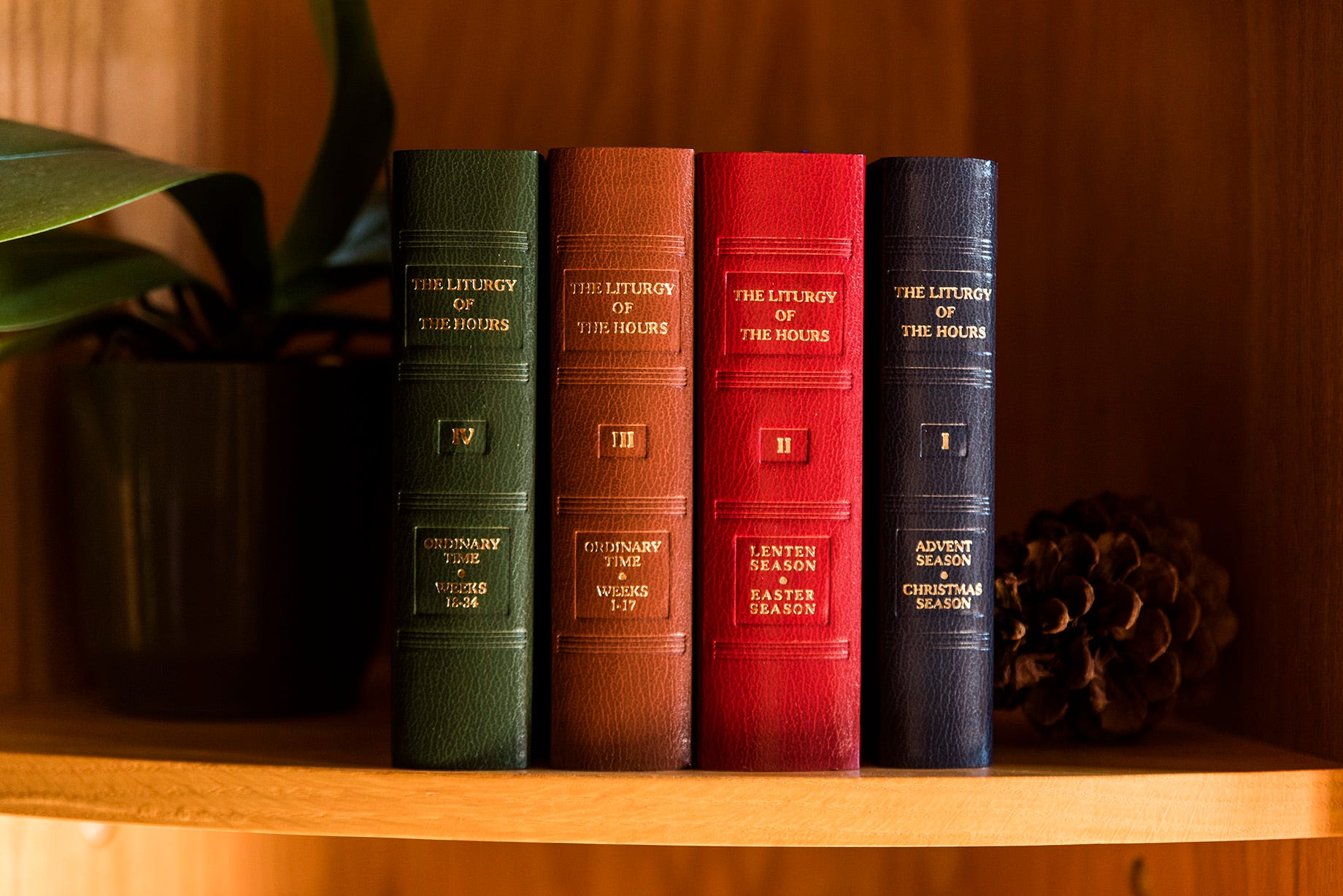
To this day, relatively few practicing Catholics pray the Liturgy of the Hours. Most would not even know where to begin. It is true that we have seen more widespread participation in different pockets of the Church. But if we were to take a survey, I suspect that, statistically speaking, the numbers would be miniscule.
As the Catholic Church in the United States prepares for the release of the new translation (Liturgy of the Hours, Second Edition), this will undoubtedly present an opportunity to introduce the Church’s prayer to the faithful. However, the question will still remain: why? Of all the prayers and devotions that we have available to us as Catholics, why even bother with the Liturgy of the Hours (especially with all those ribbons!)?
This is where we must recognize the need for catechesis. In order for people to fall in love with the official prayer of the Church, they must first know what it is and understand why the Church encourages them to take up at least some part of it.
So, whether you have prayed this prayer for years or have never opened a breviary, here are my top 10 reasons why every Catholic should pray the Liturgy of the Hours.
The Catechism teaches that “the mystery of Christ... permeates and transfigures the time of each day” through the celebration of the Liturgy of the Hours (CCC 1174). It also calls the Hours “an extension of the Eucharistic celebration” (CCC 1178).
The Eucharist is the source and summit of the Christian life, but the Church never intended that its fruits remain confined to the hour spent at Mass. Through the Liturgy of the Hours, the graces of the Holy Eucharist reach out to touch every part of our day.
The General Instruction of the Liturgy of the Hours reminds us that Christ “continues His priestly work through His Church.” Every time the Church gathers to pray the Hours, Jesus Himself is praying to the Father in and through His members. Blessed Columba Marmion says that the Church’s liturgy is “the praise of Christ passing through the lips of the Church.”
In other words, in the Liturgy of the Hours we are not merely saying beautiful prayers. We are entering into Christ’s own prayer with His Father. As we pray the Psalms, canticles, readings, and intercessions, our voices become united with His. His praise becomes our praise. His thanksgiving becomes our thanksgiving. His intercession becomes our intercession.
There is no greater school of prayer than to learn to pray with Jesus Himself.
Modern life often feels fragmented. Our schedules are ruled by meetings, appointments, deadlines, and distractions. The Church proposes something radically different. In the Liturgy of the Hours, we consecrate to God every moment of the day.
Morning Prayer consecrates the beginning of the day. Evening Prayer offers thanksgiving as daylight fades. Night Prayer entrusts us to God before sleep. Even the lesser Hours sanctify the ordinary flow of work. Rather than squeezing prayer into an already busy schedule, the Liturgy of the Hours teaches us to organize our day around our relationship with God.
Time itself becomes holy because it is continually offered back to the One from whom it came.
The Second Vatican Council taught that the vocation of the laity is to bring the spirit of Christ into every aspect of human life—family, work, education, culture, politics, and society itself. The Liturgy of the Hours prepares us for precisely this mission.
Because it extends the grace of the Eucharistic celebration into every hour, it equips us to carry Christ into the ordinary circumstances of daily life. Prayer and mission are never separated. The more deeply we enter the Church’s prayer, the more we become instruments through whom Christ renews the world.
Every liturgical service is a participation in the heavenly liturgy. The Constitution on the Sacred Liturgy from the Second Vatican Council reminds us that, in the Church’s worship, we already take part in the heavenly Jerusalem where Christ is seated at the right hand of the Father.
In other words, when we pray the Hours, we never pray alone. Our voices join those of the Blessed Virgin Mary, the Apostles, the martyrs, the saints, and the choirs of angels in offering endless praise to the Most Holy Trinity. The Liturgy of the Hours makes manifest the communion of saints.
The Church has always venerated Sacred Scripture “just as she venerates the Body of the Lord” (CCC 103). Nowhere is that more evident than in the Liturgy of the Hours. Nearly every page consists of Scripture.
The Psalms form its heart. Canticles from both the Old and New Testaments punctuate its rhythm. Scripture readings nourish the mind. Even the antiphons, responsories, and intercessions are woven almost entirely from biblical language.
The Church does not merely ask us to read Scripture. She teaches us to pray it. And little by little, God’s own words begin to shape our minds, our desires, and even the language of our hearts.
In His letter to the Romans, St. Paul says that “we do not know how to pray as we ought.”
God has answered that problem by giving us the Psalms, which form the heart of the Liturgy of the Hours. Inspired by the Holy Spirit, prayed by Israel, fulfilled in Christ, and continually prayed by the Church, the Psalms express every movement of the human heart—joy, sorrow, gratitude, fear, repentance, confidence, longing, and praise. Divine in their origin, they are human in their expression. Taken up by Christ - the Word made flesh - they lead us to God.
As the Church fathers have said, in the Psalms, God has given us the words by which we can offer Him perfect praise.
The Church’s year is not simply a calendar. It is the life of Christ unfolding before us.
Throughout Advent, Christmas, Lent, Easter, Pentecost, and Ordinary Time, the Liturgy of the Hours continually immerses us in the mystery being celebrated. The prayers, antiphons, readings, and hymns allow each season to shape our hearts long after we leave Mass. Instead of merely observing the liturgical year, we begin to live it. And in doing so, the mysteries of Christ gradually become the pattern of our own lives.
The memorials and feast days celebrated throughout the year remind us that holiness is not an abstract ideal, but is made manifest in the lives of the saints. In fact, it can be said that each saint reflects some unique aspect of the holy one, our Lord Jesus Christ.
Through the readings, prayers, and commemorations of the saints in the Liturgy of the Hours, we are drawn into friendship with them. Their witness encourages us. Their example inspires us. Their prayers accompany us. The Church places them before us not merely to admire them, but to imitate them. As we celebrate their victories, we are reminded that the grace which sanctified them is the very same grace offered to us.
Perhaps the greatest privilege of praying the Hours is that we become participants in Christ’s own priestly prayer. The Letter to the Hebrews tells us that Jesus “always lives to make intercession” for us. Through Baptism we share in His priesthood. And it is through the Liturgy of the Hours that we exercise that priestly vocation in a unique way.
Through its hymns, psalms, readings, and intercessions, we become united to the eternal prayer of Christ before the Father. Few Catholics realize the immense dignity of this vocation. When we pray the Hours, we are not praying only for ourselves. We are praying with Christ for the entire Church and for the salvation of the whole world.
If you’ve never prayed the Liturgy of the Hours before, don’t be intimidated. Begin simply. Morning Prayer or Evening Prayer is an excellent place to start.
Above all, remember that this is the Church’s public and communal prayer.
Pray it with your spouse. Pray it with your children. Gather a few friends before daily Mass. Encourage your parish to celebrate Sunday Vespers.
The Liturgy of the Hours was never intended to remain hidden in monasteries or reserved to clergy. It belongs to the whole Church.
If you don’t yet own a breviary, you might want to wait for the new translation to be released starting next Lent. While you wait, there are several apps that make it easy to begin, including Universalis, iBreviary, or DivineOffice.org.
If you already own Christian Prayer or the four-volume Liturgy of the Hours, be sure to check out our Beginner’s Guides. They’ll help you learn how to navigate the breviary with confidence.
Today, the Church invites you to take up the prayer of Christ and to sanctify your day with her sacrifice of praise. When you do so, she will teach you how to pray. The Psalms will become your own. The seasons of the Church will shape your heart. The voice of Christ will become your voice. And if you persevere, you will discover that the Liturgy of the Hours is not simply another devotion. It will become a way of life, a continual participation in the prayer of Jesus Christ, a sacrificial offering for the glory of God and the salvation of the world.
Comments
Nothing yet. Say the first thing.
Sign in to join the conversation.