
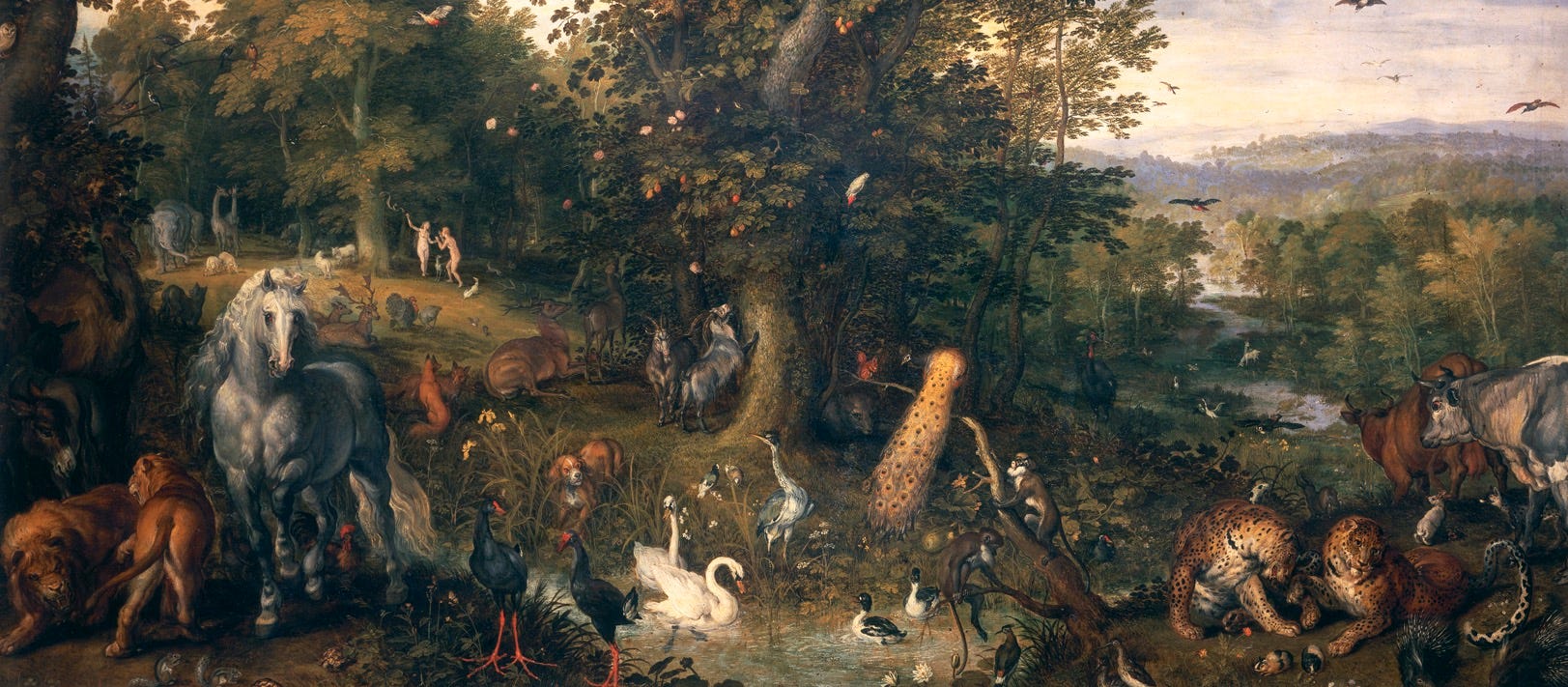
In the beginning, God created the heavens and the earth. He called forth light and darkness, waters and dry land, plants and trees, and all living creatures. Then He formed man from the dust of the ground and breathed into his nostrils the breath of life. He planted a garden in Eden and placed the man there to ‘ābad and šāmar.
These Hebrew words in Genesis 2 are usually translated “to till and keep.” Yet the same words appear later in Exodus (and also in the Prophets) to describe the ministry of priests in the tabernacle, where they are often rendered “to serve and guard.”
The point is this: from the beginning, man was given a priestly vocation. Eden was God’s temple—for there God walked with man and sought communion with him. Man received a commandment to obey and was entrusted with serving and guarding this temple. Stamped with the very image of God, he became a kind of vicar or mediator of God on earth.
But this mediation worked both ways. Not only was man created to represent God to the rest of creation, but he was also made to stand before God on behalf of creation. While he was tasked with “serving and guarding” God’s temple, cultivating and developing it, and reflecting God’s glory in the world, man was also to serve as a priestly mediator and laudator—one who gives praise and offers thanksgiving—on behalf of his fellow creatures. As a rational creature made in God’s image, only man could fulfill this vocation of giving to God what is truly right and just: a sacrifice of praise.
This vocation was forfeited when, instead of giving thanks for the gifts God had entrusted to him, man cast aside God’s commandment and sought those gifts on his own terms. That is why some have suggested that Adam’s “sin of commission” in which he ate of the fruit of the tree was actually preceded by a “sin of omission” in which he failed to give thanks—the only right and just response to God’s benevolence.
To rectify this, God sent His Son in the likeness of human flesh, so that He might offer a supreme sacrifice on behalf of all mankind. This sacrifice—the sacrifice of our Lord Jesus Christ on the cross—is re-presented on our altars in the Eucharistic sacrifice of the Mass. It is the perfect act of praise and thanksgiving offered to the Father, for it is nothing less than the sacrifice of God made man. He alone has offered, and continues to offer, what is right and just. We assist in this offering by joining our praise and thanksgiving to that of our Lord.
But this sacrifice must reach beyond the Mass, touching every square inch of our existence. For this reason, Christ in His eternal wisdom has provided His Church with the Divine Office, or the Liturgy of the Hours. This prayer allows us to pray without ceasing and offer a continual sacrifice of praise here and now—restoring fallen man to the true vocation for which we were made and rightly ordering our days as a holy offering unto the Lord.
This has also become the way we live out our priestly call to give glory and praise to God on behalf of all creatures. We see this most clearly in the Canticle of Daniel, which the Church prays at Lauds every other Sunday in the first and third weeks of the Psalter. When we pray this canticle, the Church gathers her children into one voice and calls all of God’s creatures to bless Him:
“Bless the Lord, all you works of the Lord.
Praise and exalt him above all forever…
Sun and moon, bless the Lord.
Stars of heaven, bless the Lord…
Mountains and hills, bless the Lord.
Everything growing from the earth, bless the Lord…
All you birds of the air, bless the Lord.
All you beasts, wild and tame, bless the Lord.”
When the Church sings this canticle, she lends her voice to all creatures and begs God to receive their praise through her lips. These creatures offer a kind of praise by virtue of their God-given existence, but left to themselves they cannot give God rational praise. For that, they need man. They need a priest. Blessed Columba Marmion thus says:
“In order that it [creation] may consummate its adoration, man must be its mediator. He must lend a voice, an understanding, and a heart burning with love, to all visible nature that it may love, in man and through him, the invisible beauty of the Creator… because although the world contains him, he has a mind and a heart greater than the world; in order that contemplating the whole universe and gathering it up in himself, he may offer, sanctify, and consecrate it to the Living God.”
This is all made possible only in and through Christ our Lord, the true and eternal High Priest. But when the Church, united with her Head, takes up these great benedictions, she fulfills not only her own purpose but that of the whole created order. In doing so, she anticipates the day when all God’s sons will be revealed and creation itself “will be set free from its bondage to decay and obtain the glorious liberty of the children of God” (Romans 8:21).
In the end, this is man’s vocation: to be a son of God who not only mediates God’s presence to the rest of His creatures but also offers right praise to God on their behalf. Yes, this is truly right and just. It is our duty and our salvation.
Comments
Nothing yet. Say the first thing.
Sign in to join the conversation.