
“Each vineyard has its crucifix, each path its wayside shrine,
Where flowers adorn the Virgin’s brow, and crown the Child divine;
And few will pass those sacred spots without a lifted eye,
A crossing of the weary breast, a prayer, — at least a sigh.” —John L. Stoddard
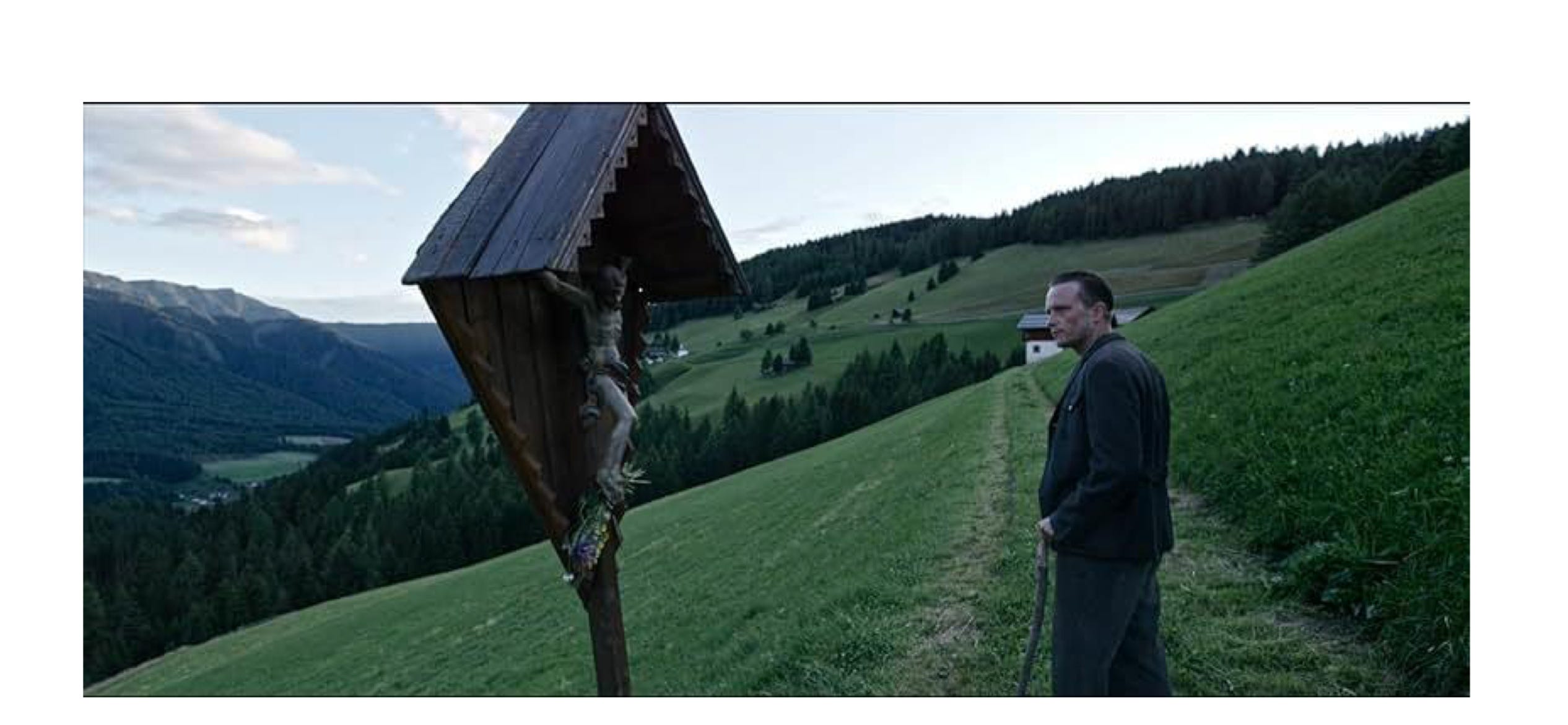
There is a scene in the movie A Hidden Life when Franz walks past a wayside shrine in the Austrian mountains. He stops for a minute to gaze at the crucifix before continuing on his way. It is a powerful moment in which he seems to recognize where his own cross will lead him. From prison, he reflects on the verse from Matthew 16: “If any wish to come after me, let them deny themselves and take up their cross and follow me. For those who want to save their life will lose it, and those who lose their life for my sake will find it.”
This scene is not merely fictional. Franz Jaggerstadder, the Austrian saint who was killed for refusing to take an oath to Hitler, almost certainly encountered these wooden wayside crosses throughout his life. They are ubiquitous in Austria, standing exposed along well-worn paths and hidden high on craggy mountains where many a child has trekked just to pray at the priedeu under it. Those who erected such crosses knew that but a glimpse at a cross, the sign of our salvation and the love of our God, could be enough to give hope to a tired traveler or weary soul.
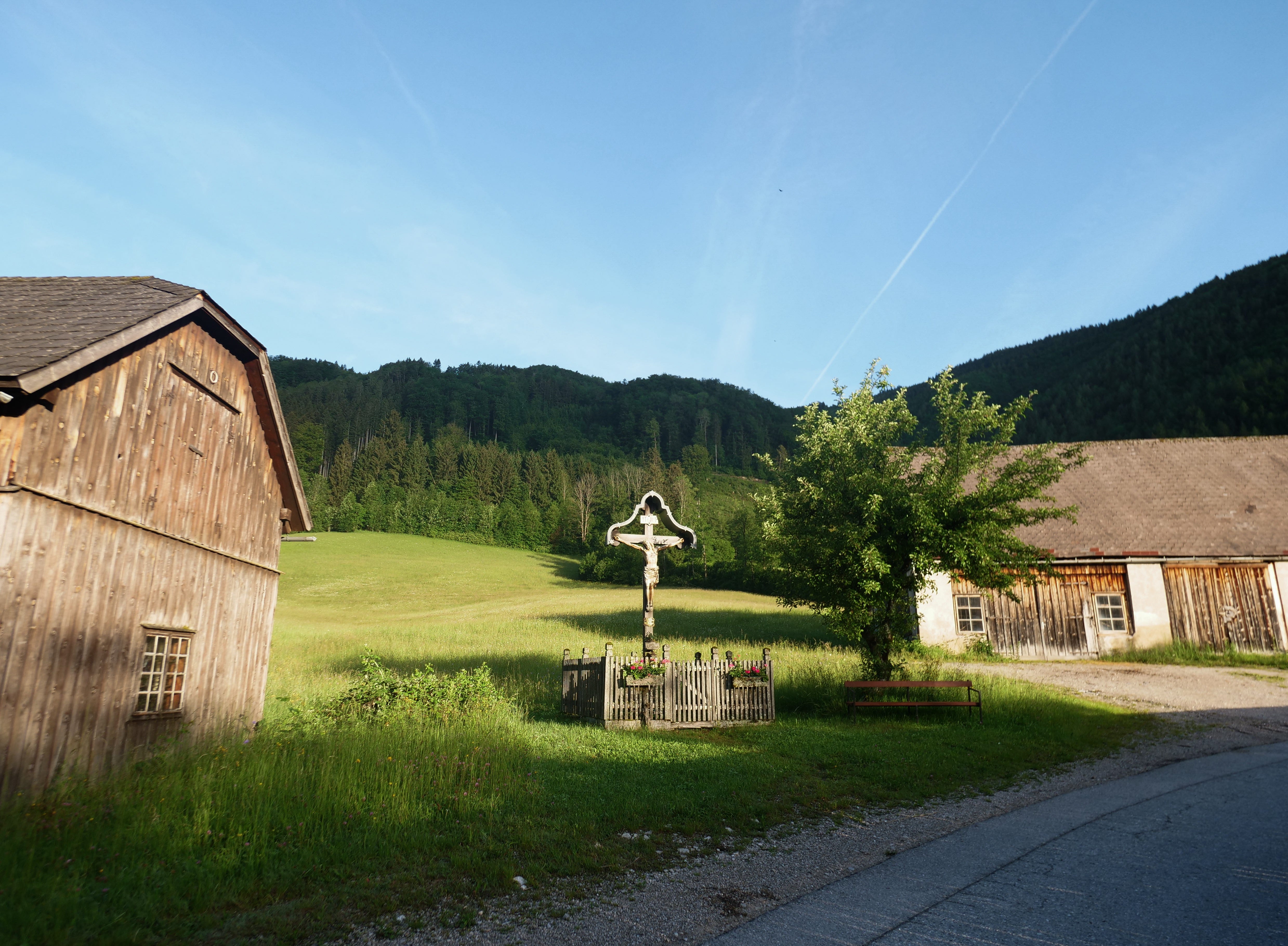
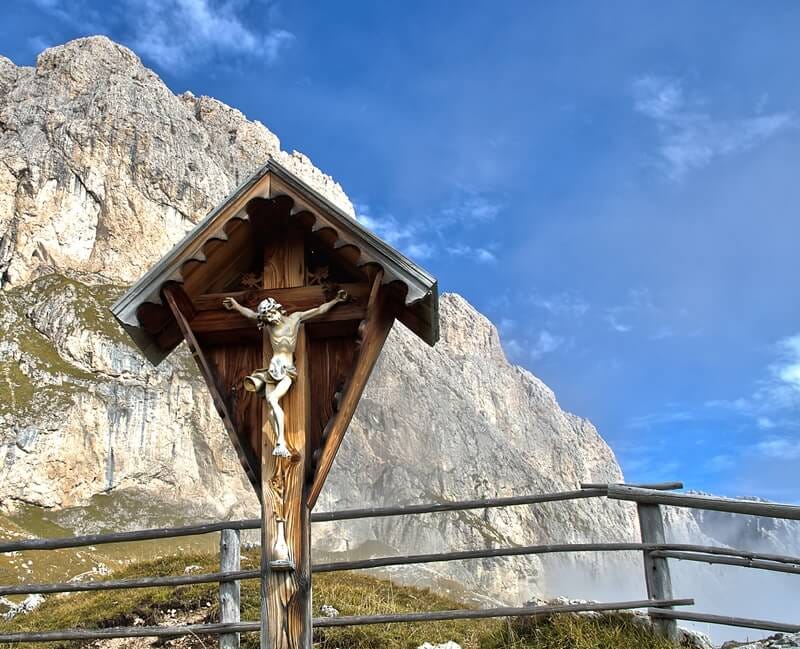
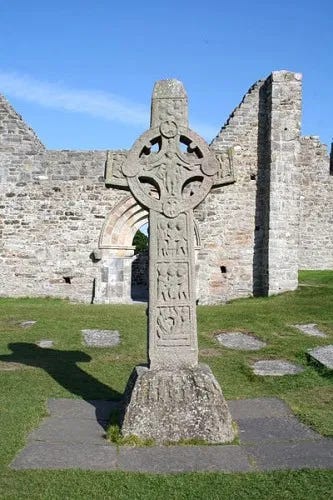
Although the Bavarian style wayside crosses are certainly some of the most iconic, the tradition of wayside crosses is not particular to this region. Freestanding crosses began to sprout across Europe in the early middle ages, and by the year 1600, hundreds of thousands had been planted across the landscape of the continent. Before a village could build a church, they would erect a cross and an altar around which they would gather to worship the One God. The crosses proclaimed to the pagans that the tree was not a god but a throne for the one God. During this era, the cross and the Passion of Christ became “the supreme Christian emblem”, especially in the West.1 As Bishop Erik Varden said in his Lenten retreat: “Reverence for Christ’s wounds defined Christian sensibility for centuries.” He explains:
At the heart of it was respect for the tremendous mystery of suffering, constitutive of the human condition as we know it. The Cross lets us own reality while it affirms the non-finality of wounds, which can be healed and become sources of healing…Christ’s Passion lets us lament without rage...We may call out to the Crucified-and-Risen-One: ‘My Lord and my God!’ The Gospel states that Christ’s wounds, after his rising, were not done away with, but rendered glorious…2
These medieval wayside crosses, which often featured Passion imagery, delineated parish boundaries, heralded Christ’s victory over former pagan shrines, stood in the middle of marketplaces, provided signposts for pilgrims, crowned mountains and hills, guarded gravestones and gallows, and welcomed villagers for prayer. Poor sinners erected them as a penance or as a thanksgiving, and towns gathered to decorate them for feast days.3 During Ascensiontide, churches would process around the parish, stopping at the cross-shaped boundary markers to pray.4

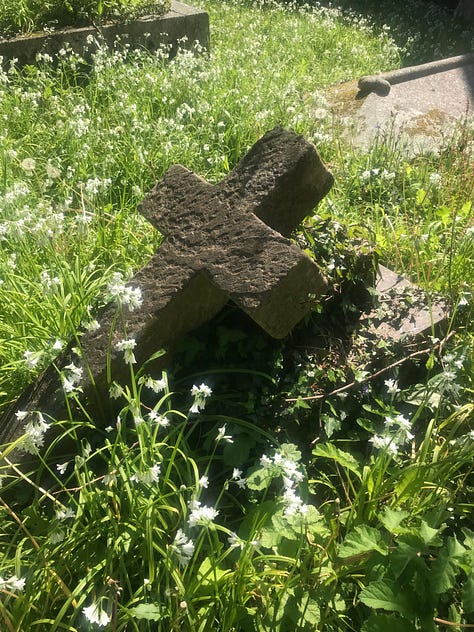


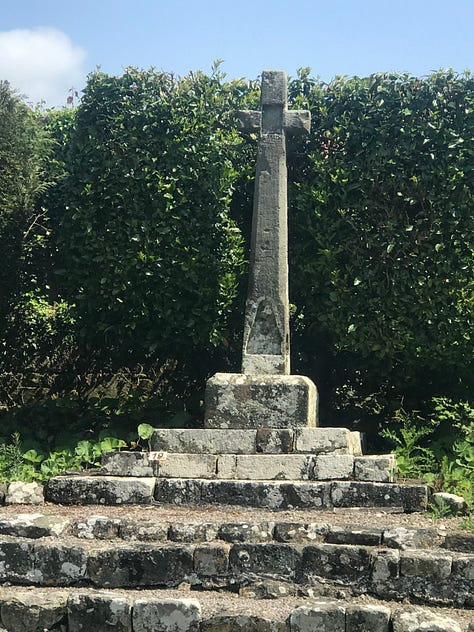
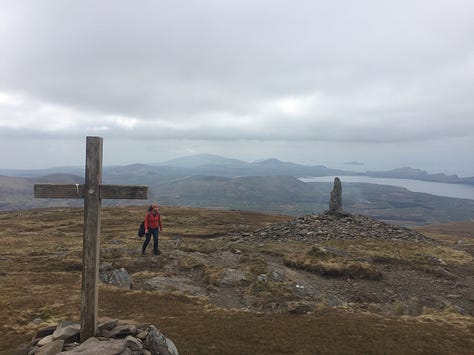
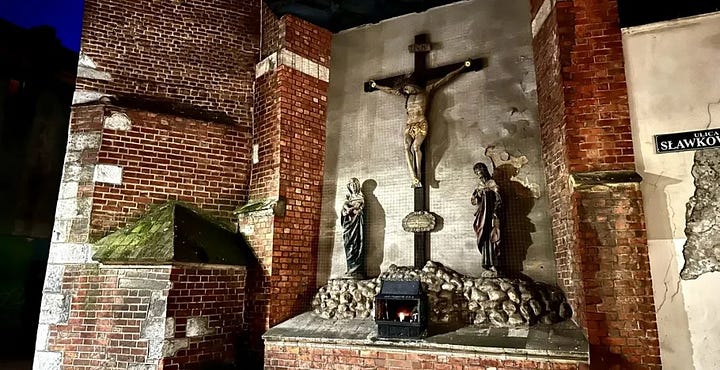
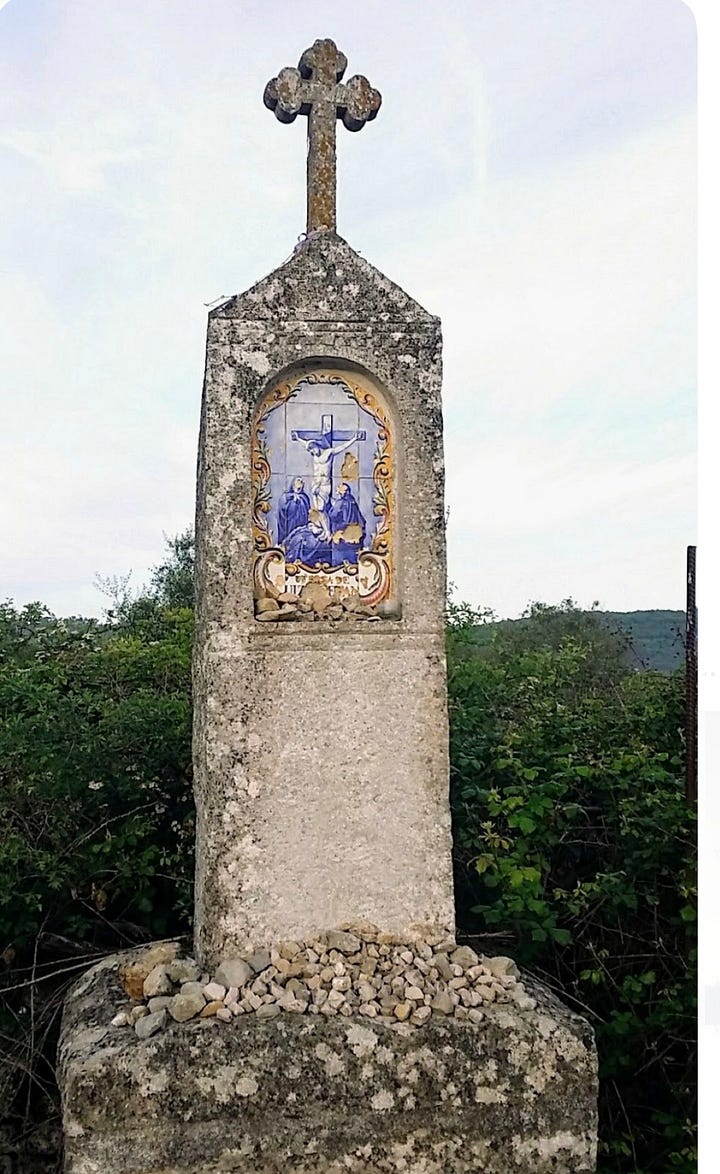
A couple of weeks ago I asked you to send me pictures of wayside crosses and shrines. I received pictures from England, France, Ireland, Austria, Germany, Poland, New Mexico, New Jersey and even Missouri. Some are wonderfully intricate, and some magnificent even in their simplicity. While Bavarian shrines are often carved from wood, English and French crosses are most often made from stone. Eastern European shrines are often crafted from metal. Different cultures know of them by different names; they are Calvaries in France and Italy, Martels (for martyrs) and Bildestocks in Germany, przydrożne krzyże in Poland, and kryžius in Lithuania.
Indeed, the cross dots almost every place that has seen a Catholic missionary. Wherever Christians go, so goes the cross of Christ. As Saint Paul preached to the Corinthians: ‘I did not come proclaiming the mystery of God to you in lofty words or in wisdom. For I decided to know nothing among you except Jesus Christ, and him crucified.’
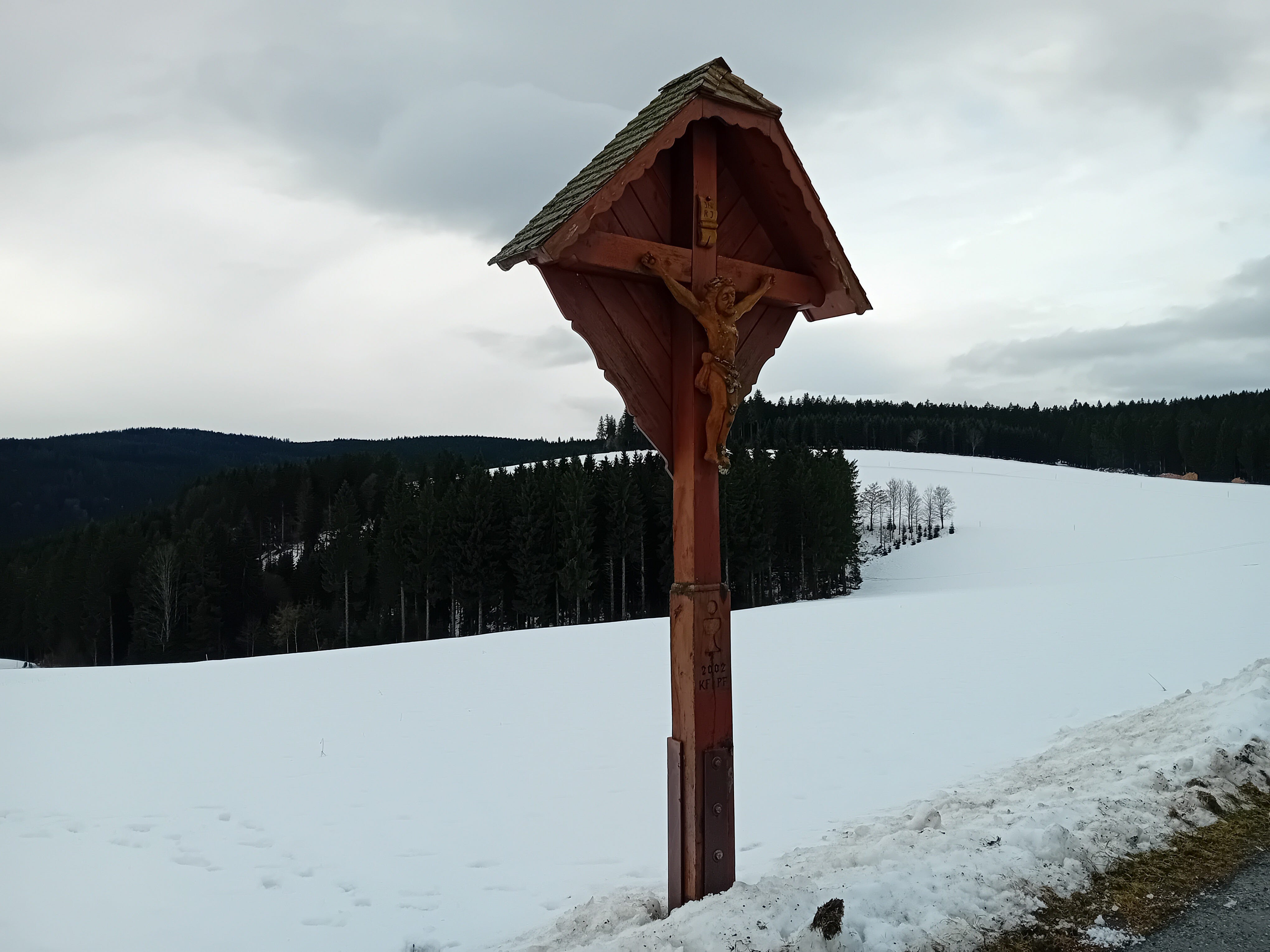
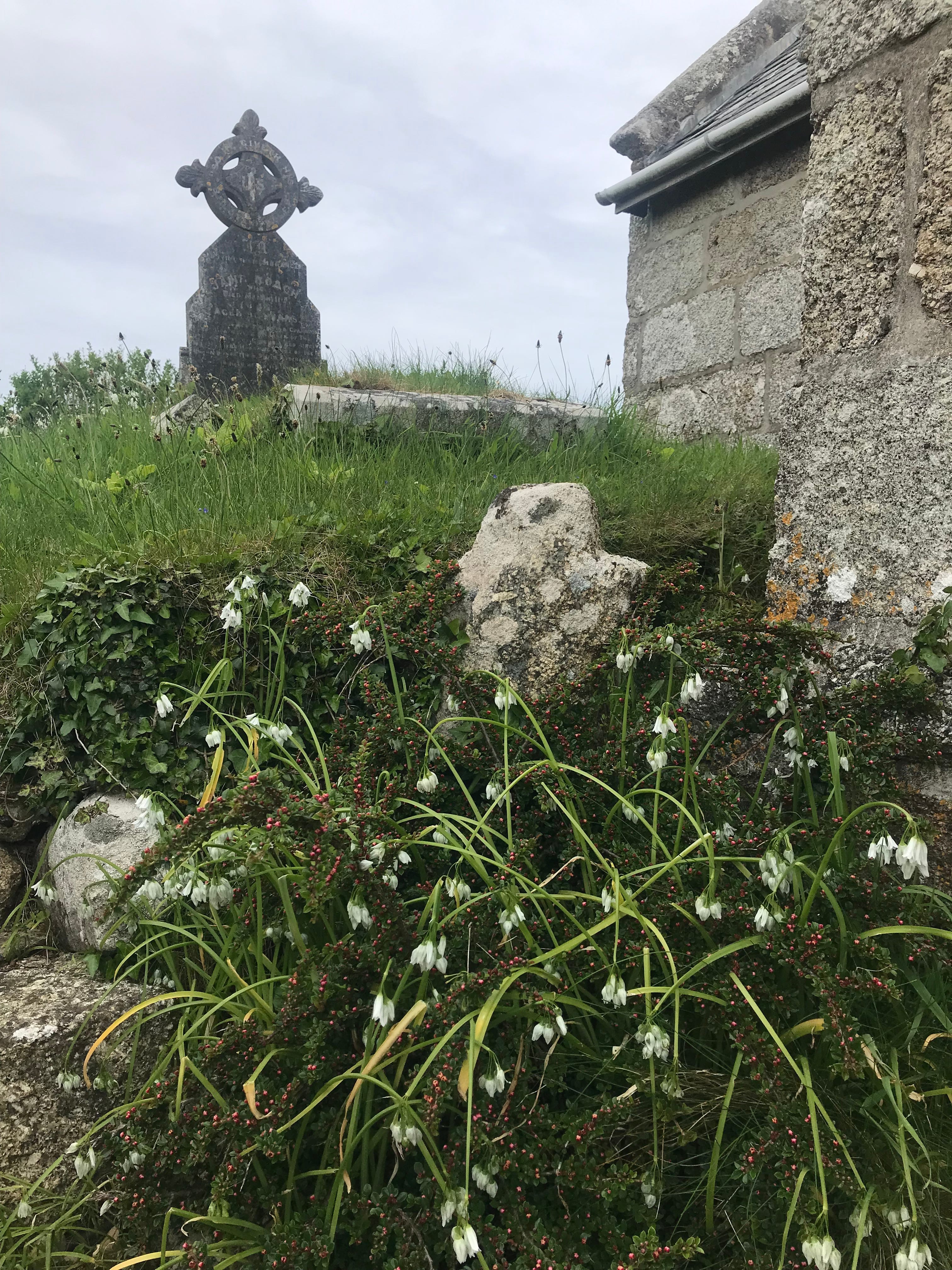
While many of these crosses are masterpieces in their own right, they point less to themselves and their artists, and more towards the Divine artist. Through the changing seasons, the cross stands unchanging as a reminder of Christ’s steadfast love. More than that, it gives a locus through which to interpret the cosmic temple. As winter’s cold grasp spreads across the land, all creation groans with Christ, suffering as he does on the cross. In spring and summer flowers crown him with glory proclaiming his Resurrection and the eternal light of heaven. Life comes out of death. These crosses seem to proclaim with Sunday morning lauds:
Frost and chill, bless the Lord. Ice and snow, bless the Lord. Nights and days, bless the Lord. Light and darkness, bless the Lord. Lightnings and clouds, bless the Lord. Let the earth bless the Lord. Praise and exalt him above all forever. Mountains and hills, bless the Lord. Everything growing from the earth, bless the Lord. (Daniel 3:63-80)5
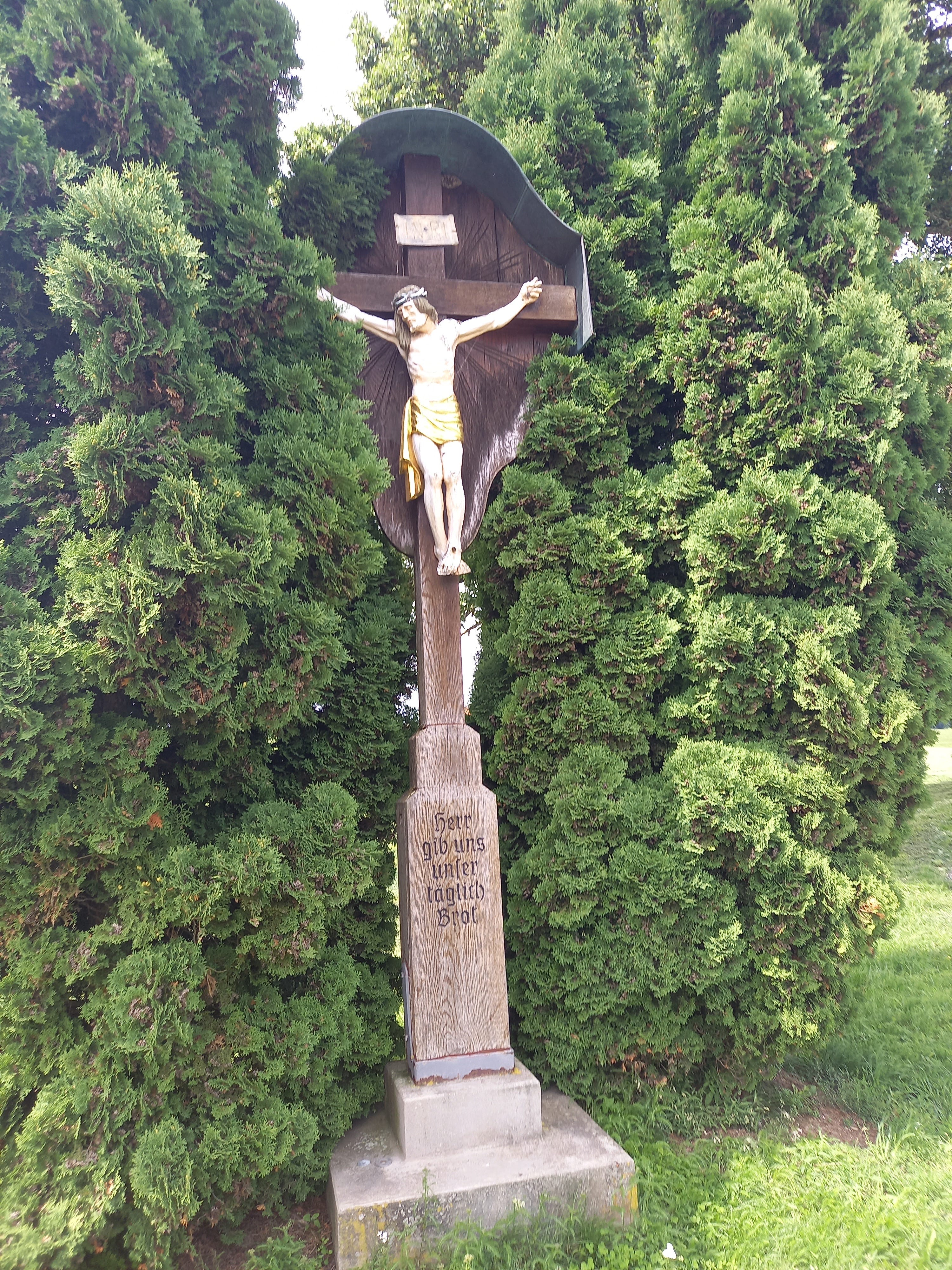
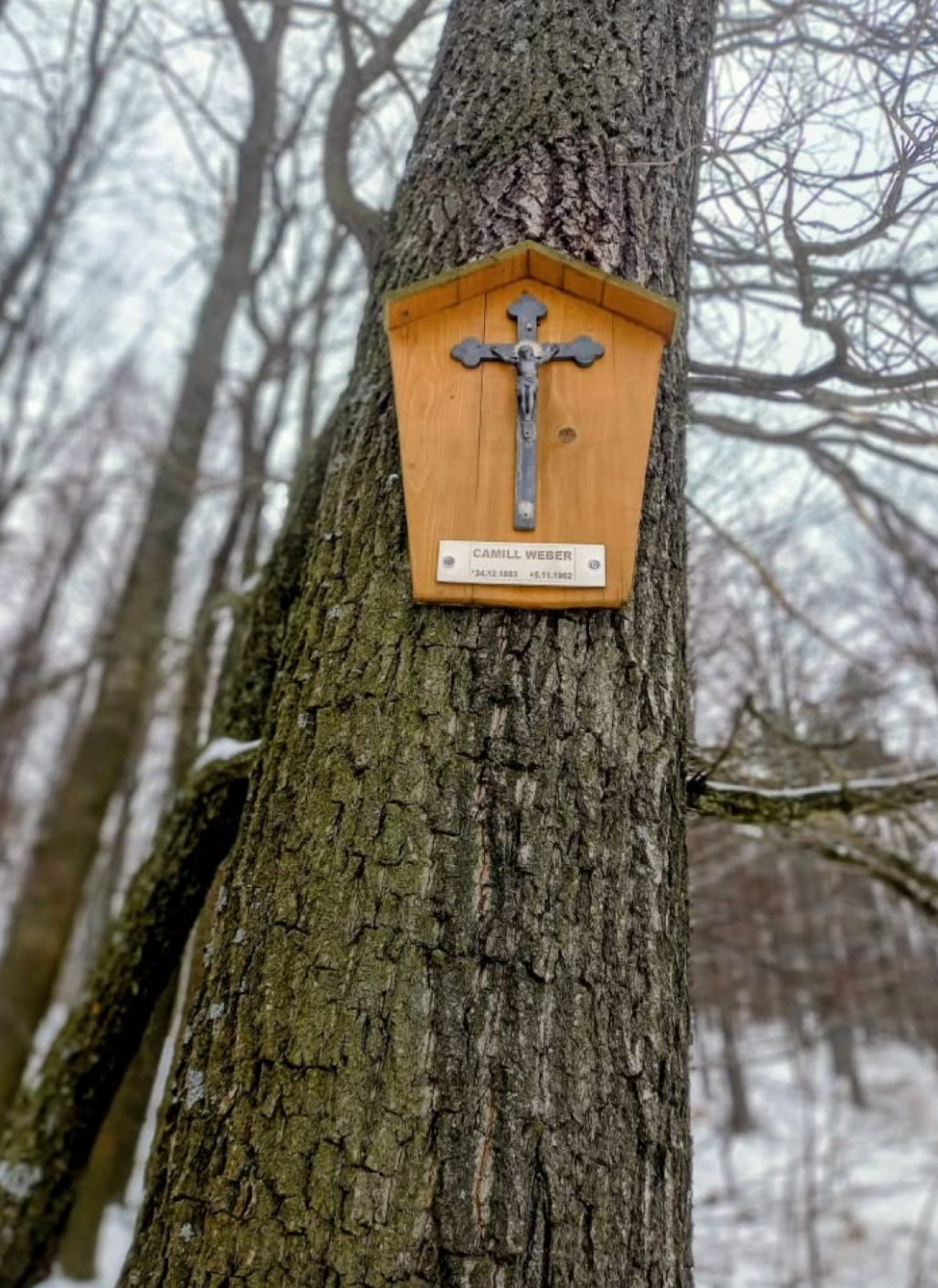
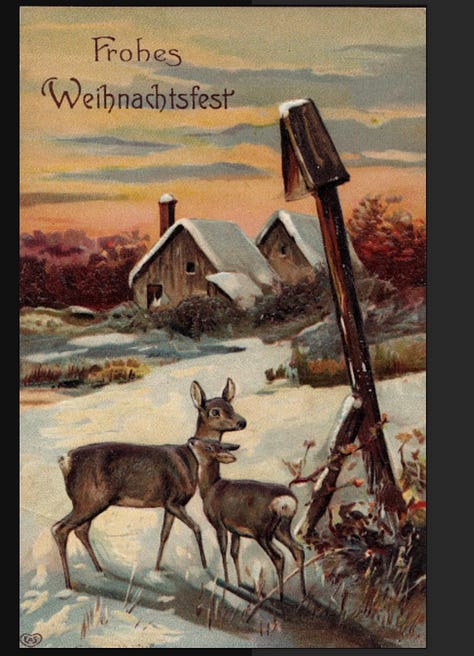
Unlike Gothic cathedrals that tower over all around them, these crosses often blend with the landscape. If you aren’t looking for them, they can be easy to miss, hiding as they do beneath shrubs and weeds. In the medieval mind, in which pilgrimage loomed large, these crosses became signposts, transforming pathways and country roads into the way of the cross, the way by which Eden is restored and the gates of heaven are opened.
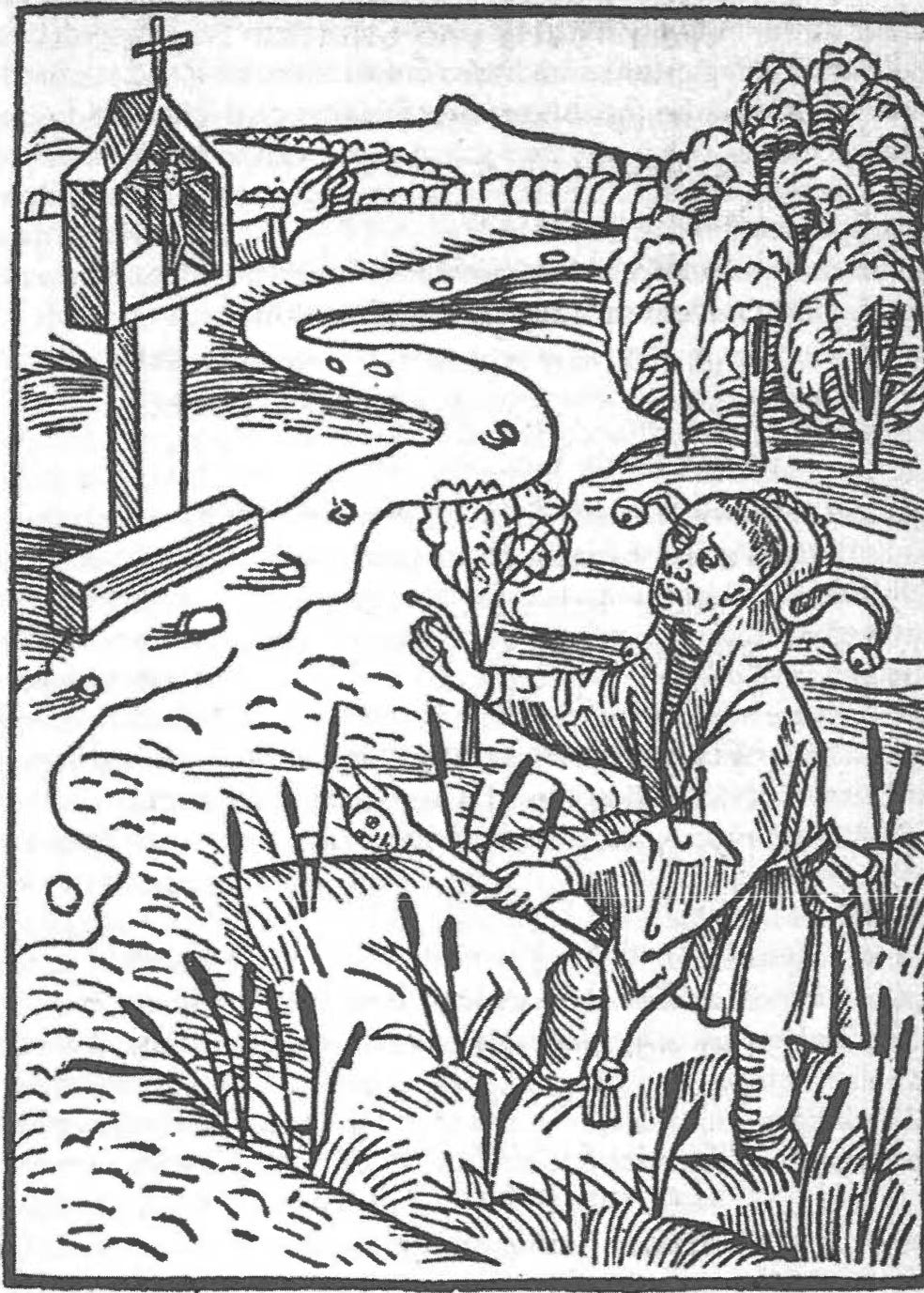
Medieval artists typically depict the wayside cross as a signs for pilgrims, pointing towards their destination. In one sense, the cross gives directions to a physical destination, usually a great church, which is itself an image of the heavenly Jerusalem. In another sense, it gives moral and spiritual direction to all, as life itself is a pilgrimage to the heavenly Jerusalem.6
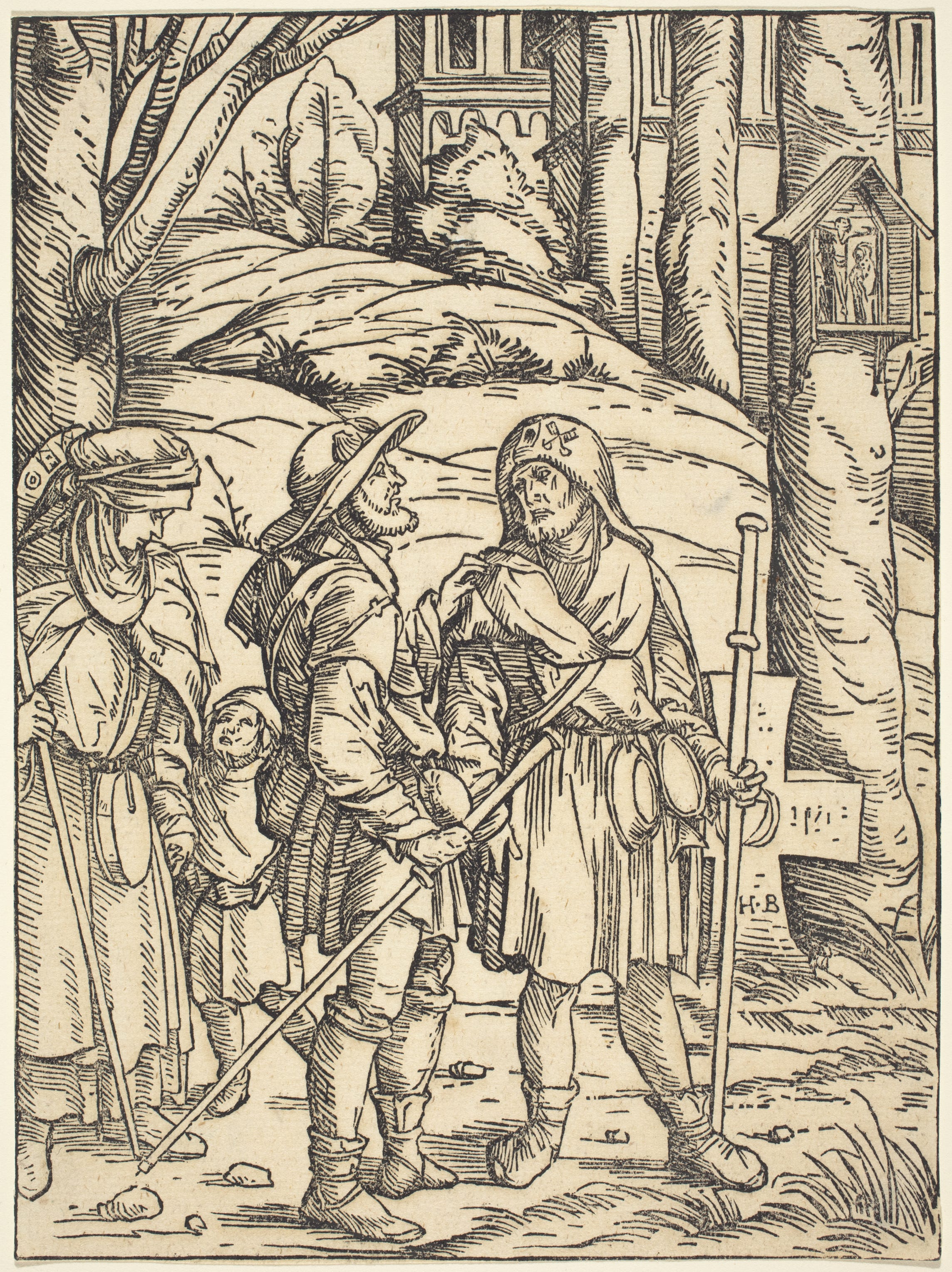
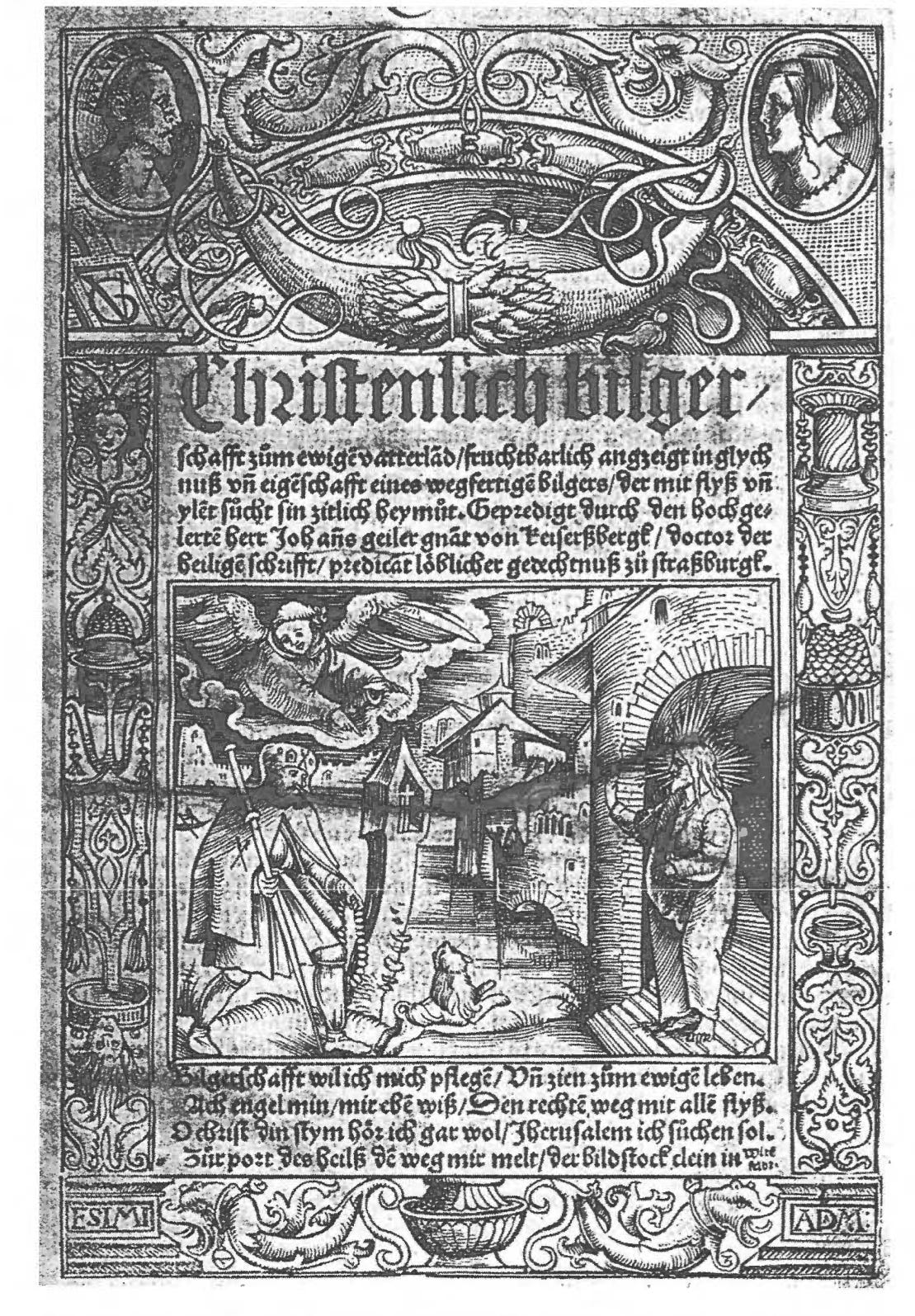
In the image above, a pilgrim walks by a wayside cross as the doors of the heavenly Jerusalem open and Christ walks out to greet him. The text below the image makes this theme explicit:
I want to devote myself to pilgrimage / and stride toward eternal life. / O angel mine, / show me now / the right way with all diligence. / O Christ, / I hear your voice so very well, / I must seek Jerusalem. / Toward the gate of Salvation I am shown the road / by the small wayside shrine (bildstock) in the open field7
Thus, wayside crosses remind us that Christ is the way, and His way is the way of the cross. The medievals saw the cross as not only the instrument by which Christ achieved our salvation, but also as a school of virtue and a map to Heaven. Aquinas wrote:
In the face of all the evils which we incur on account of our sins, we have found relief through the passion of Christ. Yet, it is no less an example, for the passion of Christ completely suffices to fashion our lives. Whoever wishes to live perfectly should do nothing but disdain what Christ disdained on the cross and desire what he desired, for the cross exemplifies every virtue.
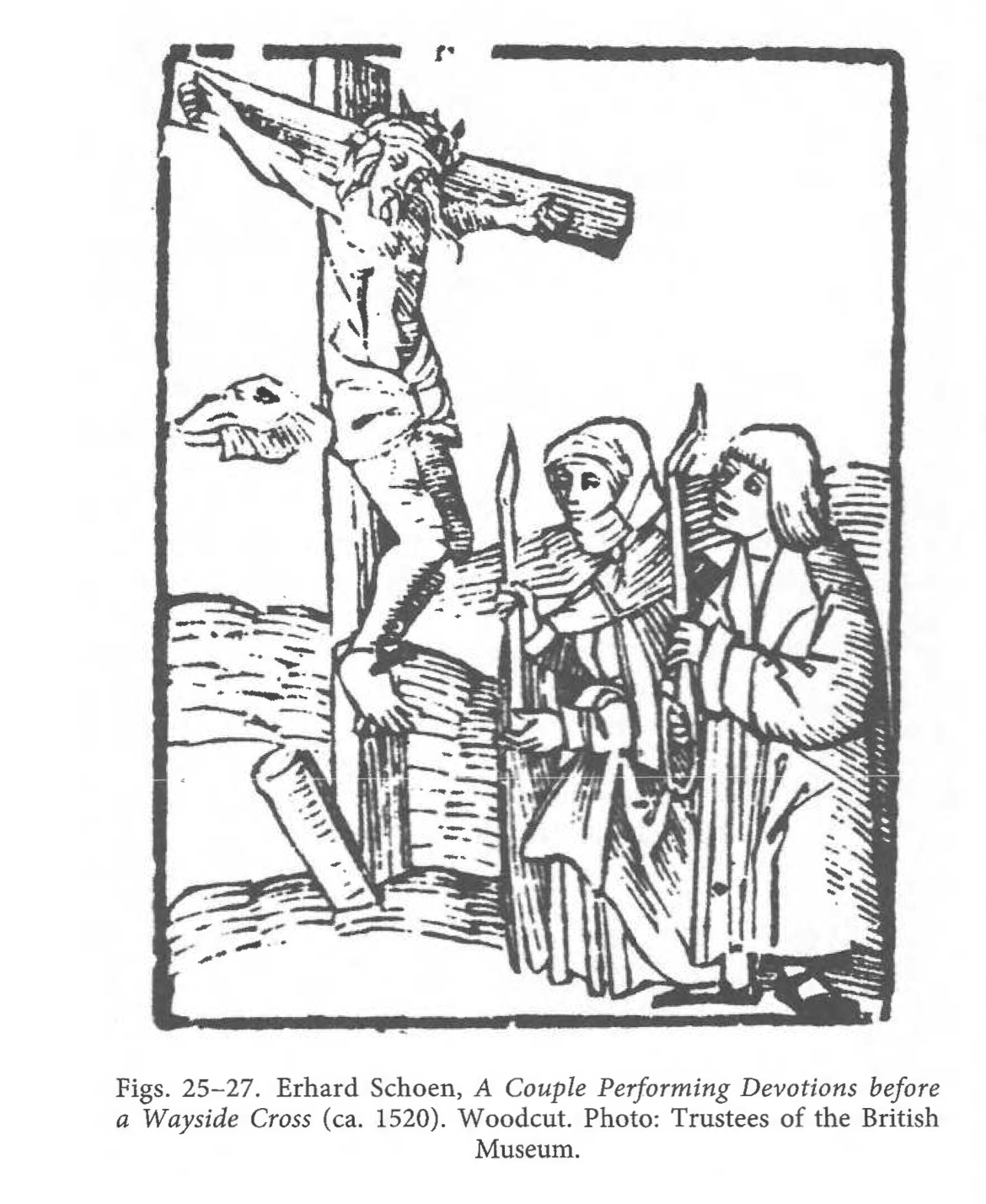
While wayside crosses were ubiquitous in the medieval era, they became much more controversial during the Reformation. Many Protestant reformers had them torn down as did the French revolutionaries. By the seventeenth century few of these crosses remained in England. However, Austrians continued to erect them throughout the eighteenth century, and the nineteenth century saw efforts made to restore what little remained in England. In the twentieth century these crosses sprouted again throughout eastern Europe during World War II and after the fall of communism.
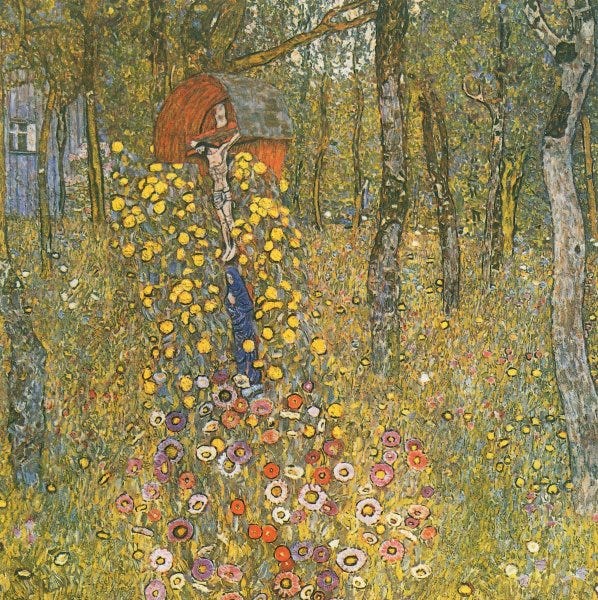
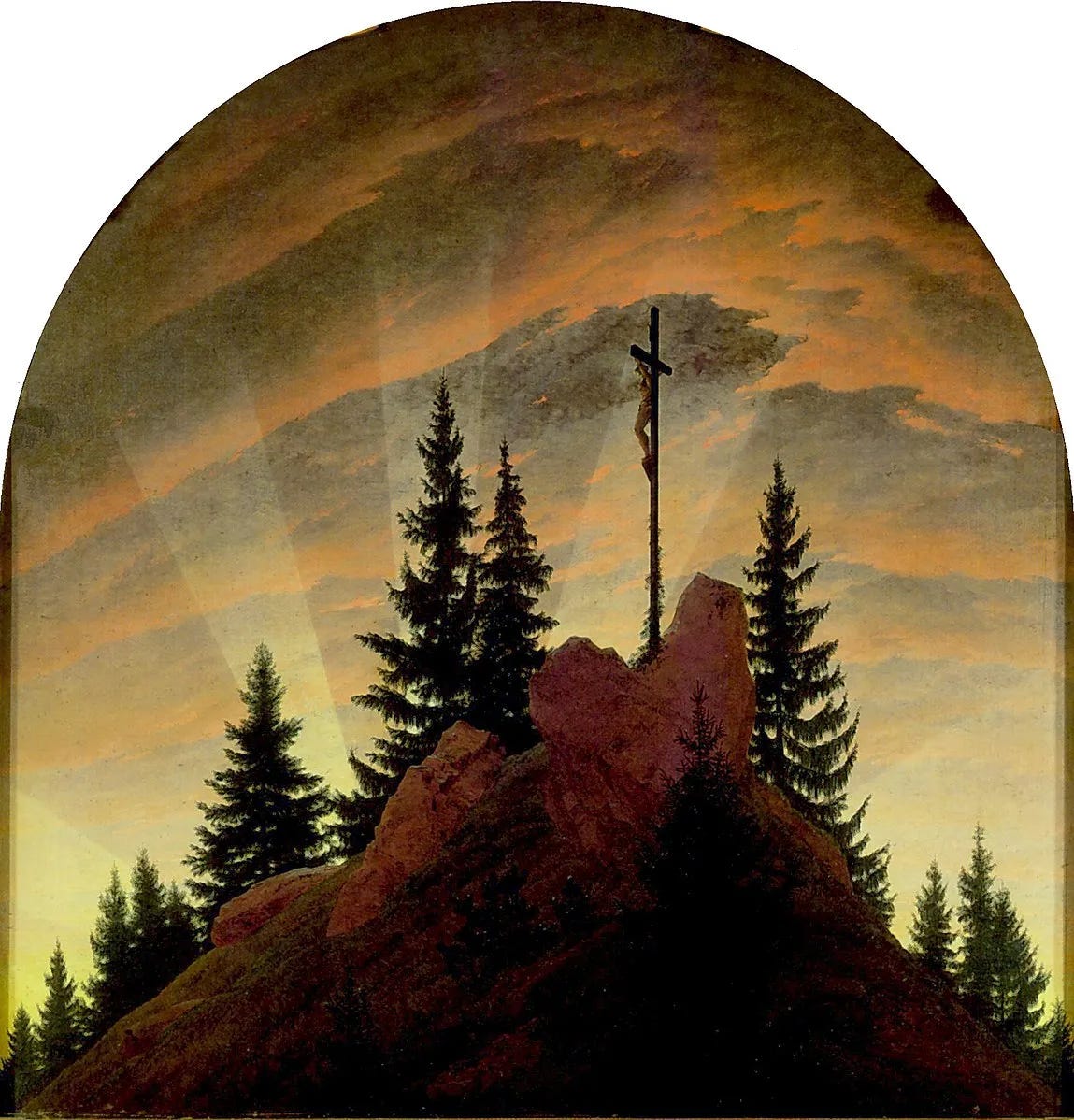
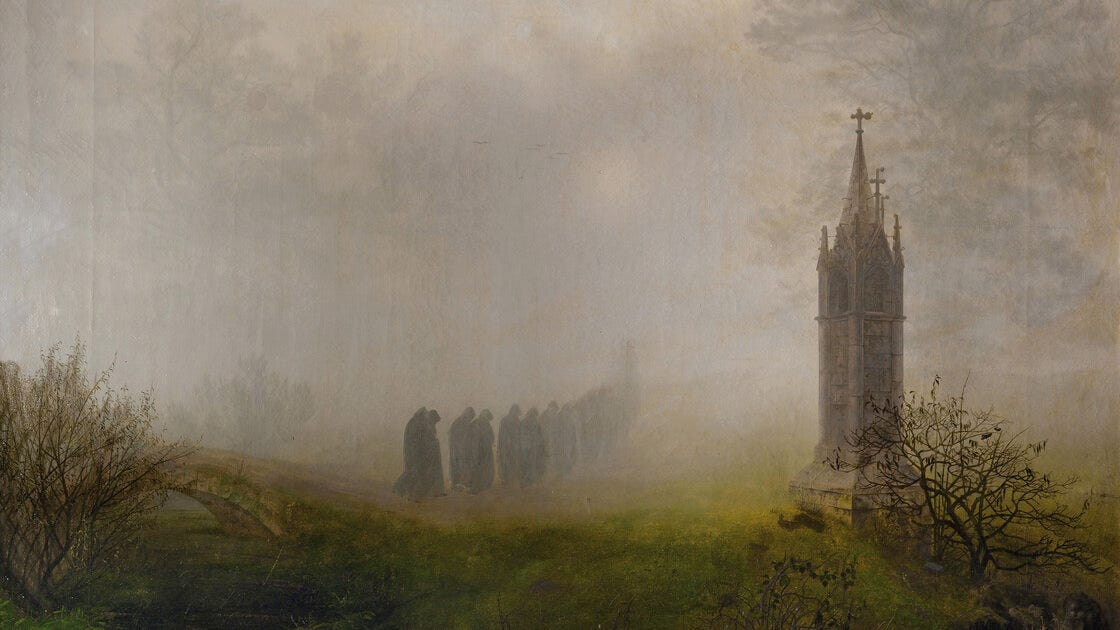
Artists throughout the ages have been enamored by these crosses. It is no wonder why romantic painters loved to paint these wayside crosses which give a face to the sublime beauty of the natural world. In these paintings, such as the ones by Caspar David Friedrich, all the wild beauty of creation converges in the suffering body of our Lord, in whom all things live and move and have their being.
That the crosses often stand in remote, desolate places bears witness to the way that Christ descended into our most painful desolation on the cross. As Pope John Paul II wrote:
There is no evil to be faced that Christ does not face with us. There is no enemy that Christ has not already conquered. There is no cross to bear that Christ has not already borne for us, and does not now bear with us. And on the far side of every cross we find the newness of life in the Holy Spirit, that new life which will reach its fulfillment in the resurrection. This is our faith. This is our witness before the world.
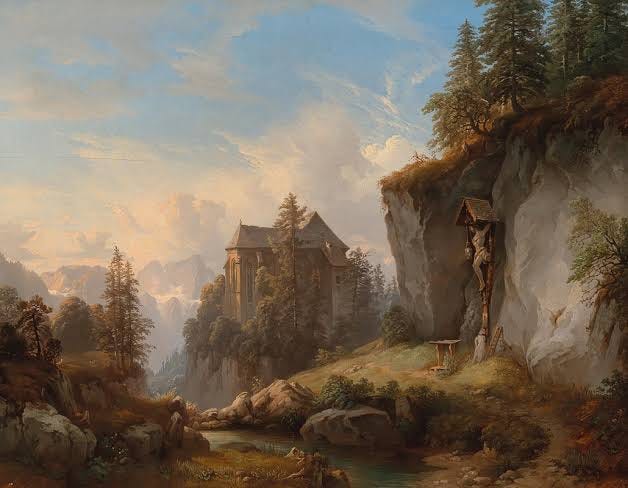
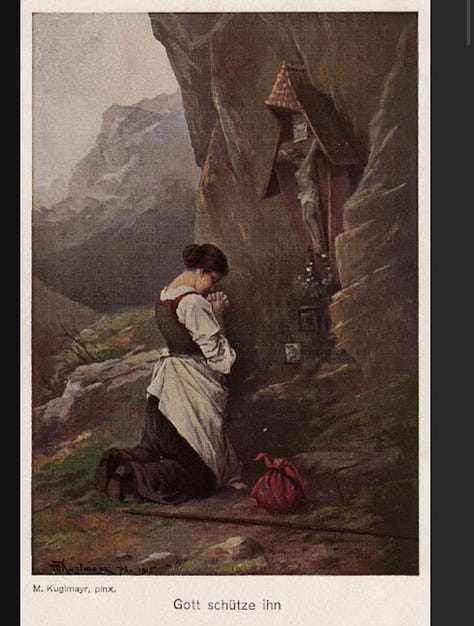
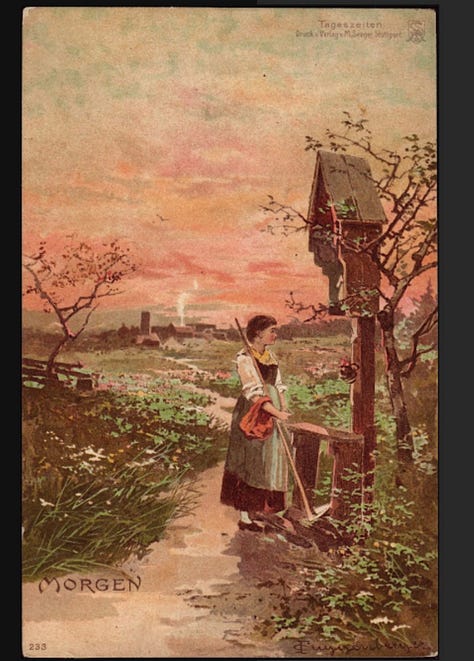
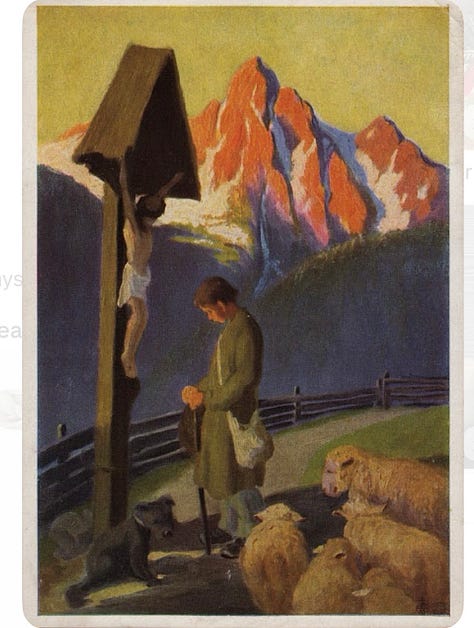
Realist painters of this time also often depict the communal piety and tenderness these crosses inspired, especially among children and the poor. Similar images also frequently featured on holy cards in the 19th century. These scenes of wayside crosses are Edenic and may even conjure a nostalgic longing for an age more pious than our own. Of course nostalgia can be dangerous, insofar as it can distract us from our present gifts and duties; however, nostalgia isn’t all bad. Ultimately, nostalgia points to a longing for Paradise, and the cross itself points us there.
It is easy enough to despair about the fate of civilization and Christian art, but there are still some things we can do, even those of us with only basic artistic skills. Some examples are building a wayside cross, a small shrine, or a Mary garden, if only for our families and friends to appreciate and congregate around for prayer. We are embodied creatures and still need signs to point the way, small as they may be. The wayside shrine need not be an artifact pointing to some former age. The cross is as strong a sign as it once was. As we sing in the Vexilla Regis during Passiontide Vespers:
O Crux ave, spes unica,
O Hail the Cross, our only hope
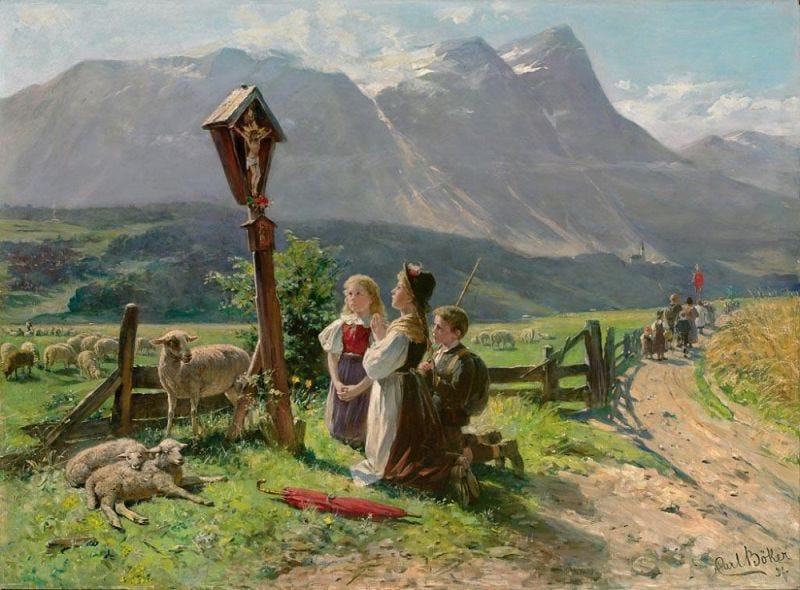
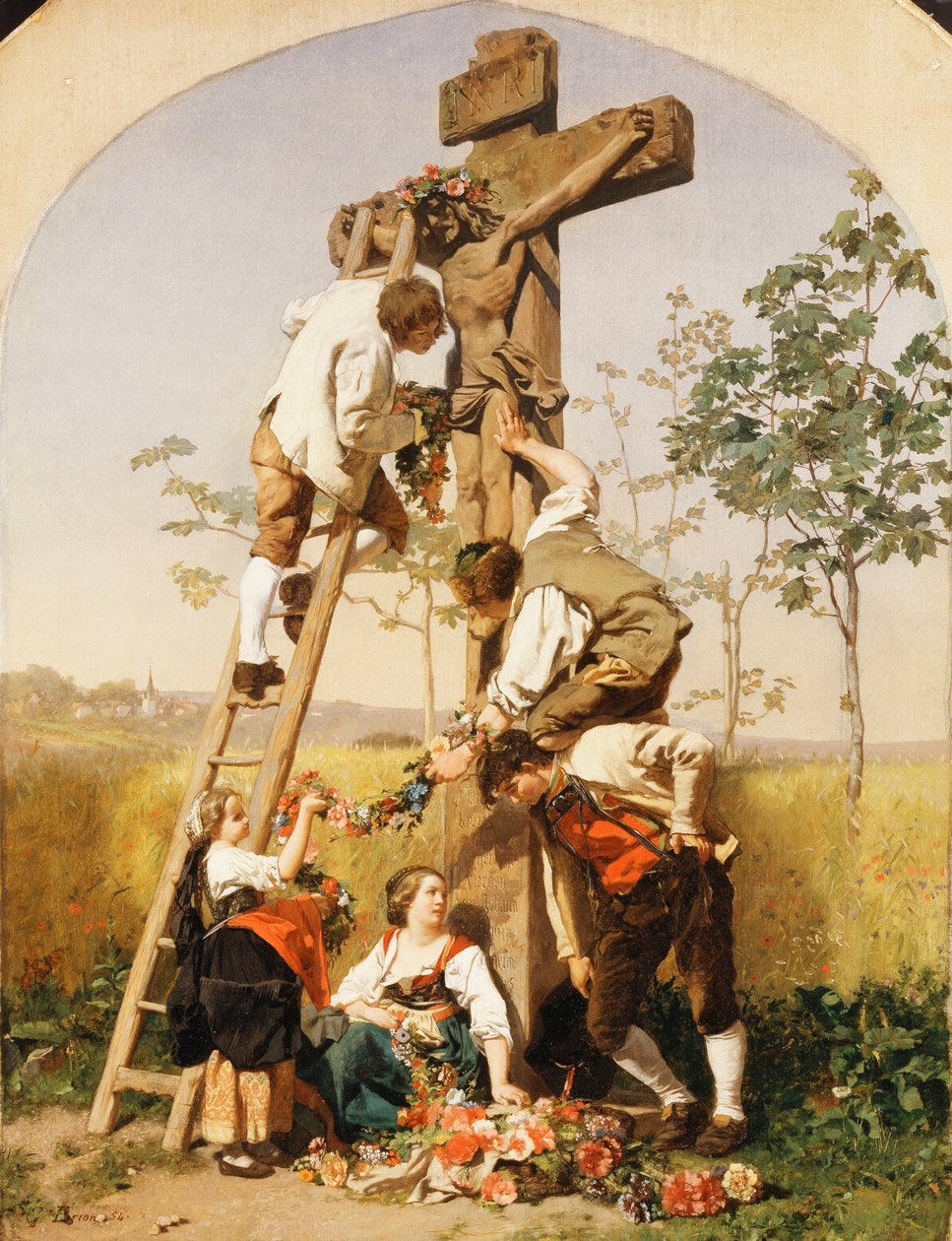
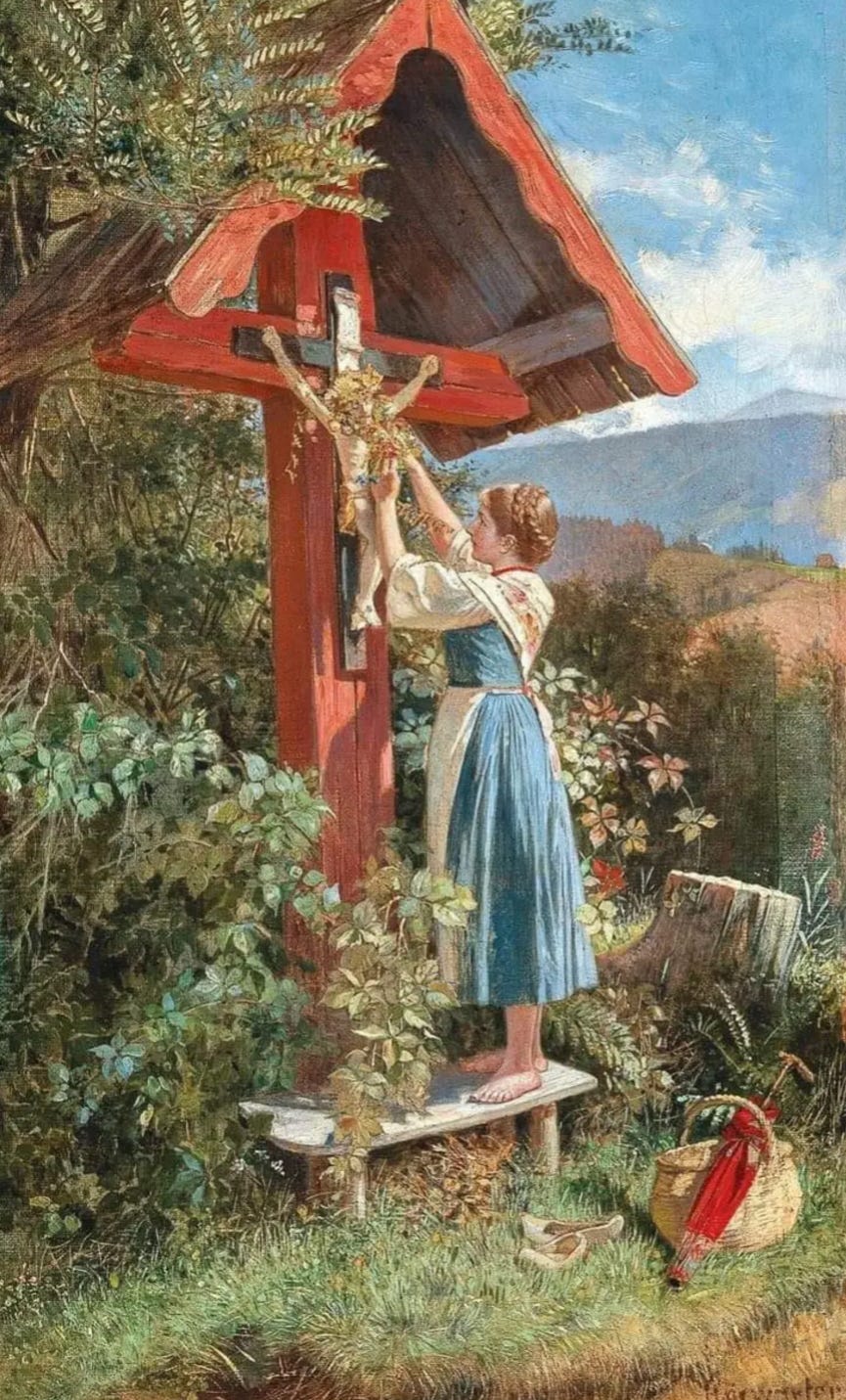


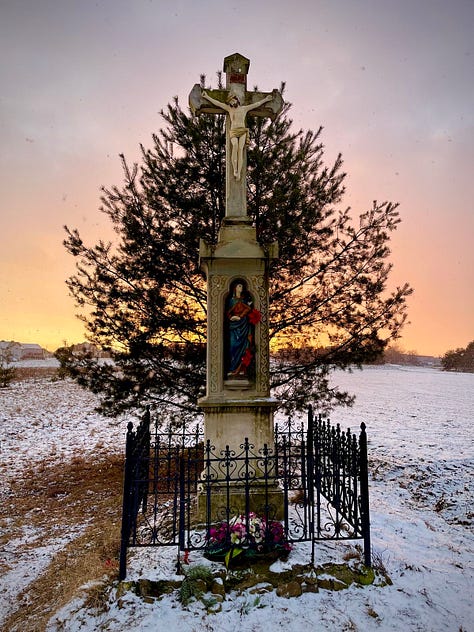
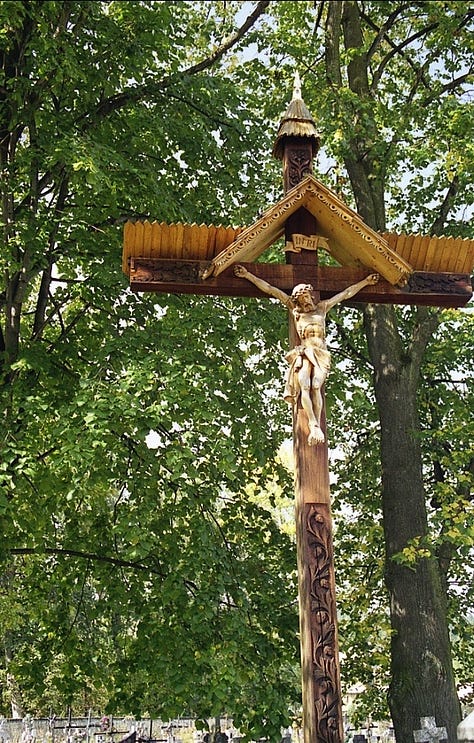
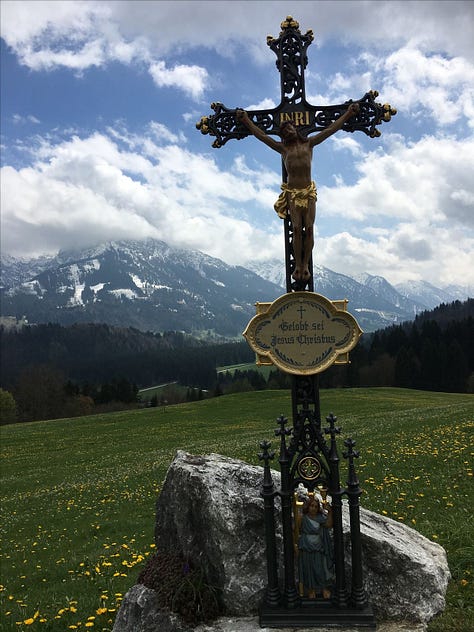
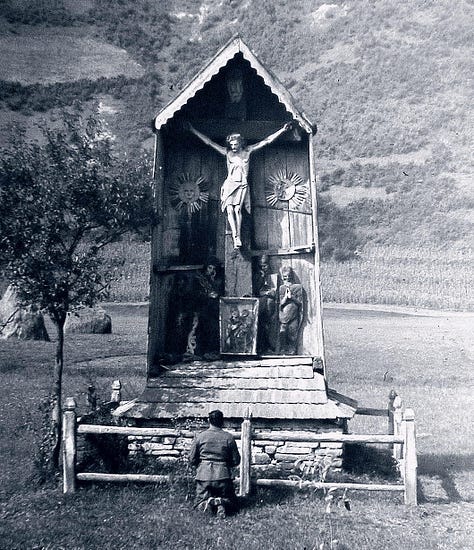
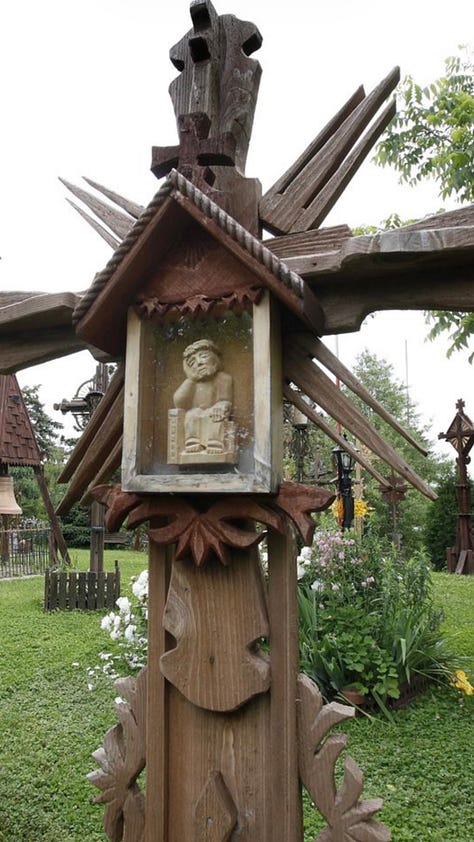
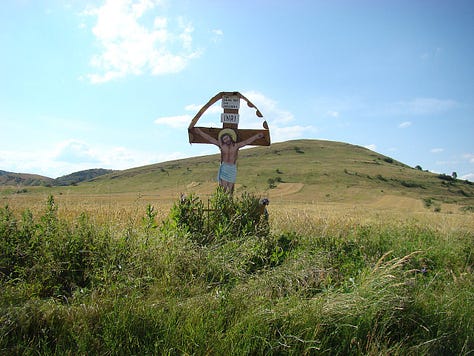
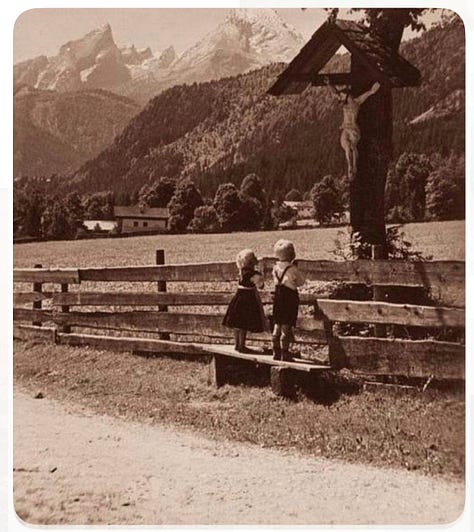
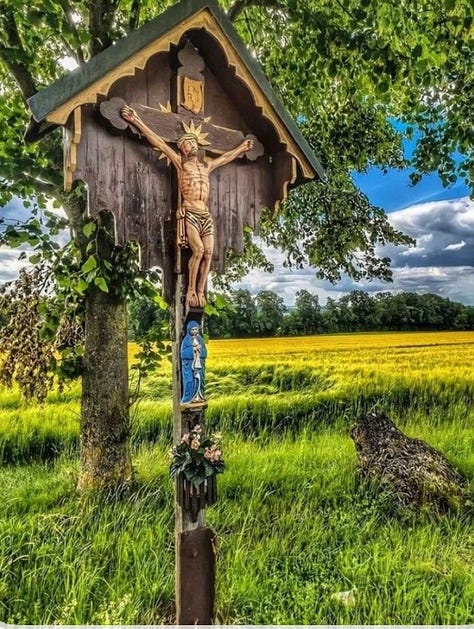

Many thanks to those of you who sent in photos Stephen Weller, Mary Grace Curran, Phillip Hadden, Newleif, Jonathan Geltner
Some articles about the restoration of wayside crosses:
https://www.dioceseoflansing.org/news/watch-wayside-crosses-westphalia
https://www.waysideshrines.com
https://www.ncregister.com/news/young-catholics-restoring-wayside-crucifixes-across-france
I also wrote about Mary Gardens last year:
Mary, Gardens, and May
·
May 14, 2025
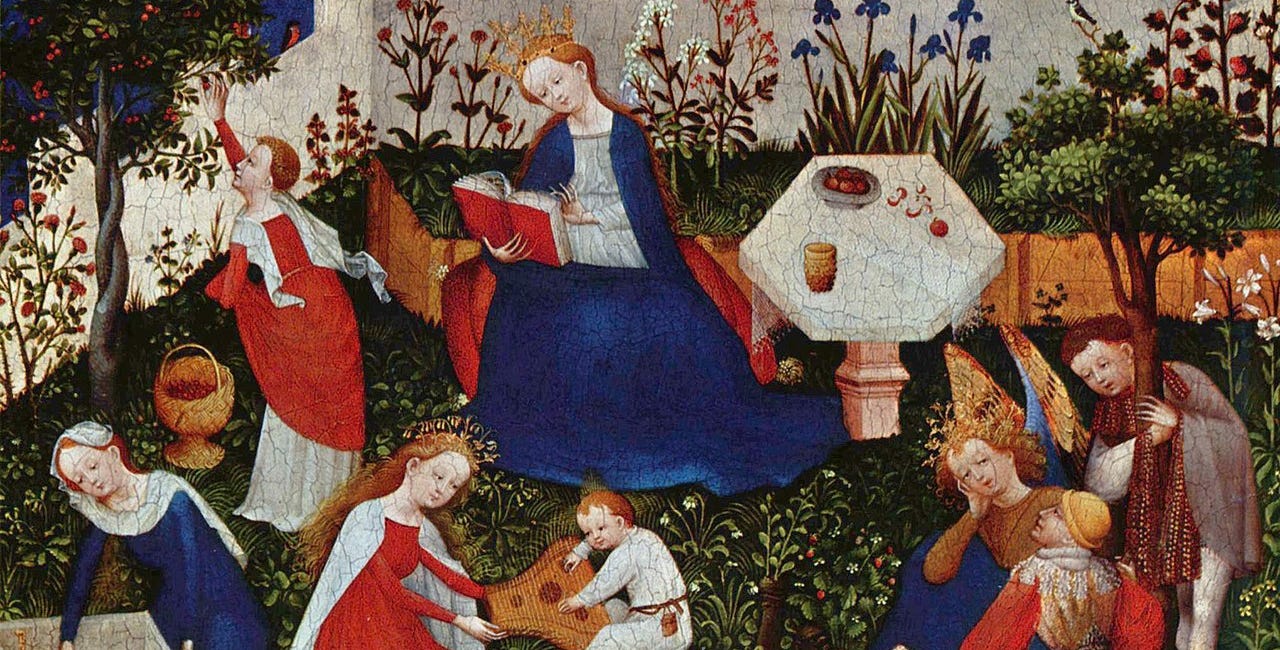
During the month of May, children crown statues of the Madonna with wreaths of flowers and Mary gardens begin to bloom, for in the Church, May is Mary’s month. Although the tradition of associating the month of May with the Mother of our Lord did not take place until the sixteenth or seventeenth century, the Holy Virgin has been associated with flowers, gardens, and Paradise itself since the Patristic period.
Erik Varden has a nice succinct explanation for the reason: “For centuries the Church was cautious about displaying the wounds of Christ’s Passion. She was busy framing in words the paradox that constitutes the heart of the Christian proposition: that in Christ divinity and humanity are both integrally present, that this man ‘born of the Virgin Mary’ is likewise ‘God from God, Light from Light’. Only once the Council of Chalcedon had refined the conceptual framework required to safeguard this equilibrium was the Christian spirit free to envisage, not only in words but in art, graphically, the freely assumed humiliation of God-made-man. The crucifix emerged as the supreme Christian emblem. It came to take centre stage in cultic practice, at least in the West, where representations of a wounded God became the focal point of churches and other edifices, gradually forming public consciousness.”
I also wrote a brief history of the Crucifix in this five images last year:
The Cross and the Paschal Mystery
·
April 18, 2025
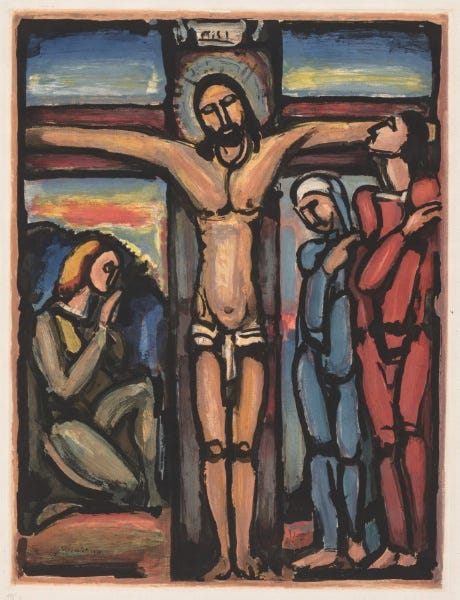
Some art from the first few centuries of Christianity survives. The Crucifix is not among these images. It is not as if the Cross was unimportant to early Christians. Saint Paul preaches on the centrality of the Cross to the Christian faith, “But may it never be that I would boast, except in the
https://www.vaticannews.va/en/vatican-city/news/2026-02/retreat-spiritual-excercises-bishop-varden-vatican-lent-pope.html
Tyack, George Smith. The cross in ritual, architecture, and art. London 1896. https://www.gutenberg.org/files/39839/39839-h/39839-h.htm#Page_63
Eamon Duffy, The Stripping of the Altars, p. 317
“All the church banners were carried through the parish, and the processional crosses, and a standard of a dragon, carried with a long cloth tail before the procession on the first two of these “Cross-days” or “gang days”, and carried, shorn of its tail, after the procession on the last day, as a symbol of the Devil’s overthrow. For that was the principal purpose of the processions, to drive out of the parish, with bells and banners and the singing of the litany of the Saints, the spirits “that flye above in the eyer as thyke as motes in the sonne”. At the centre of the ritual was the solemn reading of portions of the Gospel at stations on the boundaries of the parish, often marked by large wayside Crosses: the virtue of the words of the Gospel brought cleansing and fertility to the fields, and it was considered fortunate to hear these Gospels. This aspect of the ritual struck the reformers as particularly superstitious, and they bitterly condemned this “saying of the gospels to the corn in the field in the procession week, that it should the better grow” Above all the ceremonies centred on the carrying of the cross into the fields and lanes. Rogationtide was “Cross-tide”, for the cross was the triumphal banner of Christ the conquerer, and the “spyrytes that flyethe on lofte in the eyer dredythe moch ... cristis baners that ben the crossis a reysed.” As John Longland declared, “wher soo ever the devyll ... doo see the syne of this Crosse, he flees, he byddes not, he strykys not, he cannot hurte.”
This canticle is said during Lauds on Sunday mornings
Timmermann, Achim. 2012. Highways to Heaven (and Hell): Wayside Crosses and the Making of Late Medieval Landscape. In The Authority of the Word: Reflecting on Image and Text in Northern Europe, 1400-1700. Edited by Celeste Brusati, Karl A. E. Enenkel and Walter Melion. Leiden: Brill, pp. 385-442.
Translation via Achim Timmerman. Highways to Heaven and Hell.
German text: (Bilgerschafft wil ich mich pflege n] / Un[d] zien zu[o]m ewige[n] leben. / Ach engel min / mir ebe[n] wiß / den rechte[n] weg mit alle[m] flyß. / O Christ din stym hör ich gar wol / Jherusalem ich suchen sol. / Zu[o]r port des heilß de[n] weg mir melt / der bildstock clein in wite[m] feldt’).
Comments
Nothing yet. Say the first thing.
Sign in to join the conversation.