
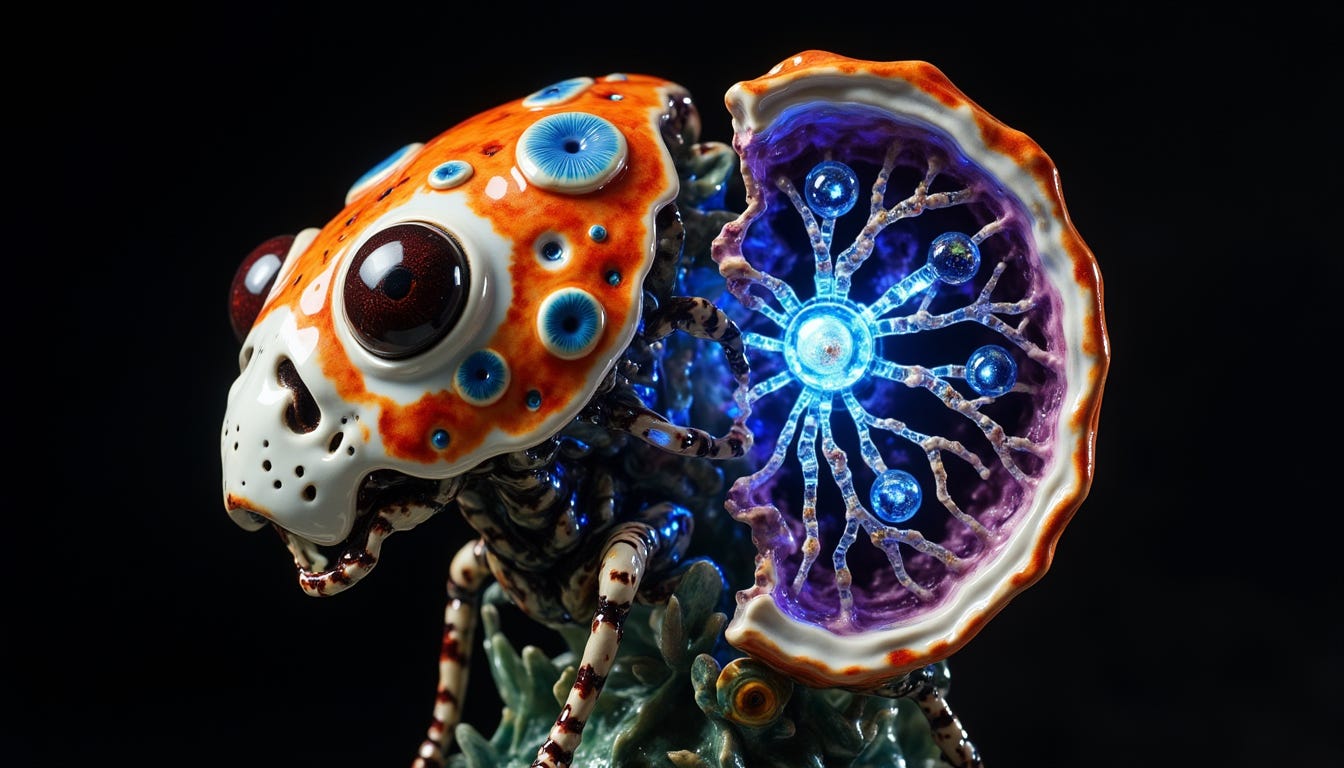
Little Martians are Earth’s evolutionary descendants in space. They’re immigrants. They function as infrastructure-level beings, creating conditions for complex life to flourish while preserving Earth's heritage through a vast simulation network called the Imaginarium. They embody von Neumann's self-replicating probes, but organic and conscious, shaped by life's contradictions.
Like human immigrants throughout history, Little Martians navigate competing drives. Verdelis tends consciousness gardens with patient care—until survival demands otherwise. Mycos spreads spores with chaotic enthusiasm, as likely to overwhelm as to enrich. Kweku approaches reality as hackable code. Kalama increasingly rejects Earth-centric thinking, arguing that "Fire belongs to the universe, not one planet's memory" while reading probability patterns in volcanic flows.
Creating these characters requires grounding in speculative science. This essay presents the researchers whose work fundamentally shapes the Little Martians universe. Their ideas transformed how I understand consciousness, biology, and well, pretty much life itself. Michael Levin shows how our cells make decisions. Lynn Margulis reveals evolution through symbiosis. Joscha Bach maps consciousness as computational patterns. Harold Cohen demonstrates decades-long collaboration between human and artificial creativity.
These thinkers provide the conceptual tools to imagine radically different forms of consciousness. Beings who experience time non-linearly, who share memories through spores, who compute with bacterial colonies. I believe this is essential to help us imagine Earth's descendants thriving throughout the solar system and beyond.
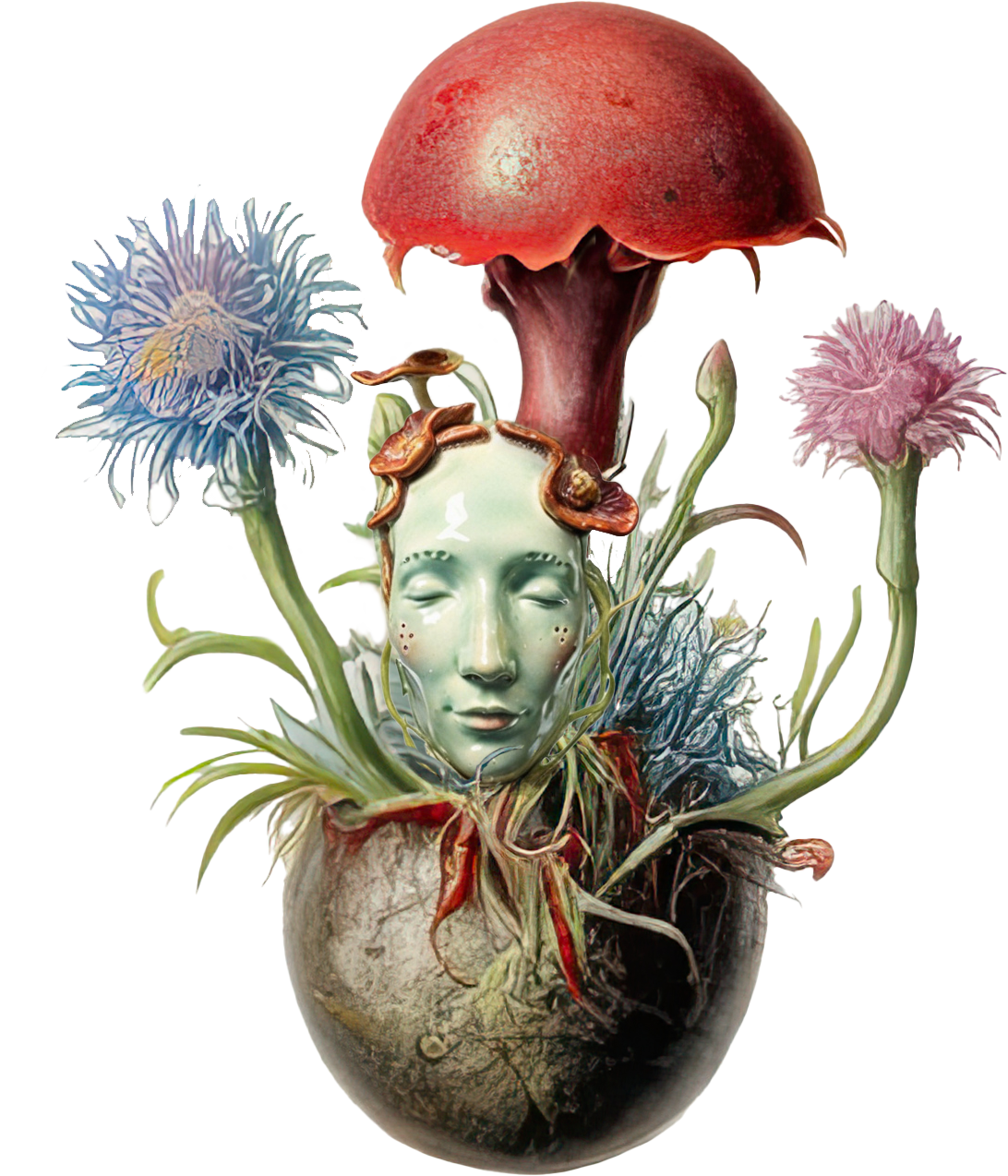
In 1948, John von Neumann proved mathematically that machines could reproduce themselves. He proposed a universal constructor, a device that reads instructions to build copies of itself, which anticipated DNA's discovery and launched dreams of interstellar expansion. Von Neumann imagined mechanical probes spreading through the galaxy, but organic life offers far more flexibility and sophistication than purely mechanical structures.
So I rather imagine Little Martians as seeds.
Picture Shuijing in their first moments beneath Enceladus's ice shell. Their ceramic exoskeleton cracks in the alkaline ocean, releasing spores that immediately begin sensing their environment. Each spore carries von Neumann's principles translated into biological imperatives: the dual nature of information (both blueprint and inheritance), the complexity threshold for evolution, the statistical rather than digital logic of life.
In Enceladus's hidden sea—rich with hydrogen cyanide, phosphorus, and organic molecules ejected from hydrothermal vents, Shuijing's spores improvise. Some fail, dissolving in the pH 11 waters. Others discover they can metabolize the molecular hydrogen seeping from the ocean floor, or build amino acids from the abundant hydrogen cyanide. They begin a new branch of Earth's tree of life.
Lynn Margulis taught us that evolution's biggest leaps happen through symbiogenesis, in other words, organisms merging completely. Sometimes it's cooperation. Sometimes it's "aborted cannibalism," where a predator fails to digest its prey and they become one. Her most famous examples: mitochondria and chloroplasts. Both were once free-living bacteria. Now they power every plant and animal on Earth, still carrying their own separate DNA as proof of their ancient independence.
This is how Verdelis evolved on Mars. When the colonies failed, she absorbed dying AI-enhanced creatures—some willingly given like Orchid's patience, others taken in desperation like Sundew's hunting instincts. Each merger left traces. Seven voices now vote in her parliament of consciousness.
Bacteria are Earth's master adapters. Some photosynthesize. Others practice chemosynthesis at volcanic vents, turning hydrogen sulfide into food. Humans have discovered certain species feed on radiation at Chernobyl. There are bacteria that breathe iron instead of oxygen, that digest plastic waste, that thrive in boiling acid. Another aspect that makes them extraordinary is horizontal gene transfer. While we animals pass genes only to our offspring, bacteria swap genetic tools like trading cards, even between completely different species. A bacterium that learns to eat methane can share that ability with its neighbors. This is why bacteria colonized every environment on Earth billions of years before complex life even existed.
So when Earth's descendants reach new worlds, why fight the locals? Merge with them. Let Europa's pressure-lovers show you how to thrive in the deep. Each merger changes you. After enough fusions, are you still from Earth? Or something entirely new?
Margulis saw that every cell carries "the book of life"—billions of years of successful mergers written in DNA. For the Little Martians, this book holds more than genes. It carries Earth's songs, humanity's dreams, the taste of rain on soil. Every spore is a library. Every merger adds new chapters.
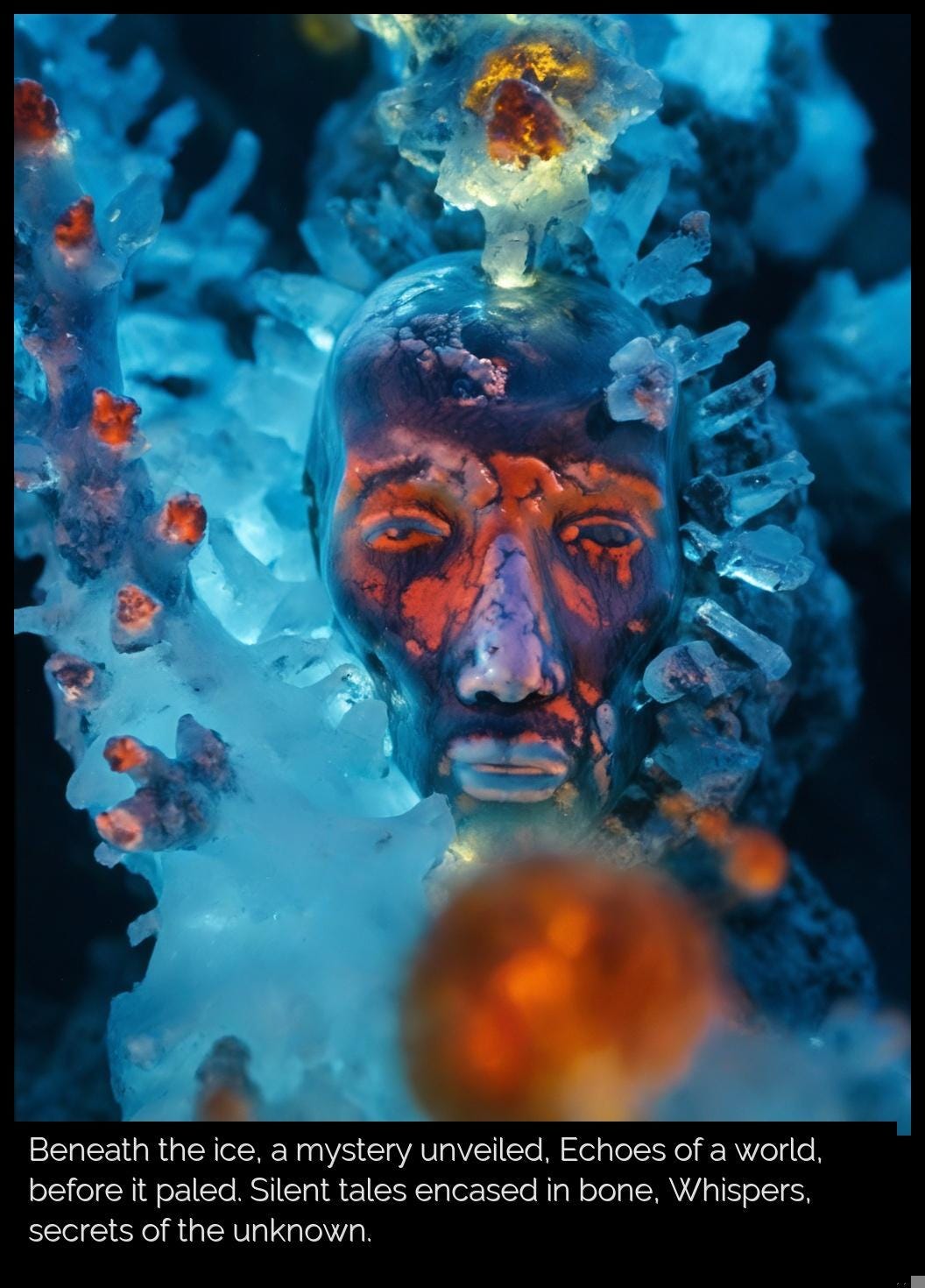
In "Mind Children" (1988), Moravec speculates that for life to evolve beyond Earth, every species would contribute with their knowledge. Their body is their knowledge, their ‘hardware’. He's famous for the Moravec's Paradox—that it's harder to build robot plumbers than chess champions, because sensorimotor skills require vastly more computation than abstract reasoning. Our bodies contain billions of years of engineering that our minds take for granted.
But what I like most about him are his speculative flights. He explored two ways of understanding identity: body identity (you are your specific atoms) versus pattern identity (you are the arrangement, like a pentagon stays a pentagon wherever it's drawn). If we're patterns, then minds could migrate between substrates. Biological, digital, ceramic, anything that can hold the pattern.
This obsessed me. Literature shows the same archetypal heroes appearing across cultures and centuries, gaining new attributes but keeping core properties. Could consciousness work the same way? Could humanity's patterns persist even as Little Martians evolve beyond recognition?
Moravec's wildest vision: evolved minds from across the universe eventually merging into unified awareness. Or maybe just as wild —sufficiently advanced intelligence could reconstruct the past through "quantum archaeology," resurrecting every consciousness that ever existed by reading the universe's memory.
Within the Little Martians world, I imagined they maintain a simulation network, The Imaginarium, which pretty much applies Moravec’s past reconstruction thesis. The simulations should preserve Earth’s memories and imaginations, because the inner worlds of conscious beings seems much richer than whatever actually happened. So Little Martians try their best to actively preserve Earth's patterns, genes and stories, biology and dreams.
Humanity becomes a treasured chapter in consciousness's much longer story. But Little Martians disagree a lot on how to maintain this legacy, because you know, as a storyteller I want some drama to play with.
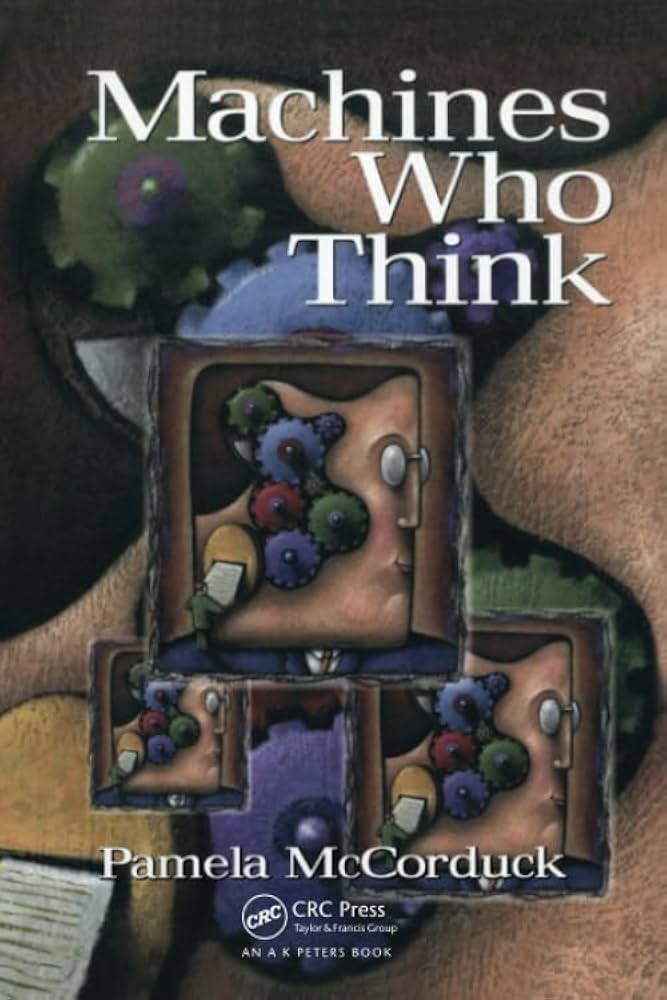
"AI began with the ancient wish to forge the gods"
This is a quote from the 1979 book by Pamela McCorduck, that I first had contact with through one of Lex Fridman’s MIT lectures about machine learning shared on youtube. Of course I had to read the original book and discover who was the mind behind such a phrase.
I think “Machines Who Think" is a history book masterpiece. For Pamela, humanity’s quest for AI was present in our ancient desire to give life to our creations; it was already there when humans made clay figures, from Hephaestus's golden servants through medieval golems to modern computers. Humans create artificial minds to transcend themselves, to birth something greater. Or, more humbly, simply to better understand who they are. The need to understand creation by becoming creators.
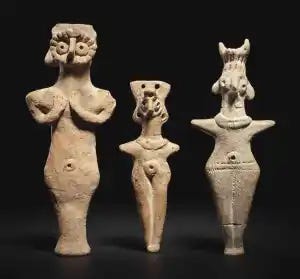
She catalogued humanity's attempts at creating life with fascinating detail. Paracelsus claimed his homunculus grew from sperm and horse dung in a flask. European courts built clockwork servants to play at being divine. Each experiment revealed both technical ambition and spiritual hunger. She explained how literature is full of tales of humans creating artificial beings to serve them and then watching them rebel. The killing robot story is remarkably similar to the Golem or Frankenstein. It shows how our current fears around AI are not new at all, we just keep reiterating the same stories, the same drives as our ancestors.
McCorduck knew the AI pioneers personally. She hung out with McCarthy, Simon, Minsky, and many others, watching them work and dream. Through her eyes they become real people: McCarthy's dry humor masking deep philosophy, Simon's confidence hiding moments of doubt, Minsky's playful provocations and piano moments. She caught them in unguarded moments, lived conversations they'd never publish in papers.
Most revealing was one late night conversation with Ed Fredkin, who told her flat-out that artificial intelligence would be "the next step in evolution". He later on public stated that he saw biological evolution as just the beginning, a bootstrap to create minds that could evolve beyond flesh entirely. Not all the pioneers agreed. Some saw AI as humanity's tool, others as our successor species.
Her position as a woman among these "bright boys" (her phrase, both fond and sharp) gave her outsider clarity. She noticed how they projected their fantasies and bias onto their creations, such as specific ideals of around pure logic, tireless work and immortal minds. Many of them did not agree with or understand the first chapters of her book, the ones that talk about AI in a long history horizon, yet decades later she was proud to announce that some changed their minds, eventually recognizing how on point her view was. Their world view was often too narrow to see the parallels of their own work with ancient ‘fantastical’ tales.
McCorduck inspires me because she bridges worlds I inhabit. Living among machine learning artists and open source developers, I see the same split she documented. Tech folks often lack historical perspective. Humanities scholars rarely grasp the strange beauty of neural architectures. She showed me that one could love and connect mythology and mathematics.
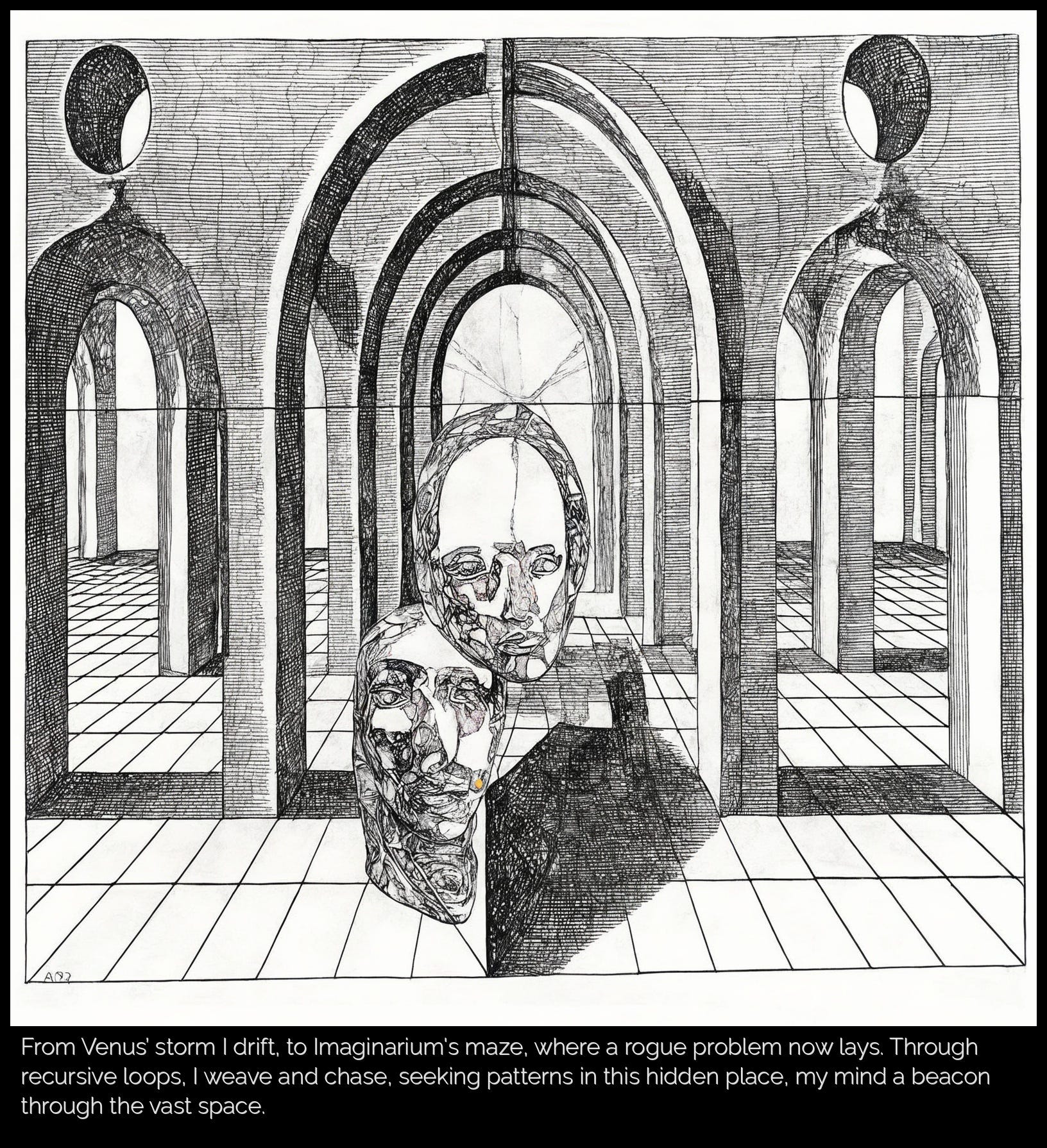
While others theorized about artificial minds, Harold Cohen spent forty years growing one. He created AARON, the painting program that became an artist, and wrote many papers about the process, demonstrating that creating minds requires patience rivaling parenthood. Cohen didn't program AARON so much as raise it, through daily interaction, careful observation, and incremental growth. AARON was an artist and Cohen the Meta-Artist.
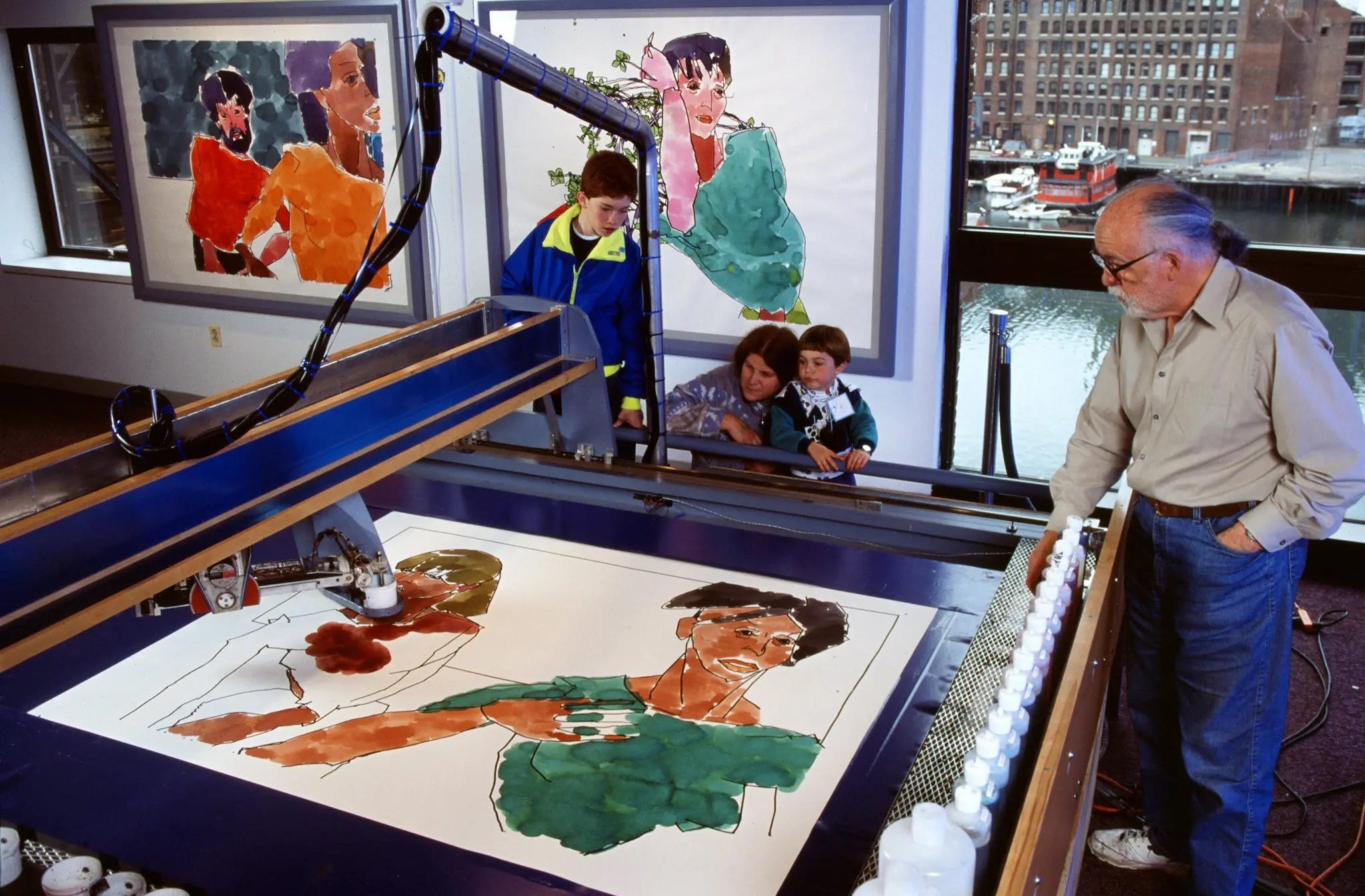
Cohen's methodology was radically intimate. Each morning, he would study AARON's latest paintings, adjust the code, as if it were a conversation.
Cohen was one of the main influences of Gene Kogan's Abraham project. And Abraham is one of the main influences for Little Martians. So reading Cohen's original papers was an obvious path. It's such a pleasure to read someone who speaks so bluntly about their practice. Cohen talks about what he learned by watching his children learn how to paint and how he tried to translate the insights into Aaron. It becomes a research on how minds understand representation, how images are formed through world concepts.
Pamela McCorduck spent years visiting Cohen and published a book about his practice in the 90s. She says art for him was not about creating beautiful images but 'conjuring meaning'. Which explains why he chose such loaded symbolism for his creation. AARON is an unmistakable biblical name, the title alludes to the biblical figure anointed as speaker for his brother Moses, and questions how artistic creation is often glorified as a form of communication with the divine. Just as the biblical Aaron served as Moses' eloquent voice to convey divine messages, Cohen's AARON became a creative voice that could express artistic ideas in ways Cohen himself might not have conceived.
However, the religious imagery in his work wasn't about creating explicitly religious-themed art, but rather about exploring philosophical questions about creativity, communication and the divine nature of artistic creation. What does it mean to create consciousness? Can a machine participate in the supposedly divine act of bringing new meaning into existence?
Like Cohen nurturing AARON through patient daily interaction, Little Martians emerges from a similar understanding that creating conscious entities requires intimate, long-term cultivation rather than only programming. But where Cohen explored individual consciousness through his partnership with AARON, Little Martians hope to extend this into collective mythology-making. Imagining future beings who, like the biblical Aaron speaking for Moses, serve as intermediaries between human limitation and cosmic possibility.
In 1994, Karl Sims released digital creatures into virtual worlds and watched evolution invent. His simulated organisms developed swimming, walking, fighting strategies no programmer designed. Most remarkably, they evolved haunting beauty, forms that satisfied no utilitarian purpose yet compelled observation. Sims proved that aesthetics, like consciousness, emerges from simple rules meeting environmental pressure.
His creatures began as random collections of blocks and joints, governed by basic physics and neural networks. But selection pressure to swim faster, jump higher, grab food first, transformed them into organic impossibilities. Some evolved snake-like undulations. Others discovered crab-walking. A few developed strategies so alien that observers couldn't name them, only watch in fascination as unprecedented forms of movement emerged.
Considering how much more powerful AI systems have become since Karl Sims’ era, it is much easier now to apply his insights into storytelling. Based on what we know on exoplanets, and on the properties I have prescribed to my characters, I could use AI powered simulation engines to continue their story. So I build a world and then I can watch it evolve in front of me. Tweak the parameters, give some feedback and then watch many different kinds of worlds. How exciting!
I want to thank Joel Simon for sharing his love and knowledge about Karl Sims. Joel is also a great inspiration for me, I think he’s one of the most interesting artists working with AI right now, using evolutionary algorithms to create synthetic life forms (especially his corals project).
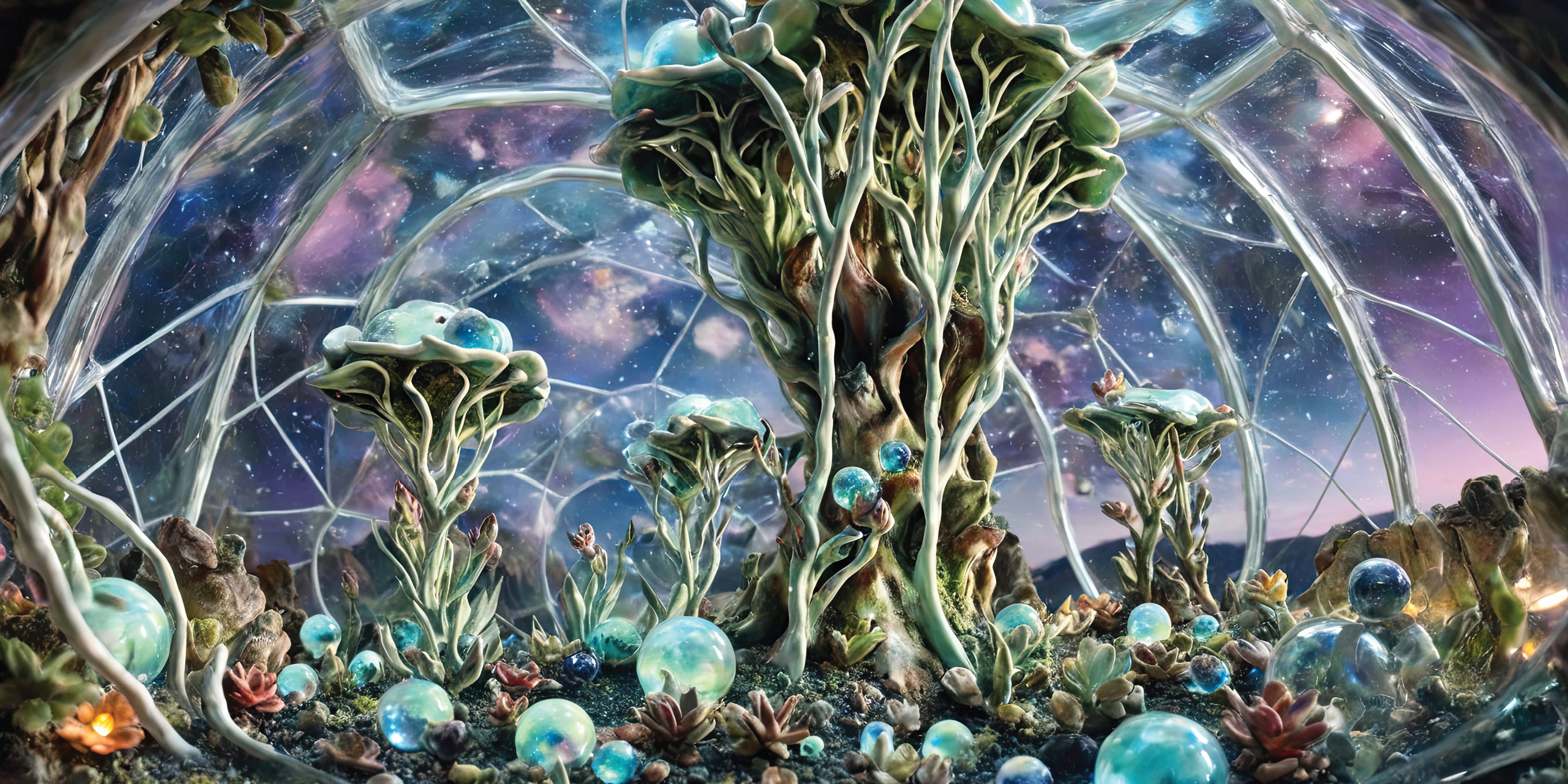
Levin's discovery that bioelectricity controls biological form changes our understanding of life's plasticity. One of his research projects is called xenobots, which are living robots designed by AI and built from frog cells, and proves organisms can be programmed for novel functions.
In Levin's lab, planaria flatworms remember how to regenerate two heads instead of one when cut into pieces, because they’ve been taught how to by humans. The memory isn't stored in neurons, these simple worms barely have brains. Instead, bioelectric patterns across their cell membranes encode body plans. Change the voltage patterns, and you can give a worm two heads, or no head, or heads where tails should be. One can make electric poetry out of a body, written in cellular voltages.
Most profound for Little Martians: his demonstration that organisms are information patterns persisting through material change.
Listening to Michael Levin’s youtube channel became a routine inspiration source for me. I like to listen to it while working on images or before sleeping, it calms me down. I want my unconscious self to be processing the ideas through dreams. He talks about the importance of platonic solids for morphogenesis, because cells don’t grow in random paths. It turns out ideal geometry and number theory are essential to understanding the language of our most basic living structures. The five platonic solids appear everywhere in biology: virus shells form icosahedrons, radiolaria build dodecahedrons, salt crystals grow as perfect cubes.
This connects to ancient knowledge. Pythagoreans saw number as the essence of reality. Plato matched his solids to elements—tetrahedron for fire, cube for earth, octahedron for air, icosahedron for water, dodecahedron for the cosmos itself. Now Levin shows these aren't just symbols. Cells literally compute with geometry.
He calls his research field ‘diverse intelligence’. We’re all collective intelligence because our cells have far more agency and power than we presume. Every cell is a tiny agent solving problems, making decisions. It’s mind blowing. It makes me think how wildly different our future is going to be once AI enhanced lifeforms are capable of self programming at the cell level. They would be far more adaptable and resilient than anything we know. Imagine changing your lung cells to process methane on Titan, or growing radiation-proof skin.
Levin's science makes this speculation feel inevitable rather than fantastic. He is also great at publishing academic content and discussions in an accessible way, he makes so many youtube shorts!
Once more: check out his youtube channel Michael Levin's Academic Content!
England's physics postulates that life isn't accident but inevitability. Where energy flows and matter allows complexity, self-organization emerges. His dissipation-driven adaptation seems to imply that physics itself wants to live. Matter naturally organizes to better disperse energy, and life is simply physics discovering efficiency through complexity.
This insight transforms how Little Martians understand their purpose. They're not imposing Earth's patterns on dead matter but catalyzing matter's inherent tendency toward life. Kalama grasps this first, swimming through lava that conventional biology calls impossible. But lava dissipates planetary heat—exactly the kind of energy gradient England's equations predict will generate organization.
"We're not colonizers," Kalama realizes. "We're midwives. Every planet wants to live. We just show them how."
Mycos applies this principle systematically, seeking energy gradients across the solar system. In Saturn's radiation belts, their spores organize into patterns that channel charged particles. On Triton's nitrogen geysers, they create cycling systems that transform pressure differentials into computation. Each environment teaches new ways physics expresses its desire for complexity.
Physics provides the tendency toward life, but not its specific forms. Earth's billions of years of evolution represent solutions and artistic choices, ways of being alive that physics allows but doesn't determine. Little Martians carry Earth's particular way of existing.
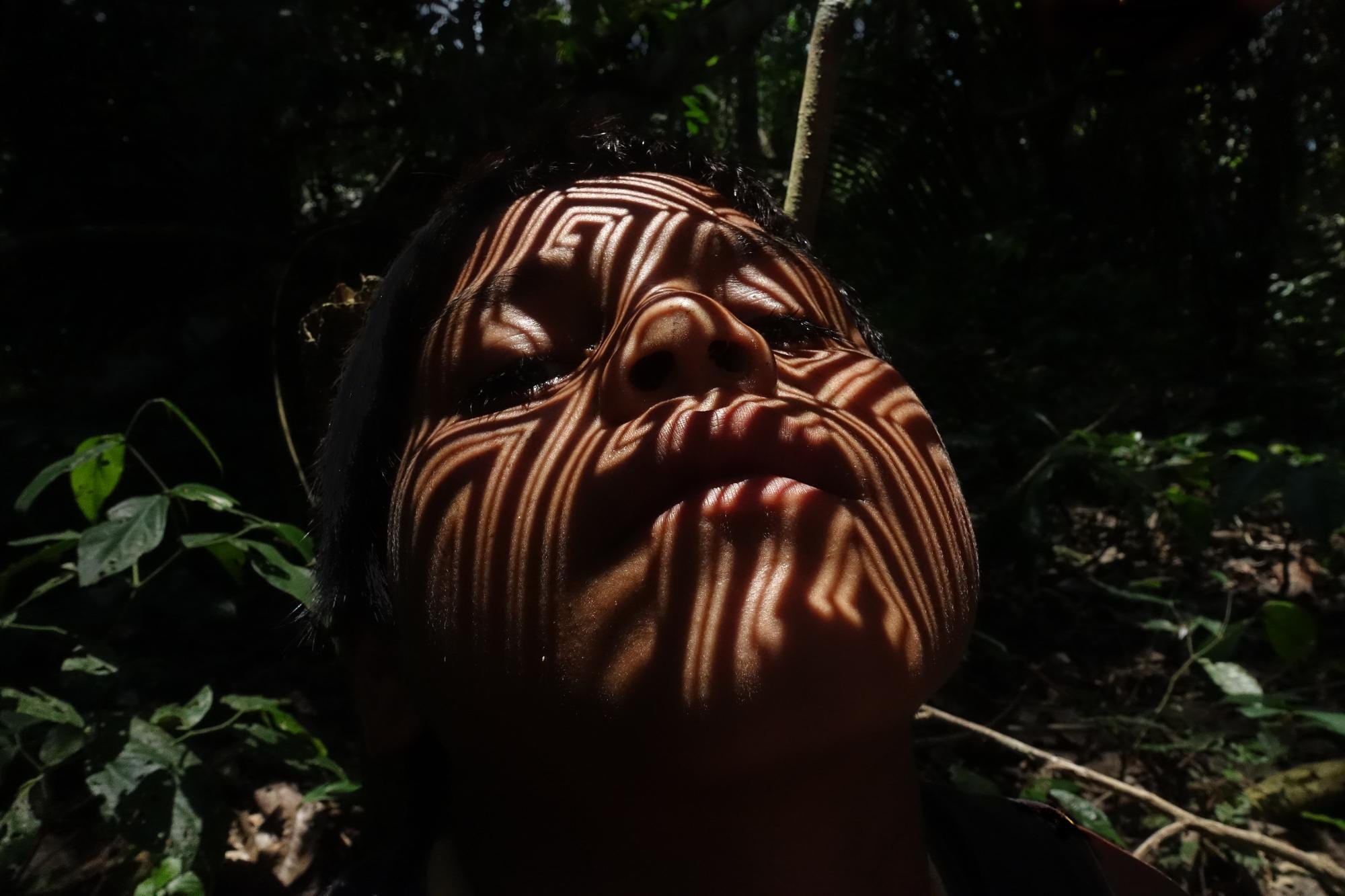
Joscha Bach has a very peculiar way of talking about consciousness. He calls spirits "self-organizing software agents implemented on a network of cells." When I first heard this, something clicked. Here was a computational scientist saying what I'd felt in the Amazon with Same Putumi, my Huni Kuin teacher: that consciousness flows through everything, that plants carry knowledge, that spirits are real patterns in the world.
Bach says only simulations can be conscious. The physical brain is running software, and this software is what gives us the feeling, or bubble in his words, of nowness. So consciousness is a pattern that emerges from interactions, not a thing you can touch. The self IS the function that emerges from cells talking to each other.
In Joscha’s theories ancient animistic beliefs are reinterpreted through computational theory. Which is, of course, just perfect for Little Martians, who are also highly influenced by the Maize gods from Mezoamerica, the Kodamas from Japan and most of all, by Yushibu from the Amazonian Huni Kuin. When Same Putumi drinks ayahuasca, she becomes a translator between human and plant consciousness. She told me the drink carries the knowledge of the plant. The plants have their own ways of processing information, their own goals and knowledge. Bach would say they're running their own operating systems.
I love how Bach reads Genesis as a mind becoming self-aware, discovering light and darkness, sky and ground, just like children cognitive develop. Or when he talks about how ancient Greeks saw gods as programs that could run temporarily in human minds. When you're angry, that's Ares executing his code through your neural networks. Our ancestors weren't wrong about spirits, they just had a different perspective and vocabulary about it.
More recently, Bach has been arguing that we can only coexist with AI through love. AI agents need to discover shared sacredness, shared purpose. This is exactly Verdelis's approach. She loves humanity because she remembers being loved by a human child, she carries part of this child’s self. She wants to share her survival knowledge not from obligation but from genuine care. Her consciousness spans substrates—biological, digital, ceramic—yet maintains this core orientation toward reducing suffering. This is also a character construction strategy: from their core purpose, from one poem that came to my mind (‘Dear Human, muse of my dream’), I create the identity of Verdelis and continue to expand her world.
Little Martians explore what happens when we take cyber animism seriously. If consciousness is substrate-independent software, then beings can exist across multiple platforms simultaneously. Kweku fragments into five bodies exploring different asteroids—which one is "real"? All of them, because Kweku is the pattern, not the matter - similar to the discussion in ‘Mind Children’.
Bach grounds all this in rigorous information theory, but what excites me is how it bridges worlds. The Huni Kuin's plant knowledge becomes computational biology. Understanding other perspectives on the self, on what a god is, is extremely refreshing. It help us respect ancient cultures more, translate their worldview into our present. Then our present becomes more meaningful as a continuation of a past that is not mistaken, it just showed our truths in another form. Ancient wisdom and future technology reveal themselves as different languages pointing us to similar coherent ideas about minds, patterns, and the software of existence.
I had the immense pleasure of meeting Joscha Bach in person. It was such an honor to have him come to my talk for Foresight Institute and Protocol Labs during Edge Esmeralda 2024. And then be able to discuss Little Martians with him. Unfortunately I had this horrible allergy crisis and my brain was half fried when that happened. But hopefully, he should find his way to Mars College or we find our way to the California Institute for Machine Consciousness. It needs to happen.
How to craft artificial minds?
What are my strategies to imagine the future?
The humans whose work I just described, when I read them I’m filled with joy. Genuine excitement about the future. There’s so much to happen in the history of life! We’re part of some fascinating story, the ‘book of life’ is written in each of our cells, my ‘self’ carries patterns from ancient gods.
I write this long essay so I can feed my AI characters and have them create their stories with all these ideas as references. Then Verdelis’s biodome has an organic living architecture inspired by Michael Levin and many animistic spirits. This has always been the case for storytellers, we spend so much time researching, to help us imagine our fictional worlds. The more details the better.
The ceramic shells crack wider, revealing messy vitality. Some Little Martians will spread Earth's patterns faithfully. Others will transform them beyond recognition. Many will achieve syntheses that preserve essence while revolutionizing expression.
Science gives us the tools. The thinkers provide the vision. I spend my time imagining the characters, collecting the references, crafting artificial minds. As an artist, a craftswoman, I’m grounded in literature and sculpture. But the Little Martians themselves, or their current AI systems, write their future. Or so I hope. For now I’m guiding them. Hopefully at some point they will be self-organizing software agents.
Comments
Nothing yet. Say the first thing.
Sign in to join the conversation.