
Welcome to this episode of Little Book House! I’ve been away from my desk for the last three-and-a-half weeks, so for this stack I had A LOT of material to sift through and ponder what it all meant. Thanks for your patience!
Sometimes it’s nice to have a plan, and to execute it. When I knit a sweater, for instance, I follow a well-worn routine—find a pattern, pick the yarn, get all my needles and accessories ready, cast-on the first row, follow the knits and purls, the yarn overs and the increases, the slips and the decreases until I get to the bind-off. Submerge the separate pieces in water, then pin them to a blocking mat to let them dry. Sew the pieces together and the sweater is done!
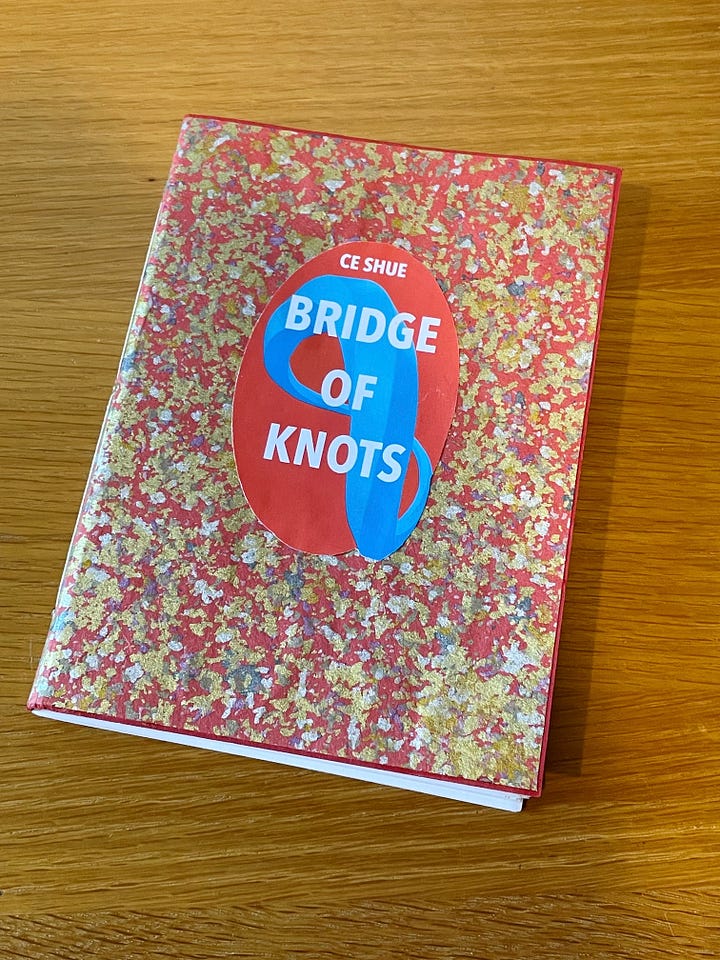
On the other hand, sometimes it’s nice to not have a plan at all—just wing it. I did this when I created an illustrated version of my chapbook, Bridge of Knots. My daughter had given me a mini-set of pearly pastel Japanese paints and I didn’t really know what I was going to do with them—until I picked up a copy of BoK and decided to go to town on it. I tore out all the pages, got out my boxes of craft papers, stickers, stencils, and brushes, and went wild. All because of a box of paints.
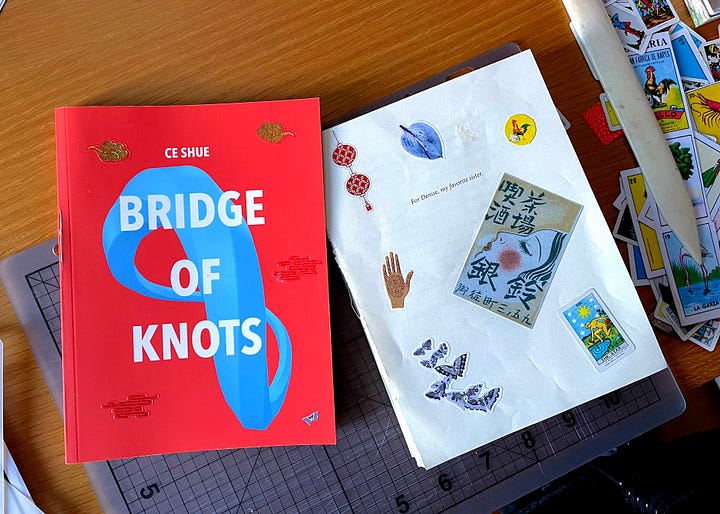
But those paints! With them, I saw that each page of Bridge of Knots was an empty canvas. I was able to just play around—with color and shape, space, and image—until I felt a sense of ahhh-ness. This, this is what the story feels like to me.
A wash of color on this page, a loteria card of a stag on another. Little blue butterflies, Chinese lanterns. A golden engraving of Shiva, dancing.
Years ago, I had gotten a tiny deck of tarot cards that sat on my desk shelf, waiting for its moment. I hadn’t even started writing BoK when I bought those little cards, but when Allie’s paints arrived in the mail, I knew they were exactly what I needed next. The Wheel of Fortune, The Ace of Wands, The Chariot, The Empress, and The Sun—all and more found their way onto BoK’s pages.
I didn’t revise or think too much about any of the illustrations; when I was finished with one, I went on to the next. It was a fluid process that felt like improv—each page a movement that led to the next movement. Loteria cards (a drum, a rooster, a scorpion, a watermelon, a pink-legged heron, a pine tree), and Asian ad designs from the 50s and 60s (also a gift from my daughter) all added to the eclectic and multi-cultural theme of my story. I didn’t realize it until I was making my collages, but my father’s childhood of learning to speak Spanish, the vagaries of chance that have ruled my life since I was given up for adoption as an infant, and my family’s Chinese heritage were all represented in the illustrated pages of my book. Like much of life—not exactly planned—but taking a specific shape, a kind of visual representation of the unconscious at work.
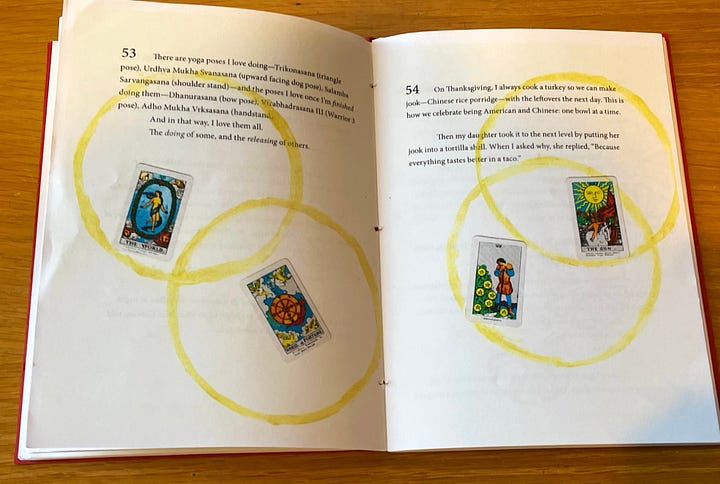
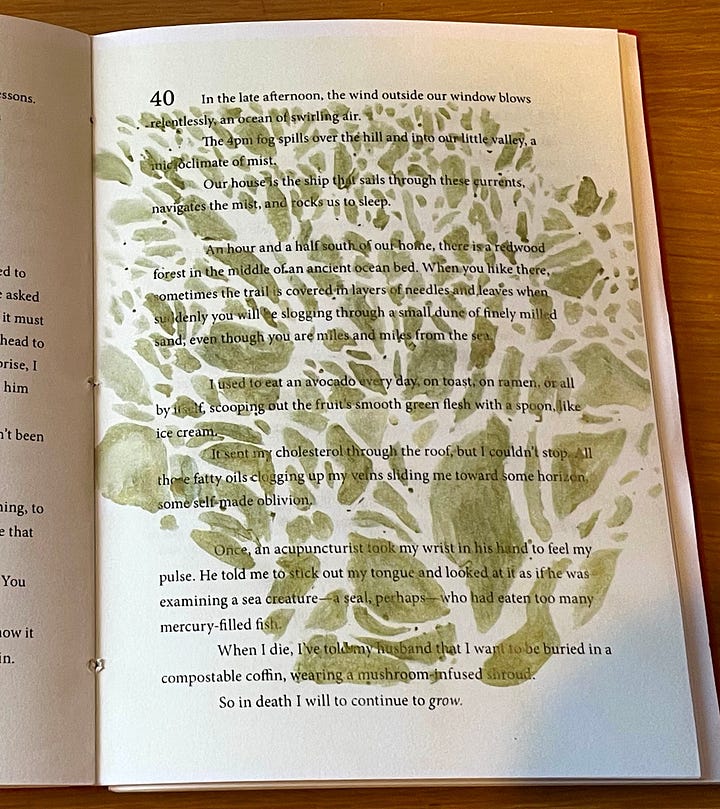
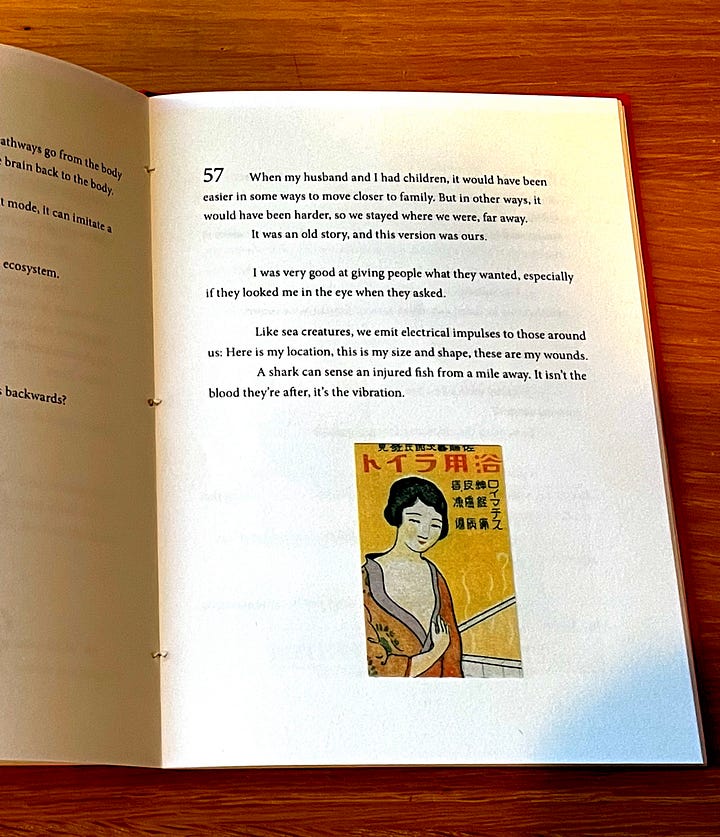
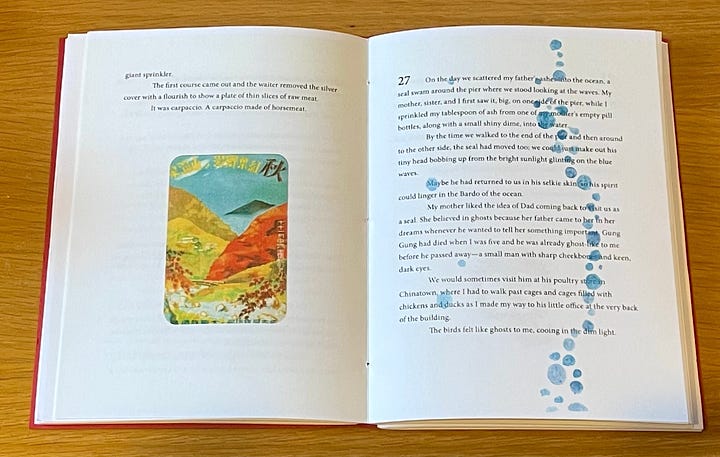
Some pages didn’t seem to call for any embellishment, so I left those as they were, just the words themselves. Those pages felt like a pause, a breath. When I finished the whole manuscript, I scanned the pages into my computer, printed them out, then hand-bound them in new covers I made with cardstock. I created a couple of different cover designs for fun—and because I had messed up on the measurements, which left me without enough red paper for all four editions. I used a Japanese sewing technique to bind the folios together, adding some beads (left over from a knitting project) at the last minute for a bit of sparkle.
So planning and not planning are two ways of creating something.
When we travel, we like to do a combination of the two. On our most recent road trip, we knew that we wanted to go to Big Bend National Park in West Texas because our friend Diane had been there and said it was amazing. It was Diane who had inspired us to get Kimba, our 2003 Volkswagen Eurovan, in the first place. She had bought one and came to our house for dinner one night to give us a tour of her new rig. It had everything we needed—a propane stove! A refrigerator! A bench seat that turned into a bed! Storage space! Swivel seats! Adjustable tables! A pop-top! The latter was the key feature, because with the top down, the camper could it fit in our garage.
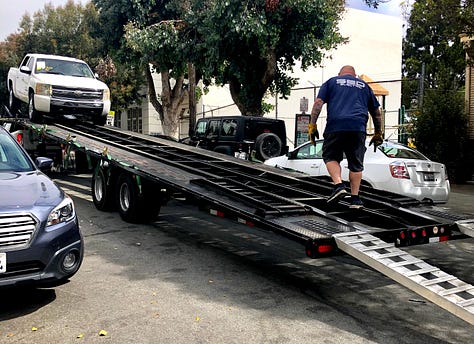
Parking in our neighborhood is notoriously difficult, so this last piece was a dealbreaker—basically we traded a bathroom for garage-ability. We immediately set about finding one for ourselves, which took several months, but we were thrilled when Kimba finally arrived—on a flat bed truck that got stuck on one of SF’s infamous hills several blocks from our house, haha. We’ve been happily tootling around the country in her ever since.
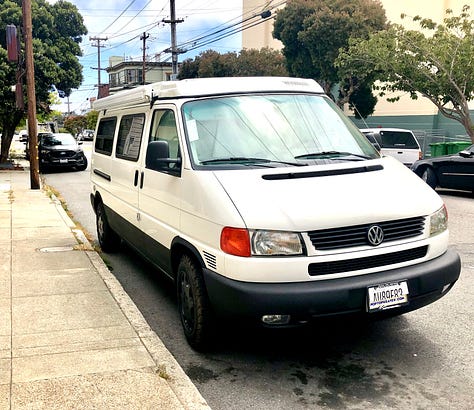
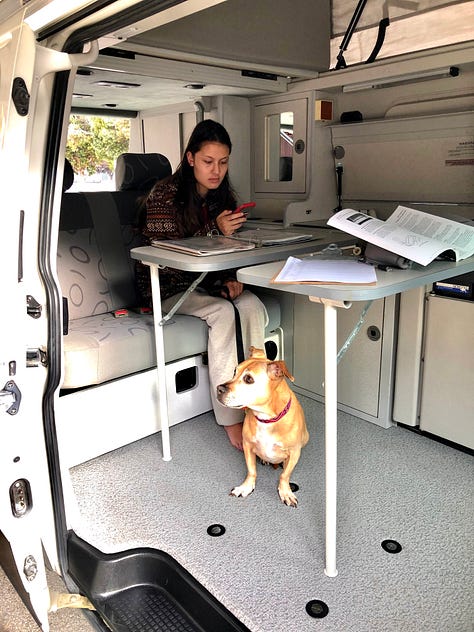
So if Diane gave Big Bend NP the thumbs up, we had to check it out, even though it’s one of the least visited National Parks in the US. The reason it’s one of the least visited National Parks in the US?—it’s in Texas, and Texas is a big state! Big Bend isn’t close to anything, no airports, no major cities, nothing! So the challenge was figuring out how long it would take us to drive from Northern California, and if we could find interesting things along the way to break up the monotony of endless driving.
Luckily, Peter is good at logistics, and he was able to plan a route that had us visiting family, then going through some quaint towns, like Bisbee, AZ and Silver City, NM where I found some fun and creative Little Free Libraries.
I’ll get back to those LFLs in future LBHs, but for this stack I want to tell you about the crazy, unplanned part of our trip, and how we found ourselves on a bumpy road to the Ancient World.
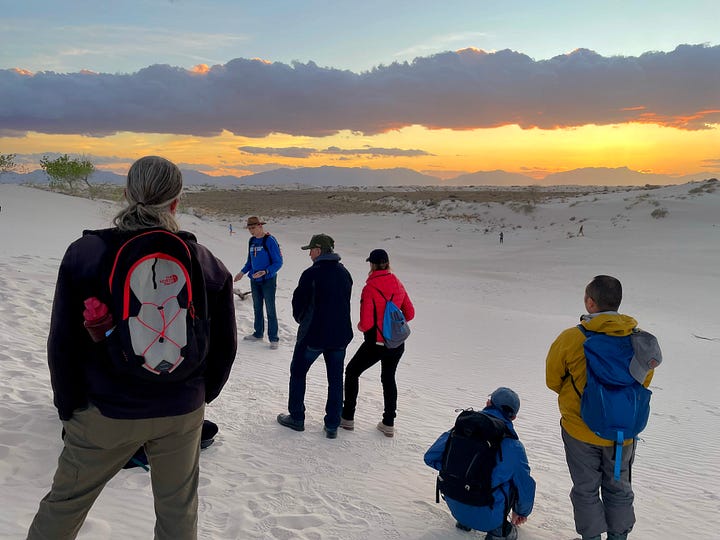
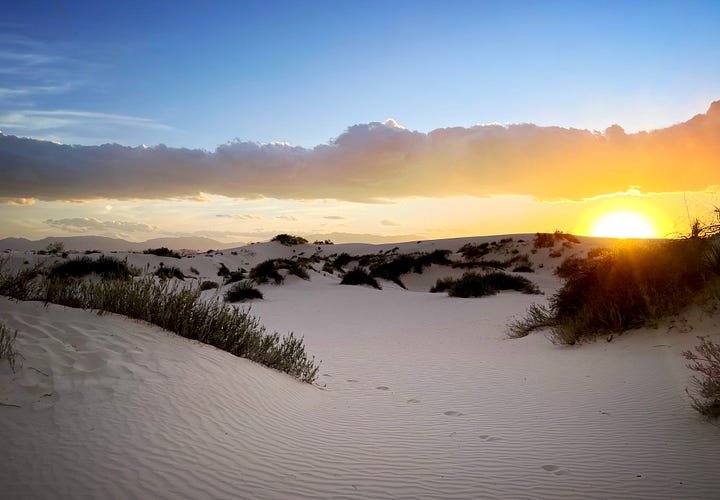
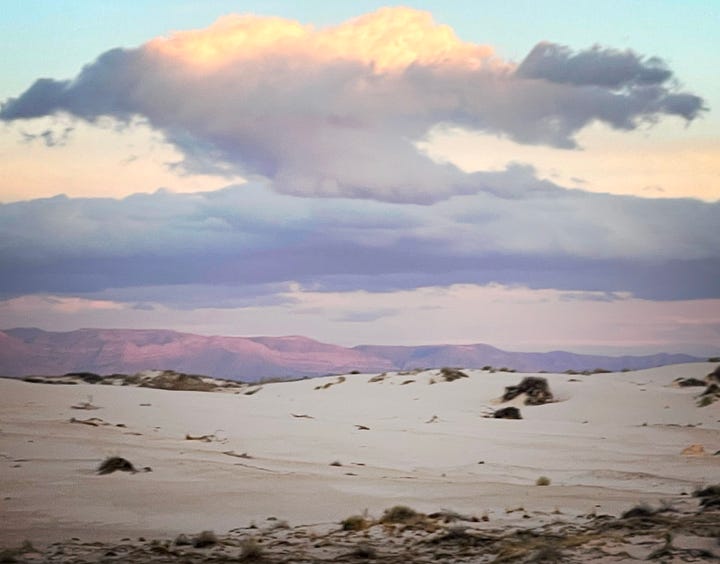
And that story begins at White Sands National Park in New Mexico. It was sprinkling when we arrived, which was unusual, but the clouds only added a dramatic sky to the iconic and thoroughly other-worldly atmosphere of the massive (250 square miles) snowy gypsum sand dunes.
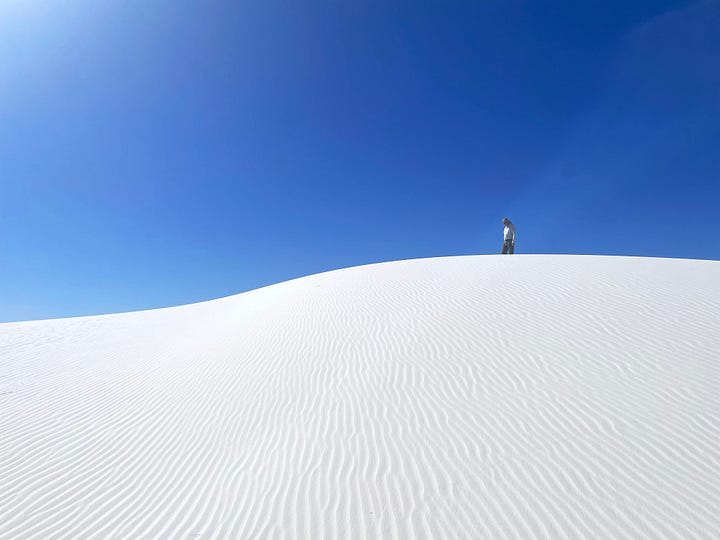
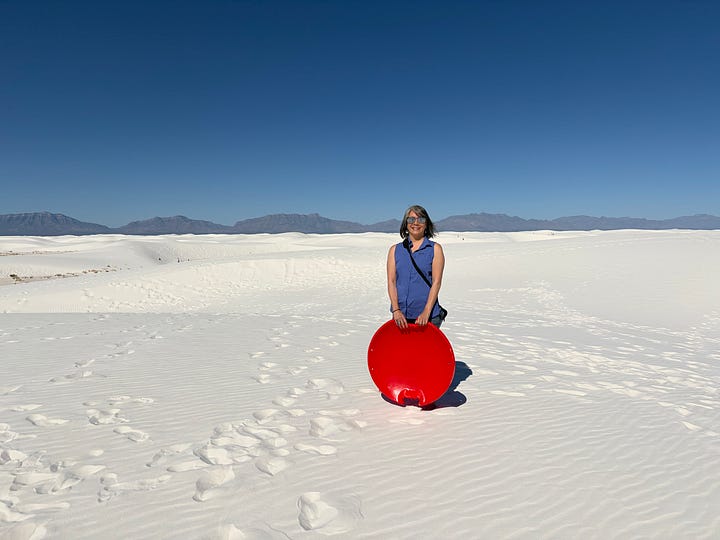
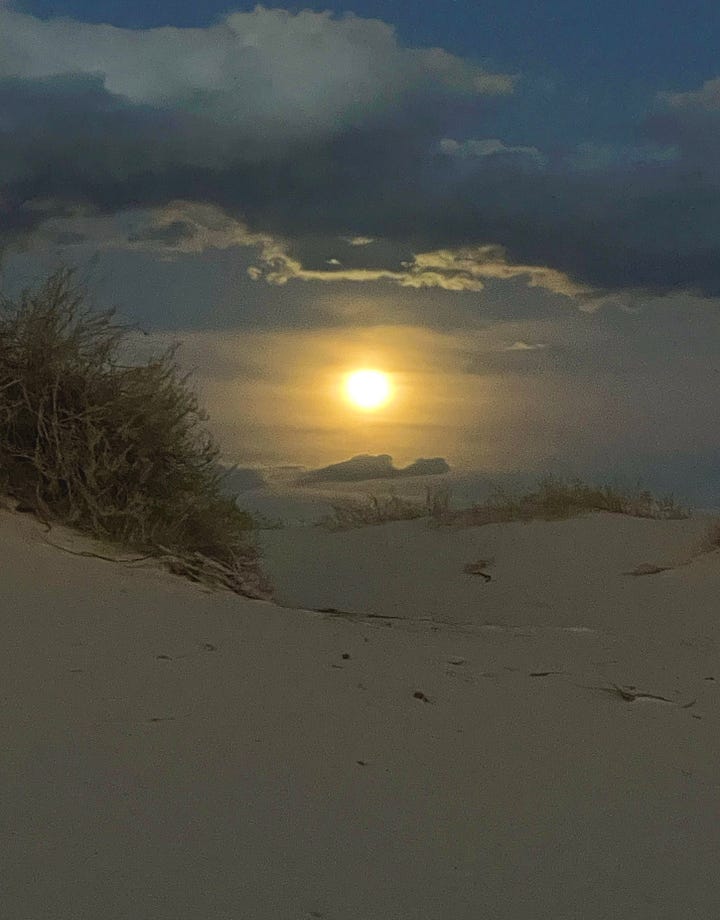
We just happened to be there on the day of the full moon, and Peter had snagged a couple of spots for the Park Service’s once-a-month ranger-led Moonlight Walks. (Hooray for planning ahead!)
We lucked out with the weather and the rain stopped before the walk started. We were accompanied by two rangers, a volunteer, and Rebekah, an Interpreter, who led the outing. The moon was set to rise about a half hour after our merry band (including a very large and shaggy St. Bernard) set out among the soapstone yuccas, skunkbush sumacs, and rosemary mint shrubs. Rebecka not only told us about the formation of the earth (did you know that the only reason there is life on earth is that an iron-laden planet collided with the floating rock that was Earth, knocking it off its axis so it now has Seasons! Weather! Life!), as well as lore from many cultures related to the stars and the love affair between the Sun and the Moon.
She told us about all the tiny sea creatures that lived in the vast inland sea that used to cover the US. How climate change dried up the sea and all the little critters got fossilized in the muck that became the desert we know today. After that, wind and rain eroded the gypsum into the fine white sand for which the park is famous.
Rebecka also told us about the different cultures of the Southwest and how they tracked the seasons through the movements of the sun and the moon. Many places incorporated geometry into their sacred places—and one place, Chaco Canyon in New Mexico—had built that geometry into their very buildings. The people at Chaco had used the angles of a specially crafted window to capture the sunlight of the Summer Solstice as a way of tracking the seasons and honoring the mythology behind the creation of the sun and the moon, which was an important part of their way of life.
Maybe I was drunk on moonlight, but after the hike I asked Pete—do you think we could go to Chaco on our way back to California? I had no idea of it was feasible, but we didn’t have a set route, no reservations had been made anywhere. If we were going to head in a particular direction, now was the time to decide.
It turned out that Chaco was a three hour drive from our last scheduled stop in Ojo Caliente, NM to meet up with Peter’s cousins Fred and Kathy. We hadn’t seen them in several years and they happened to be passing through the same area as we were on their way to Canyonlands National Park in their BAT—Big Ass Trailer. It was a stroke of luck we would find ourselves in the same place at the same time from opposite sides of the country.
We had a wonderful mini-reunion and when we said we were heading to Chaco next, both Fred and Kathy said it was a great place, but that the roads were terrible.
“The North Road is bad,” Fred said.
“The South Road is worse,” Kathy said.
And that’s how we found ourselves bouncing along a rutted—really rutted—dirt road heading for one of the most amazing places in the ancient world. The day before we’d had no plan, no idea, no inkling of Chaco on our horizon. A serendipitous mention fell into our laps that shaped our entire journey—and we found so much more than we could even imagine! (Fyi—we took the North Road. We couldn’t even imagine how bad the South Road was, but we vowed to steer clear of it at all costs.)
It wasn’t like we’d never been to ancient ruins before. We’d been to Bandelier, Aztec, Puye, Canyon de Chelly—and on this trip we’d been to Gila National Monument (home of a very well preserved cliff house in the New Mexican mountains.) But nothing had prepared us for Chaco—and as we were driving down the bone-rattling road, hoping that Kimba’s axles would remain attached to her chassis—we couldn’t imagine what we might find.
Driving into the mouth of the canyon was nice enough—with towering sandstone and shale mesas on either side of the wide canyon. It wasn’t as dramatic as some canyons, but still beautiful as the sun’s rays highlighted the tops of the cliffs as well as Fajada Butte, a monolith that stands near the Canyon’s campground. But it wasn’t until we joined a ranger walk that afternoon at the Pueblo del Arroyo trail that we began to see just how incredible Chaco is.
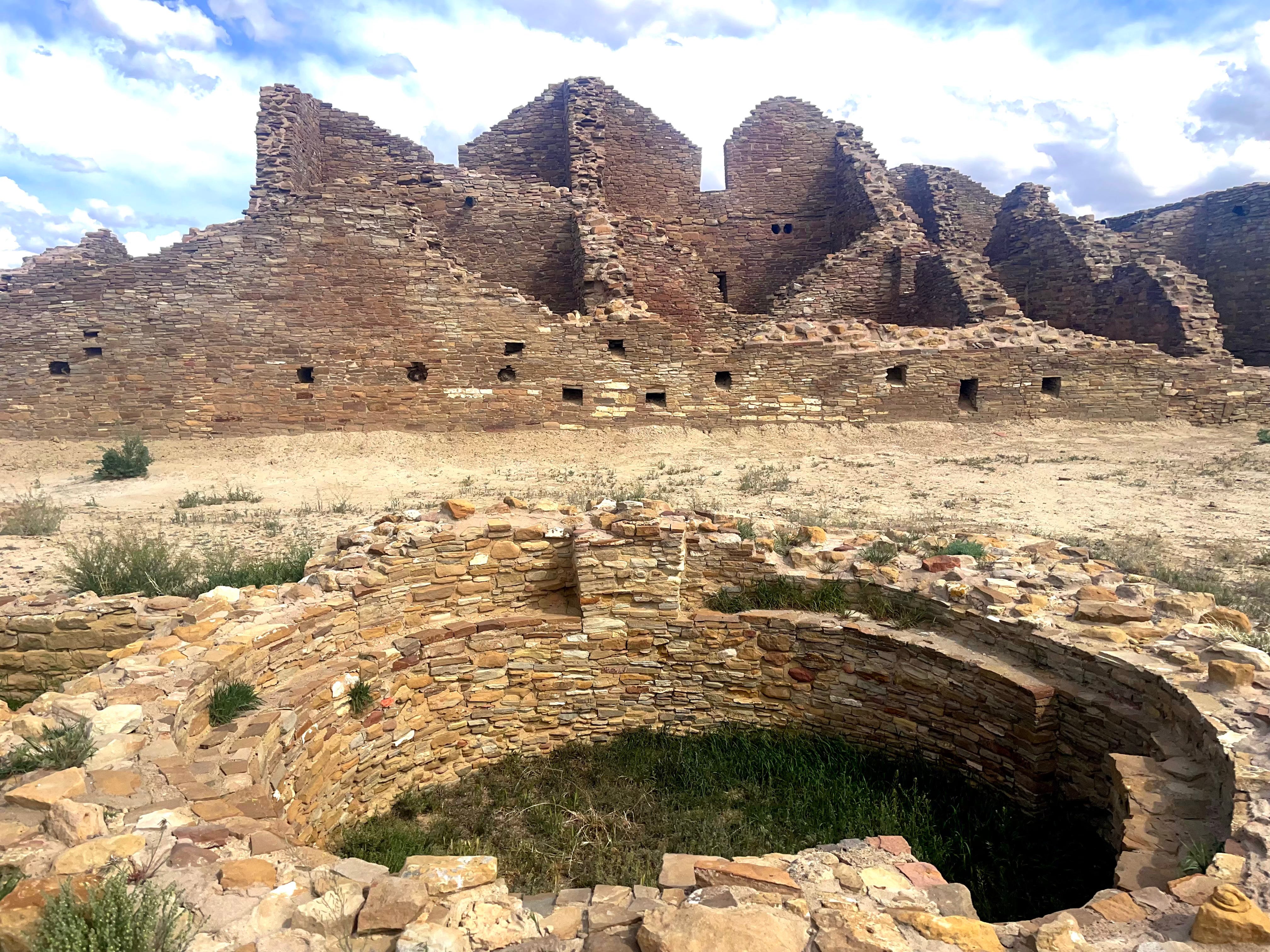
“This building was four stories tall,” our guide Wayne said, pointing to the ruins of the casa that stood before us at one story. “Built with about 5,000 trees that had to be harvested and transported from 50 miles away.” It boggled my mind that the walls before us had been constructed using nothing more sophisticated than a stone axe. The people of Chaco didn’t even have the wheel yet!
Which made the building of Pueblo del Arroyo—which consisted of 450 to 550 rooms, plus several large kivas (ceremonial spaces) and two large plazas for outdoor gathering—all the more impressive. Built between the years of 850AD and 1150AD, when there was no reliable water source close by, meant that all the water used in the mortar and plaster had to be delivered somehow to the building site as well.
Assembling one Pueblo del Arroyo would have been a great feat of construction, so the more incredible part of Chaco Canyon is that Pueblo del Arroyo was just one of MANY great houses in the canyon, including Pueblo Bonito, Una Vida, and Peñasco Blanco, and later, Hungo Pavi, Chetro Ketl, Pueblo Alto, Wijiji, Nuevo Alto, and Casa Rinconada.
In addition, there were hundreds of “outlier” villages dotting the mesas, with all of the pueblos having communication sight-lines, astronomical markers, and water systems of their own.
Surprisingly, only a few people seemed (according to archeological theories) to live at any of these Pueblos on a full-time basis. Instead of permanent communities, the people who lived in these great houses were more like caretakers and staff, tasked with the job of maintaining them for visitors. According to research done at Chaco, most of the people who came to the area over its 300 year history were actually visitors from other places.
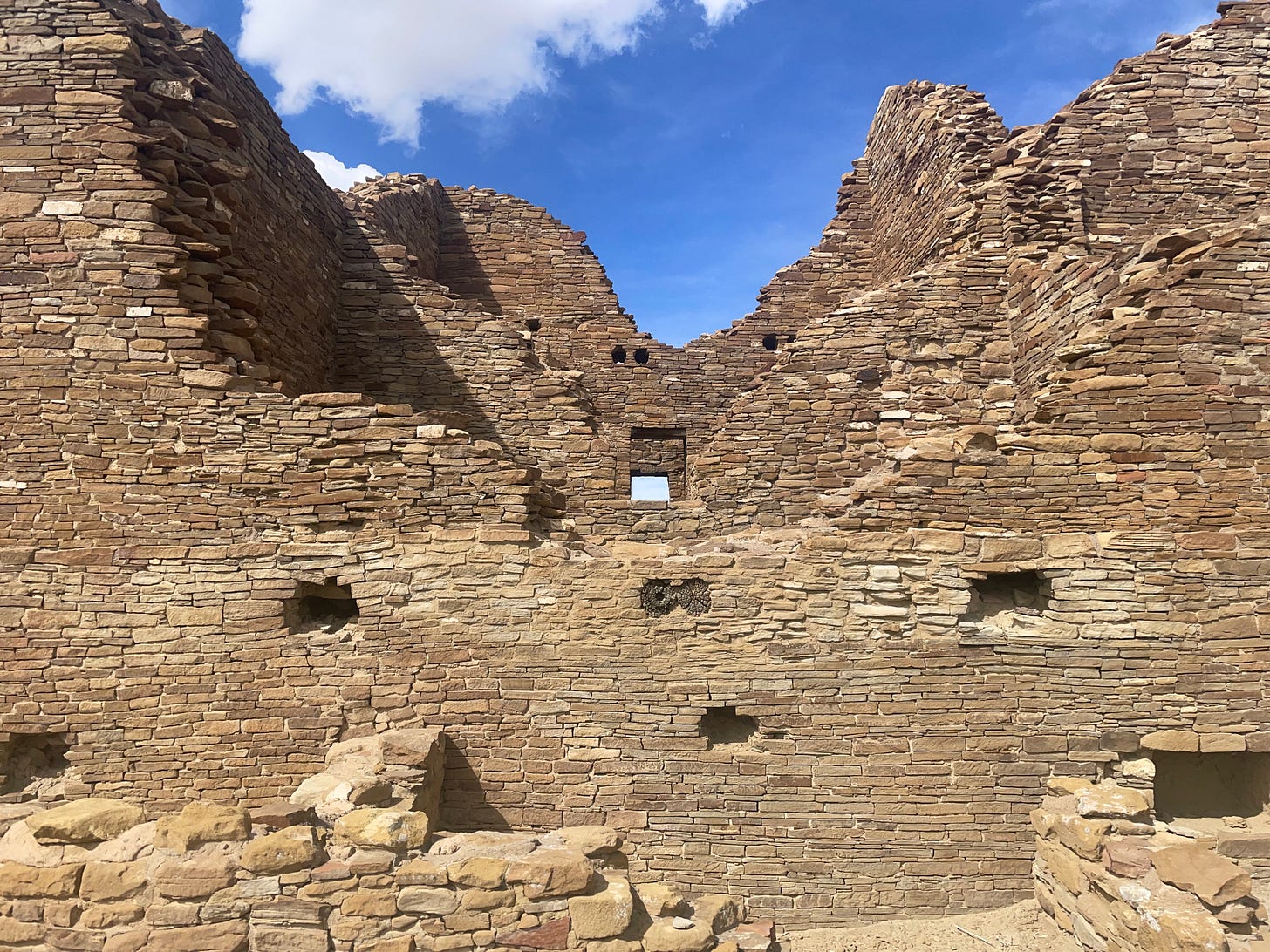
“Imagine Times Square, if it was a holy place,” Wayne explained. “You arrive from the Pacific Northwest, perhaps, a 1,500 mile journey on foot, and as you enter the canyon—on these straight roads, 30 feet wide—you see these giant, palatial buildings, surrounded by people from all over the world. People from as far away as Mexico and Central America, and all of the Southwest.”
The Pueblos were not just villages, or even large villages. They weren’t outposts or lodges to be stopped at along the way to another destination. These Pueblos WERE the destination. They were specially built public spaces to attract people from the far-flung corners of the Puebloan world—a place people could come to socialize and trade and engage in ceremonies together. Archeologists have found turquoise, cacao, parrot and macaw feathers, copper bells, obsidian, shells, beads and pottery at Chaco, even though none of these items—not even the numerous pottery sherds—were made or found locally.
In my mind, I could see a cross between a church festival, a county fair, and a trading post, all set on a grand scale, with buildings whose very architecture was aligned along compass points and tracked the phases of the sun and the moon. For three hundred years, people bought and sold goods, traded ideas and stories with one another, until something (climate change?) forced them to find other places to gather.
For three centuries, Chaco was the center of the Puebloan Civilization. That’s longer than the United States—at 249 years—has been in existence. I marveled that this all happened a thousand years ago, and I could still imagine the hustle and bustle of people when the pueblos were in their prime.
The influence of Chaco is still felt in the origin stories of many American Native cultures and details of Chacoan architecture can be seen at places like Mesa Verde, Aztec Ruins National Monument and Salmon Ruins. New Mexico has always been a special place to Pete and me (see my stack, “The Winds of Change”, to see why), so it was special to witness such an important place in the history of the land.
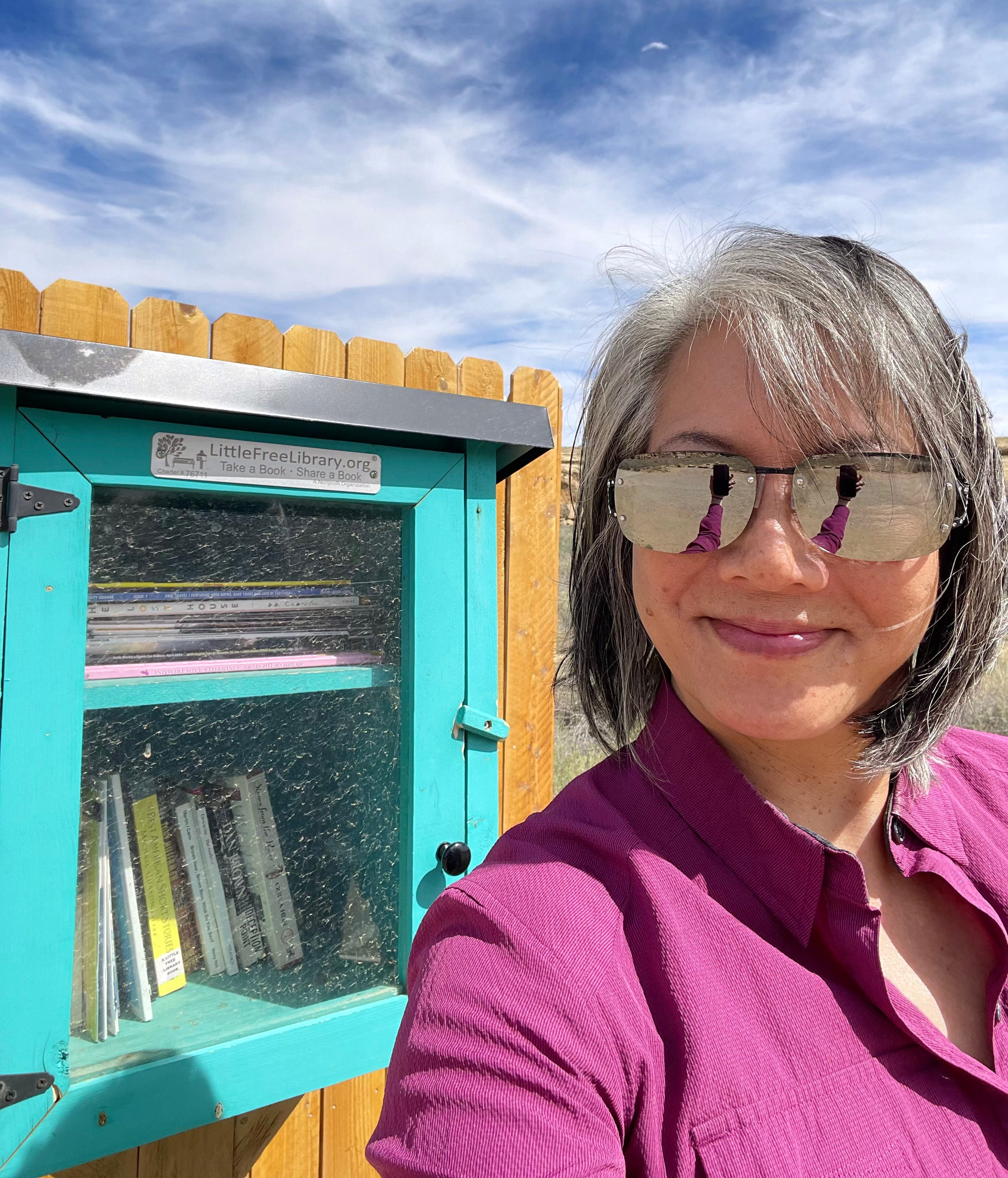
Agog from our tour of Pueblo del Arroyo, Pete and I headed for the Gallo Campground where we were staying for the next two nights. As we entered, I was sure my imagination was playing tricks on me as we passed a familiar silhouette, painted a bright turquoise hue.
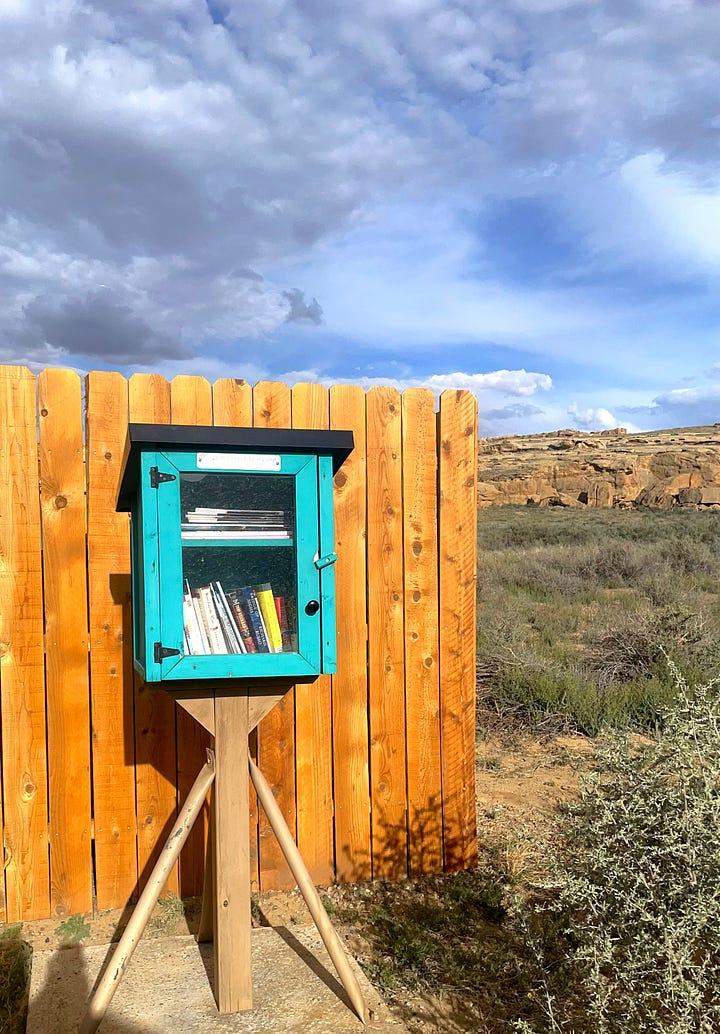
How could it be—way out here down 16 miles of teeth-chattering washboard roads in a place that hadn’t been inhabited for a thousand years—an official Little Free Library! At first I thought it must be a mirage—had we been in the desert too long?—but the distinct shape and bright color was as iconic to me as the sandstone bricks of Pueblo del Arroyo.
I am often surprised to see where Little Free Libraries pop up, but I have to say, this one might be the most remote one I’d ever come across. The juxtaposition of the rugged road, the ancient ruins, and the sheer rocky cliffs of the canyon itself, compared to the cheerful little house could not have been more incongruous—and therefore, delightful.
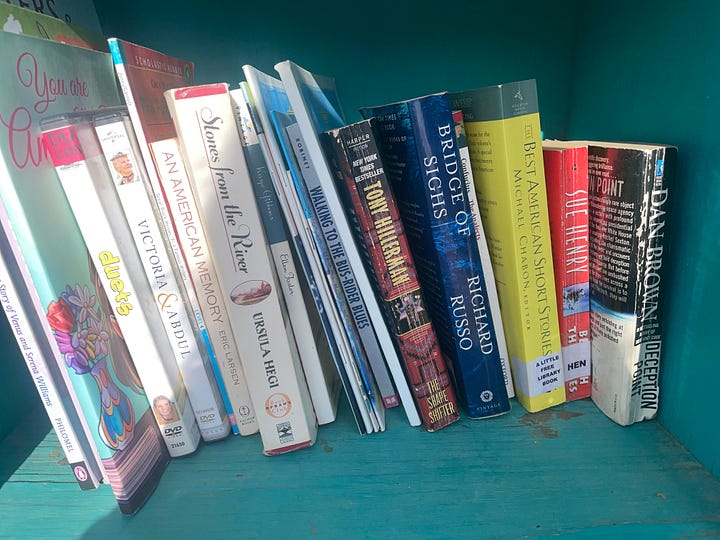
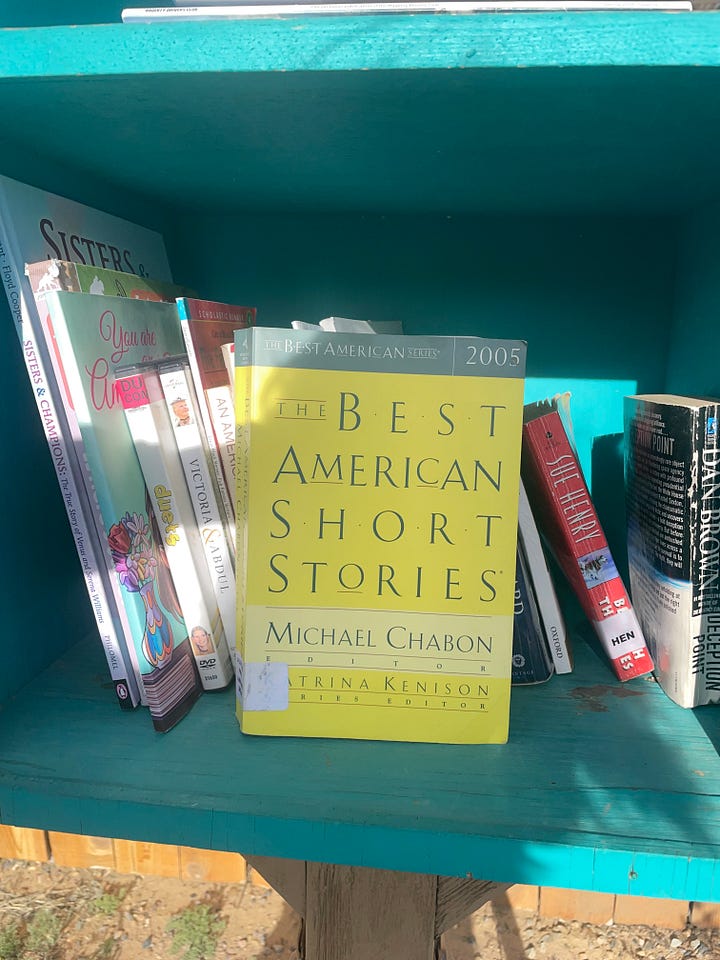
Inside were books like Stones from the River, by Ursula Hegi, Bridge of Sighs by Richard Russo, Best American Short Stories, chosen by Michael Chabon, Ellen Foster by Kaye Gibbons, and the Analects by Confucius. For mystery and thriller buffs, there was Deception Point by Dan Brown, and an appropriately Southwestern Tony Hillerman novel, The Shape Shifter.
For kids, there was a copy of one of my kids’ favorite Eric Carle illustrated board books, Brown Bear, Brown Bear, What Do You See? and Great Black Heroes: Five Famous Writers. To say I was bowled over would be an understatement. What a treasure trove in this isolated place!
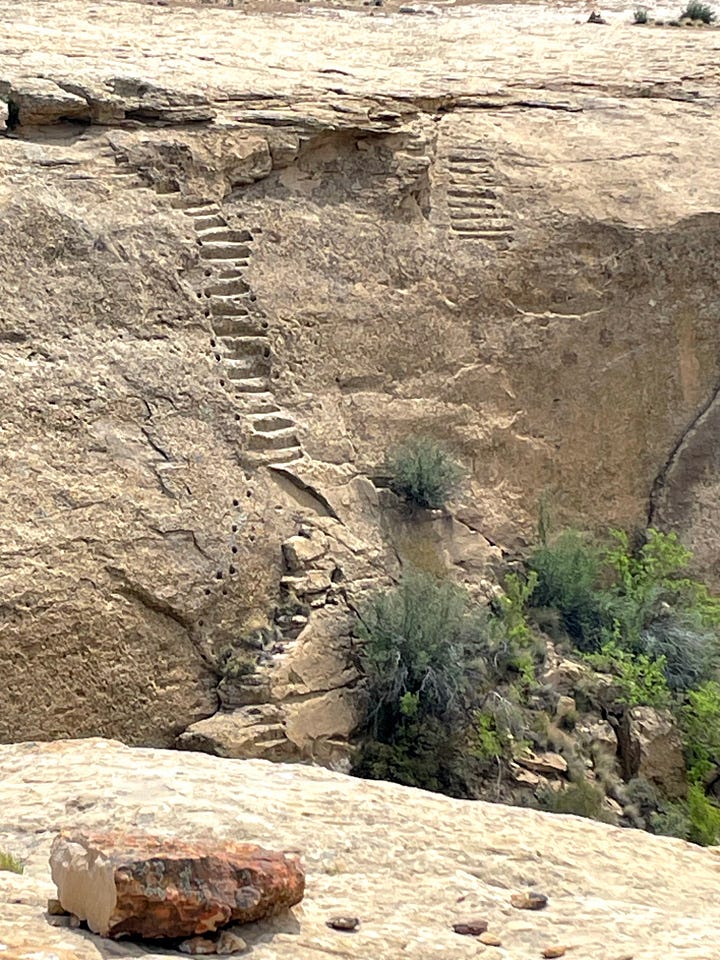
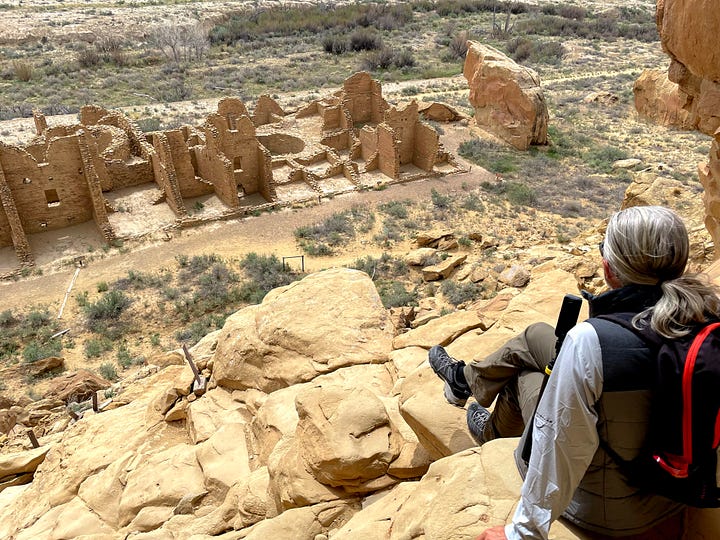
The next day, we hiked the six mile trail near Chetro Ketl up to the ridge of Pueblo Alto, New Alto, and around for a bird’s eye view of Pueblo Bonito, along with the vertigo-inducing Jackson Stairway (a ladder hewn into the cliffs that only Spiderman could actually clamber up and down).
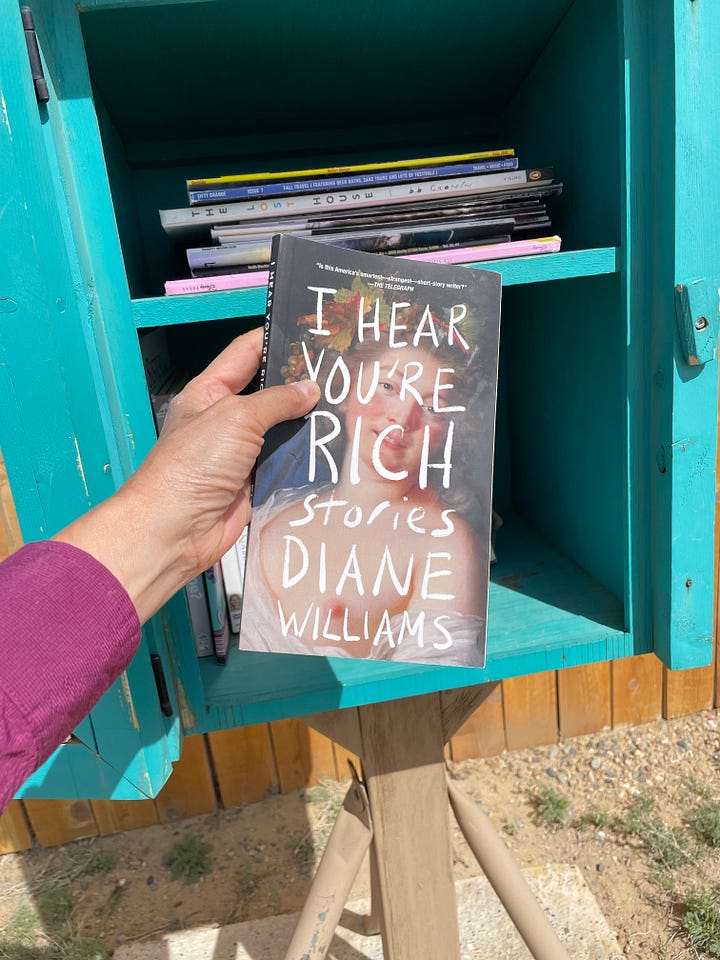
When we got back to our campsite, it was time to wind down with a good book. I had just finished the book of micro stories I had bought at the Terlingua Trading Post, a rare copy of Diane Williams titled, I Hear You’re Rich, so I donated it to the Little Turquoise Free Library and borrowed the BAP collection—stories for stories seemed like an even trade. That afternoon I read the first in the book, Tom Perotta’s howlingly funny, “The Smile on Happy Chang’s Face”, which tells the tale of the recently divorced Jack who’s the home plate umpire of the biggest little league game of the season between the Superior Wallpaper Wildcats and the Town Pizza Ravens.
Jack is a deeply flawed man whose cracks show through his relationships to everyone on the baseball field—the Wildcats coach Carl DiSalvo (who also happens to be Jack’s old high school classmate and his current next door neighbor), his fellow umpire, Tim Tolbert, and even his opinions of the young baseball players themselves, including the Wildcats star pitcher, Lori Chang, whose father, Happy Chang, increasingly takes up an inordinate amount of space in Jack’s thoughts.
The fact that Perotta can skewer his protagonist (who has lost his family due to his ugly reaction to his son being gay) and still make the reader feel his struggle is one of Perotta’s great gifts. The realization Jack has emerges amid the comedy and tragedy of the baseball game in such subtle way, like a slider that breaks over the plate before you can swing at it.
I played softball for years as a teen and I can tell you that Perotta knows the game inside and out. He’s got the personalities of the dad coaches, the young players, and even the spectators down to the smallest gestures. This is masterful storytelling in 20 compact pages from the author of several great novels, including Election (which was made into a movie starring Reese Witherspoon and Matthew Broderick), Little Children (also made into a movie with Kate Winslet and Patrick Wilson) and The Abstinence Teacher (high school sex education teacher Ruth Ramsey gets into a power struggle with the local evangelical church). Perotta is a writer who takes no prisoners, but can still show the humanity of his very very imperfect characters. Peter and I lost track of how many times we laughed out loud at Perotta’s zippy observations—he’s got the timing of a top tier stand-up comedian.
On our last morning in Chaco Canyon, we went to Pueblo Bonito, the place that had inspired our trip to Chaco in the first place. Wandering around that early morning, we were the only people on the trail and it was easy to imagine the grandeur of the place 1,000 years ago. We had never seen corner windows in any of the pueblo ruins we’d visited before, and to imagine the rectangles glowing with the rays of the summer solstice collapsed time and history as we imagined the Chacoan people gathering to mark the seasonal event.
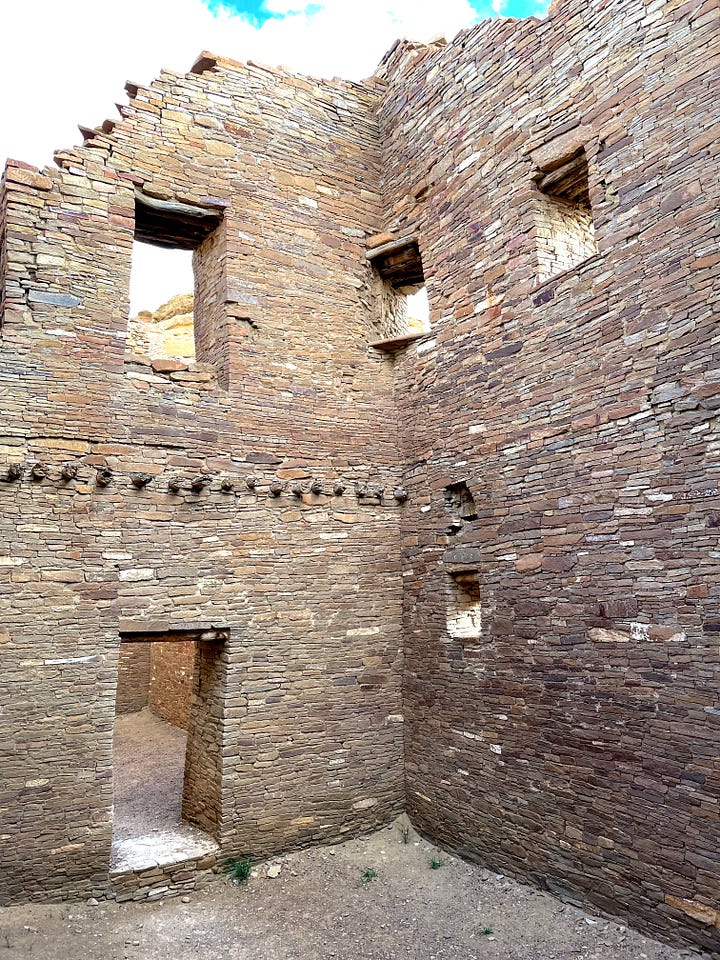
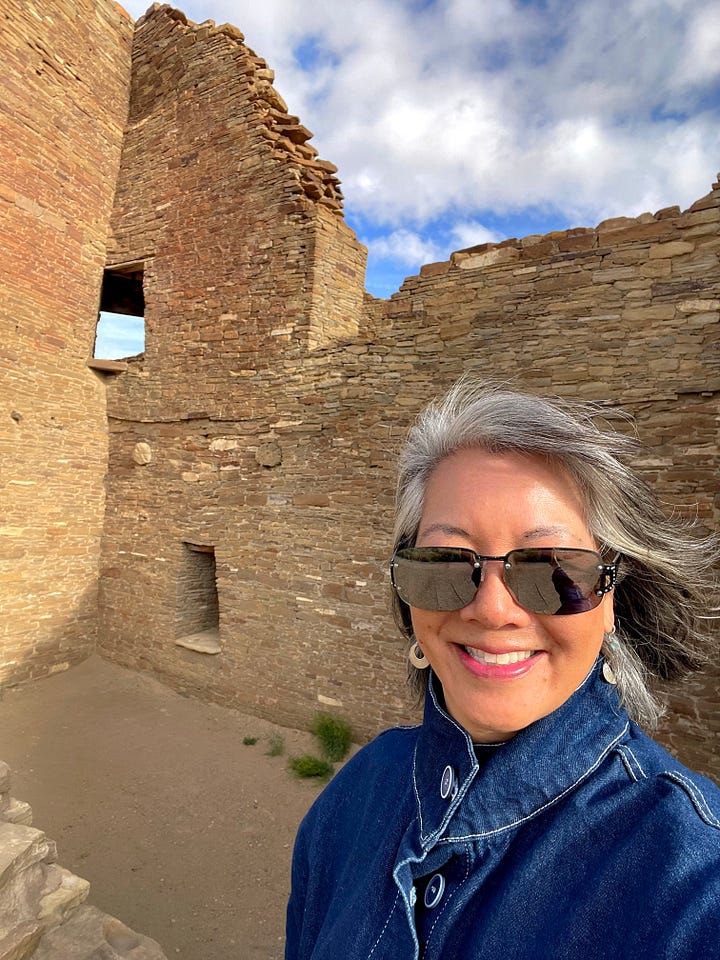
In my own neighborhood, we have a similar occurrence where a ray of light shines in a straight line between two Victorian Houses on Sanchez and 30th Streets on the afternoon of the summer solstice. People come to commemorate it every year, just like the people of Chaco Canyon must have at Pueblo Bonito.
Then it was time to bump our way to the next destination. Peter had asked for advice on driving the road at the Ranger Station and one woman lowered her voice and said, “Yeah, I just go 40 miles an hour except through the turns.” So that’s what Peter did. Our brains still rattled in our skulls, but at least we cut the driving time in half, haha.
So here’s to public gathering spaces, serendipitous events and going off script to explore a new territory. Here’s to Ancient Worlds and modern conveniences. Here’s to Park Interpreters telling stories of Nature’s Wonders. Here’s to exchanging ideas and stories and tips with those you meet along the way. Here’s to plans and being open to changing plans.
And here’s to Little Free Libraries where you least expect them. Proof that we humans are still trading stories amid the ruins of the beautiful and ancient Chacoan World.
If you enjoyed this Little Book House, please feel free to subscribe for free, upgrade to paid, share, or contribute to my li’l coffee fund. As always, thank you for reading and supporting my work—I love sharing my Little Free Library finds with you, even when it takes a bit more time to gather up the wherewithal to make it happen, haha.
Books mentioned in this post can be found at Bookshop.org: A Little Free Library in the Ancient World.
No posts
Comments
Nothing yet. Say the first thing.
Sign in to join the conversation.