
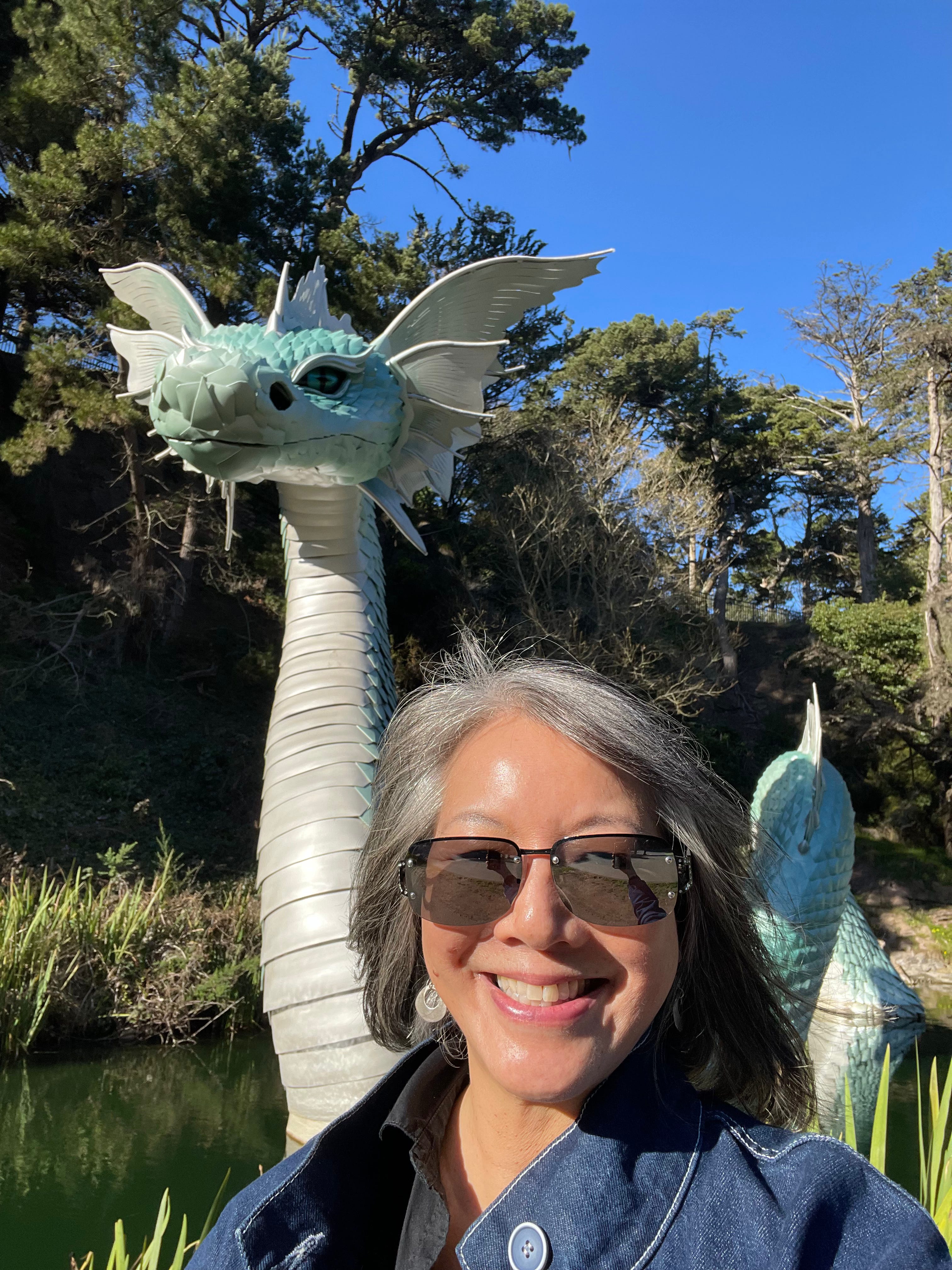
Happy Lunar New Year, everyone! Or as we say in Cantonese, “Gung Hay Fat Choy!” Let’s bid the Year of the Snake goodbye and welcome the Year of the Fire Horse!
I just published my first bonus stack about all the crazy critters I grew up with for my greatly appreciated readers with paid subscriptions, but I also wanted to write a Little Book House for everyone to enjoy—and luckily I have just the ticket!
In my November 18th LBH, A Painted Lady’s Little Free Library, I wrote about how going to see the Steiner Street Little Victorian Library helped me see my town with fresh eyes. Another great way to revitalize your connection to your home I’ve found is to show it to visitors—and I had the wonderful opportunity to do just that last month when my friend, Lisa Redfern and her husband Gary, came to stay with us for a few days, taking the train down from their home in Nevada City, CA to our home in SF.
Lisa and I met when she needed a cultural reader for her historical novel, Crossing: A Chinese Family Railroad Novel. I was excited to be a part of her editing process because there has been a lot of discussion around the concept of appropriation—what it is, who gets to tell certain stories and why, and how we can extend our imaginations as an exercise of feeling into, rather than adopting other people’s histories for personal or professional reasons.
These were questions I had when I met Lisa, and through our honest conversations about what can be a difficult topic, I feel like we furthered the understanding and evolution about how writing and literature can be used in the best, most compelling ways. I’ll be writing more about this topic (another bonus, perhaps!), but suffice to say, I know from our in-depth discussions, that Lisa’s process and her heart were in the right place—she took workshops about writing outside of one’s culture, received permission from a person within the culture to start the project, did six years of research (both academic and historical), and had many readers and editors vet her manuscript to make sure it was as accurate as possible.
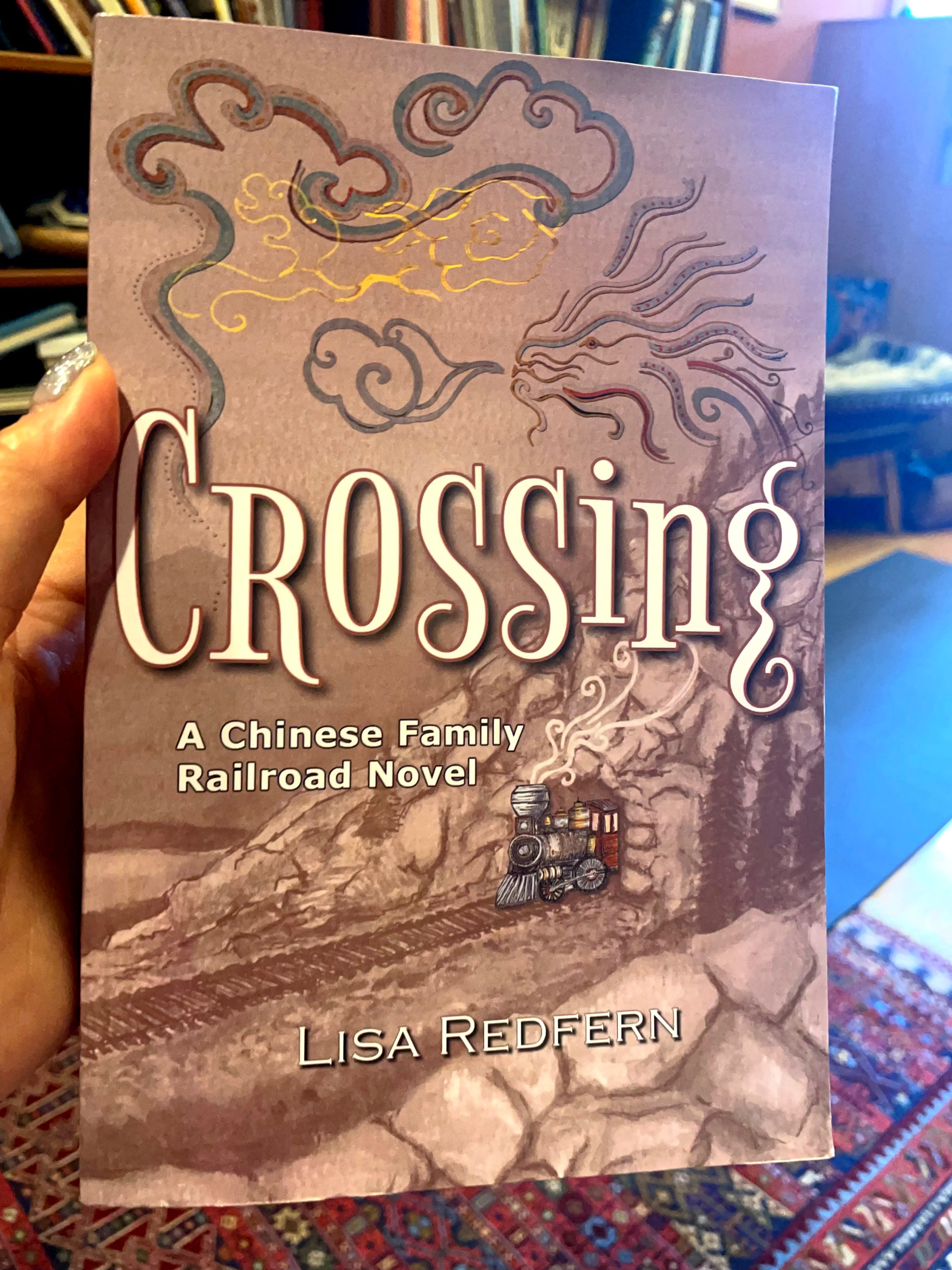
Additionally, she included a section to let the reader know about how things like Chinese names and historical newspaper articles were used in the text, as well as a bibliography of books and list of acknowledgements of the sources she consulted and the people who helped her understand the mountain of research she amassed. She even added a note about her scene-writing process and a list of the scenes that she invented—all in the name of transparency and accountability. The amount of due diligence Lisa did was exemplary, and I hope more authors of historical fiction will follow her lead in the future.
When we were working together, Lisa and I grappled with the question of writing and empathy. We both hoped that in writing a book about a place that she had lived in for many years, but about a part of history that was not widely known to folks currently living there, would be a mind and soul-expanding experience. We hoped that a book about the lived lives of two Chinese brothers who helped build our country’s railroads would not feel like something written from a place of authority, but more from a place of leaning into another person’s experience from a empathetic point of view.
Earlier, Lisa and Gary had invited me and Pete to go on a hike through the Donner Tunnels, the inspiration for Crossing. It was an amazing place—filled with old cables, blasting holes and other souvenirs of the 1800s, along with signs of more recent life—in this case, colorful graffiti. We got to see the amazing “China Wall”, a 75 foot expanse of granite that Chinese railroad workers built using the rock painstakingly dug out from the mountain to support the railroad tracks between Donner Tunnels #6 and #8. All without mortar!
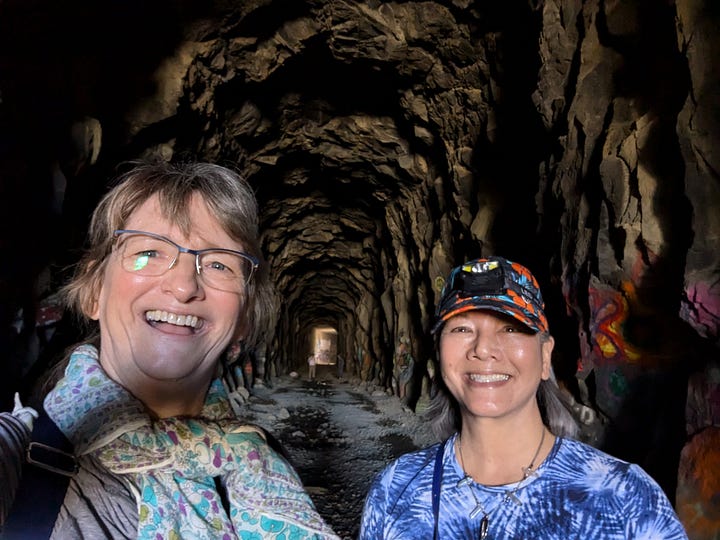
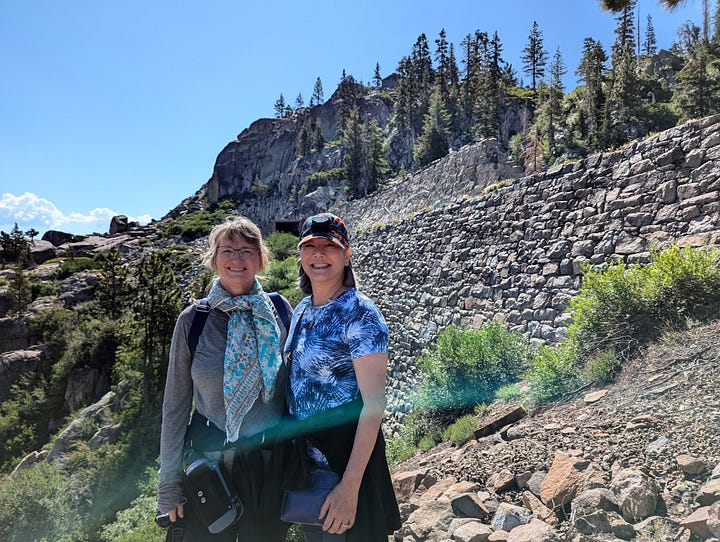
To feel the cool air of the tunnels in striking contrast to the piercingly hot sunlight in between them and to run our hands along the gouged-out rock of the mountains made us marvel at the determination of the generations of pioneers who built our country. Pretty much everyone was an immigrant then, and the Chinese contributed to our collective American History in a way that few would understand unless they visited the Donner Tunnels. Reading Crossing brought to vivid life the story about a very real time in our nation’s not-so-distant past.
So when Lisa and Gary came to visit us, it was the perfect opportunity to show off San Francisco and see how history had shaped our city as well. Since they hadn’t been to SF in a little while, we started off in Golden Gate Park, where the roads have been closed to cars, making it the perfect place to wander and take in the beauty of nature.
To see the park now, with its abundance of flora, it’s hard to imagine that back in the 1860s, the area was just 1,000+ acres of windswept sand dunes in an unincorporated area known as Outside Lands. Kind of like the old cartographer maps labeled “There Be Dragons!” on areas that hadn’t been charted yet.
So it was very fitting that the newest resident of Golden Gate Park is an actual dragon(!)—a water serpent named Naga swimming in the pond below Rainbow Falls on JFK Drive. Naga is a glorious, undulating dragon with a mischievous face and best of all—he blows bubbles!!! He’s a fun addition to our beautiful gem of a park and I want to go back to see him at night because he lights up from within.
After meeting Naga, we made our way west to the ocean to visit San Francisco’s newest park, the appropriately named Sunset Dunes. Appropriate because it is on the most Western edge of the city in the Sunset District, and it used to be The Great Highway, a thoroughfare that was frequently closed due to sand blowing over the road which prevented cars from driving on it. During the pandemic, it also became a Slow Street (closed to traffic) so people could use it for recreation when so many indoor places were unavailable. It became such a popular place for joggers, bikers, walkers, dogs, surfers, and kids that after much debate, the city made the change permanent, and christened the new park Sunset Dunes.
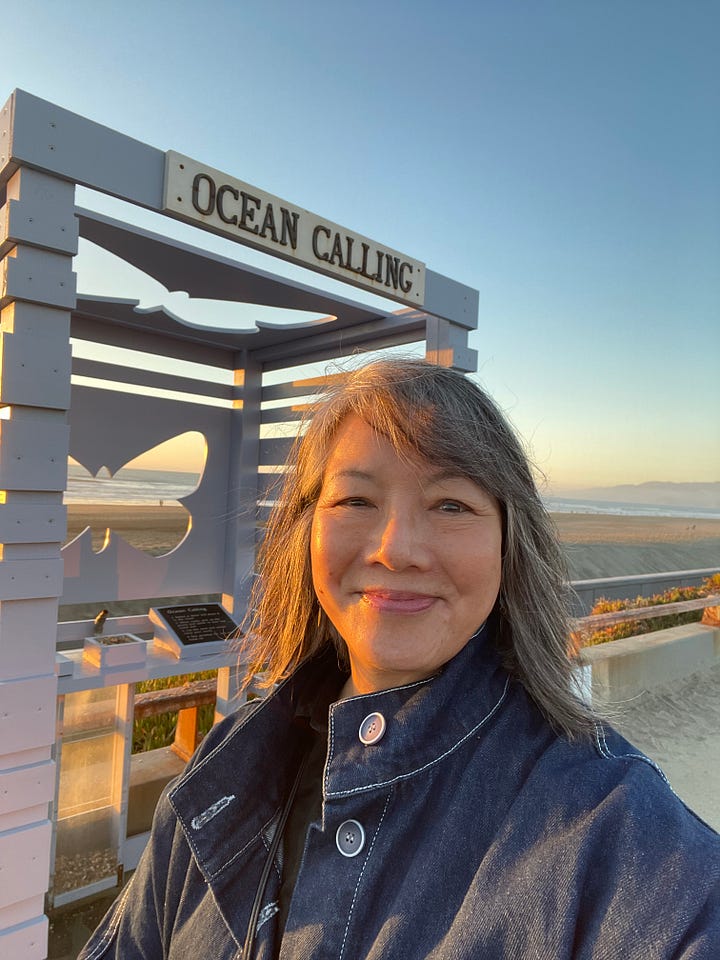
So our merry band of four joined the happy folks at Sunset Dunes to enjoy the mild weather (60 degrees in January!), revel in the ocean air and exchange life stories.
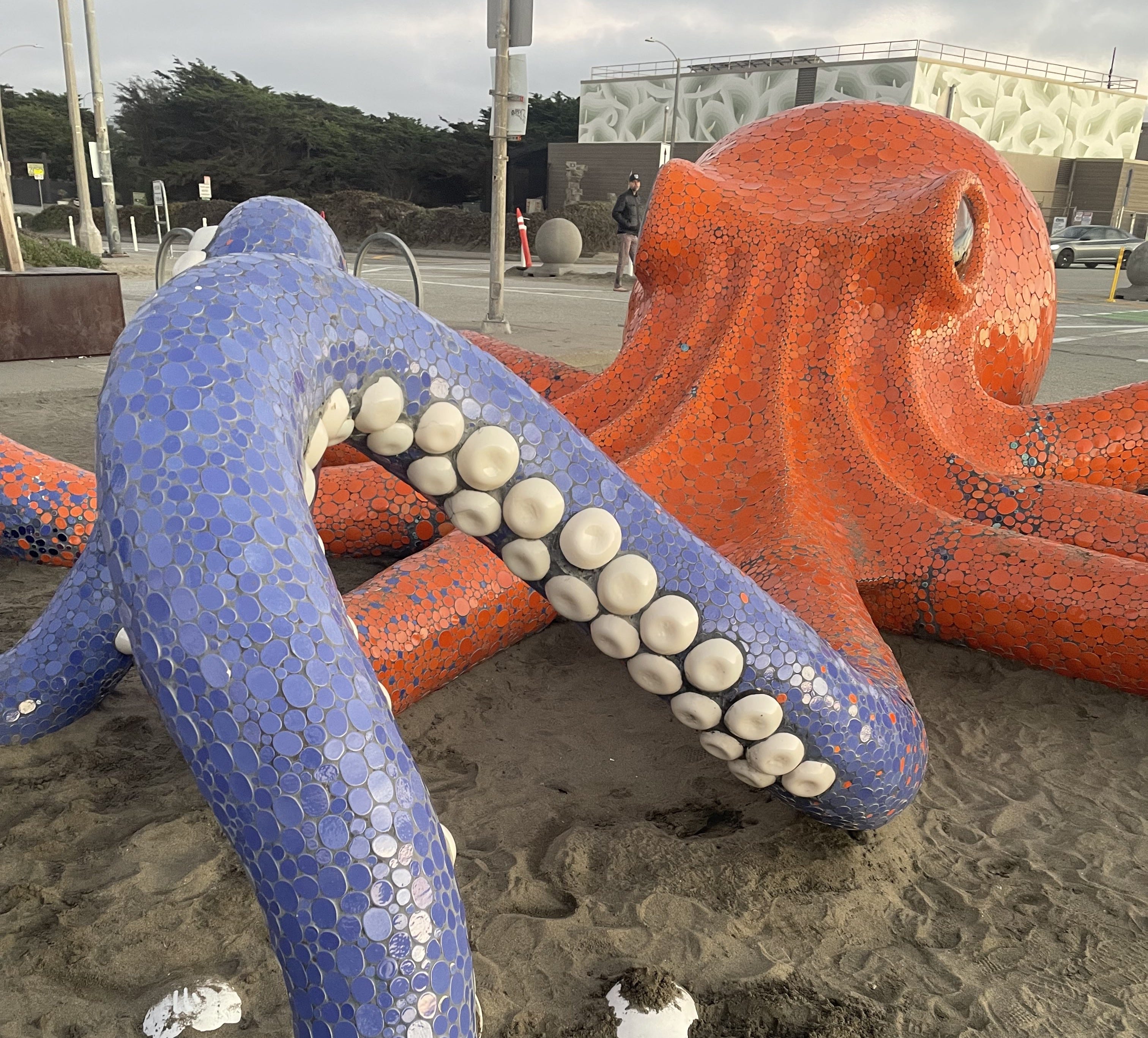
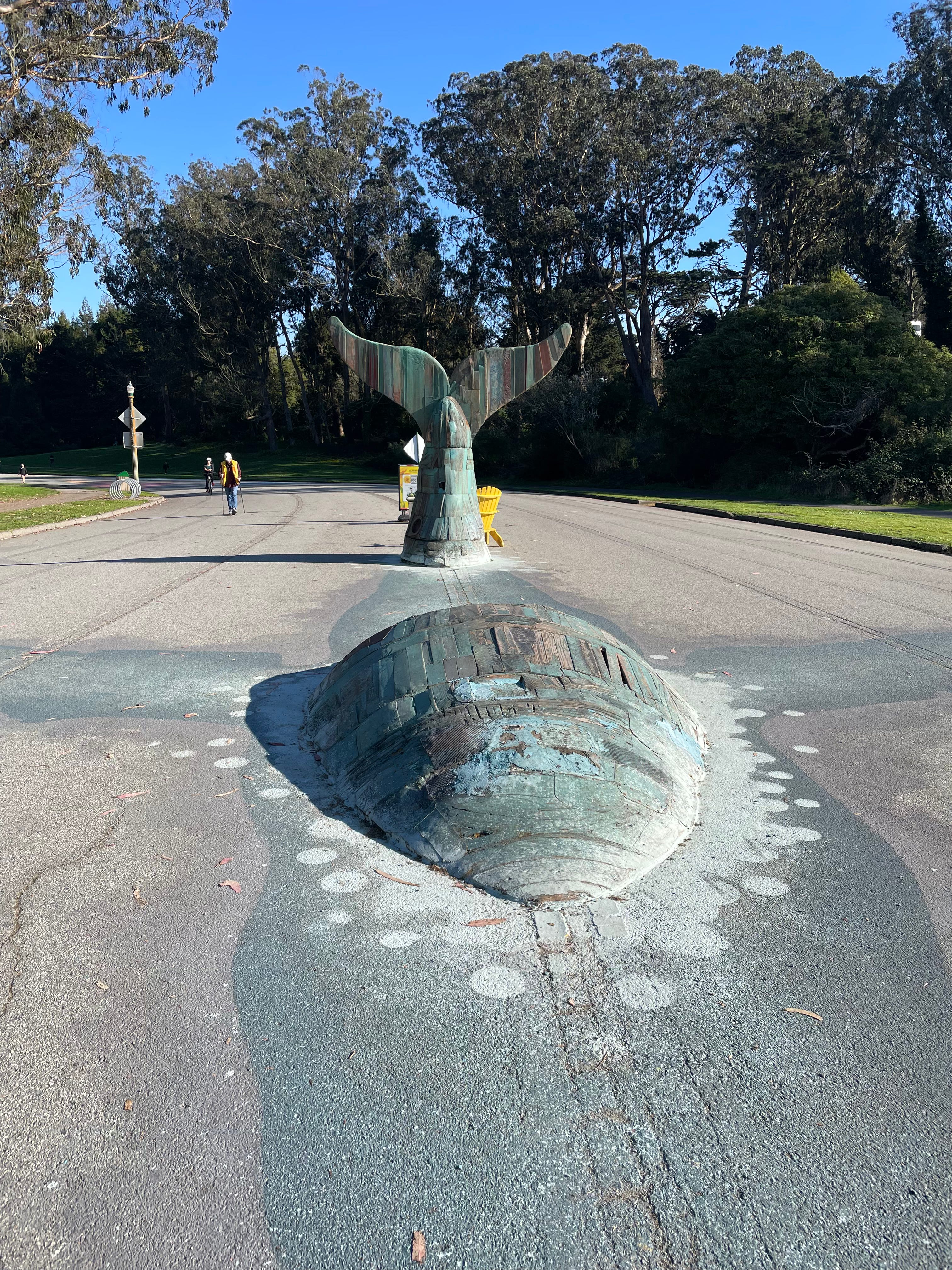
In addition to making more space for outdoor activity, Sunset Dunes has become a venue for public art. Just as Naga has taken up residence at Rainbow Falls, art and recreation areas have popped up all along the 3.5 mile pathway by the ocean. Murals of surfers, jellyfish, and iconic San Francisco scenes adorn the road, joining sculptures of a metallic heart, a giant stone, an octopus and a mama giraffe and her baby. There is also a skateboard park, and some twisty bike ramps in addition to the beautiful beach that makes it a perfect place for people of all ages.
If you need caffeine, there are lots of cafes and restaurants along the edges of Sunset Dunes, including the stalwart Java Beach where you can pop in for a coffee and a snack to fuel your walk.
As a big fan community spaces, I have to say that I love this new addition to our park system!
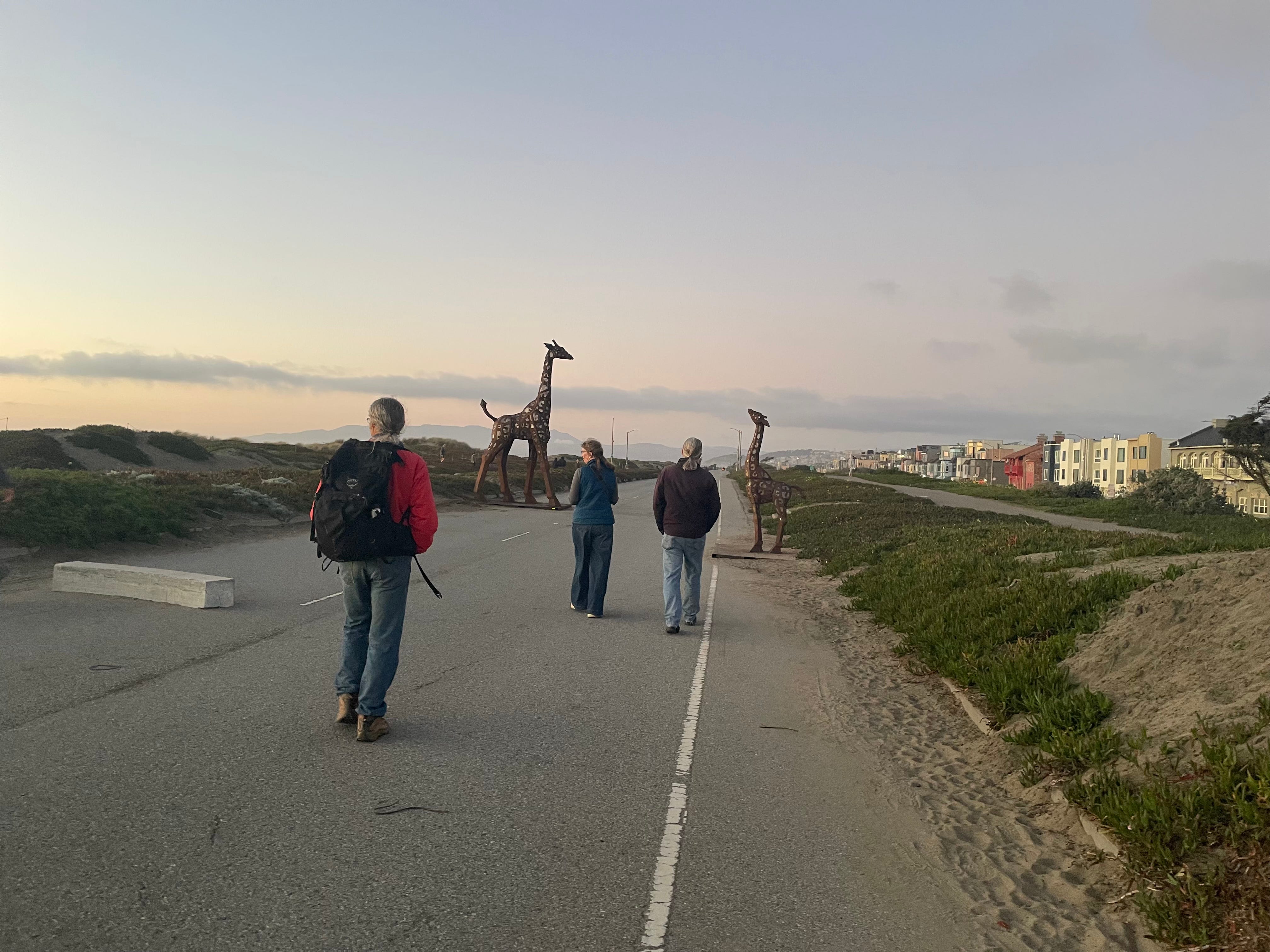
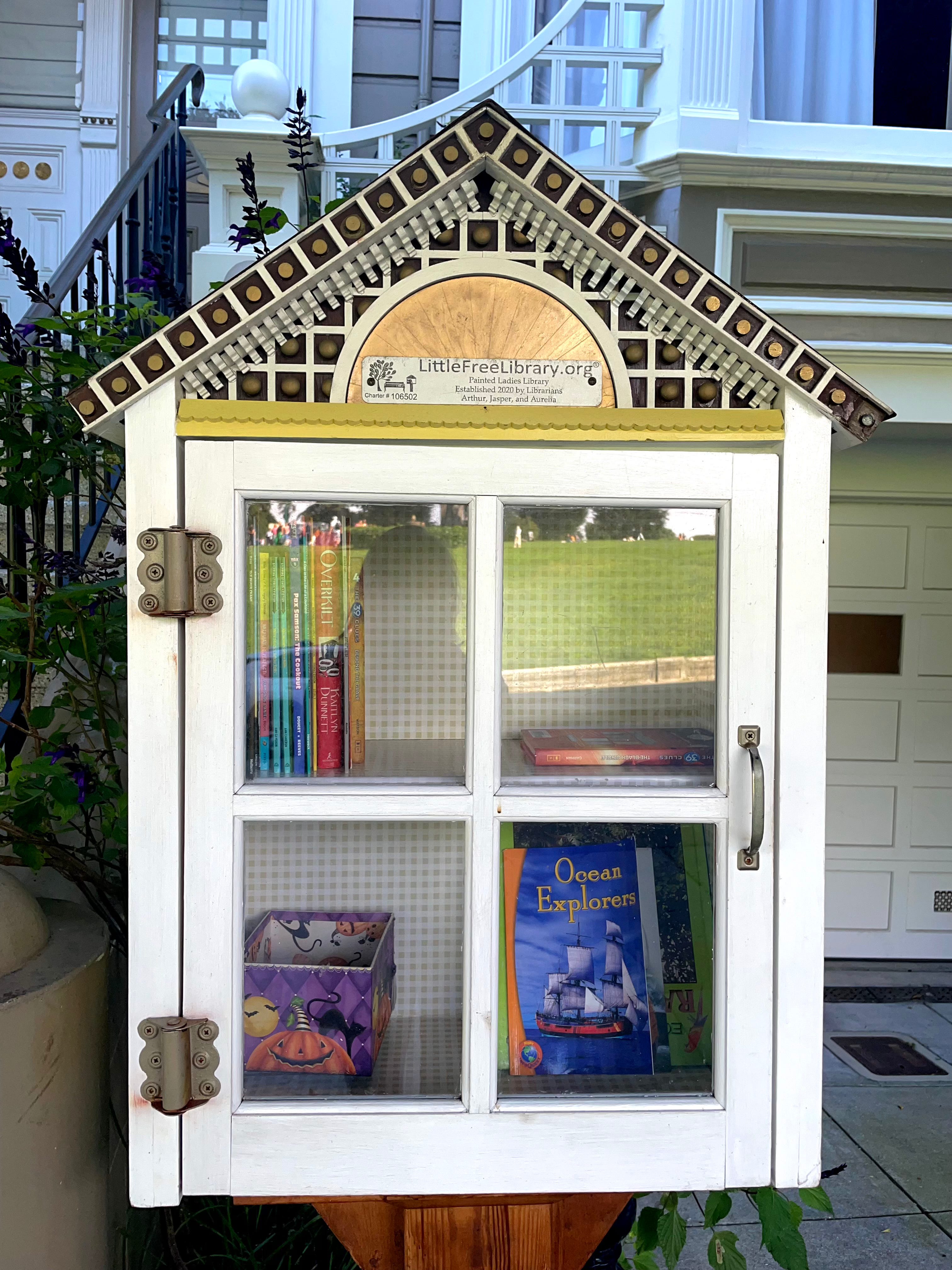
But what does any of this have to do with Little Free Libraries, you ask? Good question! As you know from past Little Book House outings, serendipity is my middle name—I’m always open to finding surprising things on my explorations—and of course, I was keeping my eyes peeled for any LFLs as we were rambling around the parks. And though it was getting dark as we were walking back to our car, I was still hoping to find a Little Free Library.
Luckily the good readers of the Outer Sunset didn’t disappoint!
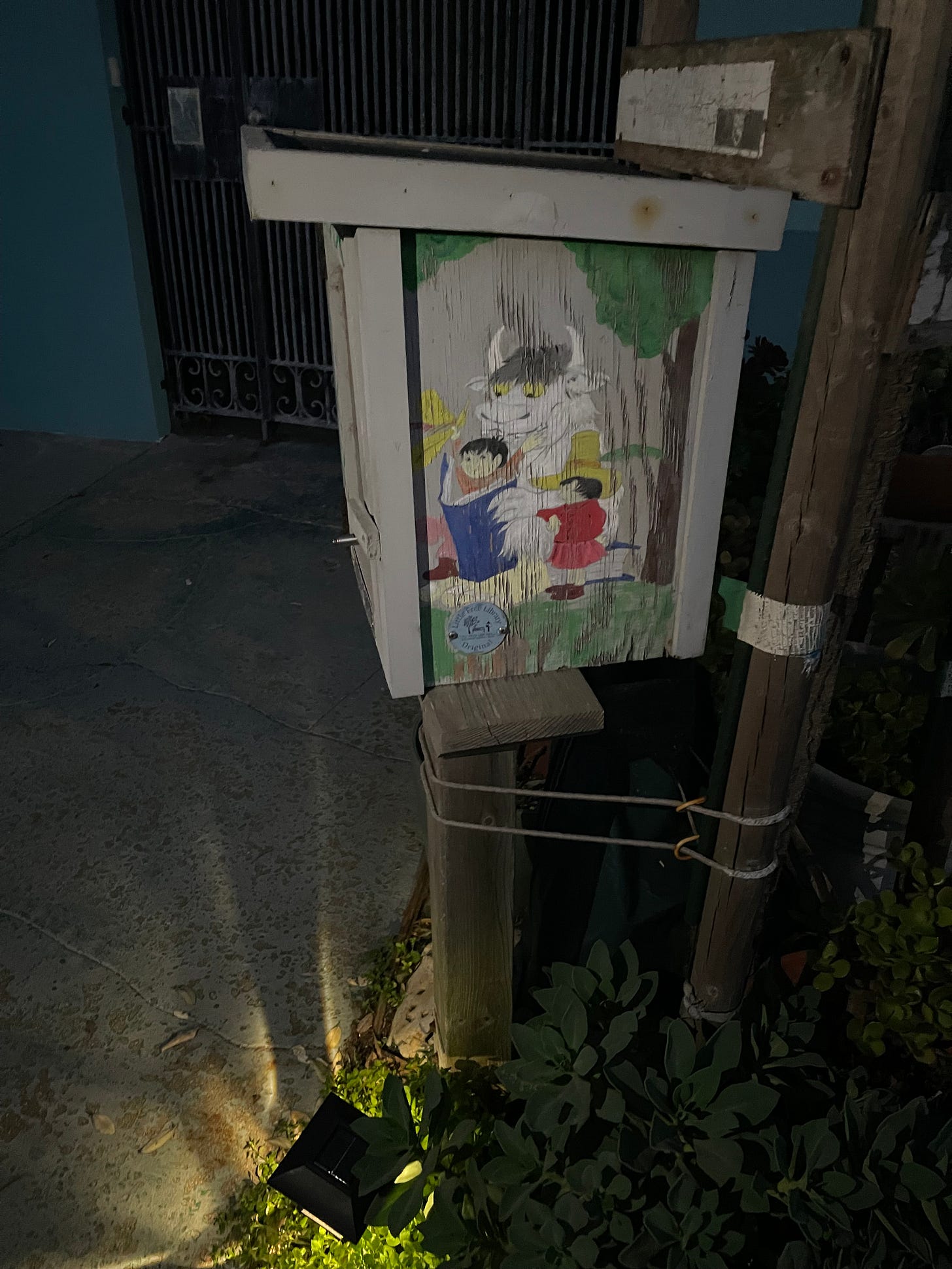
Illuminated by a light at the foot of the LFL was a darling book house decorated with illustrations from Maurice Sendak’s famous book, Where the Wild Things Are, which tells the story of a boy named Max, who, after being reprimanded for being too rowdy, goes off to find a place where rowdiness is not only acceptable, but welcomed—and finds it on an island inhabited by a bunch of fun monsters who make Max their king.
As we had just spent the day discovering dragons and other beasties, this little free library seemed like the perfect wrap-up to our outing.
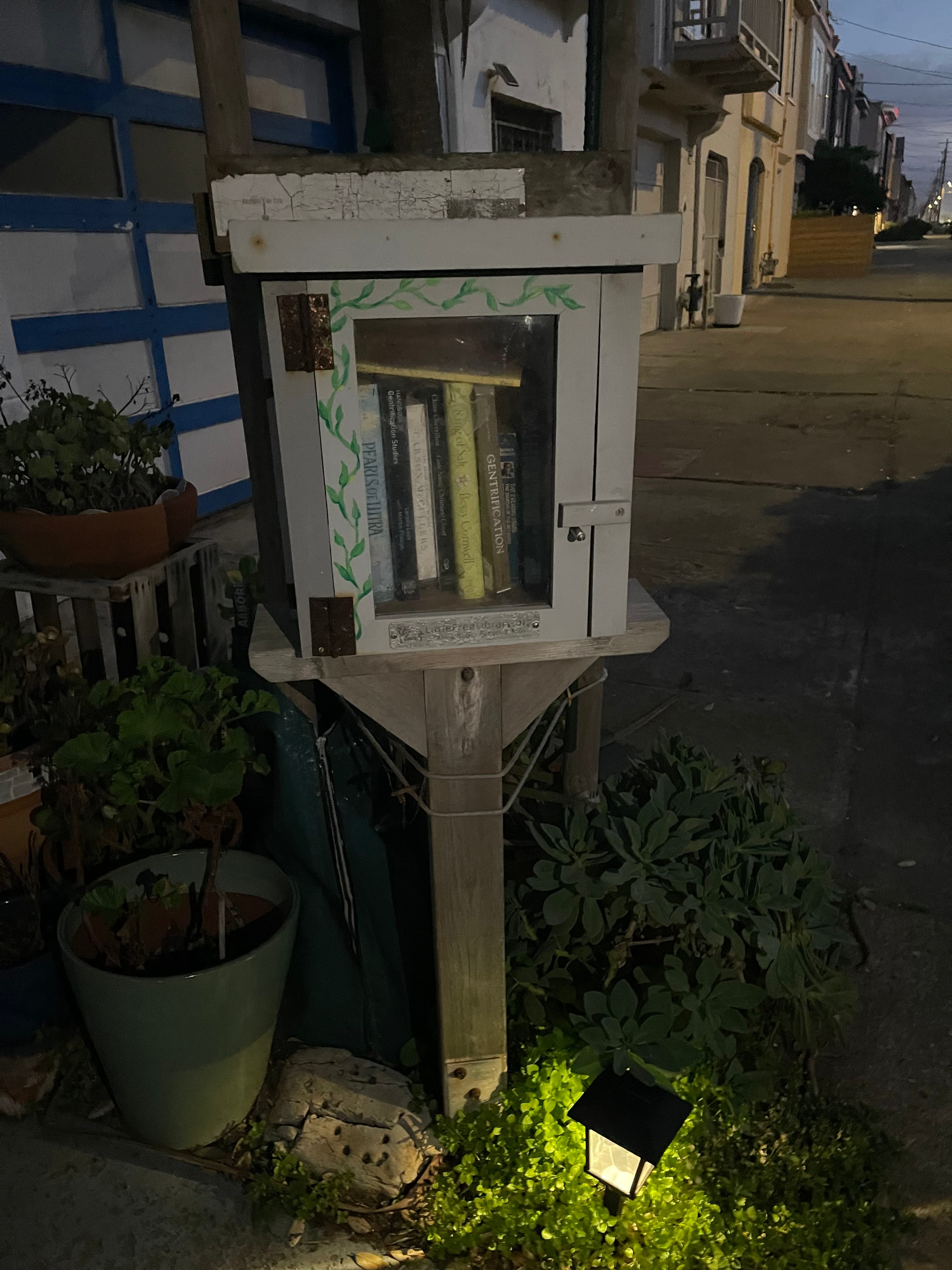
My pictures aren’t the best because we had lost the sun, but that made it all the more magical in person, like something out of a dream.
Inside the Wild Things Little Free Library were titles like Ring of Salt: A Memoir of Finding Home and Hope on the Wild Coast of Ireland by Betsy Cornwell, The Evening Stars: The Making of the Network New Anchor, by Barbara Matuso (out of print), Pearls of Lutra: A Tale of Redwall, by Brian Jacques, The Search for Joyful by Benedict and Nancy Freedman, and The Heart is a Lonely Hunter by the great Carson McCullers.
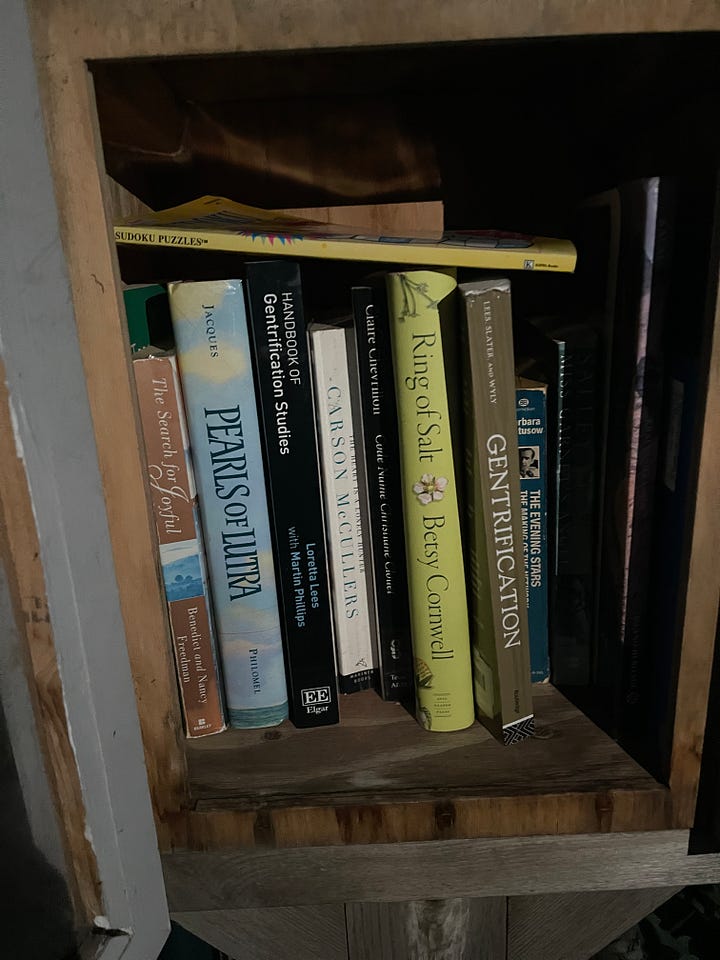
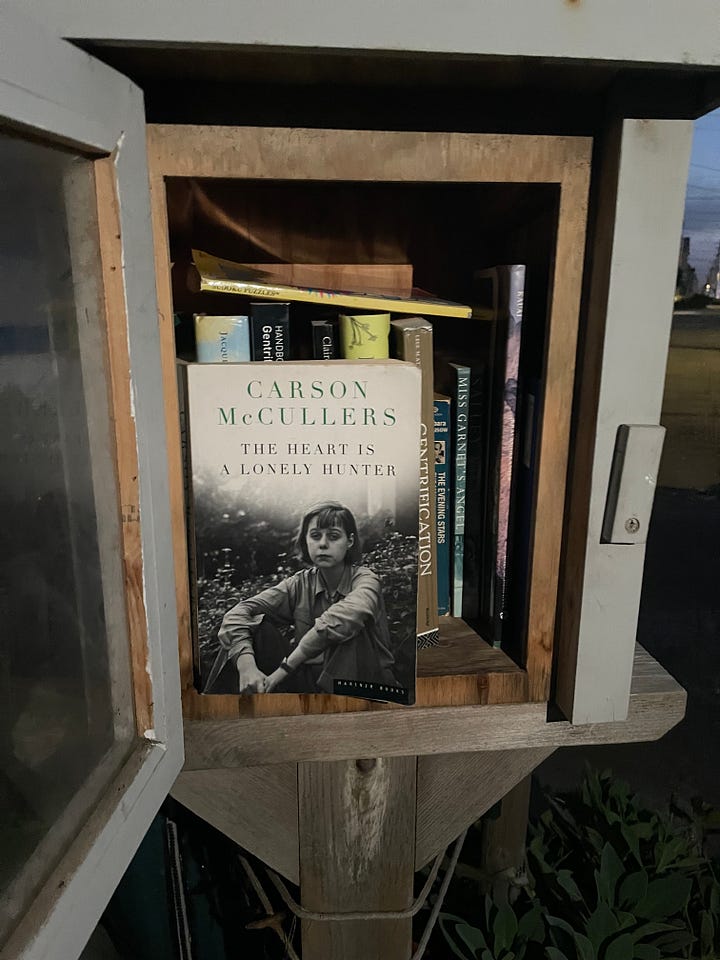
These books—a memoir by a young woman who flees a painful past, finds herself in an abusive marriage, then tries to make a life for herself and her son by deciding to buy an abandoned knitting factory on the coast of Connemara, a nonfiction book about the rise of network news personalities, a fantasy set in a kingdom inhabited by animals, a historical fiction about an orphaned Native American woman who decides to go to nursing school in Canada (and discovers her lost heritage along the way), and McCuller’s classic novel about John Singer, a deaf mute living in the South—seemed to cover a vast span of human experience, each one rich with emotion and pathos, a reckoning with life’s unpredictability.
It was funny since we’d spent most of the day encountering creatures of a more fantastical nature, but thinking about Lisa’s book about two brothers immigrating from China to California and the harsh lessons of life that they encountered there, along with the books in the Little Free Library, I suspect that many of the authors (including Maurice Sendak and Carson McCullers) knew that humans might just be the wildest animals of all.
It had been a full day in the best sense. Each book, each encounter with something or someone outside of our own experience was an opportunity to tune into and feel what it might be like to be that other—and in doing so, make a connection to a bigger part of ourselves.
The people who built the railroads opened the way to the west just as the people who built Golden Gate Park out of three miles of sand dunes created one of the crown jewels of San Francisco, and the folks who designated Sunset Dunes as a new park were continuing the evolution of my beloved city.
By then we had walked almost 8 miles through Golden Gate Park and Sunset Dunes—and we had covered a much larger distance in time, traveling into the history of San Francisco and back to the present day!
I was definitely ready to go home and rest!
Thank you for reading this episode of Little Book House. Next time will find us in The Land of Enchantment—in more ways than one!
Until then, Happy Reading!
If you enjoyed this Little Book House, please feel to subscribe for free, upgrade to paid, share, or contribute to my li’l coffee fund! Thanks for supporting my work—I truly appreciate you.
Thanks for reading Little Book House! This post is public so feel free to share it.
Books mentioned in this post can be found at Bookshop.org: Creatures and Books in Sunset Dunes.
No posts
Comments
Nothing yet. Say the first thing.
Sign in to join the conversation.