
Welcome to our weekly column offering perspectives on lit mag publishing, with contributions from readers, writers and editors around the world.
If you’ve submitted to literary journals before, you’ve likely seen them: paid critique offerings that promise editorial feedback on your work. These offerings vary widely in price, and their guidelines aren’t always equally detailed. Curious about this quiet corner of short-form publishing, I started asking some fellow writers whether they had ever tried one of these services—and interestingly, none had.
There is an obvious appeal in receiving feedback from a journal you admire, especially if you’re hoping to publish there. Insights directly from their editorial board—one that likely accepts only a small fraction of what it receives—on what could improve your story would understandably have high value. The problem is that, with many of these services, it isn’t always clear what exactly writers are paying for.
In this article, I examine ten literary journals that offer feedback services on short-form prose, representing a range of publications. A few also offer critique options for poetry and longer manuscripts, which I note in a chart later on, but here I focus mainly on short stories. To answer the question of how transparent these offerings are, I apply seven criteria to each journal and compare the results in a table. Then, I’ll end with a checklist of questions writers may find useful to ask before paying for any critique service.
Full disclosure: I run a short-form critique service myself at Fiction on the Web, which is part of what got me curious about how these offerings are presented elsewhere—and how transparent we could all stand to be about them. However, I’ve kept my own service out of the comparison itself to focus on the ten journals above.
To compare the ten critique offerings, I looked at each journal’s critique service through the same set of transparency questions: who is providing the feedback, what the writer receives, how extensive that feedback is, whether turnaround time is stated, whether editor qualifications are given, whether publication consideration is affected, and whether a sample critique or follow-up option is available. In other words, I was less interested in price than in how clearly each journal explains what a writer is actually buying.
This distinction matters because two services can cost roughly the same and still be very different in practice. One may offer a named editor, a specific number of pages, a stated turnaround window, and a clear description of the feedback format; another may simply promise “valuable” or “detailed” critique without much further detail. For writers trying to decide whether a service is worth paying for, that difference in clarity is nearly as important as the price itself.
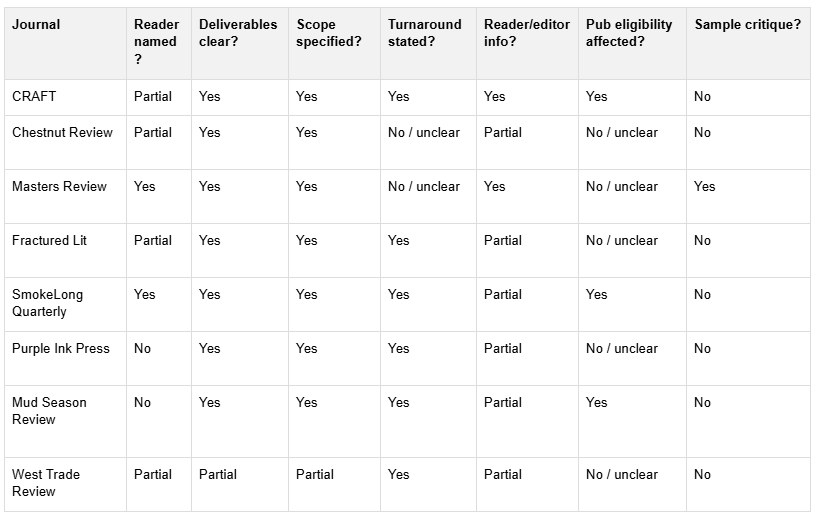

The following are some brief notes I’ve compiled based on my findings in the table.
● CRAFT clearly states the feedback format, turnaround window, and the fact that work critiqued is not eligible for future contests, making its service relatively transparent.
● Chestnut Review identifies both feedback options and the general nature of the response, though some details are less explicit.
● Masters Review is especially clear about what the writer receives, including a sample editorial letter, which makes the service easy to evaluate.
● Fractured Lit gives a solid sense of the feedback offered and the timeframe, though the reader/editor setup is less fully described.
● SmokeLong Quarterly is among the most specific, distinguishing between different critique options and noting both turnaround and publication implications.
● Purple Ink Press is clear about deliverables, length, and response time, especially for manuscript-level feedback.
● Mud Season Review spells out both the feedback length and turnaround, and also makes the publication distinction explicit.
● West Trade Review is comparatively lighter on detail, though it does state the response time and the existence of feedback.
● Tahoma Literary Review is straightforward about length, cost, and timeline, and also explains the distinction between critique and publication submission.
● The Carrier Bag gives a decent sense of what the writer receives, though some of the operational details are less developed.
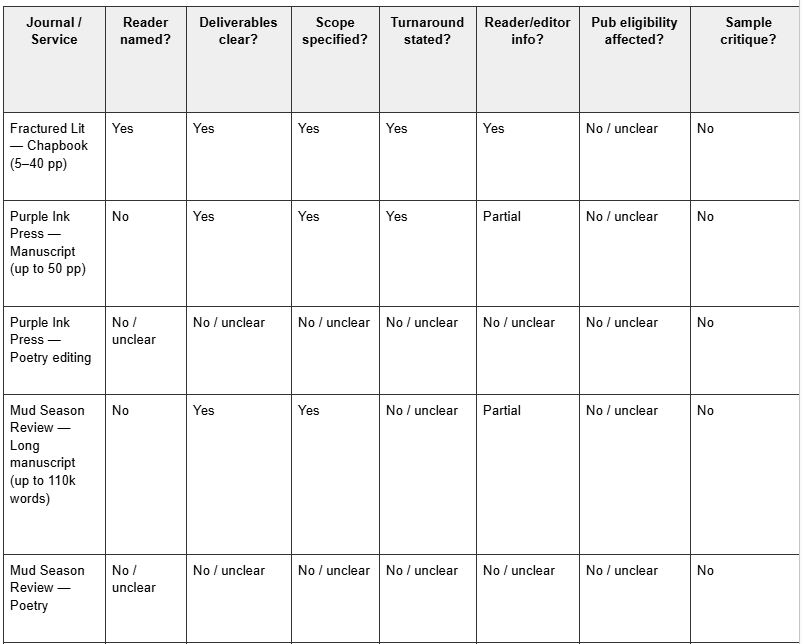
A handful of these same journals also offer feedback on poetry or longer manuscript-length work, which I’ve broken into a second table below, where I applied the same seven criteria. You might notice that the results look somewhat different; several of these offerings are mentioned only in passing, as an add-on to a more developed short-form prose service, without the same detail spelled out.


With all this in mind, here’s a short list of questions worth asking before paying for any critique service, whether that’s short-form prose, poetry, or a full manuscript.
Who will be reading my work? Are the readers or editors identified or described?
Are the people offering feedback the magazine’s editors, readers, guest editors, or freelancers? If names aren’t provided, does the journal explain who these readers are or what experience they bring? Knowing who’s behind the critique can give you a better sense of the perspective you’re paying for.
What exactly will I receive in return for my payment?
Some services promise an editorial letter, others provide in-manuscript comments, and some offer both. Does the journal clearly explain what form the feedback takes, or is it described only in broad terms like “detailed critique” or “valuable feedback”?
Is the feedback global, line-level, or both?
Not every critique aims to do the same thing. Some focus on big-picture elements like structure, pacing, and characterization; others spend more time at the sentence level. Knowing the emphasis beforehand can help you decide whether the service matches what you’re looking for.
How much feedback should I expect?
Some journals specify a page count or estimated length for their editorial letters—others simply promise feedback. Even an approximate sense of scope can help you understand what level of detail to expect before purchasing.
Is turnaround time clearly stated?
If you’re hoping to revise a story within a certain period or before a submission deadline, or if you simply want feedback within a certain timeframe, knowing when it’ll arrive matters. A clearly stated turnaround can also suggest that the service has an established workflow, whereas a more open-ended timeline may mean the service operates with less predictability.
Is there a sample critique or example available?
A sample critique is one of the easiest and clearest ways to understand what you’re buying. It gives writers a concrete sense of tone, depth, and style that descriptions alone often can’t provide.
Does paying for feedback affect my eligibility for publication?
Some journals welcome future submissions after providing a critique, while others separate critique services from contests or publication opportunities. This is especially important if you’re hoping to submit that story to the same journal later; knowing the policy in advance can help you avoid accidentally making a piece ineligible.
Is there any opportunity to ask follow-up questions?
A written critique may raise new questions once you’ve had time to sit with it. Some services allow a brief follow-up conversation or email exchange, whereas others consider the critique the final deliverable.
Does the service clearly explain what it does and does not cover?
A good service both describes what it offers and sets expectations. If the scope, limitations, or goals of the critique are clearly explained from the outset, you’ll have a much better sense of whether it’s the right fit for your needs.
My hope is that you can use these questions the next time you come across a feedback service you’re thinking of submitting to, and that it’ll make the decision clearer. Still, a chart can only tell you so much; the real test of any of these services is what actually lands in your inbox. Someday, it’d be fun to send the same story out to a handful of these critique services myself and compare what actually comes back—perhaps that’s a piece for another time.
Have you ever paid for a critique service through a literary journal? I’d love to hear what your experience was like!
Comments
Nothing yet. Say the first thing.
Sign in to join the conversation.