
When people hear that I read over 100 books a year, their first question is inevitably “How do you read that many books?” followed by some variation of “Do you even remember what you read?”
I’m now several years into my reading journey, and I finally have a system that works for me. Hot girls don’t gatekeep, so today I’m giving you the insider scoop with several tips to make reading a sustainable, intentional hobby in your life.
It’s a little different from my usual content, but I think it’s important to reflect on how we read!
P.S. If you’re looking to keep up with me outside of Substack, you can find me on Bookstagram or Goodreads!
I think the most important part is setting yourself up for success. Organizing your reading looks a little different for everyone, and I went through several iterations before I landed on something that works best for me. My digital book tracker of choice is Goodreads, which is admittedly not my favourite, but the best option available to me. StoryGraph is a great alternative, but I routinely run into issues with missing books (sadly, importing my Goodreads library was a bust), and I have trouble with the user interface. Pick the tool that works best for you!
Regardless of the tool you pick, you also need a system. While mine seems a little chaotic, it’s worked great for me for the last 2+ years. I’ll start with my exclusive shelves on Goodreads (I’m sure other tools allow for a similar structure):
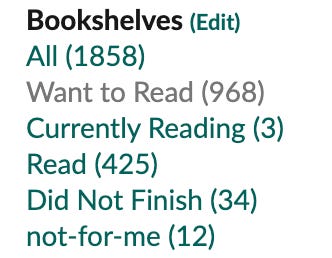
Every book belongs to one (and only one) of these shelves: either I want to read it, I am currently reading it, or I’ve read it. The books I have read a considerable part of but can’t bear to finish go on my ‘Did Not Finish’ shelf, and the books I quit early on are shelved as ‘not for me’.
From there, the books get an assortment of tags:
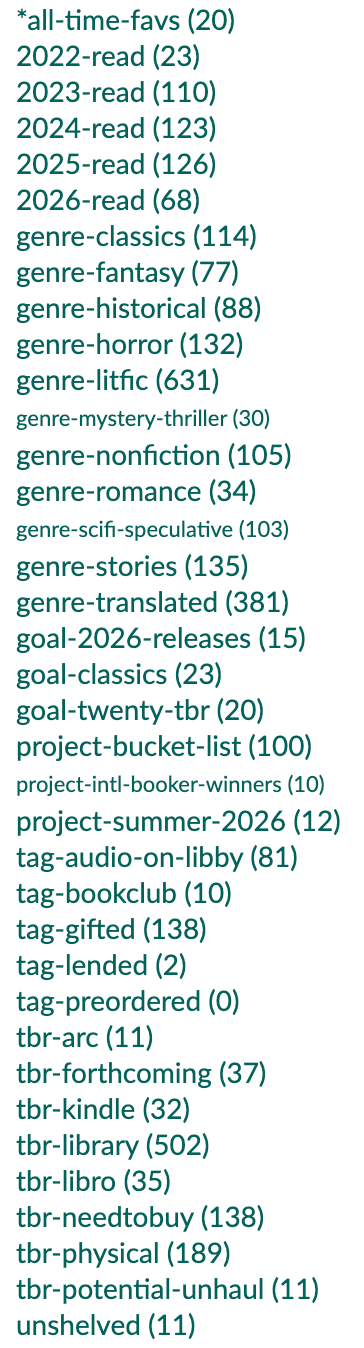
Genre is straightforward — and yes, I recognize that neither translated literature nor short stories are genres, but this is the easiest way for me to categorize them. If a book straddles multiple genres, I add it to both shelves.
Goals correspond to my annual reading intentions, which I’ll go through in the next section!
Projects are my longer-term, informal TBRs. For example, my Bucket List Challenge (100 books I want to read before I die) gets its own shelf, alongside all of the International Booker Prize winners (which I’m slowly working through).
Tags track characteristics of books that I don’t want to forget; for example, if I have preordered the book, if I’ve received it for free from the publisher, if the audiobook is available at my library, etc.
My TBR is organized by how I intend to read the book. ARCs and titles I have on Libro.fm get their own separate shelves (so I try not to forget about them), and otherwise the books are sorted by whether they’re available at my library or owned in some capacity. I also separate forthcoming releases, since the release dates can get a bit confusing (especially for translated titles and/or titles with different release dates in different places).
‘Unshelved’ is my secret to staying organized. When I discover a new book I want to read, it defaults to unshelved until I have time to add the necessary shelves. I find it much easier to let my unshelved titles grow a little, and then organize them in bulk.
Of course, there are infinite variations you can use to customize your reading system. The important part is that you keep track of the info that’s most relevant to you and that the system integrates into your reading habits without much thought.
I used to set an arbitrary number of books I wanted to read each year, and realized this was causing me to race through titles and not appreciate what I was reading. I focused on shorter titles — since the more books, the better — and tied my hobby to a productivity metric that ultimately made everything feel like a chore.
I’ve found much more success in setting qualitative intentions for my reading year. For example, in 2026, I have the following:
I’m not super fussed about the exact titles in each goal — but broadly speaking, I want to prioritize books that have languished on my TBR for too long, discover classics from around the world, and challenge myself to read bigger books. So far, so good. It’s always a balance of accountability, broadening our literary horizons, and keeping reading interesting.
I’m a mood reader through and through. I set general TBRs, but I give myself the flexibility to pick up the book that calls to me in that specific moment. That way, I’m reading what I want, when I want.
I’m also not afraid to mark books as a DNF (‘did not finish’). Life is too short to read books you don’t like; if you set a book down, nothing is stopping you from revisiting it later. Sometimes it’s the wrong book for the season of life we’re in, and other times it’s a book that doesn’t work for us. There’s no shame in trying a book and knowing when to call it quits!
The last thing, and arguably the most important, is making reading time intentional. Read when you want to read — yes, it’s a great substitute for doomscrolling aimlessly on your phone, but we also don’t need to feel obligated to read in every pocket of free time we have. During longer commutes, I like audiobooks, but otherwise, I’m not the type of reader to take a book with me everywhere. And that’s okay!
I get my best reading done when I curl up with a fun beverage (iced coffee, Diet Coke, or a beer, preferably) and have a solid chunk of time to read without interruption. I use the free Foqos app (not sponsored) to block all my social media apps because I tend to pick up my phone and distract myself. Maybe you’re more disciplined than I, but I’ve found a system like this to be a game changer!
You’ll also see plenty of aesthetic, annotated books all over social media — and while I think annotating is great, I don’t think every book requires it. I typically have a pencil beside me to underline passages or quotes I particularly enjoy, but I only heavily annotate books upon re-reading. Either way, critically engaging with the text goes a long way in committing the events to memory and ensuring that you’re giving the book your undivided attention.
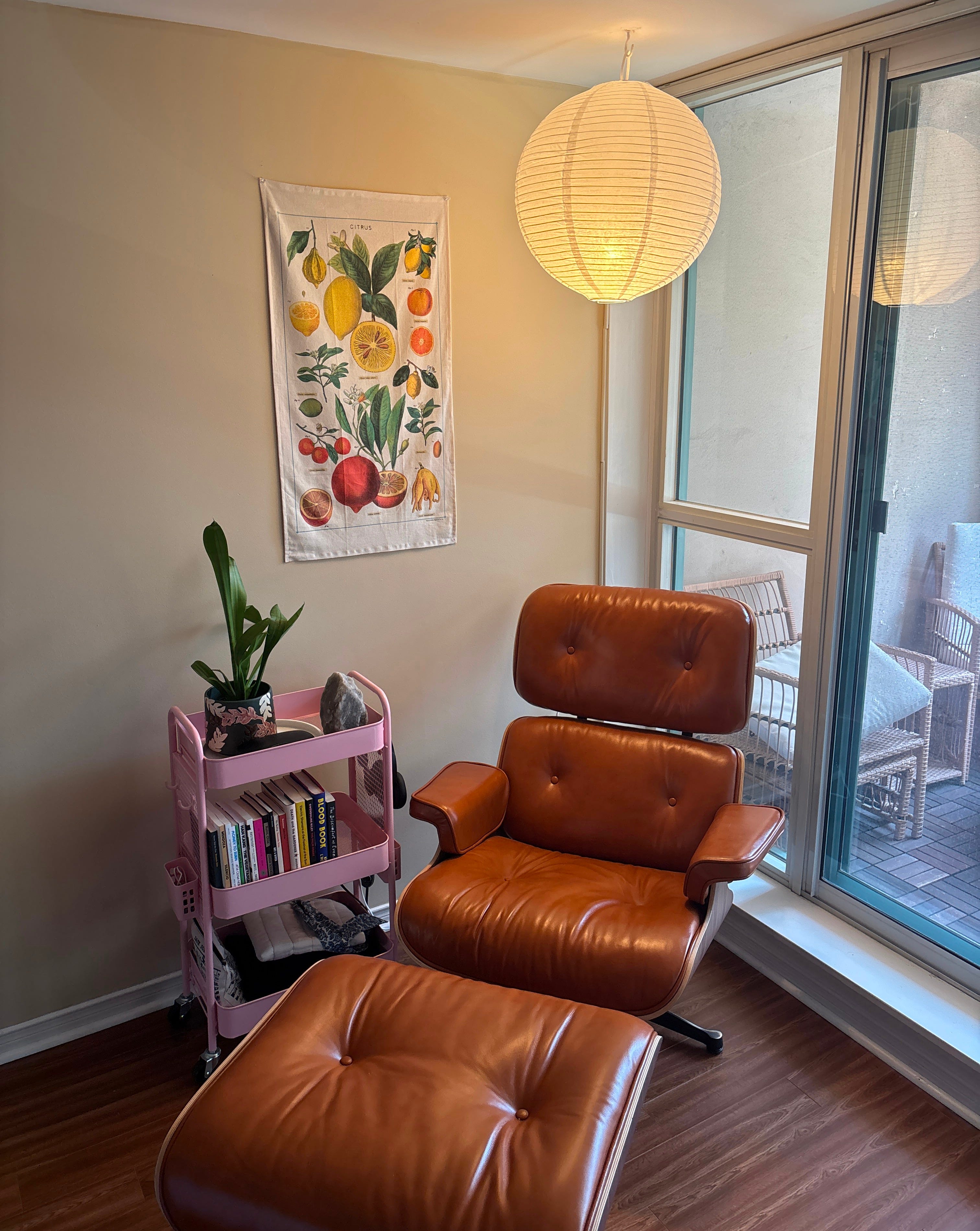
Lastly, get yourself a nice little reading corner. It doesn’t need to be fancy!
I review every book I read. This is in part because I create content, but also because I want to immortalize the time I spent with each book. Reviews are my way of sorting out my thoughts, reflecting on key themes, and understanding who I am as a reader. Reviews don’t need to be formal or beautifully articulate — but writing even a few sentences about a book within a day of finishing it can help us synthesize our thoughts and reflect on what we did or didn’t like.
Creating content on Substack and Instagram has also helped immensely in reflecting on what I read. When I’m drafting a list of book recommendations tied to a particular theme, I have to think critically about what books I view as the ‘best’ in this particular niche. Usually, the first couple of titles come to mind immediately, but I also spend time sifting through my previously read books and their reviews. This helps me recall important quotes or scenes that have been etched into my memory.
I think the hallmark of a good book is one with staying power: we don’t need to remember every bit of it, but we should remember how it made us feel. The more I talk about certain books, the more I remember and appreciate them.
My TBR is always evolving to reflect my current tastes. It’s okay for our tastes to change and for us to deviate from genres or authors we previously found joy in. It can take a while to find your footing as a reader and discover exactly what you like; embrace the trial and error, get out of your comfort zone, and unashamedly read what you like!
To curate my TBR, I find the following helpful:
Routinely unhaul books: Every few months, I scan my bookshelves and get rid of any titles (read or unread) that no longer appeal to me. These books deserve a better home, and there’s no point in them collecting dust on my shelves. Ideally, if I picked a random book from my library as my next read, it would be something I’m still passionate about and excited to read. It’s okay for us to correct past mistakes (e.g., hauling books for the sake of it) — don’t fall victim to the sunk-cost fallacy.
Avoiding FOMO: Social media is constantly inundating us with book recommendations (yes, I recognize this is largely what my page does), but it’s important to know when to tune certain recommendations out. For example, Yesteryear has been everywhere over the last few months, and it’s always enticing to join the discourse. I know my reading tastes well enough to recognize that I’m not interested in the book (which is not a criticism of the book or author). I don’t need to read every popular title solely because I’m a content creator.
Prioritize creators and publishers I’ve had success with: I’m always scanning Edelweiss and publisher catalogues for upcoming titles, and again, there’s information overload. When I’m adding books to my TBR, I try to prioritize authors and publishers I’ve had success with in the past. Similarly, not all book recommendations are equal — if there’s a creator or publisher I’ve found success with in the past, I try to prioritize those titles. That doesn’t mean I can’t enjoy everyone’s content or don’t trust their recommendations; it’s just a matter of prioritizing what we want to read so that the list is (hopefully) not completely daunting.
How do you make reading a sustainable hobby in your life? I’m all ears!
No posts
Comments
Nothing yet. Say the first thing.
Sign in to join the conversation.