
I read a lot of books in July. Probably the most I’ve read in a single month in ages. Unfortunately, there were more hits than misses, but we press on!
From January to June, I gave three books a rating of 1 or 1.5 stars. In July alone, I gave three books a one-star rating. I hope to never come close to this record again.
I really strive to avoid giving books a one-star rating, as I think it should only be reserved for a select few titles in the hall of shame. It brings me no joy to dislike a book so heavily. But who am I if not honest? So here I am, giving you reviews for the 18 books I tackled this month.
To be clear: there were some really pleasant surprises this month as well, so it all works out! I got plenty of novellas off my TBR (many of which had been there for years) so I’ll consider that a win.
I also bring exciting news: I recently hit 30,000 followers on my Bookstagram, which is a milestone I honestly never thought I’d hit. Y’all are the best! Combine that with turning 30 on August 14th (gulp), and 30 is feeling like a lucky number.
It only seems fair that I discount paid subscriptions by 30% (my biggest discount yet) until the end of August — you’ll get exclusive posts with book recommendations, reading guides, information about new releases, and plenty of other goodies every month!

Money to Burn by Asta Olivia Nordenhof, translated by Caroline Waigh
A bleak portrait of poverty and late-stage capitalism that shows how it slowly erodes our relationships. I especially liked the generational aspect, where we see how Maggie treats her daughter like a doppelganger — one who is afforded economic mobility and the privileges she never had access to — yet also acknowledges her daughter is still never far removed from the inherent violence and discrimination that women face. A short but compelling novella I’d recommend for Women in Translation month!
Rating: 4 stars
At Night All Blood is Black by David Diop, translated by Anna Moschovakis
A worthy winner of the International Booker Prize from my perspective. I seldom gravitate towards books about war, yet Diop constructs such a haunting atmosphere that I was immediately pulled in. A book about brotherhood, who we deem expendable in warfare, and the sometimes arbitrary ways in which we label some violence as justifiable yet some worthy of condemnation. Leaves a lot to think about (especially that ending) despite a short page count.
Rating: 4 stars
Look at the Lights, My Love by Annie Ernaux, translated by Alison L. Strayer
I read Exteriors by Annie Ernaux last month, which was unfortunately a rare miss for me. Thankfully, this was the quintessential Ernaux that I know and love. She dissects something so ordinary — the supermarket — and dissects its evolution, role in eroding a sense of community, and its portrayal of late-stage capitalism. It’s the type of anthropological commentary that seems asinine on the surface, but is written with such precision that you can’t help but appreciate it.
Rating 3.5 stars
Not a River by Selva Almada, translated by Annie McDermott
A novella that really should have been a full-fledged novel, in my opinion. Almada introduces a variety of interesting plot arcs that don’t have enough time and space to really come together. In isolation, there are some compelling themes of grief and masculinity, but they never quite converge beyond the most overt, fleeting connections. The imagery of the river and the secrets beneath its surface are interesting, but not enough to salvage a very linear narrative. A fine book, but ultimately not one I find particularly memorable.
Rating 3 stars

The Wounded Age and Eastern Tales by Ferit Edgü, translated by Aron Aji
I always appreciate New York Review Books for unearthing classics that are otherwise overlooked. This collection brings together two thematically related novelettes about refugees experiencing displacement and upheaval, written by a Turkish author, Ferit Edgü.
This would have benefited immensely from an introduction that provided the reader with appropriate historical and cultural context. I picked this up on a whim and enjoyed The Wounded Age (which is reminiscent of Minor Detail), but Eastern Tales went almost entirely over my head. A rare miss from NYRB for me.
Rating: 2 stars
The Rooftop by Fernanda Trías, translated by Annie McDermott
I enjoyed Pink Slime by Trías (which is apparently a hot take), and this felt like an excellent companion piece to it. Both of her books focus on women in claustrophobic, paranoia-inducing situations, and that’s exactly the type of ‘horror’ that works perfectly for me.
The Rooftop invokes a sense of foreboding and dread from the very first page. We follow a young mother tending to her young child and her sick father, with only the rooftop’s building emerging as a place of refuge. It culminates in a shocking ending that was equal parts expected and unexpected.
Rating: 4 stars
The Good Eye: Stories by Jess Gibson
A thinly veiled exercise in showcasing the author's writing prowess. The stories are stilted—often ending incredibly abruptly—and repeatedly left me scratching my head, wondering what they were trying to say. There's no sense of cohesion or throughline to the collection, and most of the stories are only a dozen pages at most.
I was wondering how this was published with such a heavy marketing push and massive praise from so many prolific authors… and then I learned Jess Gibson is Margaret Atwood’s daughter, and it all makes a little more sense now. I won’t say the success of this book is entirely tied to nepotism, but the cover is virtually the only thing I liked about it.
Rating: 1.5 stars
The Singularity by Dino Buzzati, translated by Anne Milano Appel
A book about technological singularity, the point in time where artificial intelligence outpaces humanity and wreaks havoc on us all. That will probably never happen, right?
This was written in 1960 and mirrors our current technological landscape a little too closely. It's dreamy and almost fable-like, exposing the hubris of man and the consequences of science conducted without the appropriate checks and balances. Billions of dollars were spent in the name of scientific progress, yet somehow none of that went into ethics or regulation, apparently! A little too prescient if you ask me, but I digress!
Rating: 4 stars
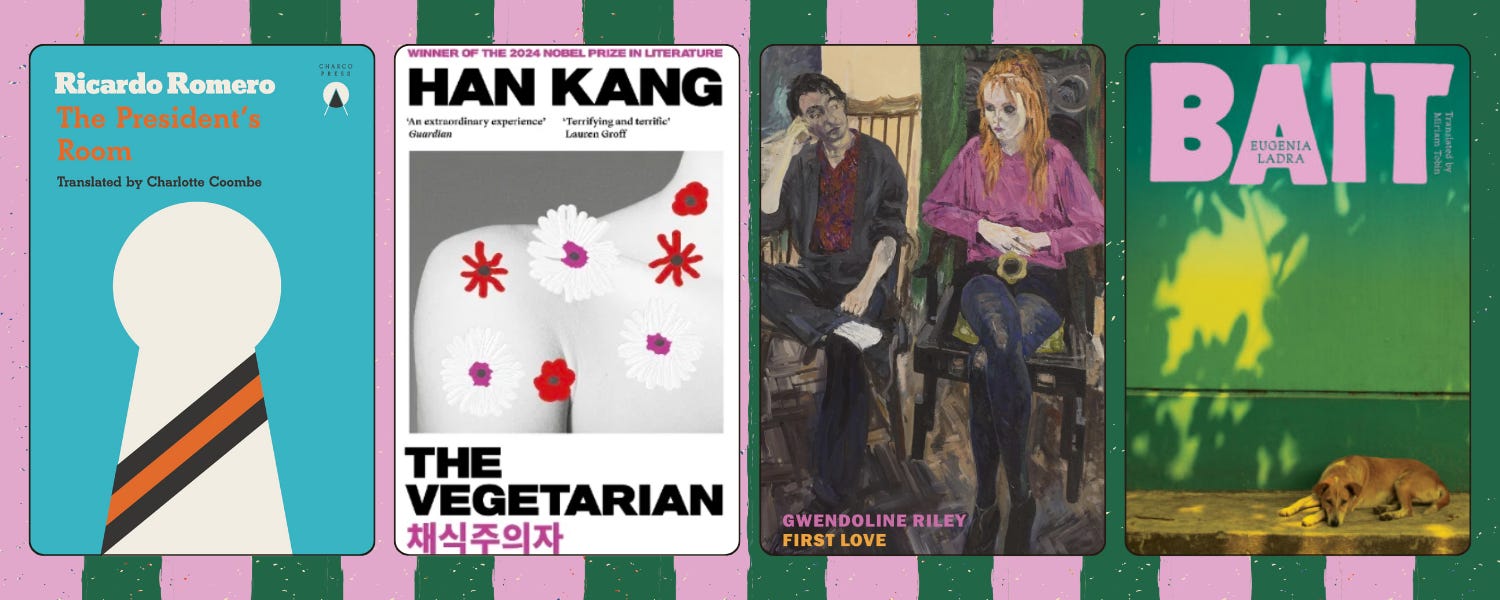
The President’s Room by Ricardo Romero, translated by Charlotte Coombe
A society where houses have a room allocated to the President on the off-chance he visits, and the room is stocked with essentials ranging from a loaded revolver to familial souvenirs. The purpose of these rooms, whether or not they're actually used, and why everyone so readily agrees to them is never explored. Is the president tyrannical or benevolent? Are the people blindly following whatever orders they receive?
There's nothing to suggest one conclusion over the other, though we get loose suggestions that the President himself is not particularly beloved. I liked where this was trying to go, but ultimately too short and ambiguous to have any staying power.
Rating: 2.5 stars
The Vegetarian by Han Kang, translated by Deborah Smith
Another International Booker Prize winner that I’ve knocked off my TBR, and yes — I am ashamed it took me so long to read this. Given how widely read this book is, I’m not sure I have much to say that hasn’t been said already.
The three-part narrative structure is excellent, and the deliberate choice to frame every section from everyone except the protagonist helps emphasize her lack of autonomy. I don’t think it’s Han Kang’s best work from a technical perspective (We Do Not Part is superb), but it’s hard to deny the cultural impact of this book. A very solid book, but not a new all-time favourite.
Rating: 3.5 stars
First Love by Gwendoline Riley
I often finish low-rated books with an understanding of why they're generally unpopular, even if I may have enjoyed them. In this case — I am honestly not sure why this is sitting below a 3.3 on Goodreads. It’s superb, and reminded me a lot of Katie Kitamura (one of my favourite authors).
First Love is a portrait of a dysfunctional, abusive marriage that psychoanalyzes each half of the couple and gives the reader plenty to mull over. There’s no justifying the violence and abuse that Neve suffers, yet eventually you realize her husband’s scathing remarks do have some validity to them. It’s even more haunting when Riley traces through generations and highlights how women like Neve can find themselves recreating the unhealthy environment they grew up in — seldom a conscious choice — but rather one rooted in familiarity and unresolved trauma.
Rating: 4.5 stars (favourite book of the month)
Bait by Eugenia Ladra, translated by Miriam Tobin
For what it’s worth, I do think we throw around the label of ‘plotless’ a little too freely these days. But in the case of Bait, I think it’s a justified descriptor; virtually nothing happens in this book, and I’m left scratching my head wondering what the point was.
If you asked me what this book was about, I’d struggle to come up with any coherent summary. It’s about a stranger spontaneously appearing in a remote village, whose hazy days are only broken by the annual circus. It’s certainly an atmospheric book that reads well in the summer, and the writing is strong, but it’s also just undeniably…plain.
Rating: 3 stars
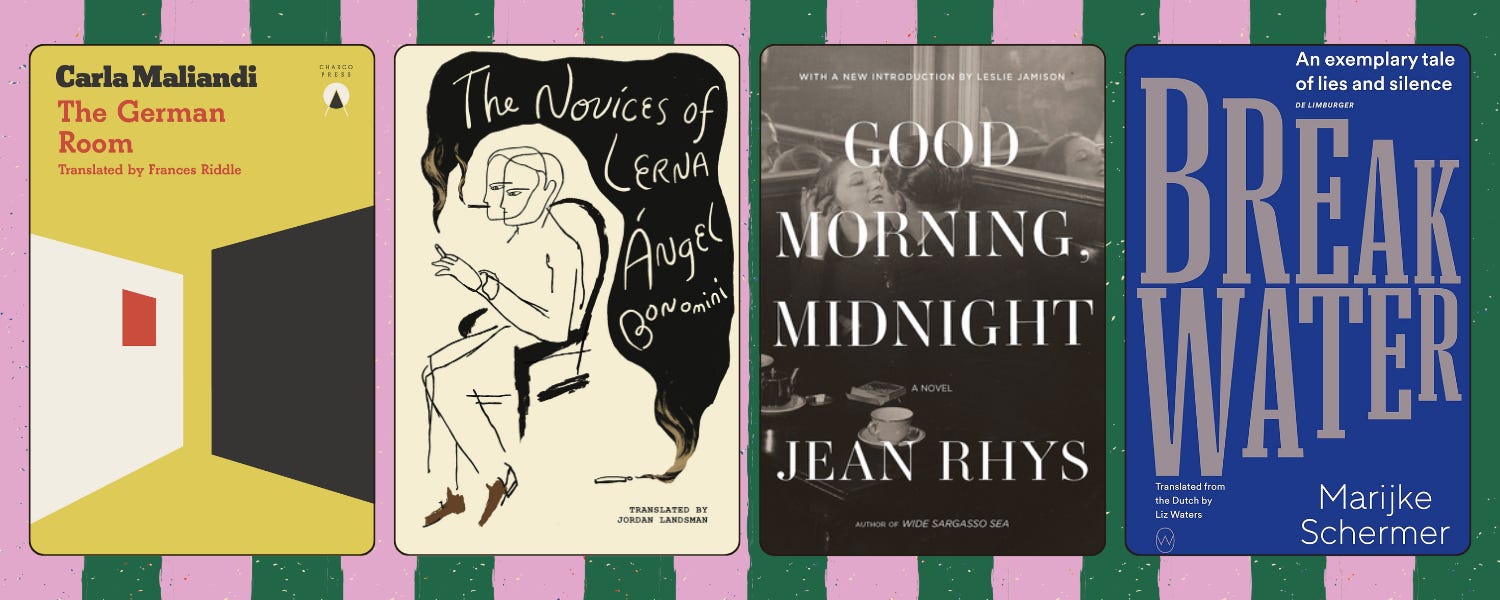
The German Room by Carla Maliandi, translated by Frances Riddle
An older title from Charco Press’ catalogue that deserves more attention — it’s a fascinating story about exile and memory that is reminiscent of My Year of Rest and Relaxation. It’s about a woman who abruptly leaves behind her life in Buenos Aires following a break-up and returns to her hometown of Heidelberg in Germany.
The narrator is perpetually kept at an arm’s-length distance from the reader, and we only ever get fleeting glimpses into her life before the events of the novel. Everyone she meets seems to be combating similar feelings of exile and displacement, and it’s never clear how reliable her recollection of events is. There are no clear details, no clean resolution, and a deliberate ambiguity that the whole story hinges on. Yet somehow it kept me rapt, and I only wish it were longer.
Rating: 4 stars
The Novices of Lerna by Angel Bonomini, translated by Jordan Landsman
This has been languishing on my TBR for two years, and I was glad to finally knock it off my list. The titular novella is followed by a collection of short stories, all of which rely on magical realism to construct premises that interrogate identity and parallelism.
There's a point of view in Bonomini's short stories that is reminiscent of Borges or Kafka. The titular novella is widely praised, but I found it a tad too ambiguous for my tastes. The short stories in the collection are often overlooked, but I found the highlights (notably The Singer, The Report, and The CCC) to be absolutely stellar. Like most collections, it evens out to a rating somewhere close to the middle.
Rating: 3.5 stars
Good Morning, Midnight by Jean Rhys
I normally run in the other direction when a book is described as ‘modernist’, but this caught my eye at the library, and I was willing to give it a chance. With the recent influx of popular ‘sad girl literature’ titles across BookTok, sometimes it’s nice to go back to the classics that helped normalize discussions around womenhood and mental health.
We follow Sasha as she recounts her past — a string of failed relationships, the loss of a child, her perpetual lack of money or stability — and Rhys never relents. Few books capture the perpetual shame that poverty imposes, but Sasha's descriptions of her squalid hotel rooms are unforgettable. How does language even begin to capture sorrow like this?
Stream-of-consciousness is perhaps too light a description for a book like this; you have to be willing to take your time reading it and be willing to accept that chronology is thrown out the window on page 1. But if you stick with it, this underappreciated classic is very solid.
Rating: 3.5 stars
Breakwater by Marijke Schermer, translated by Liz Waters
I have difficulty talking about this title without being able to read the original text — the writing quality is abysmal, but it almost feels like equal fault between the translator and author. Every sentence feels translated in the most literal sense, and I’m of the mind that most native English speakers would struggle to get through this. For example, sentences like “what exactly had in fact happened between them?” and “particulates breathed out by cars and breathed in by people” are grammatically correct but written so...oddly?
There’s a hyperfixation on statistical references in this novel (because the protagonist is a statistician, every metaphor must use the normal distribution!) that really doesn’t work. Perhaps it’s my bias as a statistician, but the references are at best forced, and at worst, completely nonsensical.
I wanted to enjoy this given the subject matter, but the execution is unforgivable.
Rating: 1.5 stars

Slanting Towards the Sea by Lidija Hilje
It’s an incredible literary feat when a book makes me side with a heterosexual man. The protagonist in this reminded me of Eeyore, the plot was contrived and cheesy, and the writing was trying far too hard to be deep. Combine that with didactic, heavy-handed references to historical events, and you have a book that I wanted to DNF so many times.
The ending made me so upset that I don’t even want to say more about this book. Sorry to my book club, but I am a vehement hater.
Rating: 1 star
On Another Planet They Can Save Me by Lieke Marsman, translated by Sophie Collins
I don't intend to be critical of someone's memoir written in the throes of palliative care and metastatic cancer, and I can appreciate this as a welcome piece of catharsis for Marsman. There are some profound, beautiful quotes interspersed in this, but a distinct lack of cohesion and throughline between the pages. The digital ARC had a ton of formatting issues which certainly impeded my enjoyment, for what it’s worth.
A shame because this is now being published posthumously and was one of my most anticipated releases for Fall 2026, but unfortunately just not a memoir that resonated with me.
Rating: Did Not Finish (DNF)
No posts
Comments
Nothing yet. Say the first thing.
Sign in to join the conversation.