
I just spent the last two weeks on vacation from my corporate job. It was magical, indulgent, and restful — exactly what I needed. Nothing says microdosing Euro summer like taking time off in August, right? I’m feeling rejuvenated, the creative juices are flowing again, and I’m excited for the plethora of content I have planned.
But as I return to reality — confronted with a lengthy credit card statement, a questionable sleep schedule, and another year under my belt — it only feels appropriate to put together a set of book recommendations inspired by the seven deadly sins. I only partook in a few of these during my time off; I promise. <3
Before we dive into today’s article, a reminder that all paid subscriptions are 30% off for August! A minor way of giving thanks for 30k followers on my Bookstagram account, and a not-so-subtle ode to my brand-new decade.
P.S. All book links below are through my affiliate storefront on Bookshop.org, where purchases help financially support independent bookstores. If you purchase titles through the links below, I’ll receive a 10% commission.
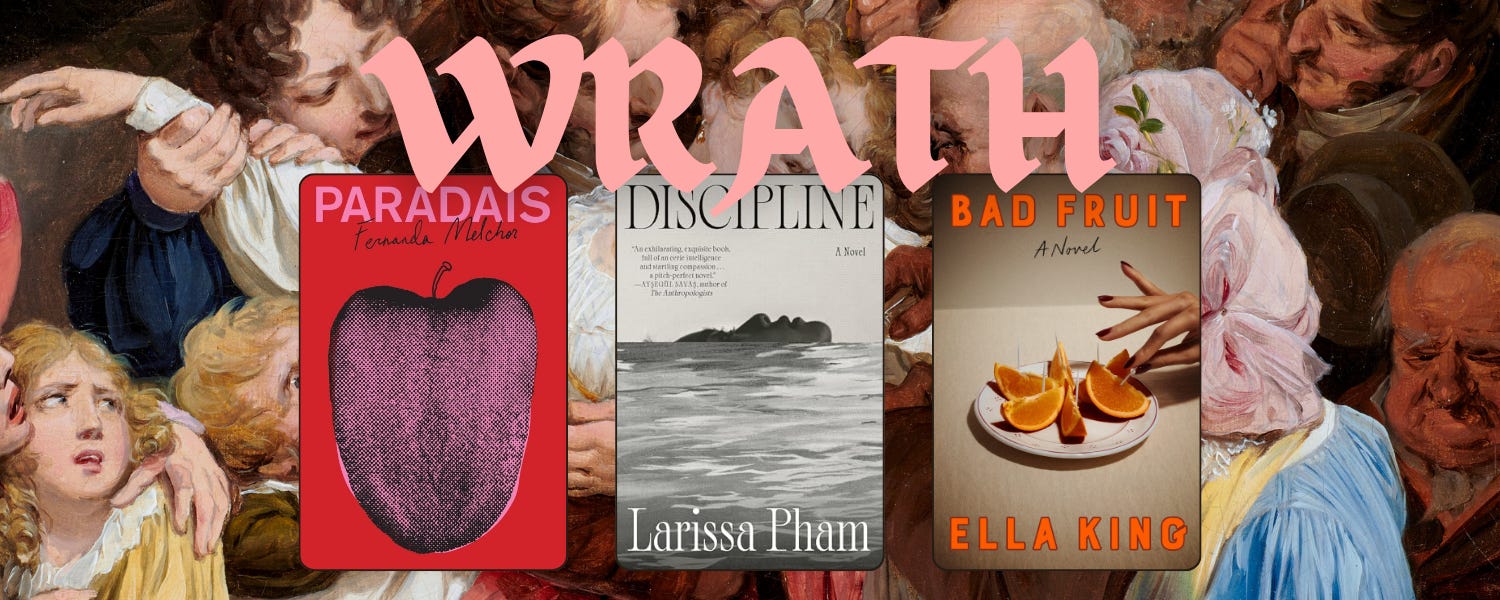
A collection of books that explore violence, resentment, and their manifestation. I wanted to curate a collection of recommendations that interrogate when wrath is warranted, if ever, and how it arises. There are plenty of niches that explore wrath, but I’m particularly drawn to books that explore its systemic causes and how it culminates in explosive confrontations between the oppressed and the oppressor!
Paradais by Fernanda Melchor (translated by Sophie Hughes): A depraved, harrowing novel that explores femicide in Mexico. Melchor depicts two petulant teenage incels who become radicalized to despise women and ultimately commit an act of unspeakable violence.
Discipline by Larissa Pham: A former artist whose ill-fated affair with a professor in her MFA program results in her withdrawal from the program and inability to paint again. As a means of catharsis, she publishes an autofictional memoir about her experience; her former professor quickly notices the parallels and reaches out.
Bad Fruit by Ella King: A volatile and abusive mother acts as a tyrant over her children. Her behavior is rooted in her unresolved trauma, yet she seldom acknowledges how she has left her children similarly bruised and isolated. A book that explores the consequences of treating children like extensions of ourselves, rather than autonomous individuals who deserve their own voice.
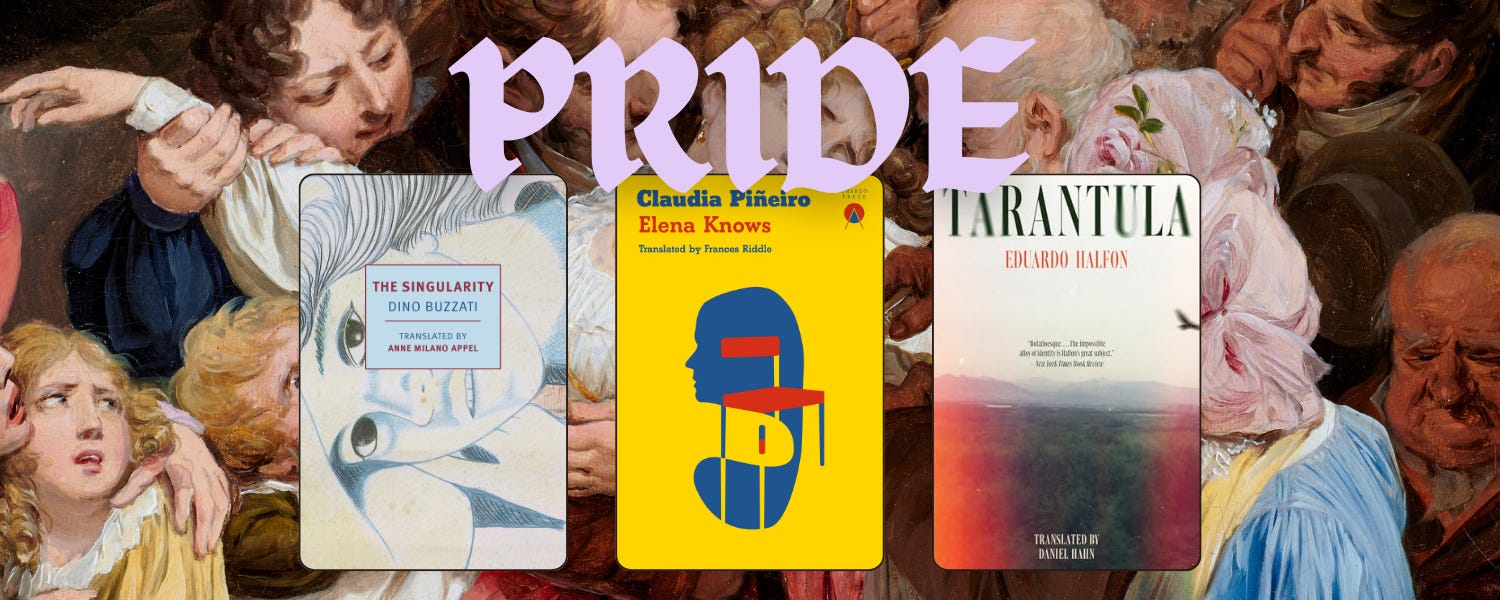
Pride centres around the inability to see beyond ourselves. This trio of book recommendations explores pride in both its individual and collective senses — the ways one person’s hubris can distort reality, and how that distortion can become collective when left unchecked.
The Singularity by Dino Buzzati (translated by Anne Milano Appel): A classic science fiction novel written in the 1960s about artificial intelligence that feels hauntingly relevant today. Buzzati explores the consequences of science conducted without ethics or safeguards, and the irreversible point at which technology outsmarts humanity.
Elena Knows by Claudio Piñeiro (translated by Frances Riddle): A literary mystery about an elderly woman with Parkinson’s Disease who is determined to solve the mystery behind her daughter’s sudden death. As she sifts through the evidence, she’s too proud to admit her shortcomings as a parent and her potential role in the tragedy.
Tarantula by Eduardo Halfon (translated by Daniel Hahn): A fascinating story about a Jewish community in Guatemala and the controversial ways they elect to remember the Holocaust. This is a book that makes you think; the characters offer differing perspectives on history, trauma, and indoctrination that all have some validity. It’s a fascinating lens into oppression and how it can perpetuate itself.
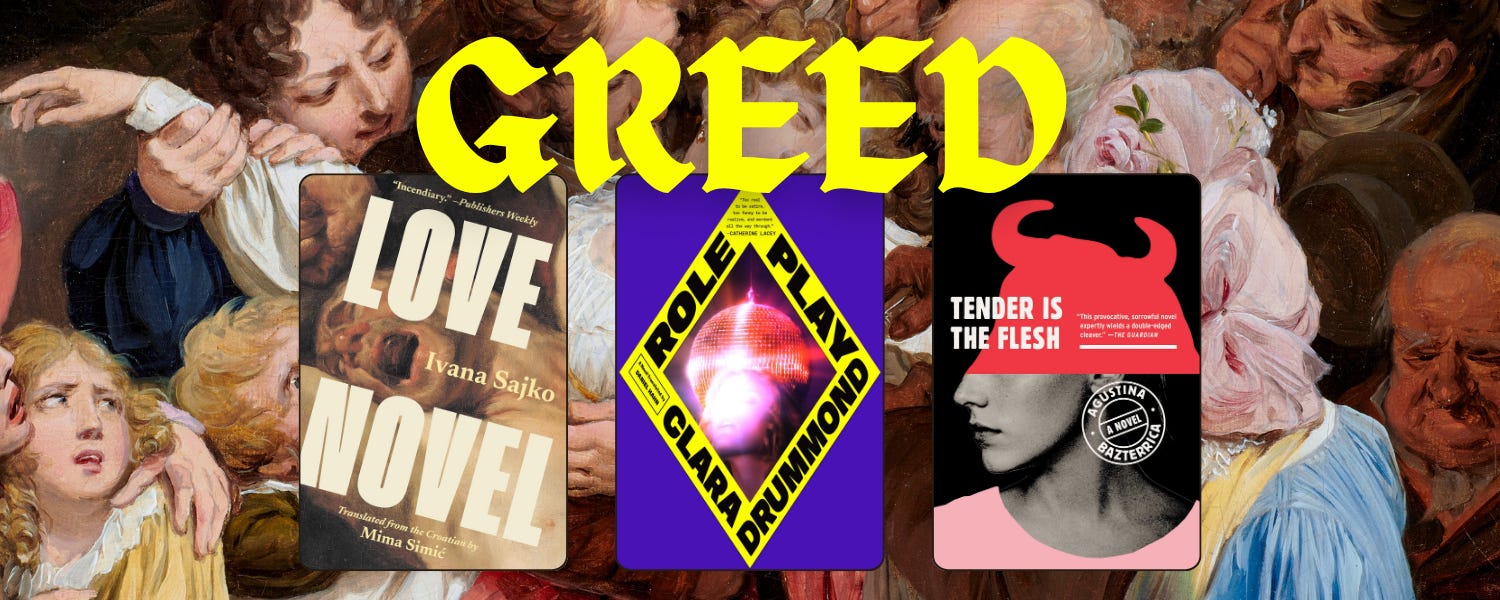
Greed naturally lends itself to books that explore capitalism, exploitation, and our complicity with these systems. It’s perhaps the most uncomfortable of the sins to confront. Few would consider themselves greedy, yet aren’t we all beneficiaries of systems built upon it?
Love Novel by Ivana Sajko (translated by Mima Simić): A bleak story that depicts relationships and families left broken by capitalism. The characters in Sajko’s novel are worn down by dead-end jobs and their lack of economic mobility, but how can collective action occur when everyone around them is similarly incapable of meeting their basic needs? Love Novel takes a scalpel to pressing issues like gentrification and privatization and creates a modern story that — depressingly — mirrors the experience of so many.
Role Play by Clara Drummond (translated by Daniel Hahn): A confrontational, provacative novel that explores the bystander effect and moral projection. When a privileged young woman grows increasingly aware of the class divide and how her privilege is built on exploitation, she feels obligated to feel guilty. Yet why should she? Would someone else in her situation do things differently?
Tender is the Flesh by Agustina Bazterrica (translated by Sarah Moses): Hardly a subtle novel, but still worth reading (at minimum for the great ending). Bazterrica creates a dystopian society where humans are bred as meat, mirroring the animal agriculture industry whose horrors we often deliberately ignore. A book that deliberately leaves you uncomfortable.
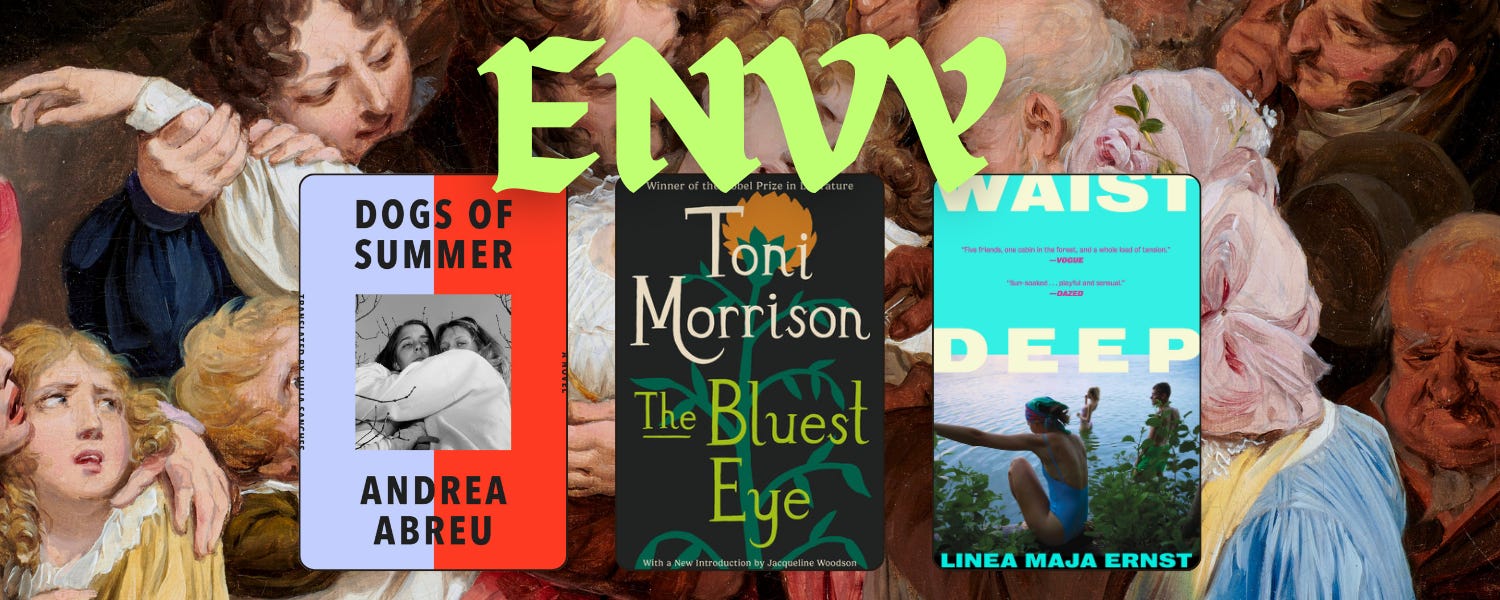
Envy is about entitlement, jealousy, and projection. It’s arguably my favourite of the seven sins to explore in literature because it’s so multifaceted. As we explore relationships between characters, it’s not hard to deny that their envy is validated. Yet do we condone their actions rooted in envy?
Dogs of Summer by Andrea Abreu (translated by Julia Sanches): A summery novel set in northern Tenerife, revolving around the lives of two childhood girls. Their friendship oscillates between love and rivalry, and Abreu doesn’t shy away from the grimy horrors of girlhood. A story where love and envy intermingle to create both codependence and sisterhood.
The Bluest Eye by Toni Morrison: One of the most depressing books I’ve ever read, but absolutely worth it. Morrison explores how beauty is commodified and weaponized against young black girls. They internalize and covet the Eurocentric beauty standards — like blue eyes — that society deems most beautiful, knowing that they are perpetually out of their reach.
Waist Deep by Linea Maja Ernst (translated by Nicolette Sherilyn Hellberg): An idyllic cottage weekend between a group of long-time friends is threatened by lingering resentment, jealousy, and pretension. Nobody in this friend group is particularly likeable, but they are so steadfast in their beliefs that it’s hard not to see their perspective. A summery read with some substance.
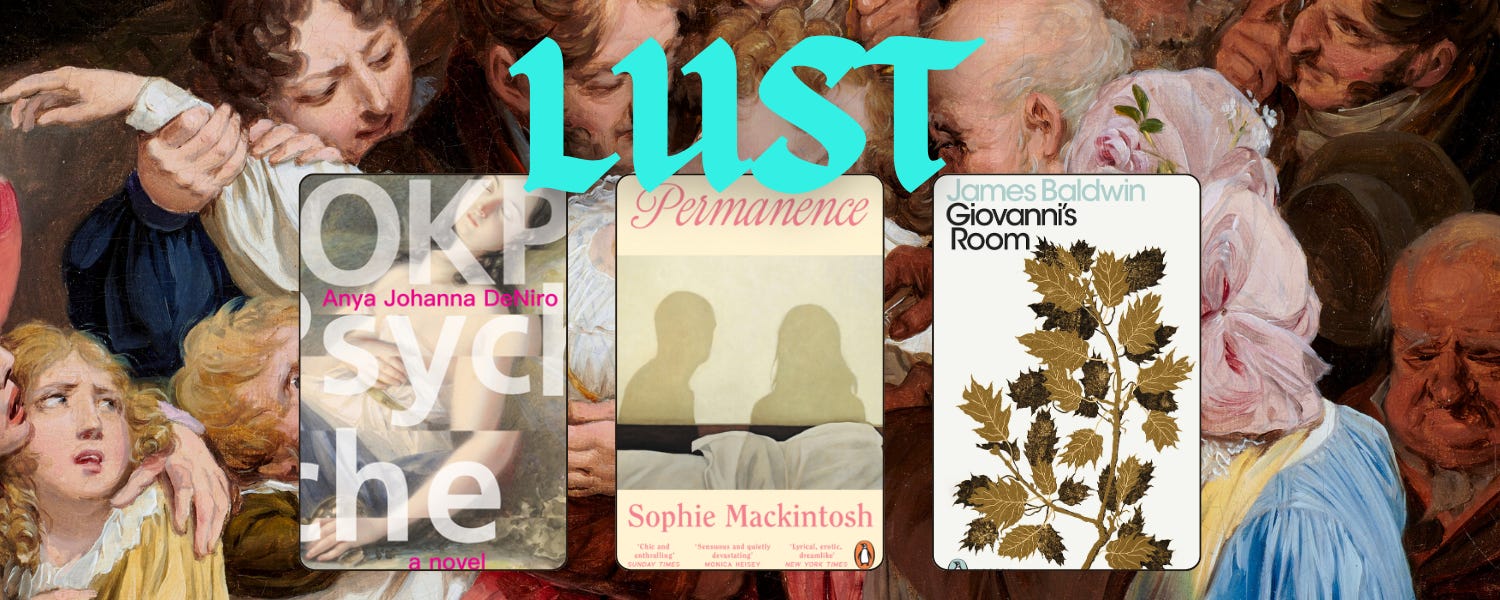
I’m not a romance reader, so my list of lustful titles may be more mundane than you’re anticipating. There’s plenty of spicier recommendations that exist, but these will satisfy that lustful itch you’re craving as a lit fic reader. Even if you’re left deeply depressed.
OKPsyche by Anya Johanna DeNiro: A quintessential ‘woman versus the void’ book from the perspective of a trans woman who routinely finds herself fetishized or ostracized for her identity. DeNiro uses her lived experience as inspiration and provides a very nuanced perspective on things like parenthood and dating after transition.
Permanence by Sophie Mackintosh: Mackintosh’s most recent novel is about a cladestine affair between two lovers who find themselves transported to a magical city where adulterers can roam freely. What initially starts as an idyllic getaway quickly exposes the fractures in their relationship, and as tensions mount, everything threatens to unravel.
Giovanni’s Room by James Baldwin: Baldwin’s most famous and accessible novel, and still my favourite. Giovanni’s Room is about two lovers, David and Giovanni, who reside in Paris during the 1950s. Their relationship is built on impractical desire and an intrinsic power dynamic; David refuses to admit his sexuality while Giovanni pines after him. It goes about as well as you’d expect (hint: very badly).

You probably expected to find My Year of Rest and Relaxation here — our literary diva who embodies sloth like no other. While I am a staunch lover of the book, I wanted to include three titles you may not necessarily expect. Here’s a collection of narrators who are listless, passive, and apathetic to the world around them.
The German Room by Carla Maliandi (translated by Frances Riddle): She abruptly leaves behind her life in Buenos Aires following a breakup and returns to her hometown of Heidelberg in Germany. The change in scenery is intended to be a fresh start, but she carries old habits with her. Left adrift in an unfamiliar city, is her journey one of chrysalis or stagnation?
Permafrost by Eva Baltasar (translated by Julia Sanches): One novella from Baltasar’s triptych (which also includes Boulder and Mammoth, and can be read independently), which features Baltasar’s coldest and most sardonic protagonist. A woman who wanders through life, lets her trauma fester, and does anything but healthy coping. What a mood.
Small Boat by Vincent Delecroix (translated by Helen Stevenson): A novel inspired by the migrant crisis in France, featuring a fictionalized account of a tragedy that claimed the lives of 27 people. Though the disaster was largely preventable, nobody elects to take accountability or action. Yet as Delecroix rotates between confessionals, it becomes increasingly challenging to pin the blame on one individual within a corrupt system.
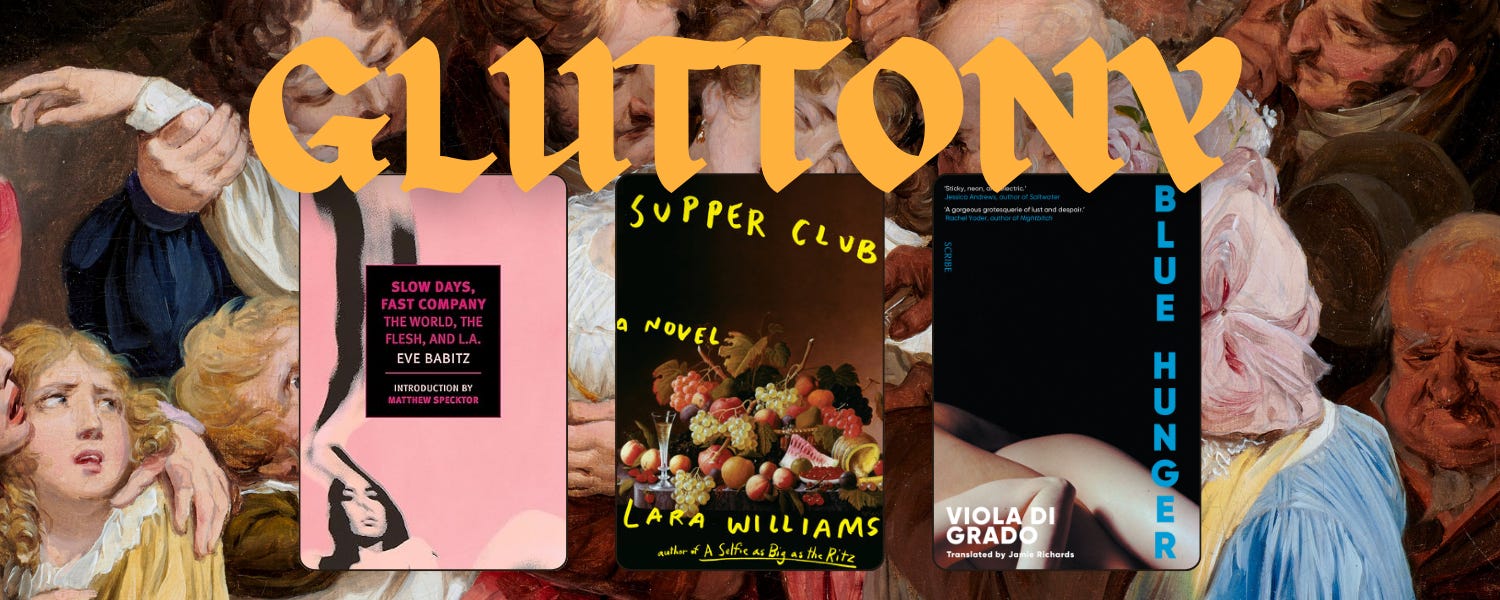
When I think of gluttony, I think of Eve Babitz. Nobody was quite as indulgent or hedonistic as she was, and I love her for it. Gluttony is about consumption in all its forms, and I love how these books rationalize — and even glorify — eating and drinking. When food has been used as a means of control against women for so long, it’s refreshing to see women unapologetically taking up space and feasting.
Slow Days, Fast Company by Eve Babitz: I hate martinis, but if a book ever felt like it paired well with a martini — it would be this one. Babitz is the quintessential California girl who lived life on her own terms. She takes us through a collection of colorful stories with prolific Hollywood stars. Unapologetic sex, drugs, and partying abound.
Supper Club by Lara Williams: A group of women creates an experimental, playful supper club that rejects the cultural norms that women are expected to uphold. They’re loud, they’re messy, and they won’t apologize for it. Williams’ debut is plenty of fun, and I don’t see it talked about nearly enough.
Blue Hunger by Viola Di Grado (translated by Jamie Richards): A weird, visceral book that involves plenty of sapphic biting (you heard me). A grieving woman finds herself infatuated with an enigmatic woman who she feels consumed by. But in the face of her overwhelming grief, maybe there’s something to be said about being consumed?
No posts
Comments
Nothing yet. Say the first thing.
Sign in to join the conversation.