
At the beginning of the cult movie My Dinner with Andre (1981) a camera follows a playwright named Wallace Shawn (played by the actor Wallace Shawn) as he paces about the streets of Manhattan in a beige trenchcoat, looking tired, forlorn, and far older than his years.
Wallace’s voiceover recounts the dispiriting chores of an underemployed actor and artist: making phone calls, buying envelopes, and mailing out manuscripts. He laments a mailbox filled with bills, contrasting it with memories of a carefree childhood on the Upper East Side.

“When I was 10 years old, I was rich. I was an aristocrat. Riding around in taxis, surrounded by comfort. And all I thought about was art and music,” he says. “And now I’m 36, and all I think about is money.”
In 2022 an organization of U.S. writers, The Authors Guild, published a study of its members’ income from writing.
The results would have made Wallace Shawn even more glum. “The median author income for full-time authors from their books was $10,000,” a shabby press release announced.
That kind of money is not even enough to secure a marginalized, artsy-Bohemian existence, let alone a middle class one.
Writers, quite naturally, try to make ends meet by working in quasi-adjacent professions. In the United States, that means teaching creative writing at universities or working as a journalist or editor. Or, for those who have the temperament to navigate corporate life, they become marketing copywriters or public relations specialists.
A Diplomatic Approach.
In Latin America, where the middle class is much smaller, and there is far less disposable income for books, the income crunch is even more acute.
There used to be some money in book reviewing, of course. Journalism was an important source of income, writers such as Gabriel García Márquez and Mario Vargas Llosa went that route. But there was another option, particularly in the 20th century, that proved both pragmatic and attractive—the diplomatic corps.
The list of Latin American writers who served as ambassadors, consular officers, cultural attachés, or foreign service bureaucrats is astounding, a veritable “who’s who” of stars and Nobel Prize winners.
Mexico, in particular, has had an all-star team of scribes who worked abroad for the government: Octavio Paz, Carlos Fuentes, Sergio Pitol, and Alfonso Reyes, who is less known in North America, but is famous for his prose poem “Visión de Anáhuac.”
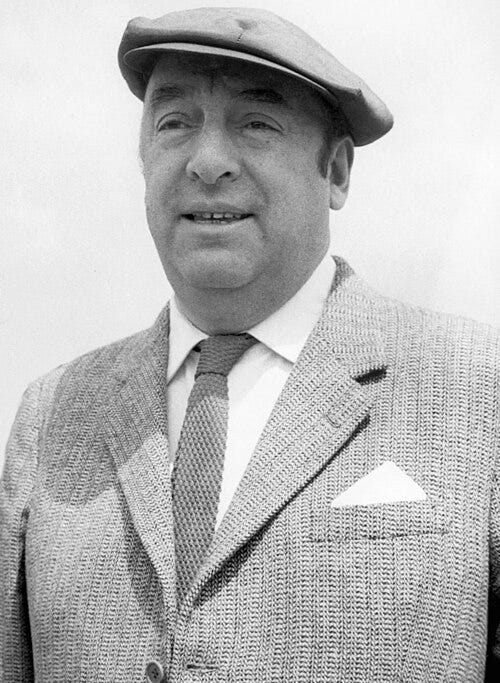
There is also Chilean Nobel Prize winner Pablo Neruda, along with two other Nobel winners from the region: poet Gabriela Mistral of Chile, and Miguel Ángel Asturias, the Guatemalan novelist. You can also throw in two fine Cuban novelists, G. Cabrera Infante and Alejo Carpentier, both of whom served the Fidel Castro government in the 1960s and ‘70s.
And this is far from a comprehensive list, which gives you a sense of the scope and impact of this phenomenon.
The Public Intellectual.
The tradition remains to this day. Colombian novelist Santiago Gamboa, for example, currently serves as Colombia’s cultural attaché in Beijing, China.
Gamboa, in a recent interview on the Literature & Geopolitics podcast, explained this tradition as a French inheritance, where the intellectual, the poet, has an inherent relationship with authority. The French formalized this practice in 1959 when President de Gaulle named novelist André Malraux to the world’s first-ever Minister of Culture position.
Gamboa said the writer’s proximity to power in Latin America is the direct result of governments believing themselves to be connected to the cultural life of the country. He contrasted this with the United States where the arts are considered the domain of private organizations or universities.
He also noted a Spanish influence, pointing out that in Spain the media and the public expect, and want, literary figures to comment on politics. Listen to Gamboa’s full remarks on the subject:
Have Pen, Will Travel.
Writers, by their very nature, are disdainful of parochialism and narrow views of living. This is one reason why they crave the novelty and adventure of traveling. And while diplomatic work does involve work, it still provides an opportunity to get paid and live abroad, two boons to any writer.
The Mexican-American critic Ilan Stavans in his beautiful and slim little book Octavio Paz: A Meditation (2001) wrote of the benefits Paz found in the career:
“His diplomatic duties allowed him to visit Sri Lanka, Afghanistan, Burma, Thailand, Singapore, and Cambodia. This peripatetic model—the intellectual as ceaseless wayfarer—is not unlike those of Orwell, Edmund Wilson, Arthur Koestler, and even Hemingway. To trek is to think in motion, to be Tocqueville again: a ‘stranger’ with a conscience, a smart tourist and partial chronicler of one’s age.”
Pitol, who spent many years in the Mexican Foreign Service, wrote in The Magician of Vienna (2005) [one book in his marvelous “Trilogy of Memory” memoir-novel fusion]:
“The (Mexican) Secretariat of Foreign Relations invited me to be a cultural attaché in the Mexican embassy in Poland for a period of two years . . . I remained in the Foreign Service for sixteen years. The embassies and countries where I found myself were abundant in experiences. My books, even now, are nourished by them.”

Watch the interview with Indian diplomat-poet Abhay K.
Reasons, Reasons.
I think money, namely the need for a salary, is one pragmatic reason for this tradition, but it is by no means the sole reason. A more comprehensive, or even a definitive answer, remains unclear to me. It’s one reason I continue my research into the subject.
I do think the French cultural influence in Latin America is a critical one, however the French were far from the first civilization to have writers/intellectuals become diplomats.
We see echoes as far back as the classical period. French diplomat and historian Jean Jules Jusserand writes that the ancient Romans employed envoys, and they called them “orators” because they believed that eloquence “is the most essential part of an ambassador.”
And in Roman civilization, orators were the elite practitioners of the liberal arts, the intellectuals of the society.
Later, in the early Renaissance period, we notice the explicit development of the writer-diplomat tradition in Italy, with Dante being the foremost example. More to come on the subject.
If you’d like to support this work, consider becoming a paid subscriber.
Robert Fay is a U.S.-based writer who has written for The Atlantic, The Los Angeles Review of Books, First Things, The Chicago Quarterly Review, and other publications. He is also the creator and host of the Literature & Geopolitics podcast.
No posts
Comments
Nothing yet. Say the first thing.
Sign in to join the conversation.