
…thing is, Black folks already knew this…
I was just reading an article about the benefits of eating watermelon and I wanted to merely read it, close it, and then click one of the couple of dozen tabs I have open to move on with my day, but it seems like the ancestors were saying, “You see how they do? Speak on this for us, will you?”
I have to be obedient.
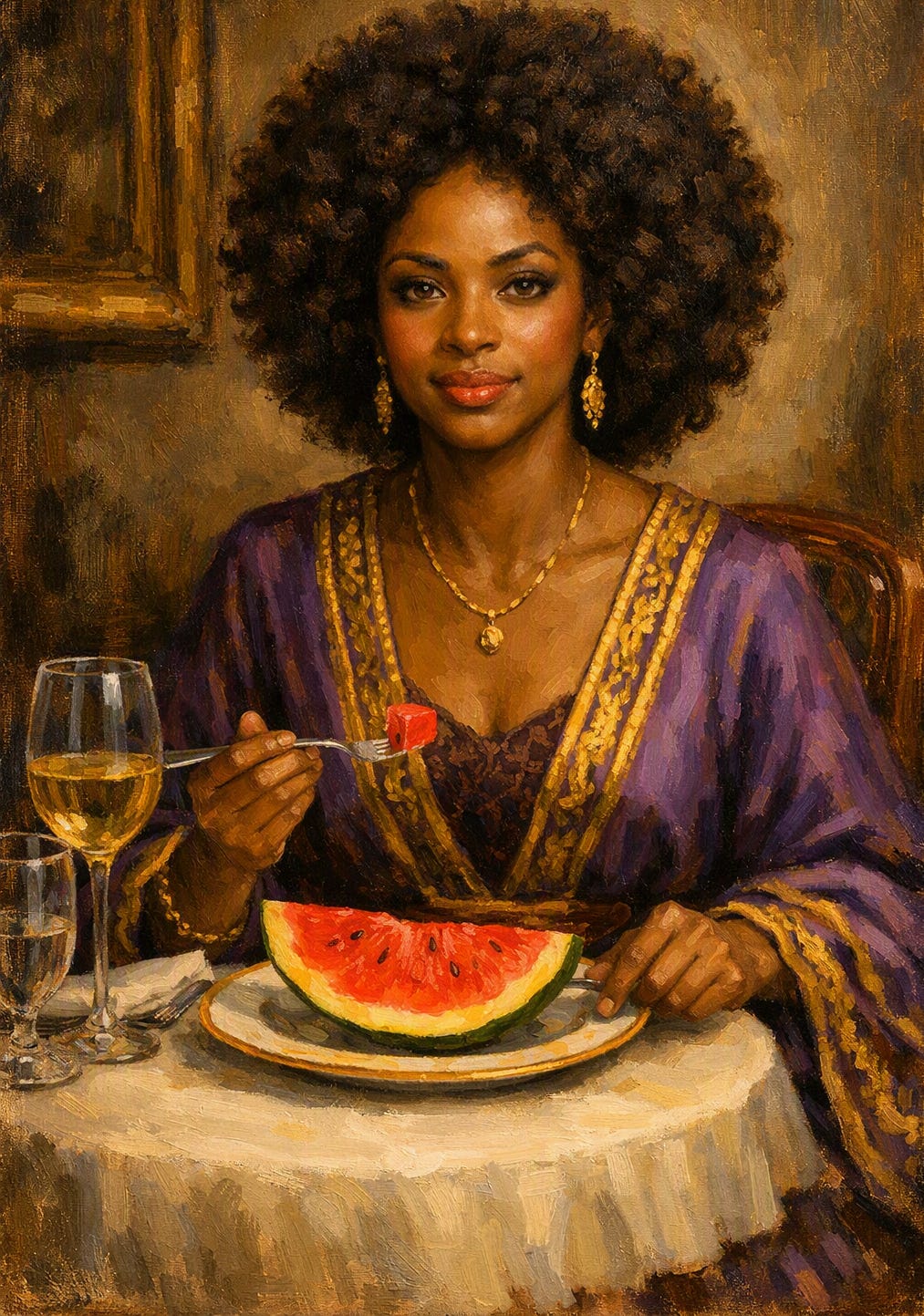
Watermelon is a delicious fruit. I like mine salted and sliced because, as country as I am, I don’t know how to split a whole watermelon by myself. But I have to admit, I have been very leery to eat watermelon in public over the years due to the fruit being associated with a racist trope. So, the majority of the time, I eat watermelon at home and at Black gatherings. During those times when I would be at a function where white people were present and watermelon was part of the food offerings, I’d intentionally skip it.
Caricatures of Black people eating watermelon and fried chicken have been prevalent in American society for decades, even to present day. Around the time of the Civil War and early in the 20th century throughout, it was perfectly acceptable for an advertisement to feature Black people looking unkept but munching on watermelon with overly exaggerated grins. Those advertisements had a deeper agenda as well. Shortly after slavery, Black farmers grew watermelon as a way to sustain themselves economically. Former slave owners despised this newfound success and prosperity, so a smear campaign was set in motion to discredit the farmers. In order to squash their profits, those ads weaponized watermelons against the very people who knew how to grow and harvest them. These images were used to associate the fruit with being lazy, ignorant, poor, and dirty.

But here’s the truth. Watermelon’s health benefits have been known for centuries around the world, but it was only racialized in America. Go figure. Watermelon was eaten by enslaved ancestors and later, tenant farmers, and other Black laborers to remain hydrated while toiling away in the heat for hours a day. Considering watermelon’s African origins, it is reasonable to consider that this fruit was another one of the things that survived the Middle Passage.
Now, watermelon, according to this article, is being positioned as a superfruit that provides antioxidants to fight disease, improve skin health, and lubricate joints as part of a daily fluid intake. That’s apparently news for the masses because MSN wouldn’t have bothered to write and post the article if not. And yet, while I intend to enjoy watermelon for its benefits, I will continue to be leery eating it among any other people besides Black people, especially in today’s intensified social climate. It is a peculiar thing indeed to have to grapple with the psychological residue triggered by a fruit, out of all things. But, this is one of the lingering effects of how racism distorts Black living, though.
Thanks for reading and carry on with your day!
Next Up: I have a historical piece coming up on Black banks in Mississippi. It’s part of my new series, Magnolia Blossoms.
Interested in reading more about how advertisements and the media shaped the negative perceptions of Black Americans? Check out this work by Tom Burrell, Founder of Burrell Communications Group, a highly successful, Black owned, full-service marketing and advertising agency based in Chicago.
Click the book image to visit my Scribe-a-Licious Bookshop!

Writers and readers need their things! If you’re anything like me, I have to be comfortable when diving into a new read and there is no such thing as having too many notebooks. Consider these two items from my Scribe-a-Licious Pop Up Store. Items are designed with the reader, the writer, and the art lover in mind. Shop today!


Comments
Nothing yet. Say the first thing.
Sign in to join the conversation.