
In This Post
📚 What 200 reader surveys revealed about classics guilt, unfinished books, Russian names, slow plots, and the books people secretly want help reading
📖 Why most readers do not need more discipline, they need better sequencing
There is a specific kind of reading shame that sounds like this:
“I know I should have read more classics by now.”
Notice the word.
Should.
Not “I am curious.”
Not “I want to meet Anna Karenina and see what all the emotional destruction is about.”
Not “I would like to understand why everyone keeps threatening me with Moby-Dick.”
Should.
This is how the classics were handed to many of us: as a moral invoice.
Here is your reading debt. Please pay it in dense nineteenth-century installments.
Very normal. Very healthy. Nothing to see here except a woman hiding from Middlemarch under a blanket while pretending the audiobook counts if it played while she unloaded the dishwasher.
I have now read through 200 custom reading plan surveys from Literary Fancy readers.
And let me tell you something very directly.
You are not bad at classics.
You are not intellectually defective because you got lost in Russian names.
You are not morally weak because *Moby-Dick* started talking about whale anatomy and your soul quietly left the premises.
You are not a fraud because you have read Jane Eyre, The Great Gatsby, and Pride and Prejudice, but still feel like there is some secret door into “being well-read” and everyone else got the key in college.
Most readers are not failing the books.
They are reading without a map.
The most fascinating thing in these surveys was not how many people were afraid of classics.
It was how many people wanted them.
Readers said they wanted intellectual challenge. They wanted books from other eras. They wanted to understand literary references. They wanted depth. They wanted to discuss books without feeling like they had wandered into a dinner party where everyone else had done the reading and also inherited better lamps.
This is not laziness.
This is longing with bad infrastructure.
People are not saying, “Please remove all difficulty from my reading life.”
They are saying, “Please help me understand what kind of difficulty I am signing up for.”
Different problem.
One is avoidance.
The other is navigation.
Do you know which books showed up again and again in the “I started it and gave up” answers?
Of course you do.
*Moby-Dick.*
*War and Peace.*
*Ulysses.*
*Middlemarch.*
*Don Quixote.*
*Anna Karenina.*
*The Brothers Karamazov.*
*Les Misérables.*
The usual suspects.
The literary Mount Rushmore of “I swear I was going to finish it but then life happened and also the book kept introducing men named Nikolai.”
These are not bad books.
They are also not always good first moves.
Starting your classics life with Ulysses is like deciding to get into hiking by being air-dropped onto Everest with a granola bar and vibes.
Technically possible.
Deeply unnecessary.
Length matters, yes.
Nobody looks at a 900-page book and thinks, “How breezy. A purse snack.”
But the bigger fear in the surveys was this: not understanding what makes the book great. That is the real wound.
Readers are afraid they will finish the book and still not get it. Or worse, they will hate it and suspect that means something embarrassing about them.
This is why so many people treat classics like a test.
If I love it, I pass.
If I hate it, I fail.
If I do not understand it, I must quietly return to thrillers and never speak of this again.
No!
A classic is not a purity test.
It is a conversation across time, and some conversations are awkward at first.
Some require context.
Some require the right translation.
Some require you to be thirty-seven instead of seventeen.
Some require you to stop expecting every chapter to behave like a Netflix episode with corsets.
There is a reason so many people can love modern books with complex plots, multiple timelines, rich characters, historical settings, moral ambiguity, beautiful prose, and emotional devastation, then suddenly panic when the book is called a classic.
The skill is already there.
The bridge is missing.
If you loved Project Hail Mary because it moved fast and had humor, you do not need to start with The Brothers Karamazov and repent your way through 800 pages of theology and family dysfunction.
You might need a faster classic with a clear engine.
If you love family sagas, morally complicated women, historical atmosphere, gothic weirdness, academic settings, psychological intensity, or social commentary, there is a classic doorway for that.
The problem is that most people were handed the canon as a marble wall.
It should have been handed to them as a house with doors.
This apparently needs to be said, because school did a number on us.
You are allowed to read classics because they are juicy.
Because they are funny.
Because they are dramatic.
Because a woman stopped all the clocks in her house after being left at the altar and let the wedding cake rot, which is both horrifying and, frankly, commitment to the bit.
You are allowed to read Dracula because everyone is writing urgent letters while the vampire is somehow better at logistics than the entire group of men trying to stop him.
You are allowed to read The Count of Monte Cristo because revenge is narratively delicious even when we are all pretending to be spiritually evolved.
You do not have to approach every classic like you are applying for tenure.
You can simply want the story.
This is legal.
I checked with the ghost of Dickens. He was too busy being paid by the installment to object.
This is the part that made me want to bang a tiny literary gong.
Again and again, readers said they wanted to be challenged.
They wanted to think.
They wanted to read books with depth.
They wanted to finish books they had been avoiding for years.
They wanted to understand and remember enough to discuss them.
That is not a shallow reading goal.
That is a beautiful one.
But “read harder books” is terrible advice.
Hard how?
Hard because the sentences are long?
Hard because the names are confusing?
Hard because nothing happens for 80 pages except moral weather?
Hard because everyone is depressed in a Russian room?
Hard because the book is actually experimental and does not care if you brought snacks?
Those are different kinds of hard.
You need to know which kind you are choosing.
A good reading plan is not a list of impressive books.
That is just a guilt spreadsheet wearing perfume.
A good reading plan knows what you have already read, what defeated you, what you love in non-classic books, how much time you actually have, whether you can tolerate bleakness, whether Russian names make you want to fake your own death, and whether your idea of success is “I finished twelve books” or “I finally understood why people keep talking about George Eliot.”
That is a different thing.
That is not a list.
That is a way in.
Quick Literary Fancy schedule note before you wander back into your normal life and pretend this was merely about books: this Saturday, August 8, I am hosting a live webinar on how to host a book club people actually want to come back to.
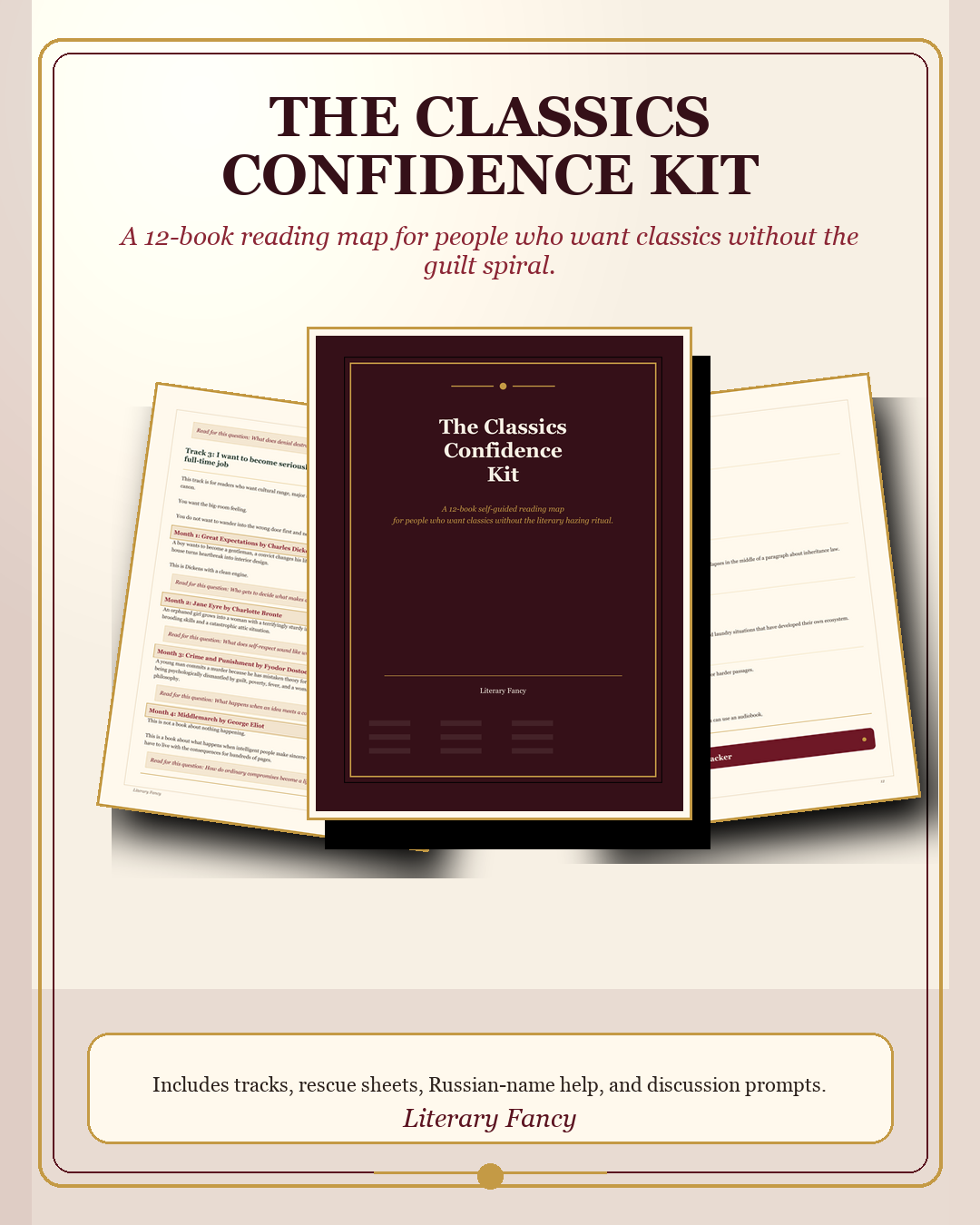
On Sunday, August 9, members are getting the practical follow-up to this post: the exact four-part framework I use to rescue readers from classic-book paralysis. Plus a BONUS freebie -Classics Confidence Kit. This is actually already loaded in the member’s library under guides.
Member's Library
Jun 12
Your private members’ archive, where serious readers get the good stuff…reading guides, reading lists, annotation tools, and seasonal challenges that make every book more worth your time.
For members: the Sunday post will walk through how to choose your first classic, what to do when you want to quit, how to handle slow pacing, and how to stop treating confusion like a character flaw.
Founding Members also get a custom 12-month reading plan built entirely around their join survey: what they have read, what they have avoided, where they are in life, and what they want to feel when they finish a book. The survey link is in the welcome email. Check the spam folder.
Members, I will see you Sunday with the practical framework.
Free readers, you are not being abandoned in the whale chapter.
I am simply refusing to pretend this can be solved by another vague recommendation list with a tasteful serif font.
You need a map.
And we are making one. Join us?
Which classic have you been avoiding because you are secretly afraid you will not understand it? Drop it in the comments.

Comments
Nothing yet. Say the first thing.
Sign in to join the conversation.