
Disclaimer: The following review was written after being given an uncorrected advanced reader copy by the novel’s author. In addition, the reviewer considers the author to be his friend. He did not receive any other compensation for the review, financial or otherwise. The review may contain major spoilers for some readers.
It took two wars for American states to be forged into a nation. One is the Civil War, as is often acknowledged to be the decisive event. The other, which seems to be less remembered in such a manner, is the Indian Wars. Though no one would argue against the claim that the Frontier played a critical role in the American nation-building, a subtle shift in nuance occurs when the term changes from “expansion” to “war”.
Refusal to Obey by J. Aaron Courts is first and foremost a novel about America. It starts in the 1850s and ends with the assassination of Silas Soule in 1865, an officer who refused to participate in the massacre of Indians at Sand Creek and testified against those involved. Despite its subtitle “A Novel of the Massacre at Sand Creek”, only the fifth out of the six “books” that constitute the novel directly addresses the massacre, and the rest are about what happens before and after.
An interesting aspect of Courts’ novel, or a stimulating artistic choice he made as its author, is that it is presented as a work by none other than Walt Whitman. Within the world of Refusal, it is Whitman retelling the story of Silas based on records left by Quinton Laurel Stoddard, Silas’ friend and comrade in arms. Quinton had used a copy of Leaves of Grass owned by Silas as a journal, writing entries in the margins, and Whitman came into possession of it.
The mental image a reader would construct, the handwritten records of Bleeding Kansas, the Civil War in New Mexico, the Indian War in Colorado, and their aftermath, colliding and merging with Whitman’s poetry, together with that of him working on the story of Silas and Quinton, inevitably leads the reader to ponder what America is. It can be no coincidence that Courts chose the lines from Whitman’s Song of Myself as one of the novel’s two epigraphs: “Do I contradict myself?/Very well then I contradict myself,/(I am large, I contain multitudes.)”
It will be fruitful to point out at this point that in the same poem, Whitman’s poetic self sees “the marriage of the trapper […] in the far west” with “a red girl” and lets a “runaway slave” stay at his house before he “recuperate[s] and pass[es] north”, even having “him sit next to me at table”. Quinton, the novel’s narrator whose voice is assumedly reconstructed by Whitman, remarks on his way to Denver from Kansas: “I came to understand the immensity of our continent. […] There had to be enough of this—this land—this place and its plenty—for the Indians and us. There had to be enough of everything for everyone. Surely there was enough room out here for them to keep something of their way of life and still secure our interests and westward expansion.” His naïve American optimism will soon be crashed in the wars. Indeed, America is large and contains multitudes, which means it can contradict itself.
In one of the most symbolic scenes in Refusal, Silas gives the copy of Leaves of Grass to Grey Tail. Grey Tail is a man who “can not only speak English, but […] reads and writes too” and “enjoys fine verse.” An Indian felon called Three Legs spits on the book, as if to mock a line from the “Poem of Walt Whitman, an American”, in Whitman’s own words, “that all men ever born are my brothers, and the women my sisters and lovers”.
Quinton likens Three Legs to “literal giants—mythically large men” from the tales of the past, a “Red Goliath” whose shoulders are “higher than the tallest mount’s”. In Courts’ West, the Whitmanesque vision of coexistence in abundance seems to fall apart against the juggernaut force of brutality or evil. White people not only kill or drive away Indians but also scalp Indians and hang the scalps on walls. One of the novel’s White characters, Squires, cuts out an Indian woman’s genitalia and uses it for his hatband. There are plenty of atrocities committed by Indians too, including enslavement of Black and White people, murders, rapes, and harrowing mutilations. Three Legs attacks White settlers, castrates the men, puts their genitals in their mouths, and makes them watch him rape the women as they are dying. Needless to say, belonging to the same race does not guarantee there will be no mutual violence either. Indian tribes have been at wars against each other, just as the Union and the Confederacy are. In Silas’ words: “They take slaves and sell them, same as us. They kill their enemies, same as us.”
It does not take too many years for Quinton to agree with Silas’ understanding of the Frontier: “God’s awfully silent in these parts”. Three Legs and Chivington, who could properly be called the main villains of Refusal, do not face justice. It is Silas and Grey Tail who are killed, the former for whistleblowing against Chivington and the latter for the crimes Three Legs committed. The Indians at Sand Creek are massacred by Chivington and his men, having innocently believed that hoisting a Stars and Stripes and a white flag would ensure them protection by the US army. The American Frontier is where the sense of divine justice gets blurred, if not challenged, by divine silence.
Though not an overtly religious work, Courts’ novel touches upon important Christian themes. Silas and Quinton spend their teenage years as Jayhawkers, fighting against slave owners and Bushwhackers. However, Silas has his own original sin: he partook in the hanging of an innocent Black man accused of spying for slavers. A raid had gone bad, and someone had to be put to blame. The Black man “didn’t argue, or scream, or try and run,” like a proper scapegoat. Silas spat on him and watched him die. He hated the man, not “for being Black”, but for “taking it”. Having concluded that he is “done fighting for men who won’t fight themselves”, he heads west and becomes an officer, which will bring him to his death as a martyr.
As is well known, the word martyr originated from the Greek martys, which means witness. Silas’ journey begins by witnessing the death of the Black man and ends with witnessing the Sand Creek Massacre and being killed for it. While Silas’ refusal to obey the order by Chivington counts as an act of defiance, what he does, technically, does not stop the slaughter of the Cheyenne and Arapaho. Silas himself acknowledges: “I cannot stop it, but it will not stand.” He just stands there and watches the innocents die.
Nevertheless, the act of witnessing in Refusal—watching and attesting to what one watched, even if it means getting killed for it—apparently saves Silas, freeing him from his guilt. Then, a significant question to be raised might be: can America be saved from its original sin in the same fashion, even when divine justice seems to merely keep its silence? Considering that Courts, after all, chose to write a novel, the answer he strives to provide must be yes. Still, he does not make any elaborate statement about America, at least not blatantly. There is no explicit justification of the American nation or politico-historical theodicy in his book. Likewise, Courts does not condemn America or God outright either. “I have no mockings or arguments—I witness and wait.” Quite likely, Courts would agree with Whitman’s such outlook.
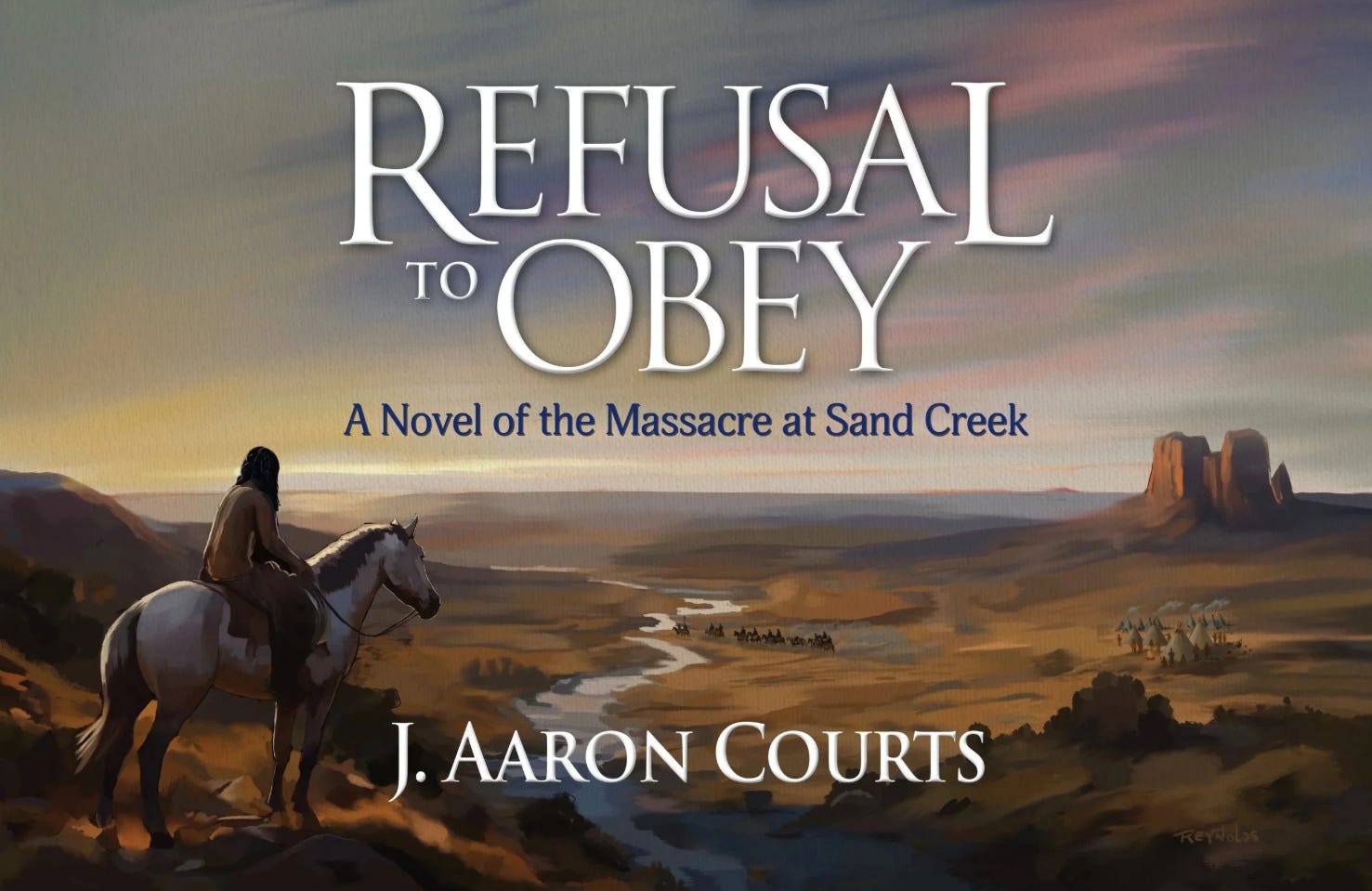
Refusal to Obey can be pre-ordered from Pane Books’ website. Its official release date is September 21st.
If you enjoyed my work, you can buy me a cup of tea. I am not a coffee person, by the way.
No posts
Comments
Nothing yet. Say the first thing.
Sign in to join the conversation.