
“HE SAID GIVE ESMOLOL!” you hear the intern shout and hear quick footsteps as he bounds down the hall to the resus bay.
“Esmolol! We need to give her Esmolol” he yells, completely out of breath.
“What. No. Ew,” the senior resident says to him, dismissing the idea.
“It’s not my idea!” the intern chokes out. “I talked to Dr. B. He said Esmolol will keep her out of Vfib.”
“Are you sure he said Esmolol? If you’re wrong, this could kill her.” The senior responds
“YES! Esmolol…”
*******
(1 hour earlier)
“NEXT! … Hello Ma’am! Let’s get you checked in, what brings you to the emergency room?” The clerk asks the next patient in line.
“I… Uhhh. I … help.”
The clerk looks up from her computer and her eyes get wide. She sees a very anxious 30s-year-old female who is pale, tremulous and diaphoretic. “I need help up here!” she yells into the radio and two nurses and Shannon, your charge nurse, rush up to registration.
“Emergency Resus in Bay 3 NOW!” Shannon radios back as they rush the patient back.
You rush and your team run in. The senior resident pushes the intern to the front of the room and prompts him to take a history. “What’s going on ma’am?” He asks her.
“I don’t feels very well. I .. uh.. I … I took some pills.” She says as she vomits.
“Blood pressure 90/60, heart rate is 170, SpO2 90% on room air” Shannon calls out.
“She’s on the monitor, ECG coming your way, Doc” the tech says as she hands you an ECG.
“Caffeine pills. A lot of them. Like most of a full bottle…” You hear the patient tell the intern as you review the ECG:
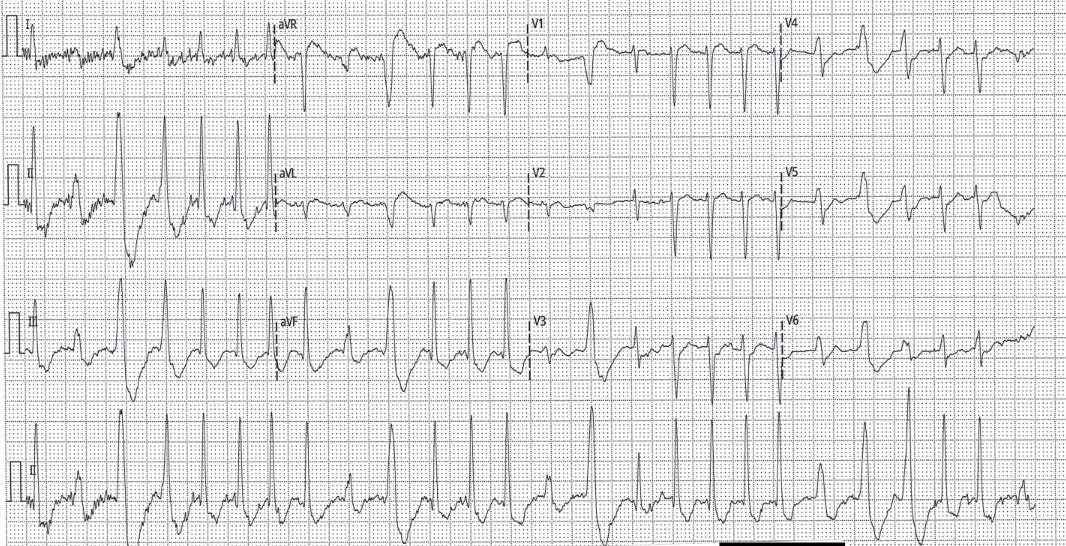
Rate: 171 beats per minute (thanks ECG machine)
Rhythm: Great question. I stared at this for a while and my best guess is that it’s some kind of atrial arrhythmia not coming from the SA node with significant ectopy. There’s a decent bit of artifact from her tremors which aren’t really helping. But I’m also open to other suggestions.
Axis: Normal axis
Intervals: QRS is narrow, QTC looks ok (Machine says 444)
Morphology: lots of ectopy (PVCs). This heart isn’t happy.
Final read: Tachycardia with significant ectopy.
“Doc! Stat labs coming back: pH is 7.25, K of 2.2, lactate of 5.8!” Shannon calls out, pulling you out of the ECG.
“Rhythm change!” you hear the senior resident call out as the tech prints another ECG and hands it to you.
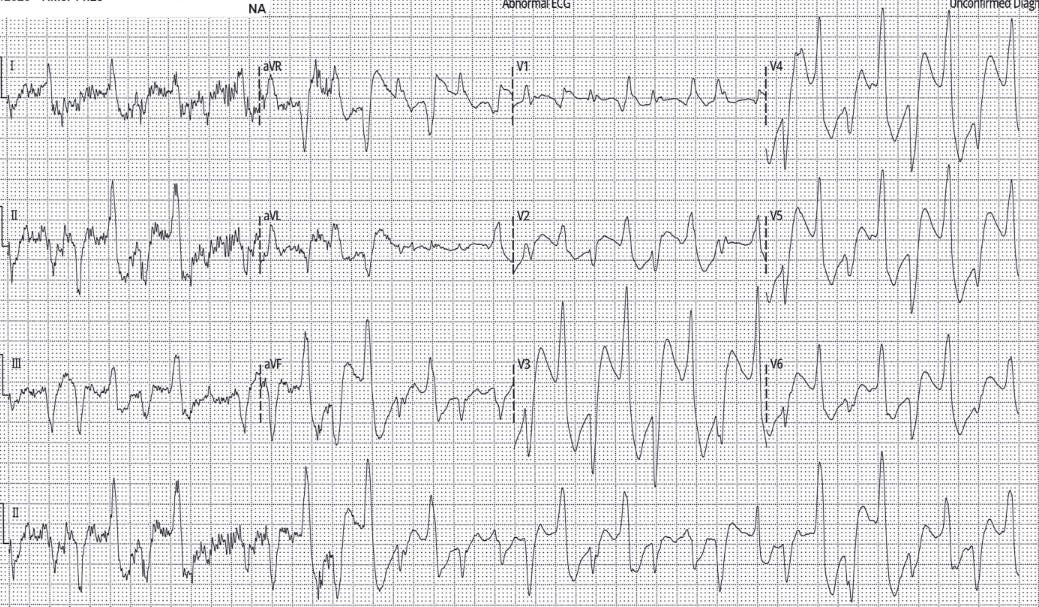
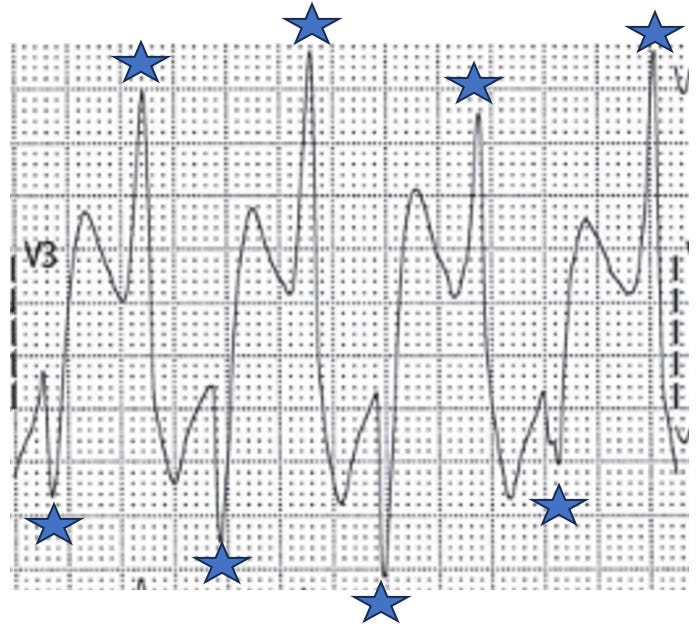
This is the holy grail of Tox ECGs. This ECG shows Bidirectional Ventricular Tachycardia. Notice how the QRS complex axis swings 180 degrees back and forth. To see it better, look at V3 marked up below. The (*) shows the QRS complexes. (Side note: this rhythm is classically associated with a digoxin OD on board exams…).
“This is really, really bad,” you say to the team. “Who’s on call for tox? Whoever it is, put out a stat page to them now, please!” you ask your clerk.
“It’s Dr. Boroughf,” the clerk responds, “I’ll stat page him right now.”
At least Bill is on today! You think to yourself as you try to wrap your head around what’s going on.
“Rhythm change again!”

“That’s Vfib. She’s unresponsive! Checking for a pulse … No pulse, start CPR!” you hear the senior resident call out.
That’s not good. “Defibrillate now! Who’s here from pharmacy? Scott? Good. Pull up an amp of epi and we’ll need magnesium too. Let’s try to get her out of this rhythm. Intern, to the head of the bed, take the airway!” you call out.
The patient bounces in and out of vfib multiple times. She gets ROSC and then goes right into Vfib again, despite your best efforts. You give her mag and even try running 20 meq of potassium in over 20 minutes to see if that would stop the cycle but nothing seems to be working.
“Doctors, excuse me,” you hear the clerk say. “I have Dr. Boroughf on the phone.”
You lock eyes with the intern. “Tube in is; I’ll take the call!” he says, and runs out of the bay to the nearest phone as you continue ACLS.
“Dr. B! We need some help…” you hear him say as the resus bay’s door closes.
****
“That’s right, Vfib. In and out,” the intern says pacing just outside of the recus bay doors.
“We shock her and she’s good for a minute or two, but then she jumps right back into it like we’ve done nothing at all. Well, I’m mean, the ROSC rhythm is still really chaotic, but at least she has a pulse, until she doesn’t and we have to shock again,” he says, while keeping an eye on the monitor through the window.
“Yeah. Caffeine, lots of it by the look of it…what? Dialysis? There’s no way! She’s too unstable! Nephrology won’t come within 100 yards of her.” The high-pitched whine of the charging defibrillator could be heard again.
“Esmolol? She doesn’t have a pulse and you want…Esmolol?!? Yeah, you better explain this when the dust settles! We’ll see you when you get here.” he exclaims as he hangs up and rushes back to the resus bay.
“HE SAID GIVE ESMOLOL!”
*******
(Present time)
“Esmolol’s in!” Shannon exclaims.
“Ok, that’s 40 mg… let’s see where things stand?” you say, anxiously glancing up to the monitor. “Well, the heart still looks pissed, but at least the rate’s coming down a bit. We have a pulse and the BP’s stabilizing. Now, intern, what else did the Tox doc say?”
“Well, for starters, let’s start her on an esmolol infusion” says Dr. B as he walks into the resus bay. “And get nephro on the phone, we need them for stat dialysis.”
“Ok, Bill,” you say, “you’ve got to fill us in here. What’s with the esmolol? That’s nowhere to be seen on the ACLS algorithm.”
“Yeah, sorry about that” says Dr. B. “As much as I like to wax toxicological, that wasn’t quite the time to get into the details. Thanks for trusting the process! Looks like she’s loving the esmolol right now, and we’ve got nephrology on the speaker. Let’s take a second to go over critical caffeine toxicity and why the standard ACLS approach is the opposite of what you want to do.”
“Caffeine (and it’s cousin theophylline) give you a double-shot of pep by blocking adenosine (the fatigue molecule) and stimulating release of epinephrine and norepinephrine, with the net result of increased beta-adrenergic activity. Now, this beta-stimulating activity is great if you’re sleepy or having a severe asthma attack. But in the world of caffeine, a little goes a long way and a lot goes the wrong way.
A little too much caffeine, and you get the jitters. More and you get the reflux and the nausea. Even more still can result in restlessness, intractable vomiting, pseudohypokalemia and marked tachycardia.
Go really big and in addition to all this absolute misery, you are treated to severe cardiac irritability and any manner of potentially recalcitrant tachydysrhythmia including…
“VFib!” shouts the intern. “I think we’re all familiar with that now. But where does the esmolol come in?”
“I’m getting there,” Dr. B says. “Here’s the thing that’s cool about caffeine: the vfib that comes with caffeine is an entirely different animal than your average ischemia-induced fibrillation. All of that potent adenosine antagonism and beta receptor agonism results in a super irritable myocardium. Those cardiac cells are looking for any reason to depolarize, and usually that reason is epinephrine (see also: sudden sniffing death syndrome from inhalant abuse or this article for more info). Your patient’s case is particularly nerd-cool because that irritability is almost shouting out from EKG in the form of bi-directional ventricular tachycardia, which is super rare for caffeine but a clear harbinger of impending VFib.”
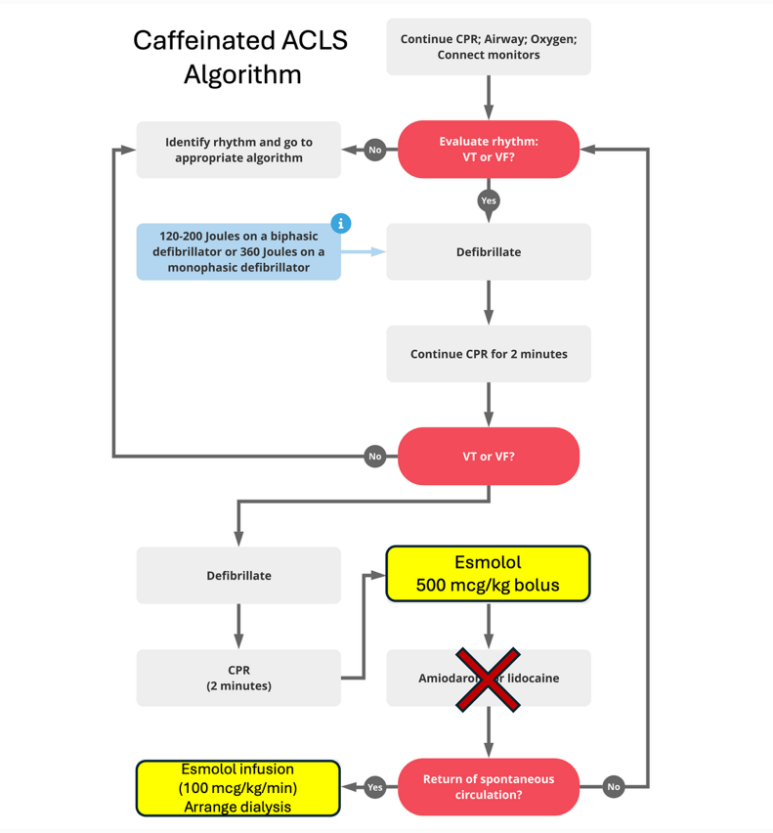
“Here’s where the esmolol comes in: caffeine sensitizes the myocardium to catecholamines, while, at the same time, massively increasing the release of those catecholamines. They then bind to the beta-receptors causing tachydysrhythmias that can devolve into VFib. However, blocking said beta receptors with a beta-blocker will reduce/prevent the arrhythmogenic effects of catecholamine (e.g. epinephrine). Hence needing esmolol– even in the setting of cardiac arrest. This is where management of caffeine-induced VFib departs significantly from the standard ACLS algorithm. Instead of giving epinephrine (which may make matters worse), you can– and probably should– give esmolol.(See these articles 1, 2, 3 for more data on esmolol)”
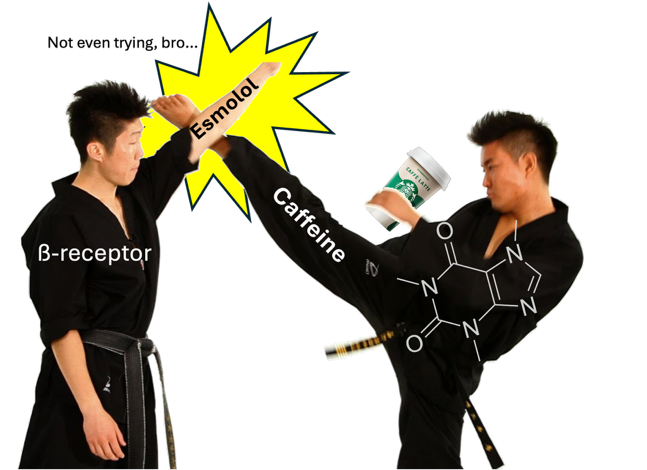
“Furthermore, lidocaine and amiodarone probably serve little purpose in caffeine overdose because they don’t address the underlying arrhythmogenic mechanism (hot take: amiodarone should probably never enter into a cardiotox resuscitation algorithm, but more on that in a future discussion). To really hit this home, I’ve adjusted the standard ACLS VF/VT algorithm below for a caffeine OD:”
Case Wrap Up:
“You know,” says the chief resident, “this isn’t as crazy as it sounds. I ran across a few articles recently that have recommended esmolol (500 mcg/kg bolus followed by 100 mcg/kg/min infusion) for other causes of refractory Vfib, even in the setting of ischemia-induced events. Apparently, a pissed-off heart is the same all around.”
“So that’s the answer? Caffeine arrest = esmolol? Then we’re done?” asks the intern.
“Well, no…” says Dr. B. “Once you’ve got the arrhythmias under control, then you can actually start fixing the problem. And that’s where dialysis comes in. In someone with severe caffeine (or theophylline) toxicity, dialysis is the treatment of choice, especially if they are unstable. Remember, these folks are too sick for NOT dialysis; it is the only way to save them. The good news is that more BP-friendly dialysis methods like CRRT or CVVHD are particularly good for clearance of caffeine and are an ideal choice.”
“And what about the potassium?” asks the nephrologist on the phone.
“Ah, yes. Caffeine can cause a pseudohypokalemia by shifting potassium into the intracellular space. There is no actual potassium loss, and thus normalizing potassium while they are toxic may result in hyperkalemia when they’re non-toxic. Unless the potassium is critically low (say, less than 2 meq/L), leave it alone. It is not the primary driver of the cardiotoxicity.”
“Awesome! Thanks, Dr. B. It looks like the patient is doing well on the esmolol infusion. We’ll get her up to the ICU and get dialysis going.
Recap:
Don’t tell ER doctors, but there actually is a thing as too much caffeine
Caffeine overdose can cause severe cardiotoxicity
Look for tachyarrhythmias, especially refractory VFib
Bidirection VTach is uncommon with a caffeine overdose but a warning sign of impending hemodynamic collapse
On board exams, if you see Bidirectional VTach, consider a digoxin overdose
I’m really really really excited about this ECG. Finding one in the wild is extremely uncommon
Remember, caffeine causes a sympathetic surge while also sensitizing your myocardium to catecholamines
Consider Esmolol in a caffeine overdose to give the heart time to recover
These patients need dialysis ASAP! So, get your nephrology friends on board quickly
Caffeine can cause pseudo-hypokalemia, so don’t rush to correct a low K unless it’s under 2
These patients are extremely tricky! Call your toxicology friends sooner than later
As always, a HUGE thank you to Dr. Bill Boroughf for sharing his cases and expertise with us
Check out his Substack, The Thing About Poison
Hit me up with any questions,
Lloyd
Heading to ICEM 2026 in Hamburg, Germany this year? I’ll be speaking at the Emergency Cardiology Challenges Workshop on 9 June 2026 with Dr. Amal Mattu and friends! Come say hi!
**Looking for a dynamic guest lecture on Emergency Cardiology for your Grand Rounds? Reach out here for a lecture request by Dr. Tannenbaum. If you have reached out already, I have emailed you back. If you haven’t gotten it, please message me directly on Substack or just reply to this email.**
_________________________
Lloyd Tannenbaum, MD
Comments
Nothing yet. Say the first thing.
Sign in to join the conversation.