
The iced tea is ready. Let’s clear the queue.
Readers kept in the dark about a character’s plans are passive readers. Establishing the character’s plans lets readers build anticipation over what’ll happen next.
Chapters aren’t a unit of narrative structure the way scenes are; instead, they play an important role in guiding the reader experience.
A good plot twist must pass the surprising-yet-inevitable test.
This “20k-word rule” of effective drafting works because it gets you to (or almost to) the first structural turning point of the story. (Check out why that matters in the section on Turning Point 1.)
Smell is the most underused sense in fiction—scent associations go straight to reader memories and moods. A master list of scents keeps this tool within reach whenever a scene needs it.
A love story and a romance aren’t the same thing. Figuring out which one you’ve written keeps you from disappointing readers who showed up expecting an HEA.
Romance readers aren’t tired of tropes—they’re tired of books that feel assembled from them. What the romance market actually wants right now, and what’s starting to cool.
The hardest obstacle you can throw at a protagonist isn’t external conflict—it’s a mirror. Five ways to get your character to realize they’re the problem.
What AI can’t replicate makes a surprisingly useful craft checklist: seven qualities of human consciousness to build into your characters, each with a prompt for your current WIP.
Your characters don’t need to track “eyelines,” and your narrator is allowed to just tell people things. Twelve things film has taught writers wrong about fiction—and four it gets right.
Your publisher owns the top of the marketing funnel. Where authors actually fit in the marketing collaboration is the middle, and that’s where most traditionally published authors are leaving sales on the table.
Fiction writers don’t need a platform … until things don’t go as planned. What that actually means for your writing career, and how to build a platform that doesn’t feel like marketing.
Most writers wait until they have a book to start a newsletter. What to write about before you have a book to promote—and why starting early pays off.
Book club readers are already committed to reading and discussing books—they're a pre-warmed audience most authors never actively pursue. Ten ways to market your book directly to book clubs, from your author page to your local library.
A former bookstore owner fielded over a thousand self-published pitches and said yes fewer than fifty times. What actually got a book onto her shelves (and what quietly closed the door).
For most fiction writers, tools like Vellum and Atticus make a DIY interior totally reasonable. When hiring a professional book interior designer is worth it, and what they bring that the tools don’t.
Traditional publishing trades control for resources; self-publishing trades resources for control. How to chart your publishing path based on what you actually want from each book.
We tell novelists they don’t need a platform—then tell them it’s not their fault when books don’t sell. What a forgotten 1980s literary career suggests about the connection between audience and longevity.
BookTok didn’t just change what gets read—it changed what gets written. Who’s controlling the stories writers write, and what it costs when the algorithm becomes the brief.
“Self-publishing” is a misnomer—you’re not supposed to do it alone. What a publishing consultant actually does and how it differs from going the hybrid route.
No one ever wakes up with nothing to say. Why writer’s block might actually be a talking problem is disguise—and how to use that to get unstuck.
You were born creative. Seven ways to get it back (including one that might surprise you).
Your writing is probably being scraped for AI training right now. Five practical ways to protect your work from AI exploitation, including some you can do today.
Beta readers can tell you where they felt confused, but they’re not qualified to tell you how to fix it. Why beta readers aren’t enough and what a developmental editor brings that they can’t.
Why flow alone won’t make you a writer—and what separates those who finish manuscripts from those who don’t.
Most writers know to break up dialogue with physical action. The problem is that the action they reach for—a sigh, a glance, a character shifting in their seat—is stage business, not story. Beats should matter. If you pull them out, the scene shouldn’t just feel bare; it should be at risk of collapsing—that’s how much work a beat can do! How to write powerful story beats that do real narrative work, including examples of five different types and what each one can accomplish.
Story structure isn’t just a blueprint of the plot. Story structure also creates the internal shape of what the character is living through in each act. Beneath the terminology of plot, you’ll spot a larger pattern created as the character works their way from one side of the story problem to the other. The Real Story: Character Journey as Structure maps that pattern across all four acts and gives you practical keywords to guide scene-level planning.
You won’t even recognize a good story idea until you’ve stacked up enough bad ones to spot the difference—that’s the premise behind the three-list brainstorming technique I laid out in How to Generate Better Story Ideas Using the Ones That Don’t Work. The first list maps the predictable terrain; the second is where it gets interesting; the third shows you the outer edge of what your story can bear. “Predictable ideas come quickly and feel safe. Interesting ones feel strange. The best ones might make you a little nervous.”
Two coaching spots have just opened up the summertime: one monthly private coaching spot, and one seat in my weekly Story Lab group.
Private coaching is designed for writers who are actively drafting or revising. Each month includes an initial assessment of your story concept and outline, bimonthly feedback on your pages (up to 25 pages per deadline), a 30-minute coaching session after each submission, email and Slack support all month long, and individually curated craft resources. $599/month.
Story Lab is my weekly small-group coaching program on Wednesday evenings at 6 p.m. US Central. Each session combines manuscript feedback with craft instruction, and a private Slack channel keeps you connected between meetings. Three-month commitment, two tiers: $500/quarter for weekly group sessions, or $800/quarter if you’d like monthly one-on-one feedback on your pages added in.
These spots fill quickly and stay filled for about the length of the time it takes someone to write or revise a manuscript—which is to say a while. First come, first served. Tap the button below to grab your seat!
Onward,
Lisa
This is The Writes of Fiction, a slow-simmered concoction of old and new thinking about writing fiction—the bits I find most helpful to writers finding their way. I hope they help you too.
And this editorial assistant Tsuki’s good side, captured at the emergency vet after she snagged an unwary critter off the backyard fence. The critter didn’t believe a dog could jump that high or run that fast; the retired athlete proved otherwise. (She’s fine now.)
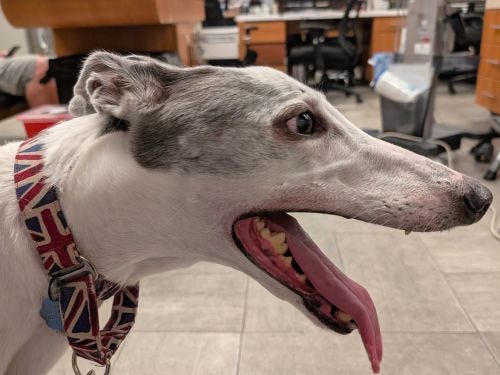
🐾 Support your #editorialassistants via Greyhound Adoption League of Texas.

If you enjoyed this week’s Writes of Fiction, consider a tip for a cup of tea. It’s book coach fuel.

Comments
Nothing yet. Say the first thing.
Sign in to join the conversation.