
Tsuki has this habit of sniffing every single object in a room before she settles: every shoe, every dog toy, every dropped piece of a cracker under the end table. It’s thorough. It’s also, to be honest, exhausting to watch when you just want her to tuck in.
Writers do this too.
The impulse to describe everything in a setting comes from a good place. You’ve created this story world, you can see it, and you want readers to see it too. So you walk through every corner, every surface, and every telling detail. By the time the scene actually begins, readers have long forgotten why they were there to begin with.
Description is not neutral. Every detail you linger on signals something to your reader: Pay attention. This bit matters. When those signals lead nowhere, you haven’t just slowed the pace—you’ve quietly eroded the trust that keeps readers reading.
The fix isn’t to rush back into the manuscript and strip the settings bare. The fix is to ask what each detail is doing in the scene. Is it anchoring mood? Revealing character? Carrying story weight? The room doesn’t need to be replete with inventory; it needs to be alive with purpose.
Starting Tuesday, April 21 at 12:00 p.m. US Central, I’m bringing back our monthly call exclusively for premium subscribers. No slides, no agenda, no performative teaching. Just Q&A and real conversation about writing, every third Tuesday of the month.
If you’ve been wanting a space where you can talk about writing without feeling lost in the crowd, this is it. I don’t have many premium subscribers, so our meeting feels warm and personal, and there’s room for everyone to chime in. It might just be one of the internet’s best-kept secrets for writers serious about growing their craft.
Meeting links will be posted and emailed to premium subscribers the day before our Brown Bag meeting. I’ll see you at lunch!

Is it setting or is in an inventory?
Revealing other characters’ inner life
How to focus your feedback for another writer
What you can learn from a book you didn’t like
When you describe something in detail the reader thinks: This must be important. You’re training them to pay attention. You’re telling them this information will matter.
When details prove irrelevant—nothing on the desk is extraordinary, that extensive hair and wardrobe rundown was pointless, or the character you spent three pages describing never returns—you’ve not only wasted the reader’s time, but have weakened their trust in the narrative.—Read more from Renee Fountain at Gryphon Quill.
More on building credibility with your readers: It’s easy to blame the tinny, artificial quality of an unconvincing story on external factors: plot holes, improbable scenarios. We just don’t believe that the plot could happen that way.
But dip into any well-written speculative novel or a tightly crafted psychological thriller, and you’ll see that readers are keen to be led into all sorts of farfetched nooks and crannies. They’ll overlook a certain amount of hand-waving and even step willingly over minor plot holes as long as the characters are all in.
If characters forge a fathomable path into the story through their thoughts and reactions and emotions, readers will dive in alongside them.—Read more at The link between character thought and credibility.
One of the most effective ways to master the art of creating vivid, substantive, affecting scenes is by learning to pay close attention to how much other people’s actions and reactions are impacting your own—and your entire interaction—and then practice putting that kind of depth and nuance on the page.
Observe not just the other people you engage with, and not merely your own reactions, but the complex dance between the two, and how it’s shaping your interaction in every single moment.—Read more from Tiffany Yates Martin at FoxPrint Editorial.
More on what’s going on inside characters: Like any of us facing a potentially eventful day, characters mentally and emotionally home in on their goals. Are they on the right track? Is today the day they’ll succeed? Or will all the cards come tumbling down?
Even the smallest actions, such as what a character chooses for breakfast, can be influenced by their goals for the day. If today’s the big presentation, will they eat a carefully balanced meal, pound a half dozen donuts, skip food to avoid nervous heaves, or forget about breakfast entirely? The way your character approaches these details reveals what they think is important.—Read more on Building character reactions from the inside out.
Most writers come to a new critique group thinking they’re going to get feedback on the top two levels of the Hierarchy of Editorial Concerns—the grammar, style, and sentence rhythm, with a dash of pacing/tightening thrown in. And to be honest, many writers are most comfortable giving that level of feedback because let’s face it, it’s easier to make one sentence pretty than it is to write a whole book that compels readers to turn pages.
And yet, getting this type of feedback when you’re writing your initial draft can not only be frustrating, but it can keep you stuck working on sentence level concerns when you’ve got big-picture story level issues to address first. So for the same reason I recommend against getting a copy editor when you’re still doing structural edits, I recommend against critique partners giving feedback in those top two levels of the hierarchy when the focus should be on the bottom two levels.—Read more from Julie Artz at Writers Helping Writers.
More on offering useful feedback to other writers: Writing issues usually have multiple causes and potential fixes, so resist the urge to offer the first solution that comes to mind—that’s probably what works for your own writing, not someone else’s. You’re working in their story now, so expand your perspective.
For instance, a character you see as a stiff cardboard token might be articulated in technicolor detail elsewhere in the manuscript; they only feel flat because those characteristics aren’t coming through in the workshopped excerpt. That says more about the scene content and tension than it does characterization, so don’t rush into an incorrect diagnosis.
Stick to description. When you catch yourself thinking, “This character doesn’t seem to be emotionally invested here,” pinpoint exactly where that reaction kicked in. What did you notice that triggered that response?
The skills you build by doing this sharpens your analytical skills and helps you understand how writing choices create reader experiences—and it will transform your ability to revise your own work.—Read how to Make yourself the most useful critiquer in your writing group.
Commenters said “I love her books.” The same words, over and over, with no mention of why anyone loved her books. Nothing about characters, nothing even about plots. Finally, I found a few more adjectives. The author’s book were described as “easy to read” and “fast-paced.”
I DNF plenty of books. If I’d finished and disliked this paperback so much, why was I still turning the pages a second time?
You’re probably shouting that question at me right now. Go ahead, shout away!
Up to this point, I was blaming my memory blackout on the bestselling author’s poor writing.—Read more from Andromeda Romano-Lax at Present Tense.
More on story pacing: tories built on four-act structure (three-act structure minus the oversized, saggy middle) hit those sweet spots consistently. These natural turning points occur at the quarter mark, halfway point, and three-quarter mark, never allowing any section of the story to drag on too long.
Missing these points by a substantial margin results in a misshapen book with sagging or surging momentum. A lumbering, oversized Act 1 bores readers by taking too long to get moving. A missing midpoint creates that notorious bane of three-act story structure, the “mushy middle.” And a mistimed dark moment, one that hits too soon or straggles in too late, can make even a potentially explosive climax fall flat.
Applying story structure to your novel doesn’t imply blind adherence to some lockstep formula. What it suggests is the wisdom of tapping into a storytelling form readers already get—the same ups and downs that have made stories work since people first shared them around the fire.—Find out the Best ways to pace your story’s key moments.
Every detail you include in your manuscript is a subtle instruction to your reader. Trust that they’re paying attention, and choose carefully. You’re building the kind of narrative trust that makes readers follow you anywhere.
Onward,
Lisa
P.S. I’d love to work with you on your book. My next openings are coming up in early summer. Drop me a message, and let’s plan your manuscript’s next steps.
This is The Writes of Fiction, a slow-simmered concoction of old and new thinking about writing fiction—the bits I find most helpful to writers finding their way. I hope they help you too.
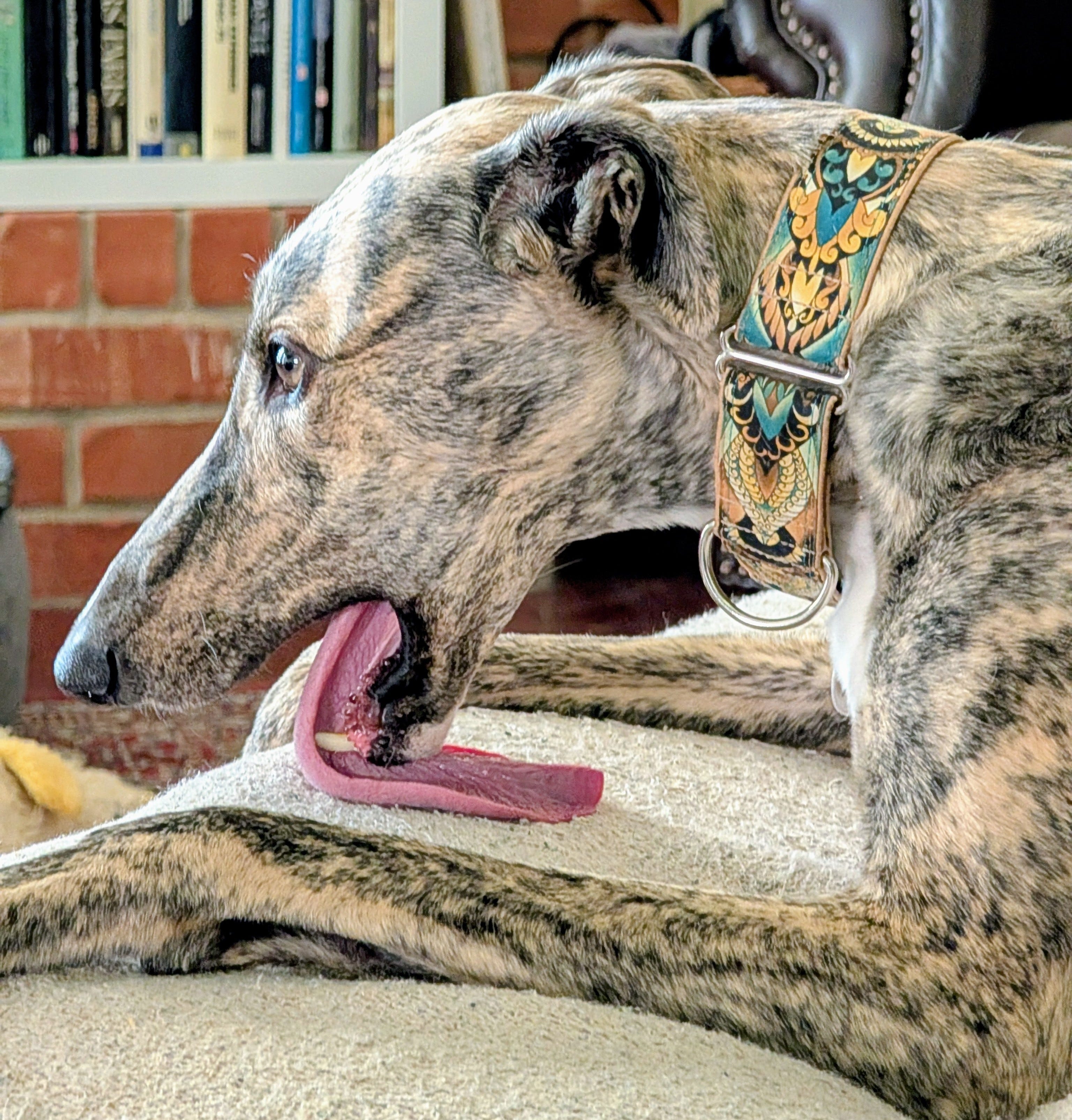
And this is Rémy and his tongue. Stuck again—I love my weirdo.
🐾 Support your #editorialassistants via Greyhound Adoption League of Texas.

If you enjoyed this week’s Writes of Fiction, consider a tip for a cup of tea. This week, I’m drinking Dammann Frères Nuit à Versailles.

Comments
Nothing yet. Say the first thing.
Sign in to join the conversation.