
Last year I thought it would be fun (and it was!) to do a series of little videos in which I gave mini-lectures about some aspect of Halloween History, using items from my collection of Halloween memorabilia. You can view all 20 episodes here:
Let’s do something different this year, something that gives ya a way better visual than my jabberin’ mug: Halloween history via vintage postcards!
In case you don’t know: from about 1910 to about 1925, there were around 3,000 Halloween postcards produced. Most of these cards featured delightful, colorful images which both reflected on and helped to shape Halloween history. Combined with the marketing efforts of companies like Dennison’s, which, starting in 1909, published (almost) annual Halloween decorating guides called Bogie Books, it’s safe to say that American retailing created the holiday we cherish now. Without the postcards and the party supplies, would we have pumpkins, witches, black cats, bats, and owls decorating our homes every October?
I’ve been collecting Halloween postcards for a quarter-of-a-century now and have acquired over 150, so we’ve got a lot to talk about! Let’s start with a classic, one that features Halloween’s three main icons and one that has been reproduced a lot, so you’ve likely seen it already:
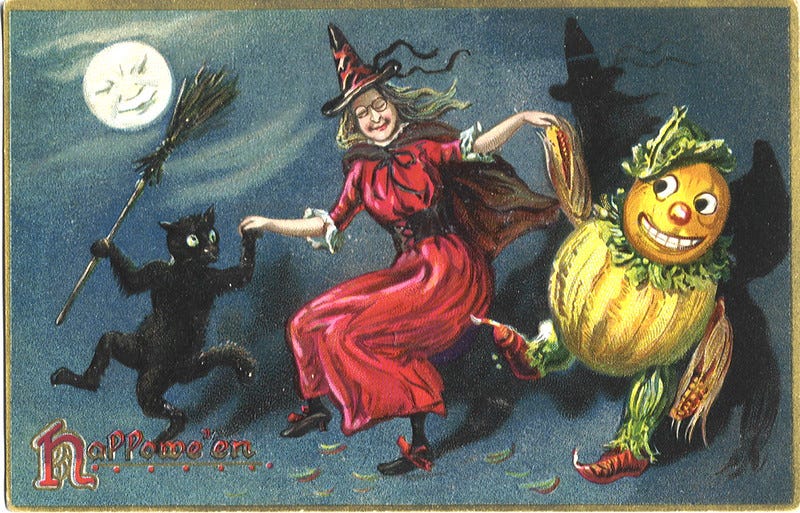
This card probably dates from about 1915. I’ve seen it sold in modern reproductions (I think shops in Salem offered it when I was there), and for good reason: it delightfully captures Halloween’s three superstars - the black cat, the witch, and the jack-o’-lantern - partying together.
Here are a couple of interesting historical points to note: each of those three icons had a famous short story from the 19th century that helped to secure their Halloween icon status: Nathaniel Hawthorne’s “Young Goodman Brown,” Washington Irving’s “The Legend of Sleepy Hollow,” and Edgar Allan Poe’s “The Black Cat.” Even though none of those stories directly names Halloween (although “Young Goodman Brown” may reference it obliquely as “this night…of all nights in the year”), all three became Halloween classics because they were so often told at parties throughout the 19th century.
I’m going to save commenting more on the witch for a later post (here’s a hint: just note that she’s wearing red, not black), and mention the pumpkin man: pay attention to the fact that he’s constructed out of various vegetables, with corn for arms, yams for feet, lettuce for a cap, and pumpkins for both head and torso. This tells us that Halloween back then often doubled as a harvest festival, something reflected in decorating guides from the time that suggest using corn, apples, and gourds to set the mood for your party.
Oh, and by the way: since these postcards are all in the public domain, feel free to share and re-use!
Happy Spooky Season!
Comments
Nothing yet. Say the first thing.
Sign in to join the conversation.