
A few years ago, a neighbor planted a peach tree in their yard along the side of the street. When I would take my morning walk and pass by their house, I would watch the tree grow. That year, we did not have a killing frost after the fruit trees had set their blossoms. Fruit trees put out more blossoms than they can hold all the way to, well, fruition.
I know this because I grew up on an orchard where our biggest crop was peaches. In June, the trees need their baby peaches thinned so the remaining fruit has room to grow to the perfect size. In July, they still need some of their branches propped up so they don’t break their own branches when those peaches come to full size.
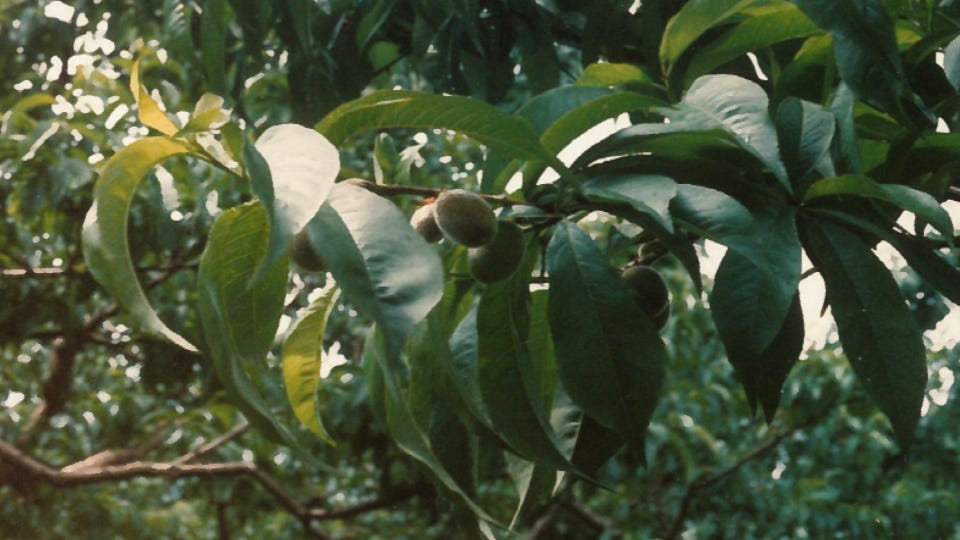
When I walked by those overburdened trees, I didn’t just lament what trouble was coming for them. In the early summer, every time I walked by, I had to resist the urge to thin the tiny peaches. I know how to thin peaches, because I started doing that job when I was 11. Every June for a decade, I thinned peaches on my orchard and later, when I was able to do it well without my parents’ supervision, other neighboring orchards.
When I see a toddler teacher now, luckily, it is my job to invest in what works and thin out what doesn’t. I don’t have to stuff my hands in my pockets and walk on by. How do I know what makes a toddler teacher and what doesn’t? How did I learn how to do toddler teaching? When did it begin?
During those same years that I spent my June mornings thinning peaches, I took on the role of babysitter in my neighborhood. Similarly, I didn’t know what I was doing, but learned through doing it over and over. I could make macaroni and cheese, I could braid little girls’ hair before bed, I could chase down a wild preschooler.
A few years later, in high school, we had the chance to work during one period of the day. Twice, my work was in a classroom where the teacher assigned me one child. One was a third grader, and the teacher seemed to know that he needed more one-on-one time than she could give while teaching the whole class. One was a preschooler who didn’t yet speak English and needed to be loved on.
I never did thin the neighbor’s tree. In the end, it died. First, it grew too heavy a load and broke right down the middle. Then, most likely because of our poor, sandy soil here in Colorado, it just gave up and died.
I didn’t yet know what I was doing as a teacher when I was in high school or even in college, where my work-study job was in a toddler classroom three mornings a week. I just happened to luck into a job where I was supported and recieved excellent modeling for several years.
A colleague who has used her own burnout experience to support others to grow and learn recently asked, “How would you reconginze the beginnings of burnout if it comes again?” Looking back to when the burnout first became recognizable, I might have been able to thin out the many ideas I was pursuing if I had known that was what was coming next — understood the trajectory. I didn’t know. In the middle, I might have been diverted from a downward spiral if I’d sought help to be propped up. In the end, the burnout split me down the middle. But somehow I fell into fertile soil. I know because I’m thriving now.
How did I learn to thin peaches? By doing it, over and over and over, the summers I was 11, 12, and 13. After that, I just knew how to do it. Every place I’ve lived where suburban neighbors have peach (or other soft fruits — I feel the same way about the apricots and plums) trees, I have to shove my hands in my pockets so as not to thin their trees. I’ll admit that if the branches hang over the fence onto the sidewalk, I may pop off a baby peach or two when I walk by, so strong is the urge to contribute to the growth of this year’s fruit and the health of the tree.
When you see the baby peaches wrapped around every branch, you might think that you’ll have a bumper crop. But you’ve got to be able to see their whole trajectory, not just an imagined future of one peach, in the moment. You can’t skip the steps in the middle.
Babies are born ‘kindergarten-ready,’ and what happens between then and kindergarten determines whether and how much of their kindergarten readiness they keep. When you see a baby, you might not think anything is happening now that matters to that future. But you’ve got to be able to see their whole trajectory grounded in this moment. You can’t skip over the best part.
When I took on a vision of the future, I couldn’t even fully put words to it. Bigger, more, better. But not detail and small steps. I said, sure I’ve got time, but it turned out time doesn’t expand to fit the size of dreams. They need to be thinned to thrive. When letting go of the projects and passing them on became the only path forward, all I could do was what I already knew how to do. Before I knew what was coming, mercifully, I had written down the steps for the things I had done over and over. I had written down the annual steps so that they would be easier the next year. And then I handed them off to someone else.
Luckily, I became a toddler teacher at some point, and luckily, that journey began with a student assistant and then a floating/substitute lead teacher before I actually took lead responsibility for a group of toddlers. I got to learn by doing. And skills transferred from other roles I’d tried on to this one.
For a few summers, I gained experience as a lifeguard, in addition to peach thinning and babysitting. As a lifeguard, I was taught some key skills, such as how to enter the pool as quickly as possible and pull a child up before they even hit the bottom when they jump in over their head.
But some skills I learned by doing over and over all day long. One of these was counting children. We kept a count as children checked in, so we knew when to bring one more guard on deck. But I’m sure I wasn’t the only guard who also silently counted in my head all day long.
When I became a toddler assistant, I didn’t even realize I was counting the children throughout the day.
One winter day, we arrived back in the hallway and were busily taking off coats and snowpants when something felt off. In my lifeguard habit, I stood up and quickly counted; in fact, only 8, instead of 9, toddlers were in various states of undress on the foyer floor.
A was standing alone in the middle of the snowy yard, looking at the door. When she realized she was alone, she froze in place. As soon as I saw her, I quickly went out and scooped her up. The gap could not have been more than two minutes. From then on, I took this into my role as a student assistant teacher. More important than supporting the lead teachers to implement the day's curriculum plans was knowing how many children should be there and making sure they all were.
What did I learn that day, now more than 30 years ago, when I looked through the glass doors and saw A’s confused and about to cry face through the windows?
It was just one time, not the repetitive practice one might think it takes to build a skill — but here too, I learned by doing. I wasn’t in charge at that time, but when I became a lead teacher of my own toddler classroom only a handful of years later, I never had to learn that lesson again. Double- and triple-checking my count of toddlers was always part of my work all day long.
Mundane? Yes. Critical? Yes.
The work of a toddler teacher is always both care and education. Having also served as a kindergarten and a fourth-grade teacher, I can tell you that ALL teachers, at least through elementary school, certainly provide both care and education. But the scope of skills and activities and pedagogies and tasks is far more vast for infant and toddler teachers than for anyone else along the continuum!
Balancing safety with the child-driven exploration that builds the foundation for a lifelong curious learner is a critical role — the preschool or later teachers can’t put that back in if it has been taken away from babies and toddlers.
They, too, learn by doing, over and over, day in and day out, that they are autonomous, explorers, interest-followers, community members, and so many other parts of their humanity.
Sometimes, we think we can skip the learning-by-doing—for peaches, for babies, for ourselves. Some might think just anyone could thin a peach tree. I can tell you, from watching failures over the years, that one has to know what a ripe peach is like to think backward and thin the tree just right.
And they have to care and know that it matters.
Some might think just anyone could be a toddler teacher. I can tell you from watching failures over the years that one has to know what the next steps in development are to interact with toddlers day in and day out in ways that help them grow.
And they have to care and know how much it matters that they do.
I cared so deeply, and I knew what the trajectory could be if we got it right, when I worked in the role where the burnout took hold. I wanted so badly for this year’s fruit to be perfect that I tried to grow it myself, and I wanted so badly for the soil of the early childhood system to work and be healthy that I similarly threw myself into it. I tried so many productivity hacks to make the passion work fit into the ordinary day. What if what I needed was to be thinned, to have props, and for there to have been fertile soil?
If the easy way is to learn by doing, the hard way is to imagine that teachers can jump over the steps in the middle. We might think we can skip over that part by writing out what all the teachers need to know and be able to do, or just telling them what to do. But they have to start where they are. And when you are right there where you belong, someone sees something in you and where it could grow. Likely, it begins with you needing a job, likely it begins with you asking for this job, or something sends you to this job.
The hard way is to imagine that studying the competencies could possibly have any meaning in a vacuum and to try to learn that way. Or that they can learn all by themselves.
The easy way is to notice the blossoms and, having known many peaches and trees in your life, to know which ones to knock off and which ones to leave to grow. The scarcity mindset sometimes gets in the way of this process.
For years in my garden with poor soil, I’ve lamented at the end of the year that no tomatoes grew ripe before the frost. But I’ve never been willing to thin out the vines so that the plants could focus on the fruits. This year I grew them in straw bales and hot sun and somehow the conditions were good enough for them to turn toward ripening and away from sprouting and sprouting. They too wanted to be in the right conditons for growth, they too want the beautiful future to come to pass.
The burnout, from my vantage now, was not a discontinuity or anomaly. There was no other path. I couldn’t come to know what burnout looks and feels like without seeing and feeling it on the path I was on. I read a book during the early phases of recovery (I used to write about ‘the recovery’ as if it was finite too, but now I think they are both infinite—an infinite spiral and an infinite jest) that included a story of someone’s client who used the prhase “just love this” to remind herself to stay present in the moment, even when it was a hard moment. I didn’t just love the burnout when I was in it. I stayed in it because, at my core, I just love the possibility that every baby could grow up healthy, now that we know how that works. I wanted to stay and make it right, make it happen. Now I just love that I have this part of my journey to make me stronger, more flexible, and more likely to ask for and give help.
The easy way is to show up, learn by doing, and be supported. It's a little like thinning peaches. I can’t explain how I learned that, except that I did, and I was supported to do so.
Comments
Nothing yet. Say the first thing.
Sign in to join the conversation.