
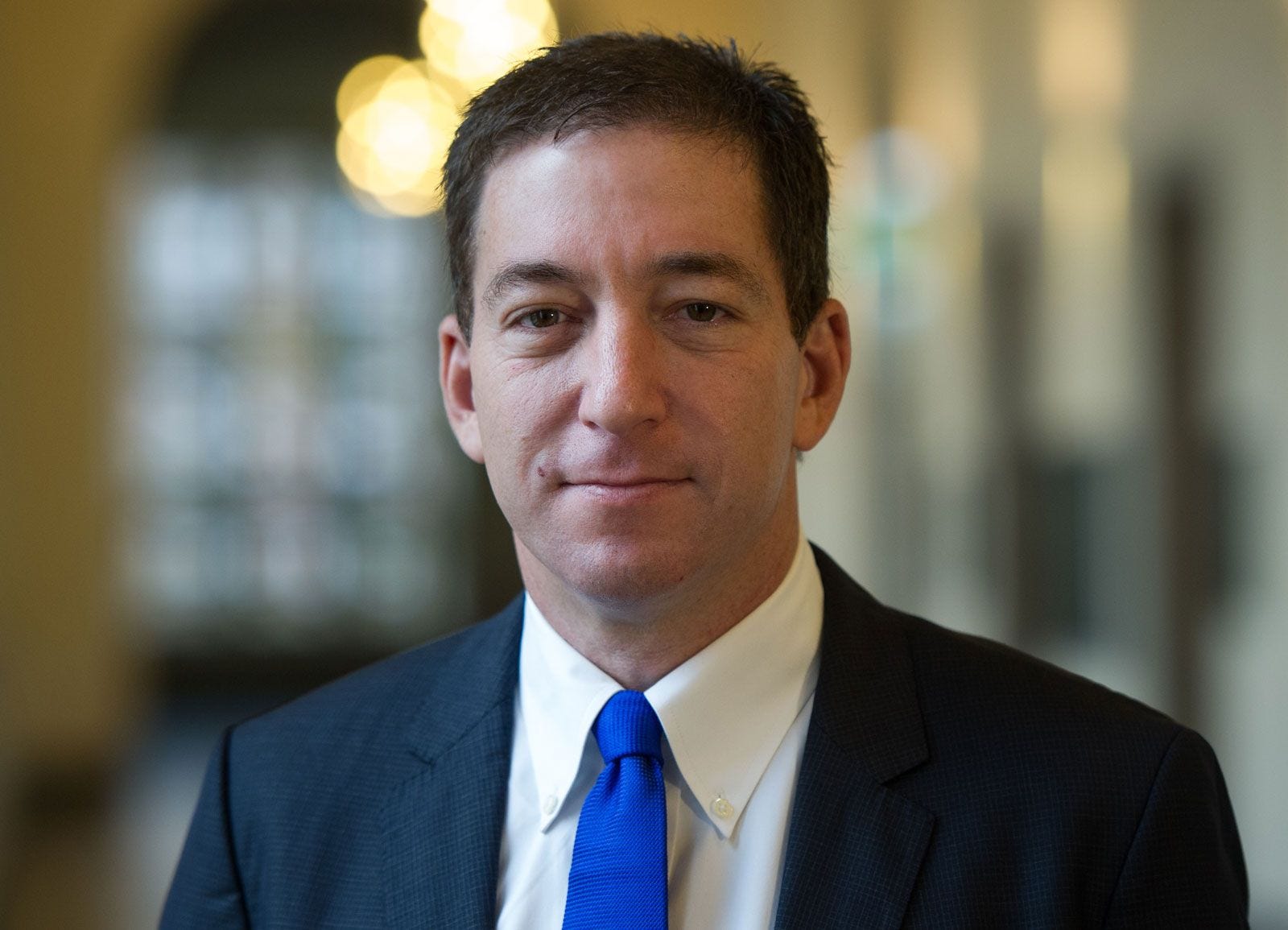
I was in my car listening to my favorite show, System Update, when Glenn broke the news that he is pivoting and the five-days-a-week show won’t be continuing. I will admit, my heart immediately sank. But then came the second part of the announcement. He’s coming back to Substack. That announcement made me feel better right away.
For anyone who isn’t familiar with Glenn’s background, he didn’t take the traditional path into journalism. He began as a constitutional lawyer, which explains his deep commitment to free speech. Long before censorship became a “bipartisan hobby,” Glenn was litigating and writing about government overreach, warning people about where all of this could lead.
Glenn knows what he’s talking about. He rose to prominence during the Edward Snowden revelations in 2013 while writing for The Guardian, helping to expose the staggering scope and unconstitutional overreach of NSA surveillance. That reporting earned a Pulitzer Prize and permanently altered the public conversation about privacy and the national security state. Later, he co-founded The Intercept, envisioning it as a home for independent, adversarial reporting on intelligence agencies and war. In 2020, he resigned after alleging that his own editors attempted to block his reporting related to Joe Biden, a dispute that, ironically, seemed to illustrate many of the institutional pressures he had spent years criticizing and ran quite counter to what was supposed to be The Intercept’s mission.
What stands out to me is that Glenn doesn’t shape his principles around whichever party is in power. Earlier in his career, many of his civil liberties positions were embraced by the left. But as the Democratic establishment grew more comfortable with censorship frameworks, intelligence agency narratives, and tighter relationships with corporate media, he didn’t quietly evolve to fit the new orthodoxy. He became one of its most persistent critics. At the same time, he has never hesitated to dismantle Republican hypocrisies either. His anti-interventionism, his skepticism of intelligence agencies, and his insistence on civil liberties apply to both sides, as they should.
On System Update, he did all of this with a level of sarcasm and wit that made even the most infuriating topics feel a little more bearable. There’s something uniquely satisfying about watching him calmly deconstruct a media panic, cite primary sources, and then let the absurdity hang in the air so viewers can appreciate it and make up their own minds.
A lot of people unfortunately treat their political party like it’s a sports team. Your side wins or loses and you cheer them on no matter what. But what happens when your team begins defending things you fundamentally oppose in your very core? When it champions policies you are morally against? At some point, cheering out of habit starts to feel dishonest. Glenn has spoken about this at times, and it resonated with me, because I left the Republican Party myself when I was in college, when it simply wasn’t working for me, and registered as an Independent.
As many of you know, the pandemic was brutal for me. I was living in NYC when it started, in an environment where deviation from consensus was treated as moral failure. Everything became hyper-politicized under COVID. Even though I was a libertarian, New York liberals began treating me like a “Trumper,” as if I was some kind of leper. I didn’t want to take the vaccine because I didn’t believe it had been tested long enough, and I found myself disinvited from events by people I had considered good friends. This came shortly after a separate wave of “friends” distancing themselves during Trump’s first term because I wasn’t anti-Trump enough (whatever that means). I got so much hate, even though at the time I was so fed up with both sides, I didn’t even bother to vote. It was isolating in a way that is difficult to explain unless you’ve lived it.
Before Glenn’s show, I had been a dedicated Kennedy watcher, but her program was tabled early in the pandemic. I pivoted to Tucker, who was undeniably brave when bravery was in short supply and who provided one of the few consistent anti-war voices left in legacy media. Still, something was missing. When System Update launched toward the end of 2022, it felt like perfect timing. I was already on a path toward recovering from the awfulness of NYC pandemic life, and this was another turn for the better. Having a show that helped me feel like I wasn’t a weirdo for questioning the Ukraine war, opposing mandates, standing against censorship, even when it targeted groups I was part of, and finding flaws on both sides of the political aisle made a real difference.
What I loved most was that Glenn didn’t stay confined to one narrative lane. He covered COVID policy, but he also went deep into the Ukraine war, media corruption, intelligence agency influence, and the broader erosion of free expression. He even covered topics that are near and dear to his heart, like animal cruelty on factory farms. He would critique liberal orthodoxy one night and conservative opportunism the next. I appreciated that he sometimes said things I disagreed with. It’s good to be challenged, because it helps you figure out where your views might be weak or even wrong. Glenn really encourages critical thought from his viewers.
When Tucker went off the air at Fox and Kennedy’s restarted show was canceled in 2023, I wasn’t too upset because I still had Glenn. System Update became that steady, independent voice I could rely on daily. While X helped create space for those of us questioning the government narrative around COVID, Glenn’s show provided something more sustained and thoughtful. It felt grounded in principle rather than reaction.
While I will genuinely miss listening to System Update every day and the rhythm it created in my routine, I am truly looking forward to what this shift represents. Substack feels like a more expansive space. It allows for deeper dives, longer arguments, more nuance, and perhaps even more of that layered analysis that first drew so many of us to his work.
There is something fitting about Glenn returning to long-form writing at a time when media feels increasingly shallow and reactive. If the last few years have shown anything, it’s that independent voices are of critical importance, and platforms that allow writers to speak directly to readers without institutional filters are necessary.
I’m genuinely excited about what he builds next, what subjects he chooses to take on, and how his voice continues to evolve. If his career has shown us anything, it is that he adapts without surrendering his core principles. The next chapter will be interesting indeed.
You can follow Glenn’s Substack here:
No posts
Comments
Nothing yet. Say the first thing.
Sign in to join the conversation.