
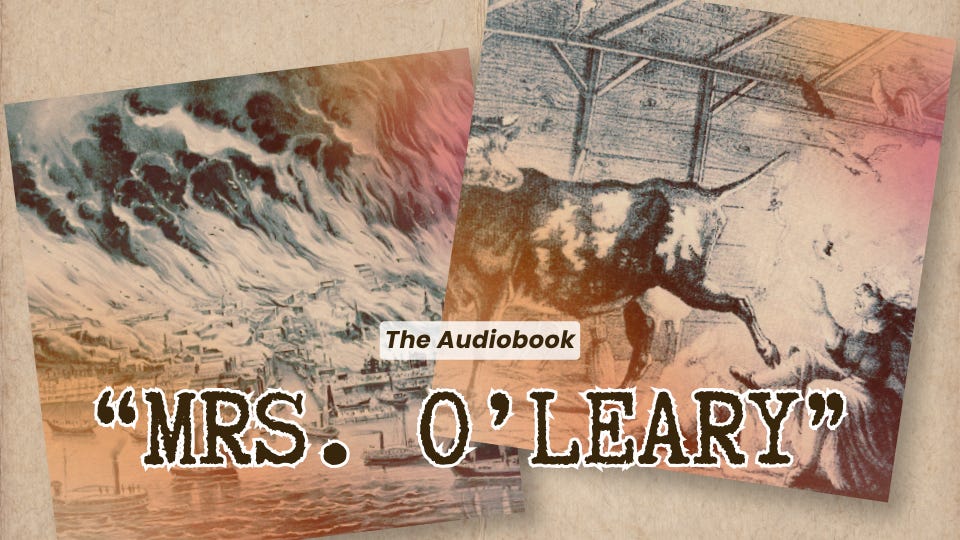
I love audiobooks, and I love fiction that brings to life the real stories of important people and events in time. So when I learned that my good friend, talented creative Melissa Birks, was seeking support for an audiobook based on the life of noted Chicagoan Mrs. Catherine O’Leary, I was all in. Melissa’s project had already been on my radar when my talented nephew performed a table read of the play upon which this audiobook is based. (Spoiler alert: Melissa is the sister of my brother-in-law, so she is that actor’s aunt as well!)
As soon as I saw that Melissa had launched a crowdfunding campaign on Seed & Spark to bring Mrs. O’Leary to the audiobook format, I asked if I could interview her to help share this story. According to Wikipedia:
The Great Chicago Fire was a conflagration that burned in Chicago, Illinois, United States, during October 8–10, 1871. The fire killed approximately 300 people, destroyed 17,000 structures across roughly 3.3 square miles (9 km2), and left more than 100,000 residents homeless. (Source: Wikipedia)
Even now, 155 years after the Great Chicago Fire, most of us don’t know the true backstory behind the conflagration. Catherine O’Leary, a faithful, hardworking Irish immigrant, was wrongfully accused of starting the fire and was not exonerated until 1997. And I’m willing to bet that most of us still don’t really know “the rest of the story” that Melissa and her team of actors are telling.
Crowdfunding enables creative projects like Mrs. O’Leary to have life. Because I would never ask you to consider supporting something I don’t believe in, I want to say upfront that I’ve already made a donation to fund this project. I share that not to toot my own horn, but to remind you that as someone committed to sharing stories that matter, I believe in this work. Today, I’m happy to share my conversation with Melissa Birks and to invite you to participate in “Freeing Mrs. O’Leary” by learning more about this work. Even small participation matters in sending a message that stories make a difference. I know you’ll love Melissa’s brand of wit and narrative!
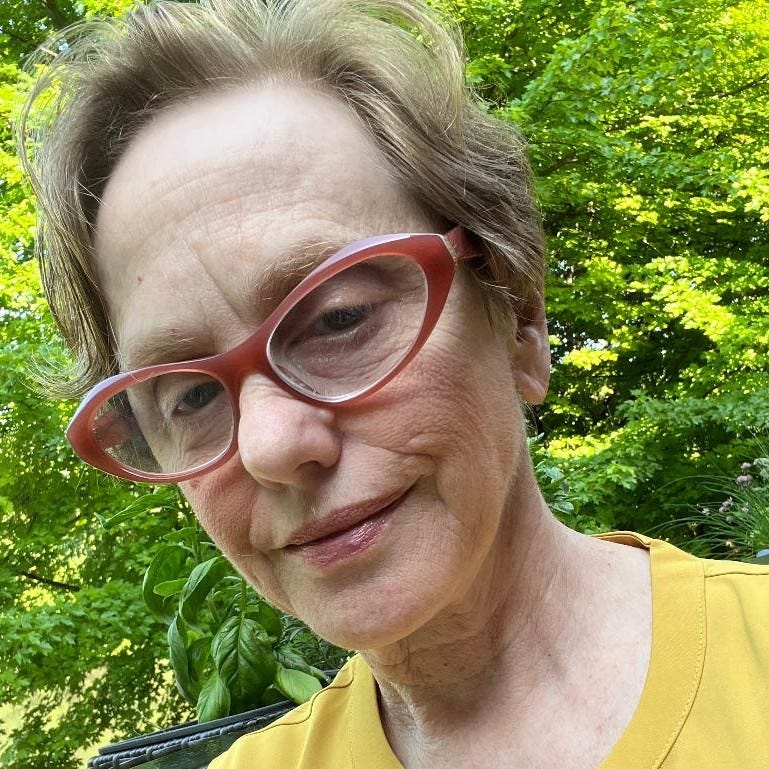
Q: For readers who may not yet know your work, would you please introduce yourself and share a bit about your creative background as a writer and storyteller?
My background as a storyteller dates back to my youth. At age 10, I earned honorable mention in a writing contest for my hometown newspaper – a small accolade that made a big impression on me. Maybe, I thought, I could be a writer one day. Years later, I started my professional career as a reporter at that same newspaper. That was five newspapers and a few other pursuits ago, including, most recently, as a writer for law firms and lawyers. Don’t dismiss the law as a dry creative mine, by the way. The Trial of the Chicago 7, anyone?
I started writing screenplays when I was still a journalist, intrigued by the idea that some stories that I read in and wrote for newspapers could be compelling on the screen. I was drawn to the screenplay structure and its economy of words. Over the years, I’ve experimented with pilots and shorts, but my focus is on features. Speaking of the law as an inspiration: I wrote a legal drama based on the case of a 1930s-era serial killer, one of my favorite scripts in my portfolio (along with Mrs. O’Leary, of course).
Q: What first drew you to the story of Mrs. O’Leary, and what was it about her life that convinced you this was a story worth telling?
In early 2025, my mother happened to read me a brief excerpt about Catherine O’Leary in a book called Bad Days in History by Michael Farquhar. I immediately envisioned Mrs. O’Leary’s story as one worth telling because of the excruciating tragedy of Oct. 8, 1871—the “Great Fire” itself and its life-changing impact on a vulnerable, obscure Irish immigrant whose barn was in the wrong place at the wrong time.
Q: Many people know Mrs. O’Leary only through her connection to the Great Chicago Fire. What aspects of her life and character do you hope audiences will discover through this project?
I hope that audiences will discover Catherine O’Leary and her husband, Patrick, as solid, stalwart members of their community on Chicago’s west side. They belonged to Holy Family Church. They owned their home at 137 DeKoven Street; they bought it after Patrick served in the Union Army. They even owned a separate home on their parcel, which they rented. By all accounts, Catherine O’Leary was an industrious businesswoman who supported her family as a milkmaid. We know very little about Catherine O’Leary as a character. After the fire, she remained largely a recluse until her death in 1895. In Mrs. O’Leary, I use my imagination to develop her character as a feisty businesswoman with a biting wit, but also with a quiet attraction to a character who seems to be her ally but isn’t.
Q: The themes of reputation, truth, resilience, and public judgment seem especially relevant today. In what ways do you think Mrs. O’Leary’s story speaks to contemporary audiences?
I think that contemporary audiences will find eerie parallels between Catherine O’Leary’s world and our own. Mrs. O’Leary focuses on the day of the fire and the months that followed through the end of 1871. The spine of the narrative is the investigation by the city’s Board of Police and Fire, which modern audiences will recognize in any number of government bodies that oversee or audit a public service—or in the response to a public tragedy.
Contemporary audiences will also recognize the kind of public judgment that Catherine O’Leary faced in the aftermath of the fire because it wasn’t so different from what we see today in “cancel culture.” In one scene, for example, she complains about the cruel jokes that the local newspapers made at her expense. In the final scene, the audience learns that one newspaper’s headline on her front-page obituary was “Mrs. O’Leary Is Dead. She Was Noted Principally Because of Her Cow.” Catherine O’Leary didn’t live in a world of social media, but she did live in a world where the media mercilessly trolled her just as it would today. I think these themes will resonate with modern audiences.
Q: You are now adapting Mrs. O’Leary into an audiobook. Why did you choose the audio format, and what opportunities does it offer that differ from a traditional print experience?
I chose an audiobook because I thought it would be more accessible to modern audiences than a screenplay or a play, both of which need the power of producers to get in front of audiences. This audiobook is powered by 12 talented voice actors and a digital engineer. The format offers modern, multi-tasking listeners the opportunity to hear the story on their schedule, on demand, with a click on the distribution platform.
Q: This production features a human cast and creative team at a time when artificial intelligence is increasingly being used in publishing and entertainment. Why was it important to you to create this work through human collaboration and performance?
I don’t use AI to write, so it’s not a factor in my creative process. I’ve written three versions of Mrs. O’Leary, and I’ve been lucky to collaborate with humans for each adaptation. It’s important to me to get human feedback and performance. For example, I submitted the screenplay adaptation to a workshopping group that is held on Zoom, so humans around the globe can participate. Actors read the full script, and then other members offer their feedback in real time. A workshopping program like that one runs on human collaboration: facial expressions, tone of voice, conversation.
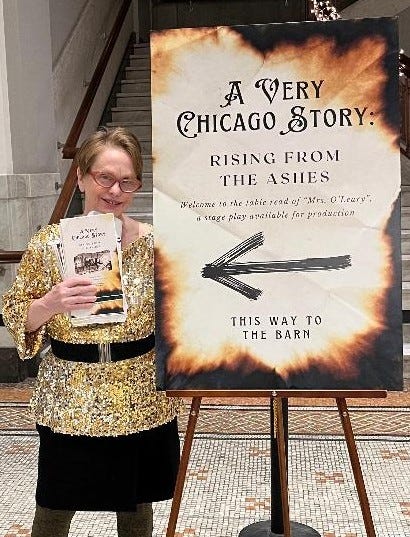
The same is true of a play. Last December, I collaborated with 12 actors to stage a table read of the play adaptation. I was able to watch the performances and watch the audience response. Did they laugh at that joke? Did they gasp? It’s important to me that humans bring the story to life for the audience, whether they are and however they are consuming the art. An AI tool is no substitute.
Q: I understand that you cast an up-and-coming young actor with the same last name. Any relation?
That young actor is my nephew, and I was proud to cast him.
Q: Creating independent art is never easy. What have been some of the biggest challenges you’ve encountered while bringing this project from concept to production?
The concept is just the beginning and probably the easiest part. For me, the biggest challenge I’ve encountered is getting the art in front of audiences. I won’t speak for other writers, but I’m an introvert and never happier than when I’m sitting at my computer writing – no outside forces or voices. I’m not a natural networker, so my challenge will always be making connections that will help me bring a concept to production.
Q: You’ve launched a crowdfunding campaign to help bring the audiobook to life. Can you explain how the campaign works, what supporters receive, and how readers can join the project?
Thank you for letting me share my crowdfunding campaign! I’m raising money to compensate the actors and the digital engineer, and to pay for marketing efforts to promote the audiobook when it’s ready for distribution. The platform I’m using for my campaign is Seed & Spark, which focuses on creative projects like films. On this platform, the artist sets their goal and the campaign timeframe. In my case, I’m trying to raise $10,000 from June 1 to July 1. The artist also describes their “wish list” – that is, the items that the campaign will fund – and “incentives” that they will give donors depending on the amount they pledge.
The incentives that I’m offering include, among others, free promo codes for the audiobook and a cute, personalized “I Freed Mrs. O’Leary” certificate (suitable for framing!). Donors make their pledges on the platform, but the artist doesn’t collect any funds until they've raised 80% of the goal ($8,000 for me). I’d be so grateful if your readers would check out the campaign and support the project, if they can. The expression is overused, but it is true that “every little bit counts.”
Q: What have you learned about storytelling, creativity, and perseverance through your work on Mrs. O’Leary that might encourage other writers and artists pursuing their own projects?
I would encourage writers, first, to persevere by finding different media for their stories. For example, I’ve been writing screenplays for years, and when a Chicago consultant who read Mrs. O’Leary encouraged me to adapt it into a play for Chicago theater-goers, I hesitated. I’d never written a play. Now, I have. When one of the actors in the play suggested that I adapt it into an audiobook, I didn’t hesitate. By that time, I felt confident in the story and my ability to tell it in a different way for a different medium.
Second, I would encourage writers to understand their strengths and collaborate with creatives whose strengths differ from their own. I’m thinking of networking, for example, or navigating technology or social media if that’s not your thing.
Finally: Don’t let perfection be the enemy of the good. I can’t take credit for that priceless wisdom, but I’ll shamelessly steal it and pass it along to any readers who stop themselves before they start. You can’t improve your writing if the page is blank.
Q: As you look ahead to the audiobook’s release, what are you most excited for listeners to experience, and what do you hope they carry with them after hearing Mrs. O’Leary’s story?
I’m excited for listeners to meet all these characters—Catherine O’Leary, of course, but also others in her orbit, including her husband, their neighbor, and the leader of the Board of Police and Fire. I’m excited for listeners to hear voices and sounds of 1871 Chicago. I’m excited for listeners to tune in and let their imaginations take them on the story.
Bonus Question: If Mrs. O’Leary could listen to this audiobook today, what do you think she would most want modern audiences to understand about her life?
Remember that headline on her front-page obit? “She Was Noted Principally Because of Her Cow.” If Catherine O’Leary were with us today, I think she’d want modern audiences to understand that “I’m noted for more than my cow.” I think she’d want modern audiences to know that she was a businesswoman, a wife and mother, a member of Holy Family parish, and part of her community. I hope, if she were with us, that she’d enjoy hearing her own voice performed by a talented actor. And if she were with us, I’d say this to her: “I hope I did your story justice.”
To learn more about Mrs. O’Leary:
Follow along on Instagram: Melissa Birks, Free Mrs. O’Leary
A question for you: What historical event would you like to see retold as a book, film, or play? (I’ll go first in the comments below)
No posts
Comments
Nothing yet. Say the first thing.
Sign in to join the conversation.