
Reading time: ~7 minutes
You closed your laptop at six. One decision is still sitting
open, the kind only you can make. You didn’t think about it once through dinner.
Your shoulders didn’t get the memo. Neither did the part of your mind that’s supposed to be off the clock.
You’d call it stress if you had to name it. It isn’t quite that. It’s something narrower and more specific: a piece of unfinished business your mind hasn’t been told it can put down.
In the 1920s, a Lithuanian psychologist named Bluma Zeigarnik noticed something odd about waiters in a Berlin café. They could recall a table’s full order in detail right up until the bill was paid. The moment it was settled, the memory vanished, fast and completely (Zeigarnik, 1927).
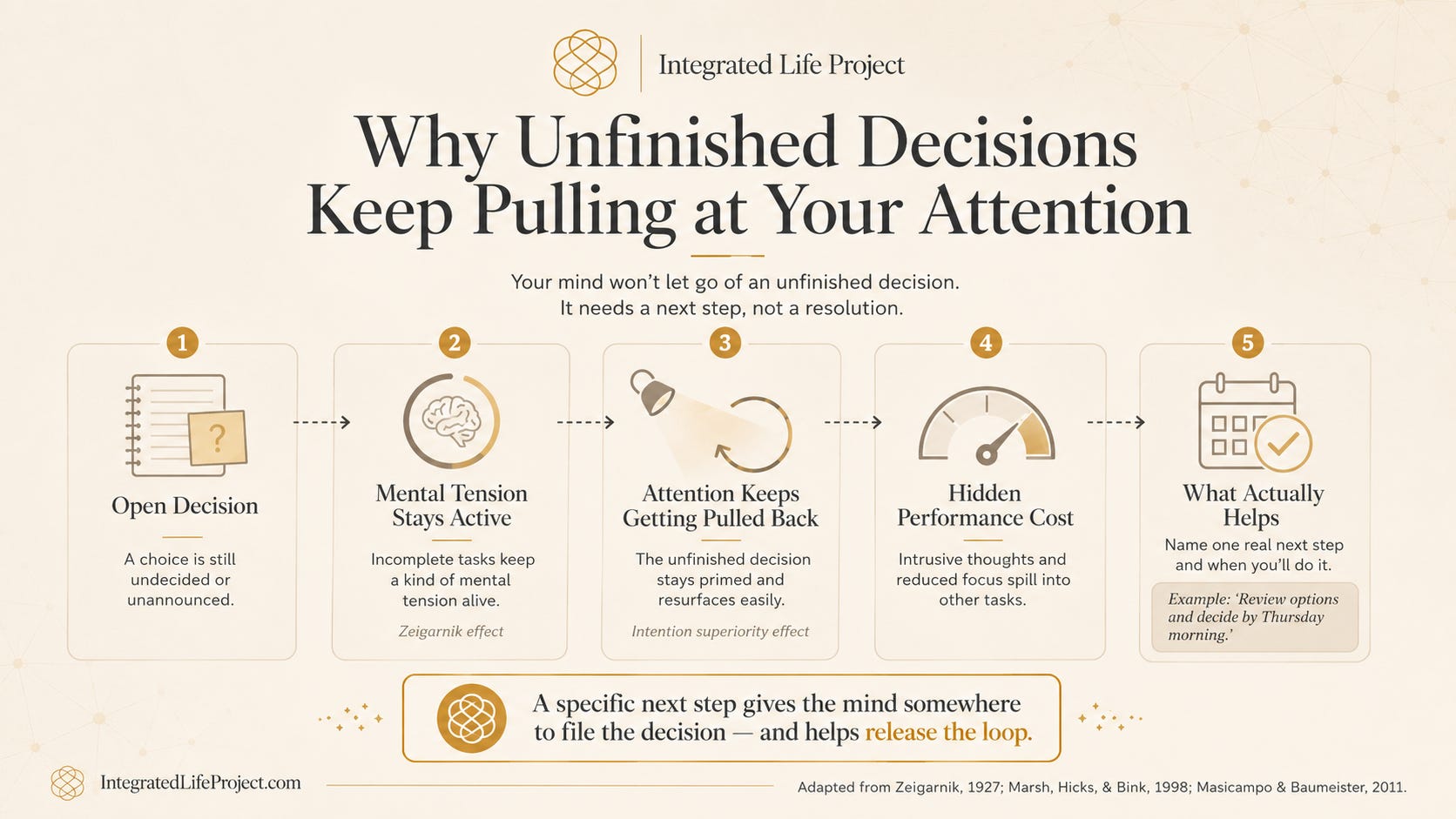
Zeigarnik took the observation into the lab and found the same pattern held for ordinary tasks. Give someone a string of small assignments and interrupt half of them before completion, and the interrupted ones get remembered far better than the finished ones. Her explanation was that an incomplete task keeps a kind of mental tension active. Once it’s finished, that tension releases, and the mind is free to let it go.
Nearly a century later, the pattern still holds, and it turns out it isn’t just about memory. It’s about where your attention actually goes.
A finding from memory researchers Richard Marsh, Jason Hicks, and Martin Bink gives this some teeth. Using a task where people had to recognize words as quickly as possible, they found that words related to something a person hadn’t yet finished were recognized measurably faster than ordinary, unrelated words (Marsh, Hicks, & Bink, 1998).
That’s a strange thing for an “unrelated” experiment to find. It means the unfinished task wasn’t just sitting quietly in the back of someone’s mind. It was primed, active, and ready to surface the instant anything nearby touched it. Researchers call this the intention superiority effect. Your unfinished decision isn’t dormant while you’re at dinner. Some part of your cognitive system is keeping it warm, whether you’re consciously thinking about it or not.
Here’s where the research turns from diagnosis into something useful. Psychologists E.J. Masicampo and Roy Baumeister set out to test whether an unfinished goal has to be completed to stop draining attention, or whether something smaller would do.
Across several studies, they confirmed the cost was real: an unfinished goal caused intrusive thoughts during an unrelated reading task, and it measurably hurt performance on a separate problem-solving task afterward. Then came the useful part. When participants were given a few minutes to write a concrete, specific plan for how and when they’d tackle the unfinished goal, later, not now, the intrusive thoughts and the performance hit both disappeared (Masicampo & Baumeister, 2011).
The goal wasn’t completed. Nothing about the underlying task changed. What changed was that the mind had somewhere to file it. And critically, the effect only held for plans people actually meant to follow through on. A vague, unconvincing plan didn’t do much. A real one, with a specific next step attached, did.
Share The Integrated Life Project
None of this argues for finishing everything today. Most of what’s sitting open on your desk can’t be resolved in an afternoon, and treating it like it should be is its own kind of pressure.
Give every open item a real next step, not a resolution. Since Masicampo and Baumeister’s effect depended on the plan being genuine, not just written down for the sake of it, the useful move isn’t deciding tonight. It’s naming precisely when and how you will: “I’ll review what I need and decide by Thursday morning.” Specific enough to actually happen.
Notice the difference between undecided and unannounced. An open loop isn’t only a decision you haven’t made. It’s also one you’ve made and haven’t communicated. Both keep the same mental tension active, according to this research, so a decision you’re sitting on to protect someone’s feelings costs you the same as one you haven’t reached yet.
Build a real end-of-day close-out, not a mental review. Since the intention superiority effect runs whether or not you’re consciously thinking about the task, silently reassuring yourself you’ll “get to it tomorrow” doesn’t turn it off. Writing the next step down, even briefly, is what the research shows actually does.
You’re not carrying these things because you’re disorganized. You’re carrying them because your mind hasn’t been given anywhere else to put them. Give it somewhere, and it stops asking.
“What’s the one decision you’re sitting on right now that isn’t finished, but also isn’t moving? Reply and tell me. I read every one.”
This is the fourth in a five-part series on the physiological patterns that quietly shape a high-performing leader’s day. Next: why your fifteenth decision of the day is never as good as your first, and what that actually costs you.

Lisa Bollow is a therapist, neuroscience-informed performance strategist, and founder of Integrated Life Project. Her work examines how nervous system regulation, emotional clarity, and cognitive capacity shape leadership, decision-making, well-being, and sustainable performance, integrating clinical insight, neuroscience, and practical strategies for high-functioning individuals and leaders.
Read more on Substack: https://integratedlifeproject.com
Connect on LinkedIn: https://www.linkedin.com/in/lisagoodwinbollow
View my Psychology Today profile: https://www.psychologytoday.com/profile/1572857
References
Marsh, R. L., Hicks, J. L., & Bink, M. L. (1998). Activation of completed, uncompleted, and partially completed intentions. Journal of Experimental Psychology: Learning, Memory, and Cognition, 24(2), 350–361.
Masicampo, E. J., & Baumeister, R. F. (2011). Consider it done! Plan making can eliminate the cognitive effects of unfulfilled goals. Journal of Personality and Social Psychology, 101(4), 667–683.
Zeigarnik, B. (1927). Das Behalten erledigter und unerledigter Handlungen [On finished and unfinished tasks]. Psychologische Forschung, 9, 1–85.
Comments
Nothing yet. Say the first thing.
Sign in to join the conversation.