
Last year we made a film about how the green transition in shipping is, as it currently stands, basically a massive scam. We followed a ship along a so-called “green corridor”, tracking it in real-time over the course of a month as it moved from Rotterdam to Singapore. Whilst doing so, we recorded ourselves chatting about upcoming maritime regulations and fuel trends. It showed at Busan Sea Arts festival.
You can watch it here:
There’s a lot we didn’t manage to fit into the film, without making it overly long and boring. Also, a lot has changed in 6 months. Here are some notes on that.
Seeing Through Green Fuel
Moving the vast majority of things around the world takes a lot of energy. Most of the energy that moves those things comes from bunker fuel. Bunker fuel is also known as Residual Fuel Oil or Heavy Fuel Oil, neither of which sound great. It is the oil you have leftover when you’re done making other kinds of fuel. Petroleum is to Bunker Fuel what extra virgin olive oil is to pomace oil (the stuff made from dissolving olive stones in chemical solvents).
It is bad. There are pushes to ban the widespread use of it. This will obviously not happen anytime soon. Perhaps the most notable piece of legislation on it is FuelEU Maritime. Coming into effect in January 2025 (probably, after significant revisions), the regulations will set limits on the greenhouse gas emissions of ships trading in and with the EU. One of the best ways to do this, supposedly, is to switch away from Bunker Fuel to one of a crop of new ‘green’ fuels, the lead contenders of which are currently methanol or ammonia, or fuels like hydrogen but made using carbon-neutral processes.
Oil is traceable, to an extent. You can use a process called gas chromatography spectroscopy to identify its chemical fingerprint. As Andrew Craig-Bennett recently pointed out, however, there is basically no way to trace fuels like methanol or hydrogen, which means no way to trace that they actually were produced in any kind of carbon-considerate way. In light of this, he predicts a massive industry of reselling regular old dirty fuels as regulation-compliant green fuels, with a hefty markup. Fuel supply chains are – as anyone who has ever studied them knows – pretty opaque, and marine fuel is a $200bn market, so this scam seems entirely plausible.
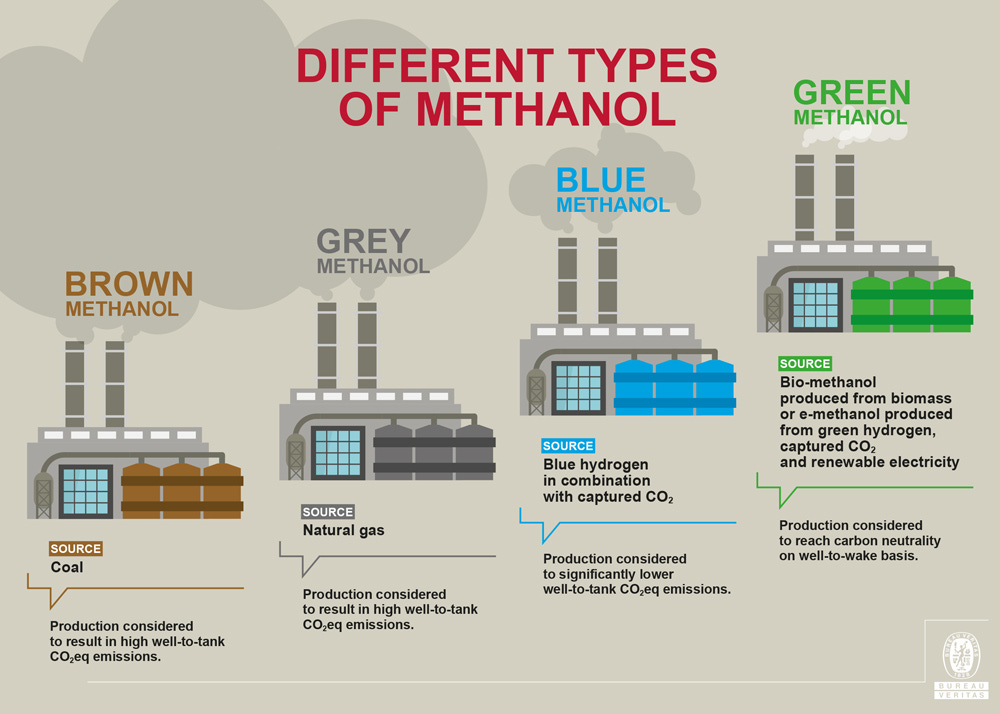
The end result of all of these processes is the same. It’s all just methanol! (Source: Bureau Veritas).
No one really believes in green corridors, or in the green transition for that matter
A green corridor is an agreement between two ports to support the movement of ‘green’ ships between them. For the Busan Biennale catalogue, we described our interest in tracking these corridors and the green transition in the following way:
“Is it possible for ‘green’ shipping to exist alongside - as an appendage to - the current shipping system? If so, what does it say about the industry’s notion of what ‘green’ means that it generates little conflict or incompatibility with the present state of things? Tracing the discursive production of green corridor infrastructure as an imagined shipping future while following the slow voyage of an actually existing container ship was a way to try and understand how the shipping industry simultaneously participates in and avoids change by continuously manipulating the space between transition and delay.”
However, in the midst of all this manipulation of the kind we sought to unpack in the film, there are moments of honesty, like when Lloyd’s List releases its Annual Outlook which includes an industry poll about pressing challenges. Some of the 2023 poll results regarding the ‘greening’ of shipping are as follows:
76% said the shipping industry would not meet the International Maritime Organization’s 2030 targets
56% thought the 2040 targets were out of reach
More specifically on green corridors, it gets even more dire, with one third of respondents saying they don’t think green corridors will have a material impact on decarbonization, not just this decade or the next, but ever.
But as we explore in the film, perhaps the more insidious dimension to the transition is that the industry won’t meet its targets (and they know it), but that climate regulations are being designed in such a lax way that it’s possible to be in compliance with them without actually reducing one’s emissions (through various semantic, accounting, or time-bending loopholes). A recent example that captures this dynamic well is the rise in industry enthusiasm for what is known as scrubber technology. Mundane as the word scrubber may sound, scrubbers are an exhaust gas treatment system that can make ships compliant with low-sulphur regulations without having to actually switch to low-sulphur fuels. Essentially, scrubbers are cleaning systems that “desulphurise” exhaust gases to prevent the release of sulphur oxides into the atmosphere. These are instead absorbed by water from the cleaning process, which becomes scrubber water. Because of the price spread between conventional and low-sulphur fuels, these technologies are an attractive option for shipowners despite being expensive. A recent Lloyd’s List article estimates that in the coming year, the potential annual savings for the container shipping industry by installing scrubbers are in the order of $4bn. Addressing the dynamics between regulatory design, compliance, and emissions reductions that we were tracing in the film, Sea-Intelligence chief executive Alan Murphy sums it up in another Lloyd’s List article on the topic:
“It is clear that the intention from some proponents of the low-sulphur regulation was for the industry to switch to using low-sulphur fuel,” he said.
“Reality has instead shown it to be more cost effective to continue to use regular fuel in combination with scrubbers. And as this solution is fully compliant with the regulations, clearly it is a desired solution for the industry.”
But this raised questions over CO2 emission reduction goals, he added.
“Financially motivated regulations are indeed coming into effect, such as the EU’s ETS carbon taxation on shipping,” Murphy said.
“What remains to be seen, is to which degree the industry will find other ways to abide by the regulation in letter, but not necessarily in spirit.”
As long as regulations are formulated in the language of financial incentives, the shipping industry won’t hesitate to beat regulators at their own game. In the end, shipowners get to have their cake and eat it. It’s got a heavy fuel filling with a green cherry on top.
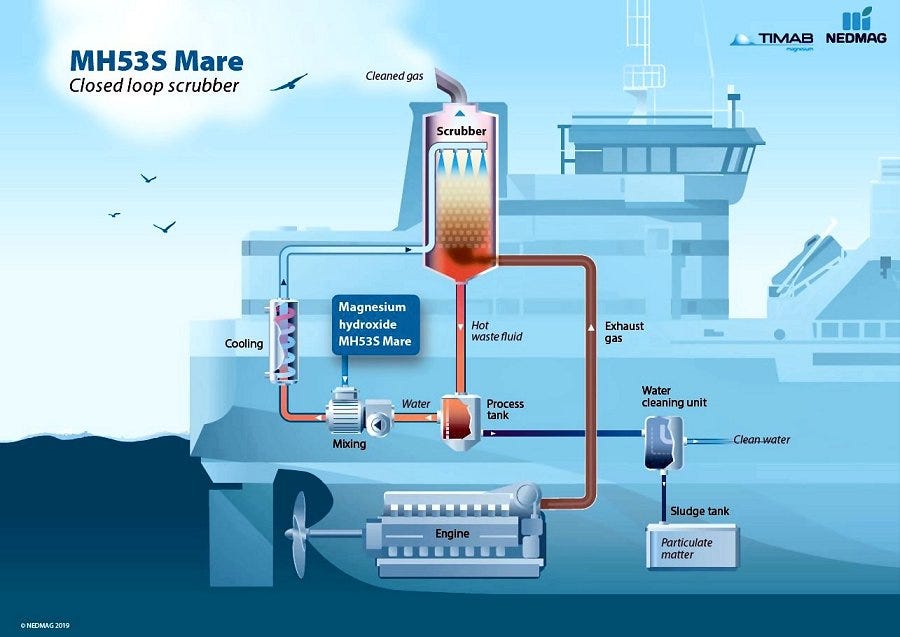
A ‘scrubber’. (Source: 2022 Nedmag B.V.)
Realigning the Oligopoly: The end of the 2M Alliance
The vessel we follow in the film was the MSC Venice, which operated on the Maersk AE55 Eastbound route between Rotterdam and Singapore as part of a longstanding vessel sharing agreement between the two companies: the 2M Alliance. In a joint press statement in January 2023, MSC and Maersk had announced that they would be discontinuing their 2M alliance in 2025, which they had introduced in 2015 to ensure “competitive and cost-efficient operations on the Asia-Europe, Transatlantic and Transpacific trades”. In January of this year, Maersk announced it would be forming a new alliance with German liner Hapag-Lloyd called the Gemini Cooperation, which also implies the exit of Hapag-Lloyd from the alliance it is currently part of (which is literally called ‘THE Alliance’), in which it is the largest partner. As part of their new cooperation, Maersk and Hapag-Lloyd will redesign the container network of the Far East-Europe trade, consolidating it around a small number of transshipment hubs, which are then moved via “shuttle services” to a larger number of ports. The implication is that the latter lose their direct calls to Europe, which in the case of the Gemini cooperation will affect Japan, South Korea, Vietnam, and Taiwan.
This consolidation pattern seems to intensify the hub-and-spoke model that a monopolized container industry tends towards, as we wrote about for Weird Economies last year. While the current 2M alliance makes 54 port calls per week in Asia, the Gemini cooperation will be making just 26. This shift is even more dramatic when one considers that the total tonnage capacity shared within the 2M alliance is 2.82m TEUs, whereas for the Gemini cooperation it is expected to be 3.4m TEUs, i.e. half the port calls despite higher capacity. The customer pitch here seems to be schedule reliability, but it’s a bit unclear how convincing that will be for shippers given that transshipment increases transit times as well as the risk of delays. It is also worth pointing out that the port terminals that liner alliances redirect their traffic toward are often ones where they themselves have a stake. Along with Shanghai, Ningbo, and Singapore, one of the four transshipment hubs of the new Gemini cooperation’s network is the Port of Tanjung Pelepas, operated by APM terminals, Maersk’s port operating company.
The Red Sea and War Insurance Premiums
Unlikely to be news for anyone at this point, another major change since we worked on the film is that the route we followed has been disrupted by the Houthis’ response to Israel’s genocidal assault on Gaza, leading ships to re-route around the Cape of Good Hope. A key point here however, as was stressed by maritime historian Sal Mercogliano in a recent Odd Lots episode, is that the most significant material driver of the diversions are not so much the Houthi attacks themselves as the war risk insurance premiums charged by insurance companies, most of which are based in London (roughly a tenfold increase from ~0.1% to ~1% of the value of the vessel. In real terms this represents, for a vessel worth $100m, a jump in the cost of insurance from $100,000 to $1m). The attempt to frame the diversions as driven primarily by just another cost assessment on the part of logistics’ companies matters in a time when ideological abstraction around threats to the ‘freedom of navigation’ - that simultaneously work to obfuscate the direct relationship between the Houthis’ actions and the genocide in Gaza - are on full display across the Western political class.
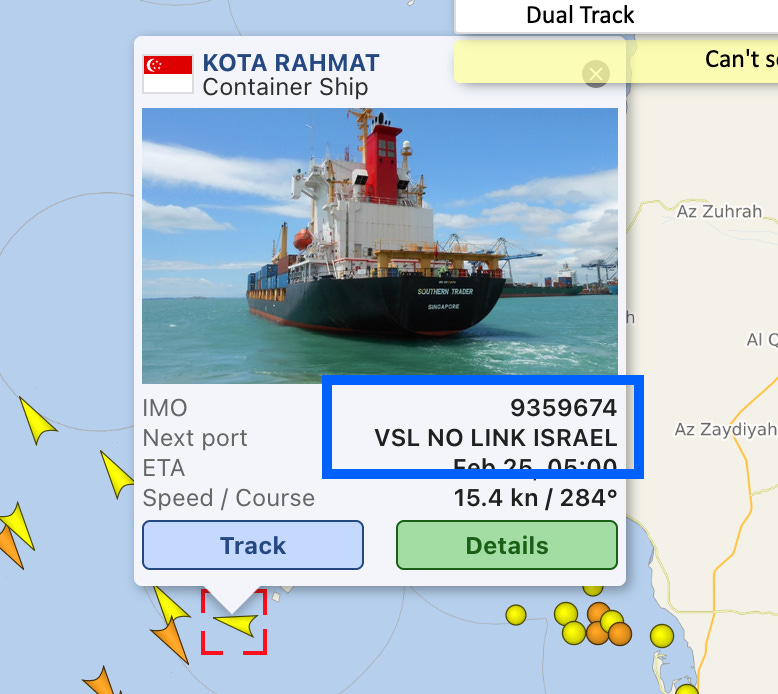
While many have pointed out the additional time and costs (ten days of extra travel time and millions of dollars in additional fuel costs) entailed by having to circumnavigate the African continent instead of passing through the Suez canal, less attention has been paid to the geographical particularities of the route change, and especially its consequences for bunkering (vessel refueling).
In December, Lloyd’s List reported a surge in demand for bunkering in South African ports, which makes sense given that Suez used to be one of the main bunkering stops along the East-West trade. As we discuss in the film, Suez is also a port where large-scale investments into ‘green’ bunkering infrastructure are being planned. South African ports have struggled to keep up with this rise and demand, which has pushed vessels to look for more fuel in Namibia (Port of Walvis Bay) and Mozambique (Ports of Nacala and Maputo), South Africa’s coastal neighbours to the west and the east, respectively. The red sea crisis thus seems to be having a twin impact on bunker demand and supply: more fuel is needed because the voyages are longer, and supply is restricted because it’s not in the right place.
Thank you – please share this!
This is a new thing for us. We want to grow it. Tell your friends!
No posts
Comments
Nothing yet. Say the first thing.
Sign in to join the conversation.