
Content warning - this articles discusses the second world war and holocaust. Therefore it touches themes such as death, systematic killing, torture, rape, people going missing, violence and dehumanisation as well as graphic descriptions of the German concentration camps.
If you were to google the name "Lee Miller" you would find headlines containing words such as "Model", "Muse" or "Vogue". The movie "Lee", starring Kate Winslet, shows Lee as a woman who first, due to sexism, captured the world of the Blitz in London as a „female" photographer and later on gained fame for her photos depicting the atrocities of the Holocaust.
Lee Miller lived a rich life, surrounded by creative people in dazzling cities. She was born in New York, studied lighting, costume and design in Paris, joined an experimental theatre program in New York and later on life drawing and painting in Manhattan. I imagine her living a life filled with creativity. How could she not, as a woman in the golden twenties, surrounded by exciting art movements founded by friends. It also can't have helped being one of the most sought-after model in the 20s or to later study, again in Paris, photography with the surrealist artist Man Ray. In those times she rubbed shoulders and made friends with big names such as the fashion editor of French Vogue or Pablo Picasso. Imagine living this life with all it's ups and downs, spending summers of free love with surrealism artists and friends in France and watching from a distance, that must have felt very far away, Nazi Germany unfold. The creative scene, as it is now, was lead by misfits, different thinkers, critical voices, wall tear downers, and those who struggled to have their voices heard in the normal world. Exactly those people who soon were to be tracked down and systematically murdered by german soldiers as well as jewish people, people with handicaps, Roma and Sinti as well as anyone who didn’t fit their image of world view. Lee moved before the start of the war with her partner to London. But once it started, she, like probably many of us, felt restless. Her life and special connection to France must have added another layer of suffering. Watching the horrors unfold on the other side of the channel, knowing that her friends were critical, were outspoken and part of the resistance and... had to disappear when the Germans invaded in 1940.
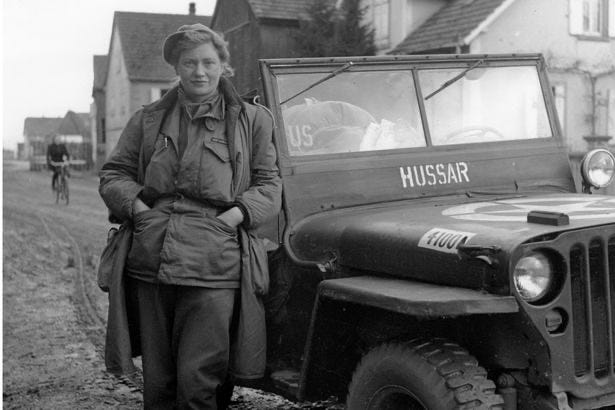
Lee tried to use her skills in photography to first document the life during the Blitz for British Vogue, taking pictures of a constantly bombarded city that was mostly run by women by this point. In 1942, after a lot of fighting and lobbying, she finally managed to get accredited with the U.S.army as a war correspondent. But there is a reason we know so little about female photographers. Women were not allowed to take part in press briefings, report from the front lines or gain access to parts of the military her male counterparts did. So she focused on what she could report on while also not letting go of her need to get closer to what was happening in Europe. Her photography often communicate kindness to the people she focuses on while also transporting the vulnerability and humanity of the people in front of the camera.
But her most important but also horrible photography took place after she gained ground in Europe. Accidentally ending up at the front lines of the Battle of Saint-Malo, reporting from the liberation of Paris and often being the first photographer at the scene to document the multi-facetted horrors of the regime. In the rear view mirror, history feels logical, easy to follow as we look back having already gathered all the necessary information. But we don't when we live through history, we have to make sense what is happening in front of us or to us while living through it. So when Lee arrived in Paris after it was freed by the allied forces, it may have on the surface seemed like a happy ending, but she encountered unanswered questions, shock, grief and trauma. A familiar city in tatters , friends grieving for communities who had been killed or were missing, leaving a huge question mark what happened to them. A question that most of members of the public had no answer to, yet.
In those days Lee documented the war and the after effects of the nazi regime with a uniquely female gaze. In many families there are to this day quietly mentioned stories of soldiers committing rape to family members. Women having to hide with small children, praying that they won’t make a sound. Lee recorded the violence done to women, the public shaming and violation of women who "collaborated" with the enemy by having sexual or romantic relations with them. Soldiers cut and shaved their heads of the „Collaborator girls“ to make their actions instantly recognisable to the public, parading them through the streets, giving room for the public to verbally and physically assault them.
When Lee and her friend and colleague David arrived at the concentration camps Dachau and Buchenwald they can't have been prepared for what to expect. Encountering a long freight train, each carriage loaded with bodies, which had been standing there for days, Lee climbed into the wagon to take a picture of a deceased prisoner, next to two first aid people on the ground looking in. But this was just the start, in the camps she encountered prisoners so starved they did not have enough energy to leave the bed, women and little girls who reacted terrified of anyone who may bear any resemblance to a male soldier. Lees most famous pictures, although you probably won't have seen it in newspapers, are the bodies of deceased concentration camp inhabitants stacked up like firewood. At their point of death they were only skin and bones, starved and overworked. After their death German soldiers started to throw their bodies on top of each other, as the coal for the cremation ovens had run out five days before the allied forces arrived. The picture, as the atrocities done to Jewish people and people who were seen worthless and dangerous in the eyes of the nazi regime, are hard to understand, hard to process when first encountered. It seems impossible that humans are able to do something like that, without anyone stepping in to stop it. The same feeling arises when confronted with Lees picture, documenting the horrors of the concentration camps, leading the brain to struggle to understand what it sees when it first looks at it. Trying to make sense of starved limbs and mangled bodies. There was no dignity how these bodies were kept. The allied forces were struggling to communicate the atrocities done by the germans in the Konzentration camps and soldiers were encouraged to write to home to their families on what they were seeing.
Her photography was and is so important, because she simply does not only document history. She captured the lives and emotions of the people who had to live through it. Her photography gives dignity to grieving prisoners of the concentration camps, standing in front of the burned bones of their former inmates. And shouts for justice in her very real close ups of the violence committed by the nazis on rail tracks and gas chambers. The British censors refused British Vogue to print Lees pictures from Dachau and Buchenwald, arguing it would disturb the population too much, and that there was a need to move on, after the war had ended. It took a year until U.S. Vogue published them with the caption „Believe it“.
The version of Lee Miller that Kate Winslet and director Ellen Kuras created does not show a frivolous aging model turned fashion photographer who accidentally became a war reporter. Because that is not what she was or being a woman during the second world war worked. But they do show the importance of photographers full stop to, in Lees own words, document war as historical evidence. And observing and capturing a world that was guarded, managed, executed and freed by men, as a woman. But also, how important art is, even in the darkest of times. In many of her pictures, for example documenting the suicide pacts of nazi families, you can see her background in surrealism and maybe even, working for vogue. She could have shot the pictures like a scene-of-crime officer. Sober. Which probably would have been easier, quicker and safer for her mental well being. But she didn’t. Which made her work far more moving and left an impact in the minds that it touched. Sometimes solidarity and resistance lies in creating, observing and documenting in the language you are capable of speaking. And sometimes it is visiting places no one wants to go to document what has happened so we can believe and remember.
You can learn more about her photographic work here https://images.leemiller.co.uk/app/WebObjects/LeeMillerShop.woa/10/wo/iwcmUXlfBw8zTDjtBApdbM/4.0.7.3.21.1.0.3.4.1.1
Keine Posts
Comments
Nothing yet. Say the first thing.
Sign in to join the conversation.