
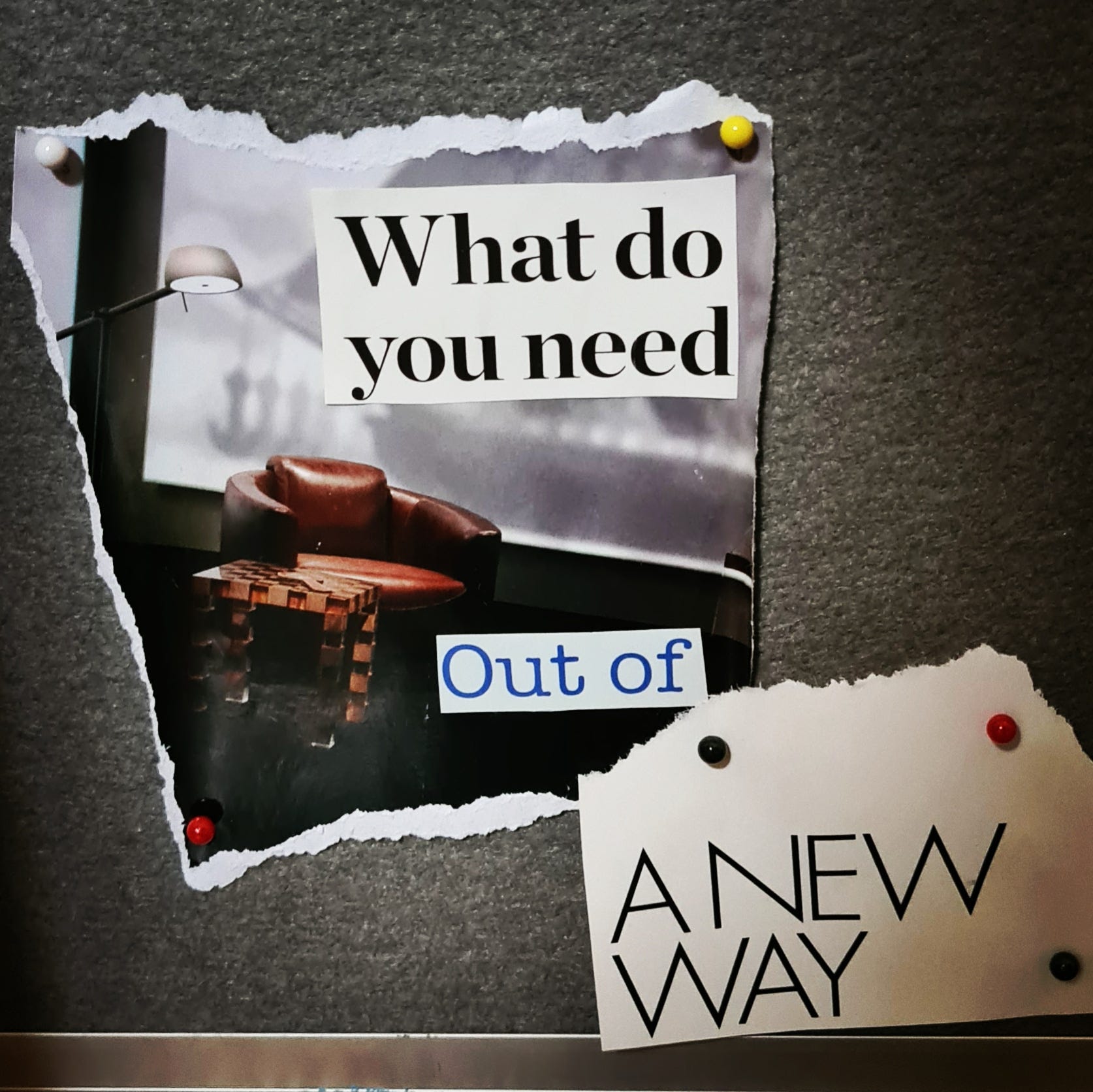
Collage by Linn Martinsen
The Quiet Room
Darkness hugged the walls on all sides; only light breaths and the gentle sounds of infinitesimal shuffling filled the space. Two small lamps generated a soft light, and a low wooden table sat in the space between us. Atop it, a vase filled with tulips, a small porcelain jug with water, and two glasses.
I sat in my vivid green armchair; you sat on the soft, sleek sofa. Legs apart, hands folded between them, head bowed.
We sat like this for a long time. In silence. I closed my eyes for a moment, noticing my heart beating slow and steady, the connection in the silence, no need for words to take up space.
The Quiet Therapist
It was so often the case, despite my occasional urge to be clever and analytical, that the most profound thing to emerge as helpful in my therapy room, was the unspoken acceptance and purposeful presence I could offer.
The world, so noisy and filled with endless demands on our time, fell away when the door closed, when the garden embraced us. When the darkness cocooned my cabin and created a place of safety and stillness.
I used an old-fashioned diary for appointments; I wrote my notes by hand. There was no computer or TV or phone in the room. It was just me when it all arrived, the gentle tap on the glass, the wet umbrellas, the hot, sticky skin, the windswept hair, the laughs, the hovering tears, the confusion, the anger.
The longing for a different kind of closeness where someone didn’t need or demand they provide something or be someone different than who they experienced themselves to be in that exact moment.
Thoughtful Transparency
My clients did not know my story. And very rarely did they ask. When they did, I sometimes answered, but often I asked why they were curious. Not because I didn’t want to be seen, but because I wanted them to be.
When I recently paused my private practice to focus on writing, I had not anticipated the melancholy of no longer being someone’s quiet presence. Despite what one may think, not sharing my own story in the presence of my clients did not make me invisible, or ‘a blank canvas.’ I was always fully present; I was always me.
All the stories I was and am, all the feelings I carried, all the cleverness and all the mistakes, they pooled together like a forest lake filled with streams, and I drew from it to nurture best I could every person who entered my room. There was never any rush. No expectations to perform, for them or me.
Shared Wisdom
The longer I worked, the more I felt the extraordinary value of stories and history; of the ‘here and now’ being a cornucopia of hope and new beginnings, and the ‘there and then’ containing riches of material for growth and understanding. And that this, for most of us, takes time to unfold. I always explained this process in the first session, giving clients a chance to decide whether working with me felt right for them.
I would refer to other therapists or professional support systems where I felt it supportive; there will always be someone who can be more helpful in certain situations, and we are not going to be the right fit for every client. I accepted this with gratitude for the wisdom and experience of others, knowing that this shared responsibility provided support and safety for both clients and therapists.
Then therapy entered the public scene, and something changed. The professionally nuanced and collaborative space of therapy became infused with buzzwords and expectations – particularly fuelled by piecemeal theory gleaned from social media. In this, trauma took a prominent place.
The Loss of Trauma Nuance
With the widespread popularity of Bessel van der Kolk and Gabor Maté, many felt seen and understood for the first time. But while their books are layered and intricate, much of their work is now seen only in snippets taken out of context in short posts and videos, making it more common to say you are dysregulated or experiencing a trauma response than ‘I feel unsettled’ or ‘that shook me.’
‘What is the problem with that?’ you may ask. ‘Isn’t it good that we are becoming educated?’
Thoughtful psychoeducation can be incredibly valuable, but the main concern with complex psychological terms being used in unsystematic ways is that feelings become pathologised before being understood for what they are – and most importantly, what they mean to each person individually.
Perhaps your anger is not dysregulation, but a perfectly regulated response in an imperfect situation. Perhaps your racing heart is not a trauma response, but your body’s way of telling you that you are experiencing stress, and that it needs your attention.
Cultural expectation grew into assuming trauma is a singular thing ‘everyone’ carries, and that every therapist should know how to work with ‘it.’ The truth is that all therapists should be trauma aware enough to know their limits and strengths in the area. Within this also lies the important distinction that not all therapists are trauma specialists – and crucially: not everyone who experiences a traumatic event will develop a stress disorder.
We are complex, nuanced human beings who deserve a thoughtful and patient exploration of our inner lives before any potential diagnosis takes place. But how do you find this, when the world keeps shouting over itself?
The Age of Visibility
Information is wonderful. Sharing is wonderful. But like many things good and well, unless consumed and dispensed with care, it can still have a negative effect. Paracetamol is considered a mild and effective form of pain relief. But take only a few too many, and your body suffers. Exercise is an amazing form of self-care but overdo it and…you get the gist.
We now have access to therapeutic content everywhere. In bite-size chunks you can consume every psychotherapeutic and psychological concept under the sun. Much of it, designed to feed a quietly exponential and coerced need to provide and consume instant gratification and instant solutions, rather than follow a natural and autonomous path toward healing.
Even self-help books are now largely written by those with huge social media platforms. Some of these are experienced therapists, while others are influencers with no psychological background. The issue is not, per se, that therapists have social media platforms, or that influencers are published. The problem arises for the reader, who cannot always tell who the expert is - especially when the content is therapy related - and who may be at risk of absorbing confusing or even potentially harmful advice.
Unintended Consequences
Most concerning: complex scenarios and theories that qualified therapists spend years studying and digesting for the benefit of their clients are dispensed in 30 second reels and in strings of images explaining ‘what you have’ or ‘what you are,’ rather than asking ‘what is your story, and how do you feel?’
And where once upon a time therapists only discussed their feelings around and about clients in supervision, many now share how the work affects them on platforms like Instagram – chronicling what certain client behaviours mean, and even sharing real-life scenarios they have experienced, and their frustrations with some of them.
These scenarios are mainly anonymised, but when stumbled upon by any client, there is a danger of becoming self-conscious rather than helpfully informed, and it can induce an expectation to behave in certain ways.
Loud Solutions, Invisible Suffering
In this urgent online transparency is also this: Everything is visible. Everything except one thing:
The human being who wishes to be seen and understood in their unique and often vulnerable circumstances.
It’s difficult not to sound pained, and even more difficult not to feel it. Especially when the world appears drunk on its own voice; slurring half-truths and over-exaggerations, adamant – in that way inebriation often evokes – that their opinion is the best and only truth.
You have trauma! They’re a narcissist! That’s gaslighting! Go no contact! This method works best! All without any personal context.
Feel exhausted? Me too. But on reflection, I also feel hopeful.
The Inevitable Pain of Change
Change is always painful. Always. Maybe not in immediately obvious ways, but some pain will always exist – either underneath or appear as a sledgehammer. The internet is the sledgehammer; our pain of separation is underneath.
Because as much as we want to believe it, social media has not brought us closer together. Algorithms made sure of that, rooting us deeper into the soil of beliefs we once grew out of – or stumbled into and couldn’t escape. They insidiously polarise, widening the distance between us.
Crucially, this gap feeds our desire to be understood by strangers who do not know us. A desire that paradoxically removes us from truly connecting both to ourselves and to others.
Finding Hope
‘Where’s your hopefulness?’ you may ask. Well, it’s here, in realising that whenever a change is needed and forming, overcorrection often takes place.
The internet’s sudden avalanche of mental health content comes from an urgent and collective need to connect, to understand, and to be understood – especially when mental health support is so difficult to access. But right now, we are still bumping into each other in the same dark room, unable to see exactly where we are going, who is around us, and how we can best use the space.
What We Can Do
Here are some gentle suggestions.
Slow things down. Step away from the content you are constantly drawn to. Seek out a group; it could be knitting or tennis or walking or books. Then stick with it past the point of feeling bored or disconnected. Wait things out.
Have patience for what you need to emerge, and practice tolerating the discomfort of setbacks, difficult feelings and occasional false connections.
Allow friends, neighbours, and family to provide a listening ear. It doesn’t have to be perfect; it just has to contain interest and warmth. This kind of consistent community care is far more valuable than many people realise.
Visit your local library and browse the wellbeing section. Pull out books that speak to you. Look into who the author is. Put social media aside and focus on digesting this book only.
If you seek therapy, do expect professional standards, ethical behaviour, and appropriate compassion, but be mindful of expecting instant fixes or for all the work to sit with your therapist. You need to meet someone halfway for change to occur, and therein also lies extraordinary potential for emotional autonomy.
And consider the richness of silence. It is one of the most potent things a therapist can offer.
Be open for good things to enter, be open for painful things to emerge and be felt before they loosen their grip. Reject the algorithms and forge your own path.
The Peaceful Therapist
For me, this means exhaling the noise and following the path I have always strongly believed in – where the air hums with unhurried patience and each story a person brings takes us to a new place.
I wish you well. I wish you safety. I wish you patience and peace in abundance.
Comments
Nothing yet. Say the first thing.
Sign in to join the conversation.