

What does it take to build an AI system that actually knows what it means? Not what it says. Not what it retrieves. What it means.
Everyone is building context layers and ontologies for AI now. Context graphs are AI’s next trillion-dollar opportunity, we are told, and ontology is the secret sauce. The term shows up in product launches from Atlassian, AWS, Databricks, Google, Microsoft, Neo4j, and Snowflake.
There’s just one problem: not everyone means the same thing when they talk about context layers or ontologies. Slightly ironic, considering context layers and ontologies are meant to address, well, meaning.
What’s underneath this wave is something the graph and semantics community will recognize: a mass convergence on problems that have been worked on for decades, now arriving at scale, under new branding.
Forrester traced the context graph lineage 40 years back to Enterprise Architecture. Deborah McGuinness wrote “Ontologies Come of Age” in 2003. The Semantic Web market reached $2.71 billion and is growing at 23% CAGR. This is not new territory. What is new is the scale, and the urgency.
Scale changes the calculus. When every major data platform ships an “ontology” feature, the word migrates. When every startup promises a context layer, the concept stretches. When every agent framework claims graph memory, the question becomes: whose meaning survives the handoff between systems? Who owns the ontology? More fundamentally – what do we talk about, when we talk about ontology?
In this issue of the Year of the Graph, we follow three converging threads: the architecture of the context layer, the mainstreaming and quiet dilution of ontology, and the emergence of graph memory as enterprise infrastructure. They converge on a single point: graph structure is necessary, but not sufficient. What matters is who gets to decide what the data means, and whether meaning can move along the data.
The AI Context Layer: Three Types of Context, Three Different Problems
Context Graphs are a Convergence, and Convergence Needs Architecture
The LLM Wiki Pattern: From Personal Knowledge Graphs to Enterprise AI
Graph Data Is Table Stakes: Why Meaning Is the Real Differentiator
This issue of the Year of the Graph is brought to you by metaphacts, Graphwise, Modern Relay, yWorks, Graphlytic, Fluree, State of the Graph, and Connected Data London.
If you want to be featured in an upcoming issue and support this work, reach out!
Everyone needs a context layer, but what exactly is it and how do you get one?
Many organizations are looking for advice on private context. They all start the same way: “how do we make our context usable for agents?” The phrasing is always the same. What’s underneath it never is. The moment you look closely, it breaks apart into different problems that only look alike from a distance.
What sorts this space, per Elisenda Bou-Balust & Miguel Arias is the kind of context you’re dealing with. That decides what exists to work with & which tools are on the table. Their AI Context Layer Market Map lays out this space in 3 buckets.
Bucket 1 is context internal to agents. The agent’s own memory and operating manual. Bucket 2 is institutional knowledge. The scattered docs, chats and tickets your company already lives in. Bucket 3 is systems of record. The hard operational data, split by who (or what) generates it: human-generated business records and machine-generated telemetry.
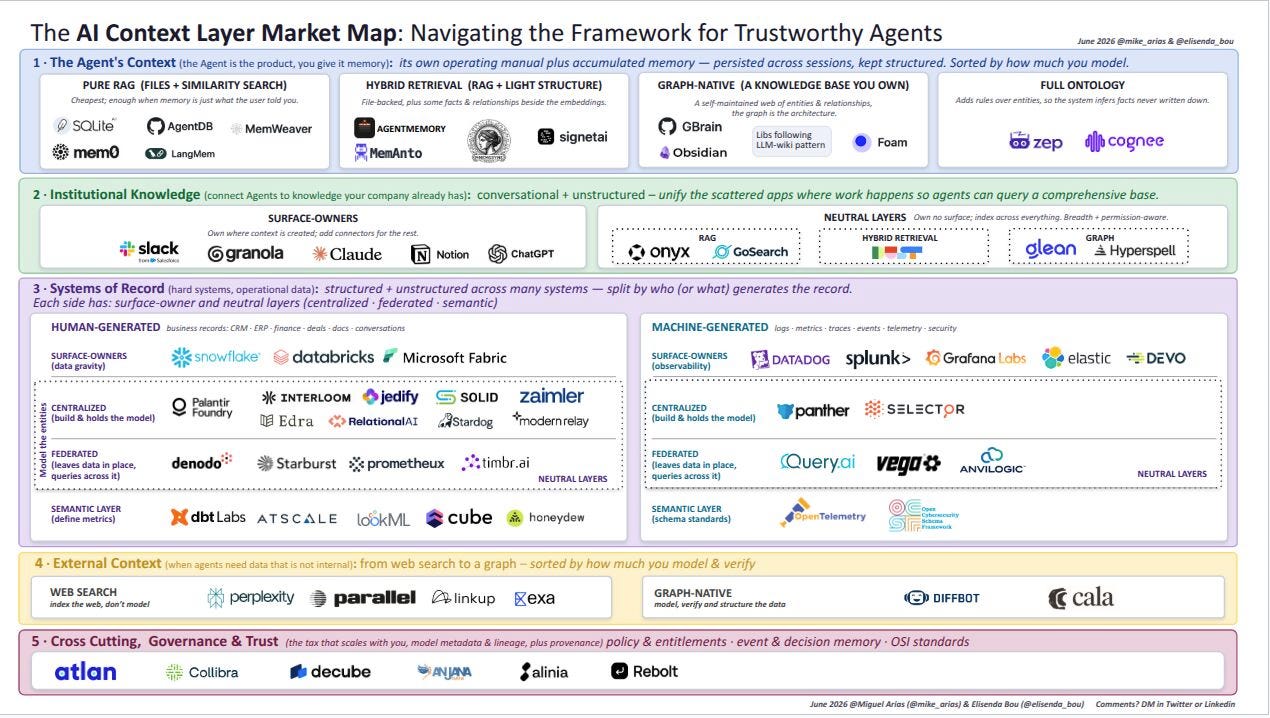
Each bucket has its surface-owners (who own where work happens) vs. neutral layers (who index across everything): centralized, federated, semantic. Plus two things that cut across: governance & trust (the tax that scales with you), and the emerging public data context layer (verified world facts and data , so agents can query external knowledge).
An AI agent operating inside a real business needs three kinds of context, and they map directly onto what the context layer has to encode: Knowledge – the map of the business, Expertise – how work actually gets done, and Norms – the rules of acceptable action. This is what Prukalpa argues in “What an Enterprise Context Layer Actually Is“.
Context graphs are structured, persistent records of product data, customer data, ontologies, and decision traces Dan McCreary argues. They capture what happened, why it happened, who approved it, and which precedents justified it. McCreary’s textbook defines context graphs as a discipline sitting between three mature fields: knowledge graphs, retrieval-augmented generation (RAG), and process mining.
Comments
Nothing yet. Say the first thing.
Sign in to join the conversation.