

When Foundation Capital declared context graphs AI’s next trillion-dollar opportunity in late 2025, and ServiceNow followed with its Context Engine announcement, it looked like a new category arriving – and with it, a new set of questions about context graph architecture. What it actually was is something older arriving under a new name: the problem of structuring organisational knowledge to make it discoverable and usable.
Forrester’s Charles Betz made this point in “Context Graphs Are A Convergence, Not An Invention.” He traced the entity graph lineage back 40 years through Enterprise Architecture (EA), the discipline responsible for mapping an organisation’s technology, capabilities and their relationships.
Configuration Management Databases (CMDBs), Application Performance Monitoring (APM) and process mining are all established disciplines with their own tooling. These disciplines have been building the pieces of a unified context graph in isolation for decades.
The decision trace layer – who approved what, why, under what authority – isn’t missing. It’s fragmented: scattered across Slack threads, incident postmortems, Jira tickets, and people’s heads.
What that fragmentation represents is something Ontology Pipeline creator Jessica Talisman named directly in “Ontologies, Context Graphs, and Semantic Layers: What AI Actually Needs in 2026“: this is fundamentally a knowledge management problem.
Eliciting tacit knowledge, encoding reasoning, and representing it in formal, machine-queryable form is not a database problem. It requires systematic knowledge engineering: observing work practices, interviewing experts, extracting undocumented reasoning, and encoding it in formal representations.
Without that investment, decision traces stay trapped in the channels where they were born. It’s a knowledge architecture problem, and it requires skills closer to what librarians, taxonomists, and knowledge engineers have developed over decades than what most data teams do today.
Another conversation runs in parallel, largely unaware of decision traces and knowledge engineering. The BI world has its own semantic layer: the abstraction above the data warehouse that maps business terms to query logic, seen today in tools like dbt and AtScale’s semantic layers, or Cube’s universal semantic layer.
Bill Inmon, widely recognised as the father of the data warehouse, established the architectural tradition this builds on and has himself arrived at semantics and ontology as the necessary next step – a journey he shared in a joint publication with Talisman.
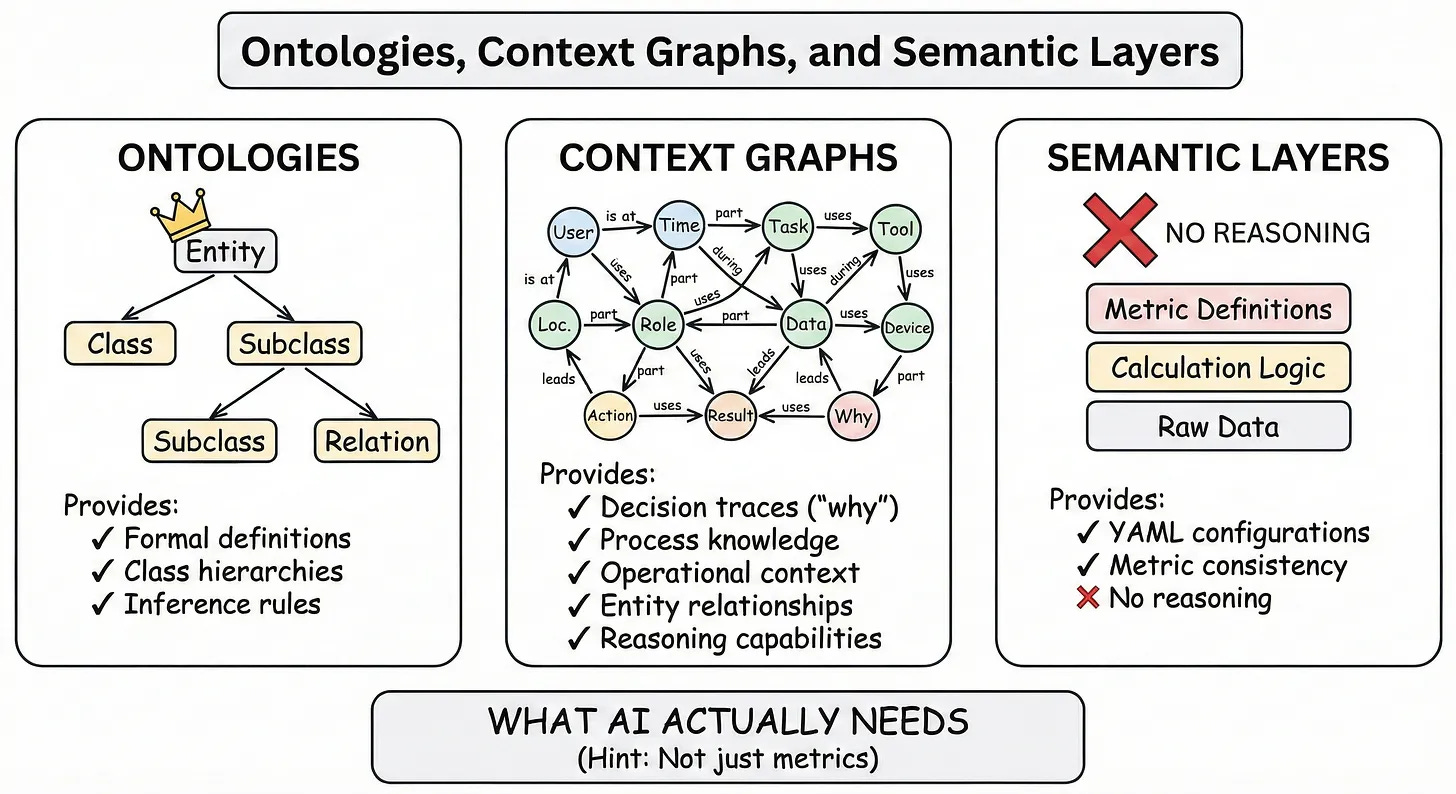
When Forrester’s Boris Evelson notes that leading BI vendors are updating their semantic layers for agentic AI, he is describing the latest chapter of that evolution. But as Talisman draws the distinction: semantic layers answer metrics-based questions; ontologies and knowledge graphs provide context without SQL constraints and support logical inference.
Both make sense for their purposes. For some use cases – metric lookup, calculation consistency, basic analytics – semantic layers remain sufficient. For others – complex reasoning, inference, elicitation of domain-specific meaning – they won’t be.
If you’re evaluating semantic layers, Talisman prompts to ask: “Is this for humans or for AI?” The answer determines whether metric governance is sufficient or whether you need richer knowledge modeling. Most organizations will need both, but building for humans and building for AI may require different architectures.
These three threads – the context graph thesis, Betz’s EA-grounded convergence, and the knowledge graph and semantic technology tradition – are moving toward each other. The knowledge architecture problem is what connects them.
What follows maps that connection, and points to where the work is already being done.
Full story on Orchestrate all the Things
George Anadiotis is an analyst and advisor specializing in knowledge graphs, graph databases, and graph AI. He runs the Year of the Graph resource hub and newsletter and the State of the Graph, a comprehensive, up-to-date repository, visualization, and analysis of graph technology.
Comments
Nothing yet. Say the first thing.
Sign in to join the conversation.