
On September 1 this year, Kyrgyzstan will assume the chairmanship of the Shanghai Cooperation Organization (SCO), the economic and security alliance formed in 2001 by China and Russia together with several Central Asian countries, and will host a summit marking the SCO’s 25th anniversary. The summit comes amid a deepening relationship between China and Kyrgyzstan. Over the past two years, construction has begun on a new railway line branded as part of the Belt and Road Initiative linking China, Kyrgyzstan, and Uzbekistan, with China providing more than half the financing. In that period, the country’s president has met with Chinese leader Xi Jinping on three separate occasions, including signing a joint statement in September 2025 on deepening the bilateral partnership.
But China’s engagement with Kyrgyzstan in terms of media and strategic narratives goes back at least two decades. Since 2004, Xinjiang Radio and Television Station has produced a Kyrgyz-language TV program broadcast daily by satellite on Kyrgyzstan’s national television, pairing short segments on Chinese culture, agriculture, and current affairs with dubbed Chinese TV dramas. A 2023 study by researcher Niva Yau for the OSCE Academy in Bishkek examined two similarly structured programs, Zhungogo Sapar and Kytai Terezesi, likewise produced by the Kyrgyz-language team at Xinjiang Television and fronted by an ethnic Kyrgyz presenter from Xinjiang. The report describes them as “an active part of China’s soft power strategy in the region,” built around stories of purported, state-narrated governance successes in Xinjiang.
Lingua Sinica spoke with Adina Masalbekova, a researcher on China’s engagement with the region, about how Chinese state media have gained a foothold in Kyrgyzstan — and how Russia’s parallel media strategy reinforces many of the same messages.
Dalia Parete: How would you describe the media landscape in Kyrgyzstan, for people unfamiliar with it?
Adina Masalbekova: Kyrgyzstan’s media landscape was shaped largely by the collapse of the Soviet Union and its aftermath. The country took a deliberate step toward decentralizing its institutions, including the media, as the Soviet Union itself had already begun to open up. The first president sought help from humanitarian and international organizations, and that’s how the country built the media infrastructure it still largely runs on today. Outlets received significant support from international donors, alongside broader development projects. That funding relationship is foundational to how the landscape looks now, and it’s a big part of why Kyrgyzstan’s media environment ended up freer and more pluralistic than its neighbors’.
In fact, Uzbekistan under its first administration maintained absolute authoritarian control over the media, enforcing regional media exchange to secure total domestic control. Kazakhstan has remained largely authoritarian, with brief windows of openness that closed again after the 2022 protests and the subsequent crackdown. Tajikistan and Turkmenistan are more restrictive still. Turkmenistan’s independent media exists only in exile. With that in mind, Kyrgyzstan is the outlier, the first in the region to see a state-scale protest toppling the government and regime change and the one place where that political opening also became a media opening with donor-funded independent outlets, a relatively freer press and for a long time, an active, vocal civil society.
DP: Would you say that Kyrgyzstan, compared to the other Central Asian countries, has a slightly more open environment?
AM: Yes, even if it’s a relative kind of openness, and one that’s been narrowing since 2022. Compared to Uzbekistan, Kazakhstan, Tajikistan, and Turkmenistan, Kyrgyzstan still has independent outlets that investigate and publish. Journalists who are widely trusted and widely read, and whose reporting reaches well beyond a small activist audience. Investigative outlets like Temirov Live and Kloop are the widely known examples, each with over a hundred thousand subscribers on YouTube alone. Both continue to operate and draw large audiences with Temirov’s most recent investigation got over 100,000 views, even after years of legal pressure and being classified as extremist organizations.
Temirov Live doesn’t legally exist anymore in the country. Investigative journalist Bolot Temirov, the founder of Temirov Live, was deported and stripped of citizenship after authorities accused him of drug possession and forging documents . He now runs the outlet from exile. Several of his colleagues were later prosecuted too and his wife, Makhabat Tazhibek kyzy, also a journalist on his team, received the most severe sentence of anyone charged in the case.
Kloop’s website has been banned by the government in 2023, and people now need to use a VPN to read it, and that’s just become normal. So calling it more open is true only in a comparative sense, but it’s an openness that’s been pushed underground and abroad, not one operating freely inside the country.
DP: You mentioned the openness that’s left is happening in spite of the environment, not because of it. What does that pressure actually look like day to day for journalists, and how has it evolved over time?
AM: As I was saying before, on the ground, it looks like outlets are surviving by relocating, adapting, and absorbing constant pressure. A former Kloop journalist shared with me that government pressure is not a new challenge for the outlet, stating that multiple previous regimes have attempted to obstruct their work and block their platforms. She added that other media outlets have felt this recent shifting political climate more sharply.
The pressure we’re seeing didn’t begin with the press, and it didn’t begin just with the current regime. There were always attempts to suppress critical voices under previous ones. Tracing it through the current regime, the administration’s broader pushback started around 2022, primarily targeting the political opposition and activists, particularly during the mass arrests following the Kempir-Abad water reservoir protests. By mid-2023, that focus shifted toward independent journalists and bloggers, several of whom faced imprisonment for their commentary. A stark example from that period was the arrest of Yryskeldi Jekshenaliev, a 19-year-old blogger who was detained and released a year later, facing a potential six-year prison sentence on charges of publicly calling for mass riots and violence. By early 2024, these restrictive measures had directly impacted established investigative outlets such as Kloop and Temirov Lab. Since then, the environment has expanded even further, affecting broader civic spaces. We’ve seen independent polling research institutes like the Central Asia Barometer forced restrict their operations. Even some selective independent academic gatherings were banned, including the cancellation of the historical forum dedicated to the Urkun centenary in December last year.
One case outside journalism shows just how far the chilling effect reached. In Tajikistan, a woman working for an independent Kyrgyz NGO running a regional survey on attitudes toward China. She wasn’t a journalist, but because the survey touched on China, she was detained and sentenced to roughly ten years on a charge that translates to “betraying the motherland.” At the same time, academic freedom took a hit. Now, many scholars and independent institutions have adopted a degree of self-censorship on topics critical of the government or of state relations with China and Russia; this trend aligns with heightened regional discussions of Russian colonialism following the war in Ukraine, alongside the further tightening of partnerships with China in recent years. The legal architecture has also hardened: last year, a constitutional amendment gave the government grounds to shut down media on the basis of extremism.
It’s not just legal pressure, either. Funding has collapsed, too. USAID (the US government’s foreign aid agency, which has funded independent media projects worldwide) pulled out, and the EU has been shifting its budget toward Ukraine and defense. Together, that’s cut off a lot of the money independent media used to rely on. To make up for it, journalists are taking on second jobs, like bartending or DJing. For younger generations, this means turning to influencer-style income sources like reader donations and ad deals rather than just reporting.
Continue at LS: China’s Impact
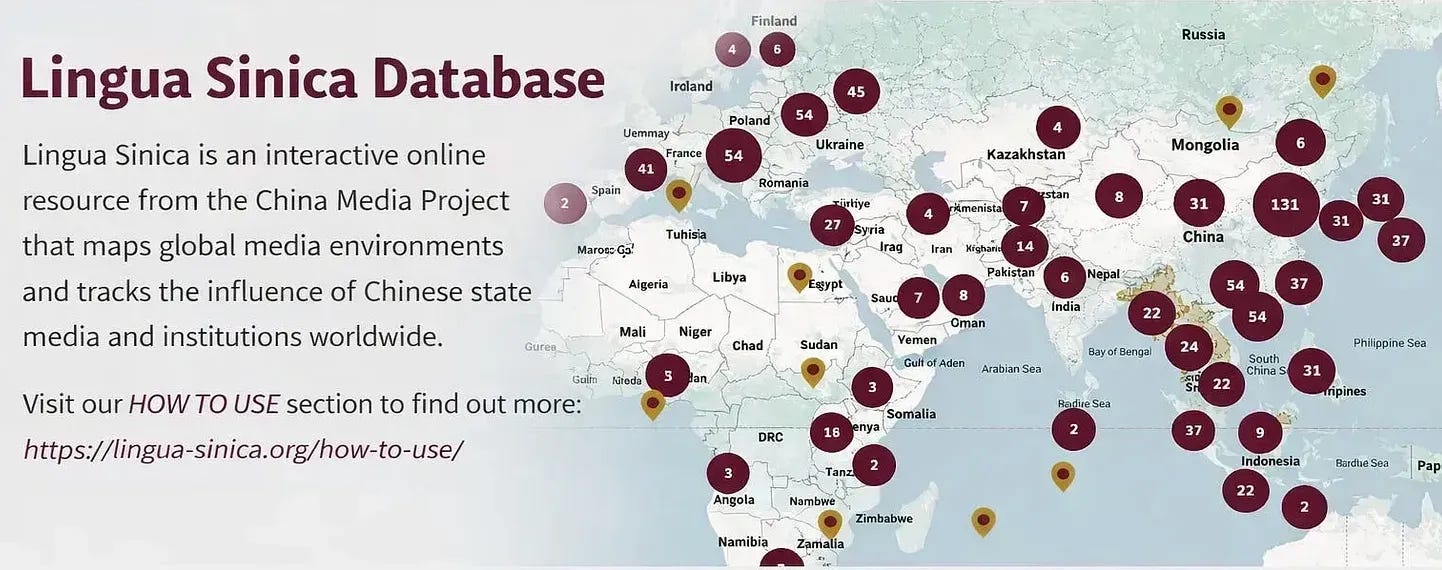
To learn more about China’s media engagements in Kyrgyzstan—selected below—check out the Lingua Sinica database. Note that the LS database now allows search by date, with a full calendar function. We encourage readers to explore the database of PRC engagements by selecting for countries, engagement types and dates under the map (don’t forget to click “Filter”). We have also implemented a full-site search function in the banner of the site. Enjoy!
May 28, 2026
Learn More About This Activity
May 27, 2026
Learn More About This Activity
November 24, 2024
Learn More About This Activity
January 1, 2015
No posts
Comments
Nothing yet. Say the first thing.
Sign in to join the conversation.