
More than seven years have passed, but Thomas Boutonnet can hardly forget how things unfolded on January 24, 2019, the day he co-organized a discussion panel at the University of Strasbourg on China’s policies toward the ethnic Uyghur population in its northwestern Xinjiang region.
By then, it had been more than half a year since reports emerged of Uyghurs being detained by the thousands in re-education camps. The topic was drawing unprecedented attention from global leaders, and emollient efforts from China. That there were claims and counterclaims over this important story spoke to the timeliness of the panel — which included four European scholars, of which two were also ethnic Uyghurs.

Surely, a frank discussion could emerge in the heart of Europe, just miles from the European Court of Human Rights, on the western bank of the Rhine, at a centuries-old French university that prided itself on defending academic freedom.
But as the panel entered its audience discussion portion, the event grew tense. Given opportunities to engage, two Chinese participants in the audience instead monopolized the time, allowing the academic speakers no opportunity to respond. Boutonnet, himself an associate professor in the Department of Chinese Studies, let the exchange run for several minutes before finally stepping in. “We need to let others speak,” he said. “We have to let the discussion flow. Otherwise, it’s simply not possible.”
The two individuals — whom Boutonnet and other colleagues later identified as visitors from China’s consulate general in Strasbourg — even came with propaganda pamphlets, which they placed at the entrance to the conference room, with claims that the people of Xinjiang were prospering. “They were small booklets published by Beijing publishers,” Boutonnet said. “So they clearly came from the Chinese authorities.”
In fact, their interruptions were just the culmination of a campaign Chinese diplomats had waged for several days with the university.
First, the faculty learned, a Chinese student had come to the office of the Dean of the Faculty of Letters saying the Xinjiang event must not take place, and threatening to report the dean to the Chinese Consulate. Next came lobbying directly from the consulate to the university’s top official. “We learned afterward that the Chinese consulate had formally asked the university president to ban the academic exchange,” says Boutonnet. “The president refused.”
That refusal, academics say, is an example of the forces that should come into play to resist external pressure on academic freedom. In this particular case, the university’s president even expressed solidarity through a general email to academic colleagues. The Chinese Consulate did not respond to requests from Lingua Sinica for comment on its contacts with the University of Strasbourg.
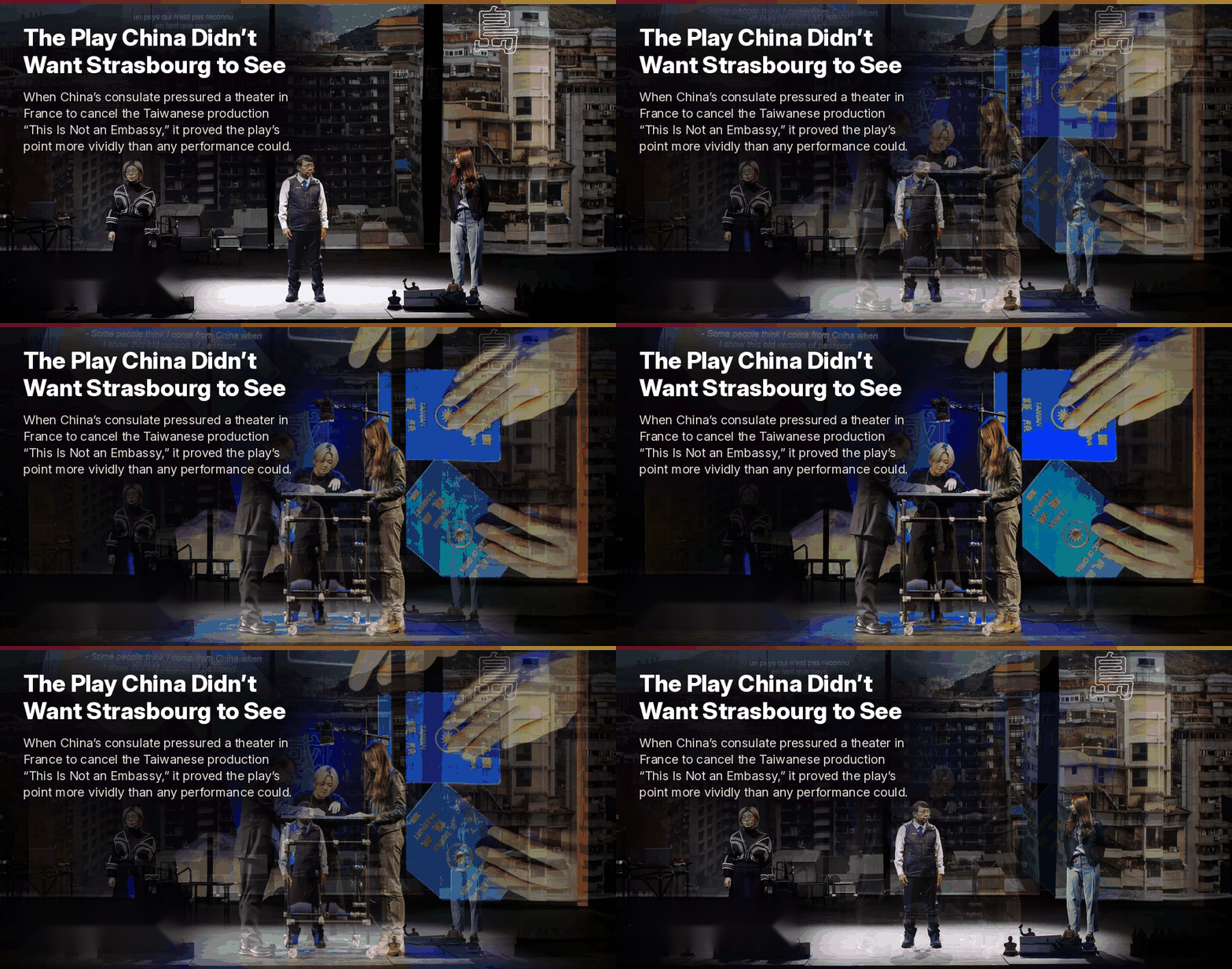
But for Boutonnet, the 2019 incident was a wake-up call. That level of direct interference in academic discussion from the diplomatic mission of another country was “something entirely new” for Strasbourg, and for France more broadly, he said. It came months before the term “wolf warrior diplomacy” (战狼外交) would be popularized to describe the more confrontational mode of engagement emerging from China’s foreign ministry, which had been taking shape through the previous year.
“So, for me, what happened was both surprising and shocking,” said Boutonnet. “Today, it would no longer surprise me, and I would probably be better prepared.”
More than seven years on, such tactics are no longer so surprising. And as the world’s second-largest economy has become an ever more important source of research funding, business partnerships, and tuition-paying international students for European universities, China has developed a growing number of levers to press its interests on campuses across the continent — from formal diplomatic complaints and legal action to the funding of academic centers and conferences.
As the panel entered its audience discussion portion, the event grew tense.
Boutonnet and many of his fellow sinologists and China specialists in Europe say they have witnessed both direct and indirect pressures growing more frequent, including a quieter set of incentives that can lead scholars to self-censor or avoid sensitive topics altogether. Across a continent that has long championed freedom of thought, expression, and scholarly inquiry, these pressures can limit discussion in ways that have the potential to seriously undermine academic freedom.
Boutonnet spoke of being “better prepared.” But what exactly are these challenges, and how can scholars, and universities, be ready to uphold their core values in the face of rising pressure? For this article, Lingua Sinica spoke with more than 30 sinologists and China specialists from across Europe, including ten early-career PRC and Hongkong scholars, to help answer these questions.
Boutonnet’s event in Strasbourg dealt with one of the core red-line issues that has provoked China’s fury on the international stage in recent years — the question of human rights and security in Xinjiang, which for China’s government is a matter of internal affairs on which all outside comment amounts to “interference.” When the European Union issued a Human Rights Day statement in December 2025 raising concerns over China’s record in Xinjiang, Foreign Ministry spokesperson Guo Jiakun called it a “gross interference in China’s internal affairs and judicial sovereignty,” and said China had lodged formal protests with the EU over the matter.
China likewise regards discussion in the academic space on this and other core issues — including Tibet, Taiwan, Hong Kong, and the Tiananmen Massacre — as a violation of the country’s sovereignty. In France and elsewhere, China’s government has tried to defend these red lines not just through diplomatic protest, but through the courts and other institutions, including universities. This has had a direct impact on scholars like Dilnur Reyhan, a sociologist born in Ghulja, not far from the border with Kazakhstan, and one of the participants in the panel organized by Thomas Boutonnet in Strasbourg.
Reyhan has taught Uyghur language and civilization for more than a decade at the National Institute of Oriental Languages and Civilizations (INALCO) in Paris, France’s leading institution for Asian and Middle Eastern studies. She is also a senior researcher at the Oriental Institute of the Czech Academy of Sciences, where her research focuses on migration, diaspora, and gender within Uyghur communities. Her published work includes a 2022 book on the erosion of Uyghur intellectual life under Chinese rule.
The crackdown on Xinjiang’s Uyghur population that began in 2017 drew Reyhan more deeply into activism. In 2019, the same year she took part in the Strasbourg panel, she founded the European Uyghur Institute, a Paris-based Uyghur research, cultural, and advocacy organization that grew out of a Uyghur student association she had led since 2009. Reyhan says the pressure she witnessed at the 2019 panel was not an isolated case. Academic events about the Uyghurs in Europe have repeatedly come under internal or external pressure to be cancelled.
Reyhan, however, has faced pressure and intimidation on a more direct and personal level too, and her experience shows how China’s government is ready to use the legal and other institutions of open societies against those who speak out.
On September 11, 2022, Reyhan took part in a protest against Chinese government policies at a Paris-area music festival. She was accused of throwing red paint on a banner held by several people from the Chinese embassy, who were staging official counter activities to a Uyghur community action on human rights violations in Xinjiang. One of the three embassy employees later alleged that it had cost him EUR 25 to have his shoes cleaned, along with the others he filed a criminal complaint against Reyhan for “degradation of property belonging to others.” Chinese officials also accused her of a “racist attack,” a charge that was later dropped.

Through a process still unclear to Reyhan, the case was reopened on appeal in June 2024, weeks after Chinese President Xi Jinping’s state visit to France, during which hundreds of Uyghurs, Tibetans, and other demonstrators had taken to the streets of Paris in protest. A hearing set for March 2025 was thrown into disarray when the Chinese embassy’s lawyer did not appear. The court rescheduled the case for October that year, when a court in Evry, outside Paris, convicted Reyhan of the property degradation charge, fined her EUR 150, and ordered her to pay one Euro in damages and interest as well as reimbursing legal fees.
Reyhan is filing an appeal of her case, but the process, she says, has already worked in China’s favor, allowing the embassy to preoccupy a vocal critic through the French legal system. “This precedent will undoubtedly open doors not only for China, but for other dictatorial regimes to do the same,” said Reyhan. “To use the justice systems of democratic countries to attack researchers and human-rights activists, further weakening democracy that is already in crisis.”
Beyond her perception that the French justice system buckled to political pressure from the PRC in her case, Reyhan is concerned about the apparent reluctance of universities to protect and speak up for academics facing various forms of intimidation. “I have worked directly or in collaboration with different French universities for more than ten years,” she said. “But when I am targeted by covert methods from a state that is almost unanimously recognized as authoritarian and that has committed genocide, these institutions have not shown courage.”
Reyhan says some colleagues at her former academic institution brushed aside her requests for support in the face of pressure, while colleagues at her current institution have told her frankly that they fear they could lose their Chinese visas and therefore access to China if they speak up too loudly in support.
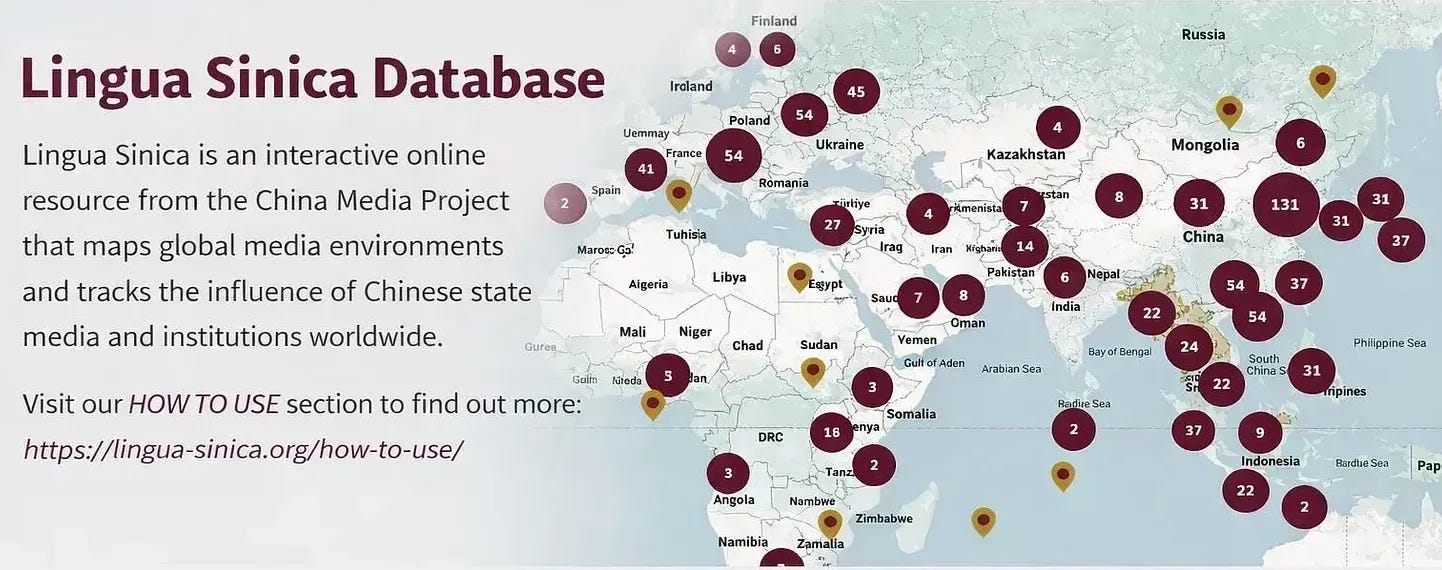
To learn more about China’s media engagements in Europe, check out the Lingua Sinica database. Note that the LS database now allows search by date, with a full calendar function. We encourage readers to explore the database of PRC engagements by selecting for countries, engagement types and dates under the map (don’t forget to click “Filter”). We have also implemented a full-site search function in the banner of the site. Enjoy!
July 21, 2026
Learn More About This Activity
June 19, 2026
Learn More About This Activity
May 19, 2026
No posts
Comments
Nothing yet. Say the first thing.
Sign in to join the conversation.