
Fair warning: today’s note is considerably longer than usual.
Most weeks, the system requires very little change—monitor the same criteria, maintain the existing outlook and avoid creating an opinion simply for the sake of having something new to say. This week is different. A risk-off alarm triggered and confirmed, requiring the first meaningful change in outlook and positioning since April.
With several newer subscribers joining during that period, I am using today’s note to restate how the system works, retrace the road from the April reset to this week’s alarm, and outline what changes from here. Grab a coffee.

Most of July’s notes probably felt repetitive. Truthfully, most of the notes have been repetitive since the middle of April. The S&P 500 delivered a nice 7% advance over the following month and thereafter consolidated sideways.
The market was bullish until proven guilty, and that would remain the case until a risk-off alarm triggered. The system shared here prioritizes risk management. It is genuinely boring until it isn’t—I like to think of that as a feature of the system, not a flaw.
As the author, there is a quiet benefit in the repetition and consistency of the analysis: it is the reason the alarm matters. There are only a handful of moments throughout a year when you are required to pause, analyze and adjust.
For newer subscribers who have not kept close tabs on the system, a risk-management system should not create a new opinion every Sunday and Wednesday. It should keep the outlook and portfolio positioned while conditions remain healthy, then force change when the data changes.
This week, the evidence changed.
The risk-off alarm is built from three criteria: trend, breadth and momentum.
Trend measures whether the S&P 500 is trading above or below its short-term trend. Breadth looks beneath the index to determine whether participation across the market is positive or deteriorating. Momentum measures the strength and direction of the market move.
Individually, none of the three is enough to force a defensive change.
In the absence of a confirmed risk-off environment, the criteria will naturally move between readings of 0 and 2. The index may temporarily lose its short-term trend while breadth remains positive. Momentum may decline as the market consolidates sideways. At times, trend and momentum may deteriorate together while strength beneath the index keeps the alarm from triggering.
These readings create areas of caution and identify what requires monitoring, but they do not independently change the broader outlook. A reading between 0 and 2 remains an environment to position long, consider individual trade ideas and identify opportunities for outperformance.
I describe this simply as bullish until proven guilty.
The alarm triggers when trend, breadth and momentum simultaneously break down, producing a reading of 3 of 3. Even then, the initial alarm is given one additional session to confirm. Markets can quickly reverse a one-day breakdown; when that happens, the alarm can be dismissed and unnecessary defensive positioning avoided.
When the alarm remains active through the following session, the change in market character is confirmed. The portfolio shifts defensively, downside targets are introduced and bullish trades are reduced or closed.
The alarm is not an attempt to identify the exact market top, nor does every alarm guarantee a large decline. Its purpose is to recognize when the probability of further downside has materially increased and the environment no longer supports the same level of risk.
That is the point when the portfolio must adjust.
The road to Thursday’s alarm began on April 8, when the previous risk-off environment finally cleared.
The alarms triggered in late February and early March served their purpose. The S&P 500 declined approximately 8% and reached two of the three downside targets considered through the decline. By April 8, all three risk-off criteria had cleared for three consecutive sessions.
Short trades were terminated, the remaining hedges began to come off and the portfolio started moving back into the bull pen. I did not immediately jump in with both feet—the market still had to prove itself—but it did exactly that.
One week later, the S&P 500 closed above 7000 and marked a fresh all-time high. ARKK and IWM became the primary long trades selected to capture potential outperformance, while the broader strategy returned to its simplest instruction: stay long.
The remainder of April was clean. The S&P 500 consolidated its breakout, the risk-off criteria remained quiet and both ARKK and IWM initially held the levels required to maintain positioning.
By early May, the S&P 500 had recorded three consecutive weekly closes at fresh all-time highs. The risk-off criteria had been absent for 19 consecutive sessions—the longest stretch without an active criterion since 2022.
There was little reason to complicate the environment. Stay long, consider individual opportunities for outperformance and monitor the risk-off criteria for a change in scenery.
A small speed wobble arrived beneath the surface in the middle of May. One risk-off criterion became active, but there was no simultaneous breakdown in trend, breadth and momentum. It created something to monitor, not a reason to abandon positioning. The wobble eventually cleared and the S&P 500 finished May at another all-time high.
June provided a more meaningful test.
The month began with wider trading ranges and the first signs of elevated risk. At several points, the S&P 500 lost its short-term trend while momentum turned lower, raising the risk-off criteria to 2 of 3.
The language in the notes changed from simply bullish to bullish, just cautious—but the portfolio did not become bearish.
Breadth was the difference.
Despite repeated weakness in trend and momentum, participation beneath the index remained positive. Several opportunities for an alarm developed throughout June, but breadth consistently refused to confirm them. Without all three criteria breaking down together, there was no alarm. Without an alarm, there was no reason to panic or force the portfolio into a defensive position.
By June 24, trend and momentum had deteriorated and the system was again reading 2 of 3 active. Breadth remained positive, keeping the alarm on the sidelines.
That discipline allowed the IWM trade established in April to reach its initial target near 300, producing a gain of approximately 11%. Half of the position was collected at target, while the remaining half was held for the possibility of a continued advance.
ARKK did not produce the same result. The volatility repeatedly moved the trade between half, full and overweight positioning as it crossed above and below its risk levels. Those adjustments created several small paper cuts along the way. The trade ultimately failed to deliver the anticipated outperformance and was closed following the alarm for an overall loss of approximately 5%.
Not every trade will work. The purpose of the system is not to eliminate losing trades; it is to remain positioned for opportunity while conditions are healthy and prevent unsuccessful trades from becoming materially damaging when the environment changes.
June ended with the S&P 500 still consolidating. Positive breadth had repeatedly kept the alarm on the sidelines, the outlook remained bullish and the portfolio remained positioned long.
July began in much the same way. Fund-manager positioning and market sentiment continued to react to individual volatile sessions, but the core system remained steady. The S&P 500 held its short-term trend, breadth remained positive and momentum reset.
By July 8, the risk-off criteria had returned to 0 of 3 for the first complete reset since early May.
The following week was equally clean. The S&P 500 traded tightly above trend, while ARKK and IWM found support near their respective key levels. On July 15, the conclusion remained unchanged: bullish until proven guilty.
The first meaningful crack arrived on Friday, July 17. The S&P 500 lost key support and the risk-off criteria quickly moved to 2 of 3. Sunday’s note introduced caution, but stopped short of turning bearish. Two criteria can create discomfort; only three trigger the alarm.
The market attempted to stabilize through the first half of last week. By Wednesday, the S&P 500 was barely holding above its short-term trend, breadth was barely positive and momentum remained down. The market had moved back to a reading of 1 of 3, but it was hanging on by a thread. A relatively small deterioration in the following session could complete the breakdown.
On Thursday, it did.
Trend, breadth and momentum simultaneously broke down, triggering the third risk-off alarm of 2026. The alarm remained active through Friday’s session, confirming the change in environment and forcing the portfolio to adjust.
The remaining half of the IWM trade was closed for an approximately 8% gain. ARKK was closed at a loss, and the broader positioning shifted defensively.
After nearly four months of remaining long through all-time highs, headline volatility, sideways consolidation and several periods of caution, the evidence finally changed.
The repetition of bullish until proven guilty continued for nearly four months.
This week, the market was finally proven guilty.
The core risk-off analysis ended the week with 2 of 3 criteria active, following Thursday’s 3-of-3 alarm. The S&P 500 remained below its short-term trend through Friday’s close, confirming the alarm and the change in market environment.
Breadth recovered to finish the week positive, reducing the active reading from 3 of 3 to 2 of 3. This does not dismiss the alarm. Price remains below trend, momentum remains negative and the initial breakdown was confirmed through the following session.
Trend: Price closed below the short-term trend (20-day exponential)
Breadth: Recovered to finish the week positive
Momentum: Negative and approaching a breach of the zero line
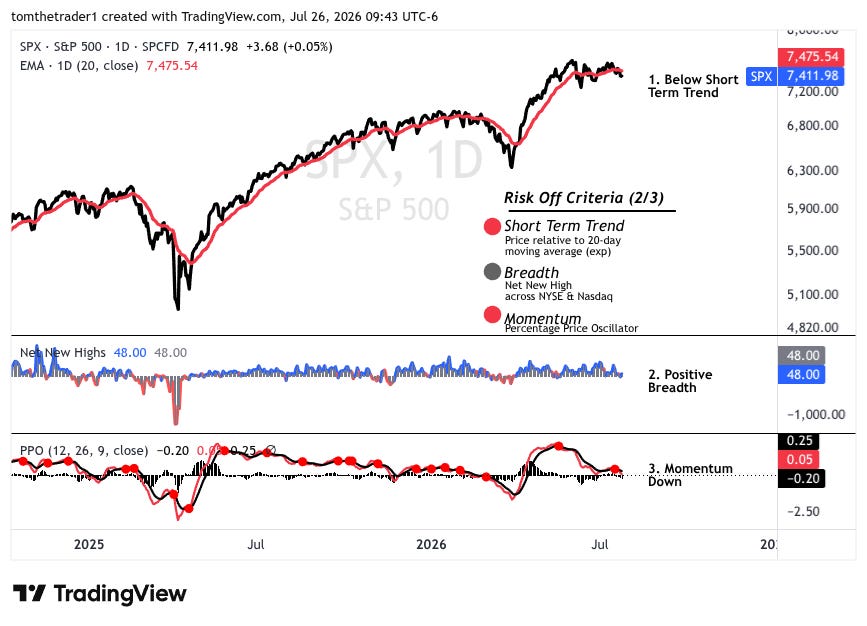
The S&P 500 rejected its short-term trend during intraday rally attempts on both Thursday and Friday—an early indication of a change in character.
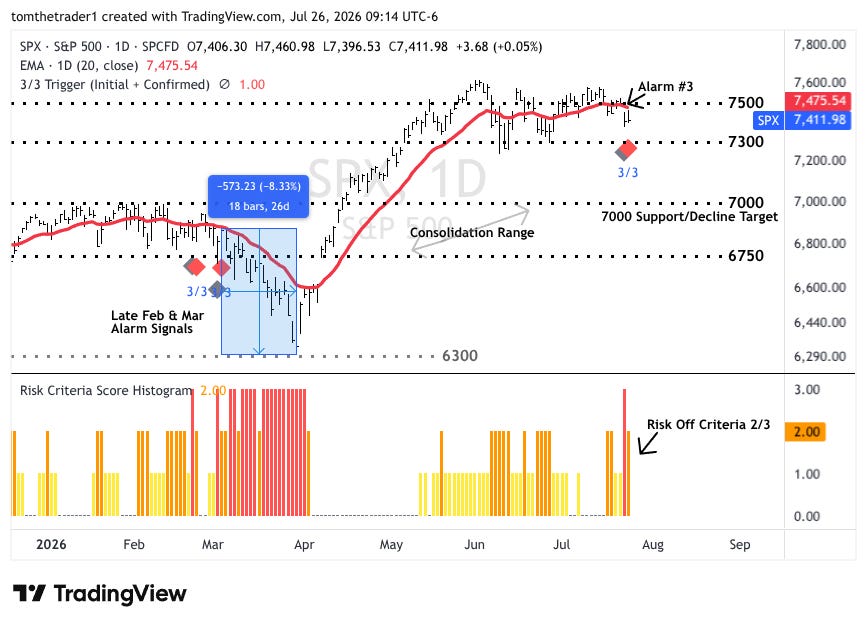
The first two levels to monitor are 7300 and 7000.
The 7300 area provided support throughout the volatility and consolidation of June and July. A breakdown below 7300 would mark a more meaningful deterioration and increase the probability of the decline extending toward 7000.
The 7000 level was the upper boundary of the consolidation that occupied the first three months of 2026. Following the April breakout, this important psychological level was never tested as support. That combination makes 7000 a logical support magnet and the first downside target considered under the confirmed alarm.
The plan shifts this week:
Maintain a cautious outlook below 7475. Sustained trading beneath the short-term trend will add confidence to the bearish outlook, but the alarm remains in its early stages.
Monitor 7300 as the first important support level. A confirmed breach would represent a further change in character and increase downside risk.
Target 7000 following a breakdown below 7300. This level combines the prior consolidation boundary, an untested breakout and the psychological significance of the round number.
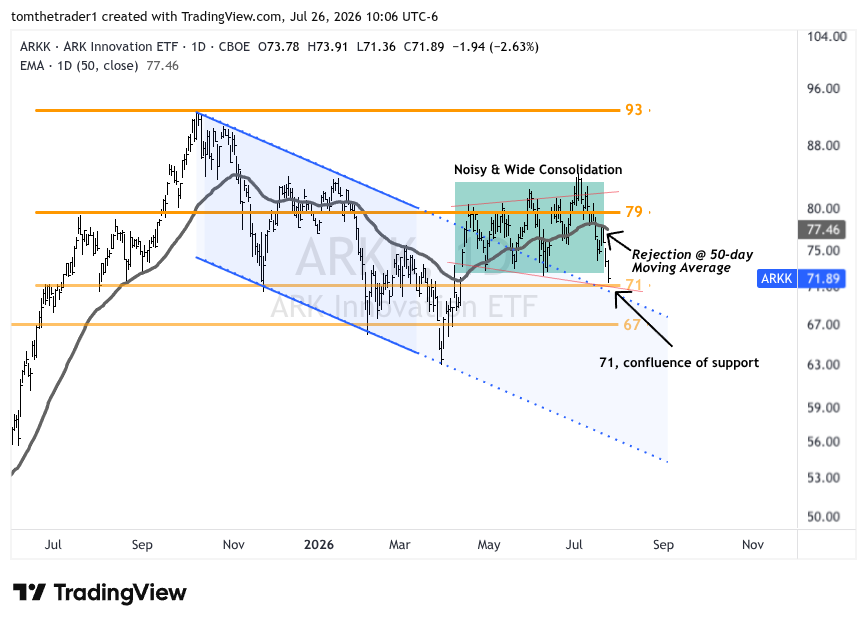
The ARKK trade is closed.
The position did not capture the anticipated outperformance between April and July. Wide, volatile trading repeatedly moved exposure between half, full and overweight positioning, producing several small paper cuts along the way. The final result, including those adjustments, was a loss of approximately 5%.
Last week, ARKK rejected its 50-day moving average and fell toward a confluence of support near 71. This area combines the lower boundary of the recent consolidation, the longer-term declining trendline and visible chart pivots from July and November of last year.
The chart may find support near 71, but the confirmed broader-market alarm no longer supports maintaining the trade. The next meaningful level below 71 is approximately 67.
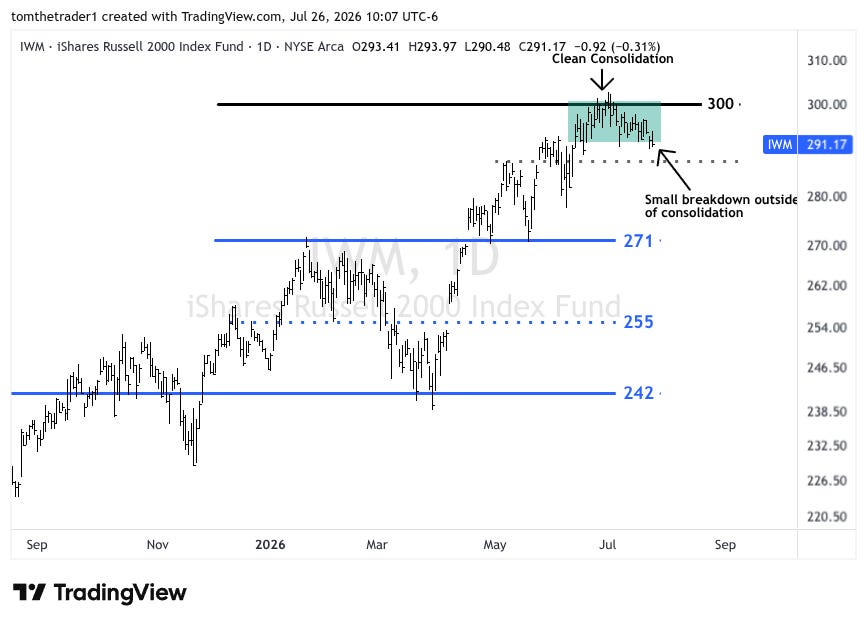
The IWM trade delivered a positive result.
The initial position reached its first target near 300, generating an approximately 11% gain. Half of the trade was collected at target, while the remaining half was maintained for the possibility of a continued breakout.
Unlike ARKK and the broader market, IWM has not yet produced a decisive technical breakdown. The ETF has moved slightly below its recent consolidation range, but its standalone chart could retain a bullish outlook while remaining above 287.
However, the confirmed broader-market alarm takes priority over the individual chart. I elected to close the remaining half of the position for an approximately 8% gain rather than maintain risk through the change in market environment.
The complete IWM trade therefore closed profitably: half collected at approximately +11% and the remaining half at approximately +8%.
The confirmed alarm changes the portfolio posture.
The outperformance trades are now closed. ARKK exited with an overall loss of approximately 5%, while IWM delivered a positive result, with half collected at approximately +11% and the remaining position closed at ~ +8%.
The next step underway through Friday is to hedge the remaining long positioning. The alarm does not require the immediate liquidation of every long-term holding, but it does indicate that the market environment no longer supports carrying the same level of risk.
TLT remains at a 25% portfolio weighting for now. The position has failed to provide the defensive performance originally expected, and I do not intend to dedicate further analysis to the trade today. If TLT breaks below 82, the position will be reduced from 25% to 15%.
From here, the focus shifts away from finding new opportunities for outperformance and toward managing downside risk:
Hedge the remaining long positioning
Maintain a cautious outlook while the S&P 500 remains below its short-term trend
Monitor 7300 as the first important support level
Target 7000 following a confirmed breakdown below 7300
Remain open to dismissing the bearish outlook if the risk-off criteria clear and the market recaptures its trend
There is no need to predict the full magnitude or duration of the decline today. The alarm has completed its first job: it identified a change in the market environment and forced the portfolio to adjust.
The next job is to follow the evidence from here.
The system kept the portfolio long from the April reset through nearly four months of market strength and consolidation. It allowed IWM to reach target, accepted a manageable loss when ARKK failed to deliver, and avoided repeatedly repositioning the broader portfolio during every period of volatility.
Now that trend, breadth and momentum have broken down together, the same discipline requires a defensive posture.
Bullish until proven guilty kept the portfolio long.
The market has now been proven guilty, and risk management takes priority.
Disclaimer: This publication is for informational and educational purposes only. Nothing herein should be considered financial advice or a recommendation. I am not a financial advisor. This content is meant to document my thinking, and hopefully encourage yours.
Comments
Nothing yet. Say the first thing.
Sign in to join the conversation.