
What has impacted the way the world consumes art more than the modern mother?
In 1968, mothers across America pressured Jack Valenti to redesign the movie rating system with the mom in mind. Needing a monitoring system for her child that was reliable and informative, she made her case.
Ever the negotiators, the parental rating system was soon adopted across the nation. If you wanted box office, or even a shot at the big screen downtown, you were going to adhere to the request to get your movie rated for the mother. And you still do.
Seventeen years later, the mothers came together again through the National Parent-Teacher Association to rally against the Recording Industry Association of America, pushing for parental advisory labels in music. Their demands created government pressure in which the RIAA had a choice: permanent censorship or the parental labels for the moms. And, thus, parental advisory in music was born.
Never dismiss the power of a PTA mom: the invisible woman who has single-handedly influenced the direction and economy of the arts at large since the beginning of time. But then, the question beckons…why have the mothers left the world of books alone? And will the beast awaken soon?
I was at one of my book signings this year when a mother approached me and asked, “Is this book okay for my daughter?” The daughter in question was standing behind her (between 14 and 17 years old), waiting patiently for the answer. I admired the mother for asking, but I had no idea how to respond.
I paid a professional content rater during the publishing process, and they told me “15+,” so that’s what I said. But I wasn’t a Christian back then, and honestly, I didn’t have the discretion to push back—or even question the decision before I accepted the rating as fact.
My original vision for the book was an adult audience. It wasn’t until a mentor told me it would do better as a YA and the content rater agreed, that I shifted the market. In YBS, some violence is vivid. Cursing is everywhere. Drinking is alluded to. No sex scenes, but perhaps a reference or two?
After discussing the details of my book with the mother, she concluded it was fine for her daughter to read—there weren’t any sex scenes, and that was her main concern. And maybe that was the right decision for her. But is that the reality for every fifteen-year-old? Even with my own book, one I’d labored over, I wasn’t sure I could say yes.
Still, this question haunted me. How could I, having spent years working on this book, not have a more definitive answer? Shouldn’t there be some scale to point to?
When you’re publishing a book, you are typically asked what age range you believe the book to be appropriate for. This, like most things in the book industry, is entirely subjective. There is no chart explaining what would warrant a higher rating. Is sixteen curse words equivalent to a violent scene? Is a closed-door romance appropriate enough to be a YA?
A case study that is perhaps the most interesting is A Court of Thorns and Roses. I tried to read this series a few years ago and made it about three chapters into the third book. Even pre-Christian Linds had to DNF the series. The story became intertwined with sex scenes between humans and dragons. Yes, really. While book one was modest, book two had a few suggestions. By book three, the idea was out plain in the open. I know this series is wildly popular, so I will just keep it simple and say, that was not for me. Lol.
Looking back on this, what’s odd to remember is that I picked up the first book in the Young Adult section. A section that is generally deemed safe for late middle school to high school readers. By the time I had the third book in my hands, it was resting in the adult fantasy section. (The appropriate section for the book.) So my question was, what happened?
When I googled the classification of the ACOTAR books, here’s what came up:
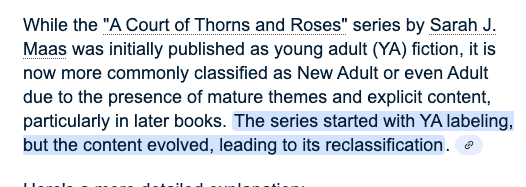
Honestly, fair enough. However, upon further investigation, I discovered that the reclassification occurred in 2020. The third book (that was nearly p*rn) was released in 2017. According to my research, this book was likely on the shelves for middle school and high schoolers for at least three years. Which I don’t believe is the author’s fault. (More on that later)
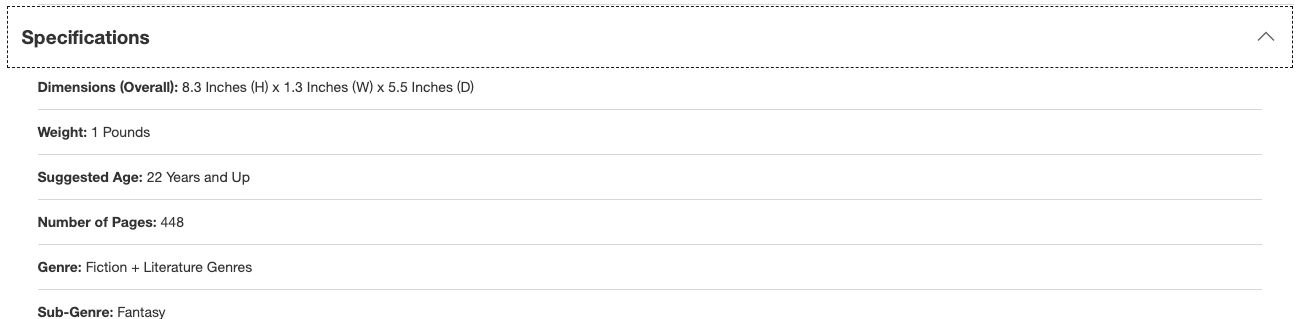
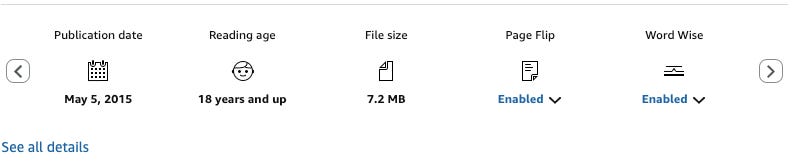
I decided to look further and see if the rating system had caught up to itself now, five years later. And to my surprise, it had not. I found mixed messaging between the retailers. Amazon rates the first novel as a New Adult appropriate book. (18+) Meanwhile, Target gives the first book a strictly adult rating. (22+)
Let me start by saying that I don’t believe the author, Sarah J. Maas, held much responsibility in this reclassification, or even in the original one. Sarah is with Bloomsbury, which has published most of her work, including her original YA series.
Likely, Sarah just wrote whatever she wanted to write, and her publisher was responsible for the big marketing decisions like what categories will this book fall under, and thus, where will it be shelved with retailers? That’s typical for a traditional publishing relationship. And it’s also typical that the author might’ve voiced concern for the YA rating herself, having written for an older audience, and been overruled.
Since Maas already had established a YA audience through her previous series, I’m assuming the publisher decided that the best bet for marketability was to keep the audience linear, at least for a time. Even if they knew it wouldn’t be appropriate down the line, it would be risky for business to shift her audience into a new age classification. This was in 2015, in a pre-TikTok world when authors weren’t taking as active a role in their own marketing processes. Pivoting audiences was a scarier business when you didn’t have all of your readers gathered in one place like social media.
Since publication, the ACOTAR series has sold over 13 million copies. Whether you like the content or not, that is truly a remarkable accomplishment. However, the question beckons: with a series that has made millions and millions of dollars, likely supported by a full-time staff, how are there still discrepancies in details like the recommended audience?
If the industry can’t figure out how to rate and place a wildly popular author’s work, what hope is there for consistency anywhere else?
Most people deeply enveloped in bookish culture will tell you (emphatically) that books should not be rated. Most of their claims rest on the idea that rating books will harm anyone who isn’t white and straight. I tend to disagree, especially when you consider how the film industry—despite its own rating system—remains saturated with diverse voices. Still, in a largely liberal-leaning industry, the sentiment isn’t exactly surprising.
First, it is essential to understand that the rating system in our major media outlets (movie and audio) has always been voluntary. You do not have to get your movie or album rated. However, there are advantages.
Consider the film industry: many theaters won’t show unrated films, and major marketing channels often won’t promote them, because without a clear rating, it’s unclear which audience to target. Rating your film as a filmmaker is typically to your advantage. But no one will ever force your hand. In film, it’s widely accepted that the rating standard helps direct your movie to the right audience, rather than just any audience. There is no censorship involved.
Simply put, it’s informed consent.
One of the ironies of the anti-rating argument is that the lack of a standardized system may actually make it easier for books to be censored, challenged, or banned outright. Without clear content guidance, parents, schools, or community members often react to one quote taken out of context or one sensitive theme, assuming the worst, because they didn’t know what to expect.
Take the case of Angie Thomas’s The Hate U Give. It was pulled from school libraries in several districts, not because of its overall message, but because of select profanity and references to drug use. Had there been a clear rating or content advisory indicating themes of violence, language, and mature content in service of a powerful social narrative against racism, those challenges might have been softened or avoided. Instead, the book faced censorship based on isolated elements, stripped of context.
A content rating or advisory doesn’t restrict access. Instead, it provides a framework to set expectations, which can diffuse outrage before it starts.
Strangely, most of the articles I found on the topic of book content ratings—even those on major platforms—weren’t written by parents. The professional content rater I hired for YBS wasn’t a parent either. As the writer, neither was I. In hindsight, the absence of experience makes the rating feel somewhat hollow.
Which leads me to ask: how do those without children develop the discernment to shape what is deemed suitable for those coming next?
Maybe with what already works.
For now, I think there’s real legitimacy in starting where the film industry is. Movies have long used a public, standardized, and easily understood rating system that offers broad guidance while still allowing room for interpretation. One that is freely accessible on the internet. (Click here to access that info)
This system is designed with parents in mind, taking a pulse of each movie based on the general sentiments of pooled parental opinion. We don’t have to reinvent the wheel—we need a system that helps readers understand the intensity and themes of a book before diving in.
What we need is a system that works with parents—one that equips them to make informed decisions for their own children. Not one that makes those decisions for them, behind closed doors.
Some might say this kind of rating system would take too much manpower, but with the pace of tech innovation, it could be a decent job for well-trained AI.
As an indie author, I’ve decided to start this initiative with my latest release and future releases. With my own work, I am working to place the rating on my books in the most easily accessible places.
For my future releases, I plan to include a small content rating on the back cover, much like what you’d find on a standard DVD. My goal is for readers to understand the intended audience before they even open the book.
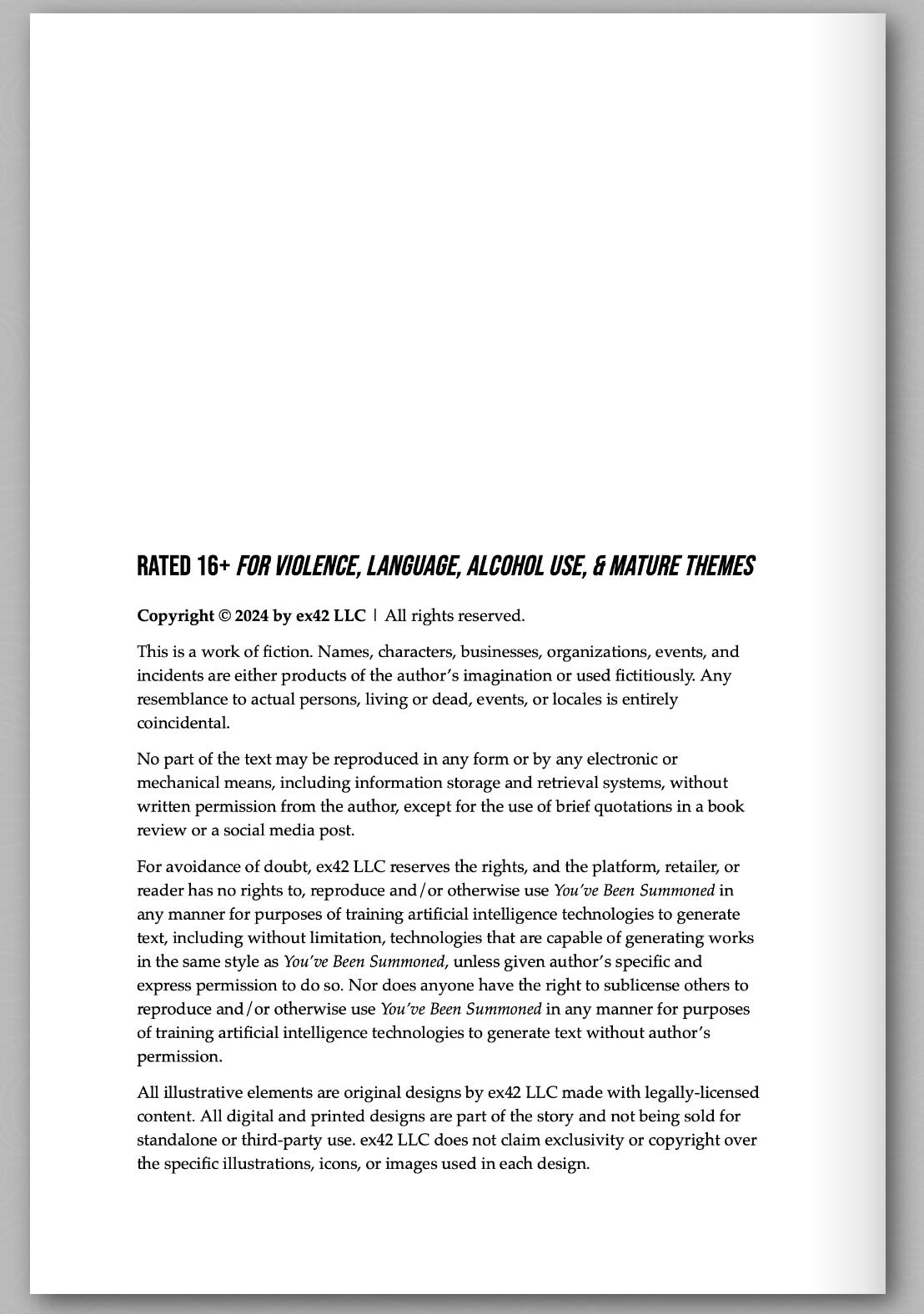
In my view, the copyright page offers a natural space to standardize this kind of information. A concise “15+” label on the back cover is helpful, but there also needs to be a place where readers—especially parents or teens—can see exactly why the book carries that rating.
The copyright page allows a place for that information to be found easily, without disrupting the flow of the book’s format.
I’ll be implementing this for YBS by the end of the summer and my future releases will have it going forward.
Writer? Parent? Teen reader? I’d love your perspective! Who gets to decide what’s “appropriate”—and how do we make that fair for everyone? Let me know in the comments.
Thanks for reading as always. Stay tuned for some exciting updates coming soon.
-linds
No posts
Comments
Nothing yet. Say the first thing.
Sign in to join the conversation.