
When you were a kid, you were likely asked a simple question over the course of your childhood: What do you want to be when you grow up?
We likely answered this question based on what sounded fun or what we enjoyed at the time, maybe even naming activities that are very unlikely to result in actual income. (I’m still trying to find the job where I can just read books for a living.)
But many of us, especially the older we got, thought about what we were good at and what came easily to us, and imagined that somehow be part of our job someday.
It’s interesting to me that the question is who do you want to “be” when you grow up, but we almost immediately go to what we will “do” in the form of a job.
For a long time, my assumed career path was music. I played the piano and sang, plus did all the school music activities of band, choir, and musicals. I sang solos in church, and eventually became the church pianist when I was just a freshman in high school.
But even before that, I would listen to my favorite CCM artists and dream of a similar career path (CCM stands for Contemporary Christian Music, for those who weren’t so immersed in that culture that you also received the magazine by the same name, IYKYK).
Why was this my dream? Because singing and music was something I was affirmed for, so naturally, I thought that would be my job.
But there’s a deeper reason: Music was something I knew I could do well, and it’s the place where I felt loved and valued. I wasn’t so sure what I could offer as a person, simply as my own self. But I knew I could sit at a piano or stand behind a microphone and bless and impress the people in the room.
Music was my thing, and it was safe to show up in that way. Growing up, I gravitated towards the spaces, such as music, where I felt competent, strong, and capable, and I hid the parts of me that didn’t feel so presentable to others. I even did this with God, looking for His love by doing good things.
I grew up in the church, so I would have told you: God loves me unconditionally. I knew that because He was God, He simply loved me no matter what and it wasn’t based on what I did or didn’t do.
I knew God loved me unconditionally. I just never really gave Him a chance to show me that.
I kept showing up in my strength, but God was inviting me to find Him in my weakness.
What was your “thing” growing up, or even now? What is it that you know you can do well?
There’s nothing wrong with celebrating and embracing our gifts and talents. Each of us has a unique contribution to make through our strengths and abilities, and the beauty of the body of Christ is how we bring our own unique selves to the community.
But too often, we inflate that part of ourselves until we think it’s our whole identity and what makes us beloved.
We think that unless we perform with perfection, we will fade into the shadows. No one will see us or care, including God.
We develop a posture of earning and proving, and if our “thing” went away, we’d have no idea who we are.
But how would it feel to receive love as-is? Without the performance or perfection, with all of us brought into the light of God’s love–both our beauty and our brokenness.
It is only in this undefended and open state that we can fully and truly experience the unconditional love of God.
Not based on what we do, or what we do not do…but simply because of who we are.
The journey of becoming beloved is a lifelong work. It’s more difficult for some of us than others, and for me, it’s a core part of God’s invitation to growth.
God has invited me into spaces and places where I have come face-to-face with my weakness. He has kindly led me into certain parts of my life where feeling capable and competent simply isn’t an option.
It’s in those places of weakness where transformation happens. It’s not in places of competence where I grow, but where I reach the end of myself and find the grace and strength of God holding me.
This is where I find I am loved, even when I have nothing to offer.
As God is healing this in me, I am learning to show up in places of strength and weakness without trying to prove or earn.
I find God in my strength, as music has become a life-giving place for me again. Because it’s simply something I do, and it’s not who I am.
I also find God in my weakness. In this season, motherhood is a place where I often feel weak. This too is becoming a place where I experience myself as beloved, even in my lack.
As you consider your own life and story, what is it for you? What is your place of strength? What is your place of weakness? And what would it mean to live as the beloved for who you are, apart from what you do?
I’m sharing more of my story on the latest episode of the REALIFE Practice Podcast, which I cohost with Teresa McCloy as part of the work I do at the REALIFE Process.
We’ve been doing a series on seasons of formation and interviewing people in different decades and stages of life, and this week, it was my turn to share my own story–both the story of my past, and what I’m navigating in my current life stage in my forties.
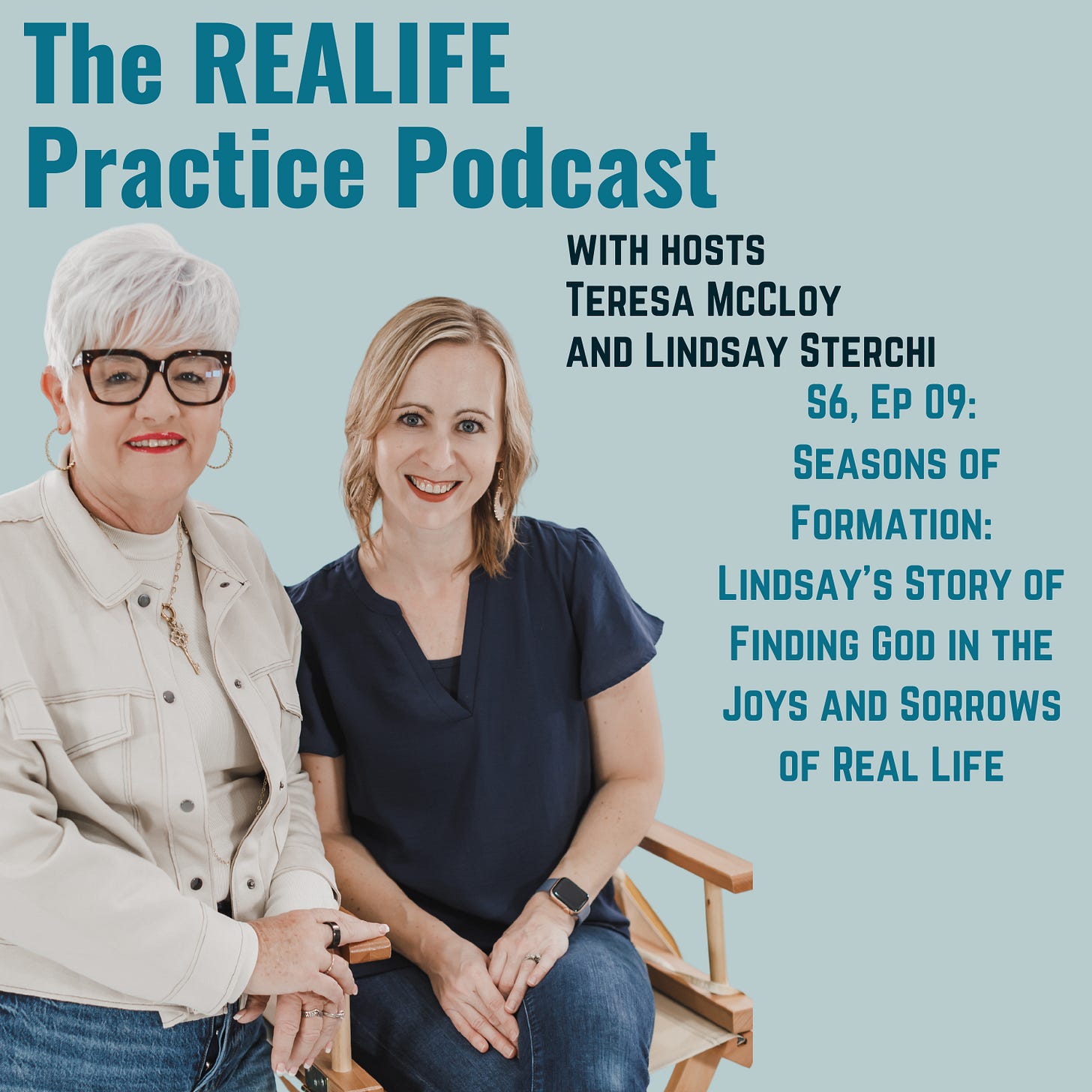
I’d love for you to give it a listen, and make sure you check out the other episodes in the series to learn from people in all seasons of life. Search for “the REALIFE Practice” in your podcast app, or CLICK HERE to check it out.
Tell us in the comments: How do you find God in both your strength AND your weakness?
Thanks for reading Simple Spiritual Practices! This post is public so feel free to share it.
No posts
Comments
Nothing yet. Say the first thing.
Sign in to join the conversation.