
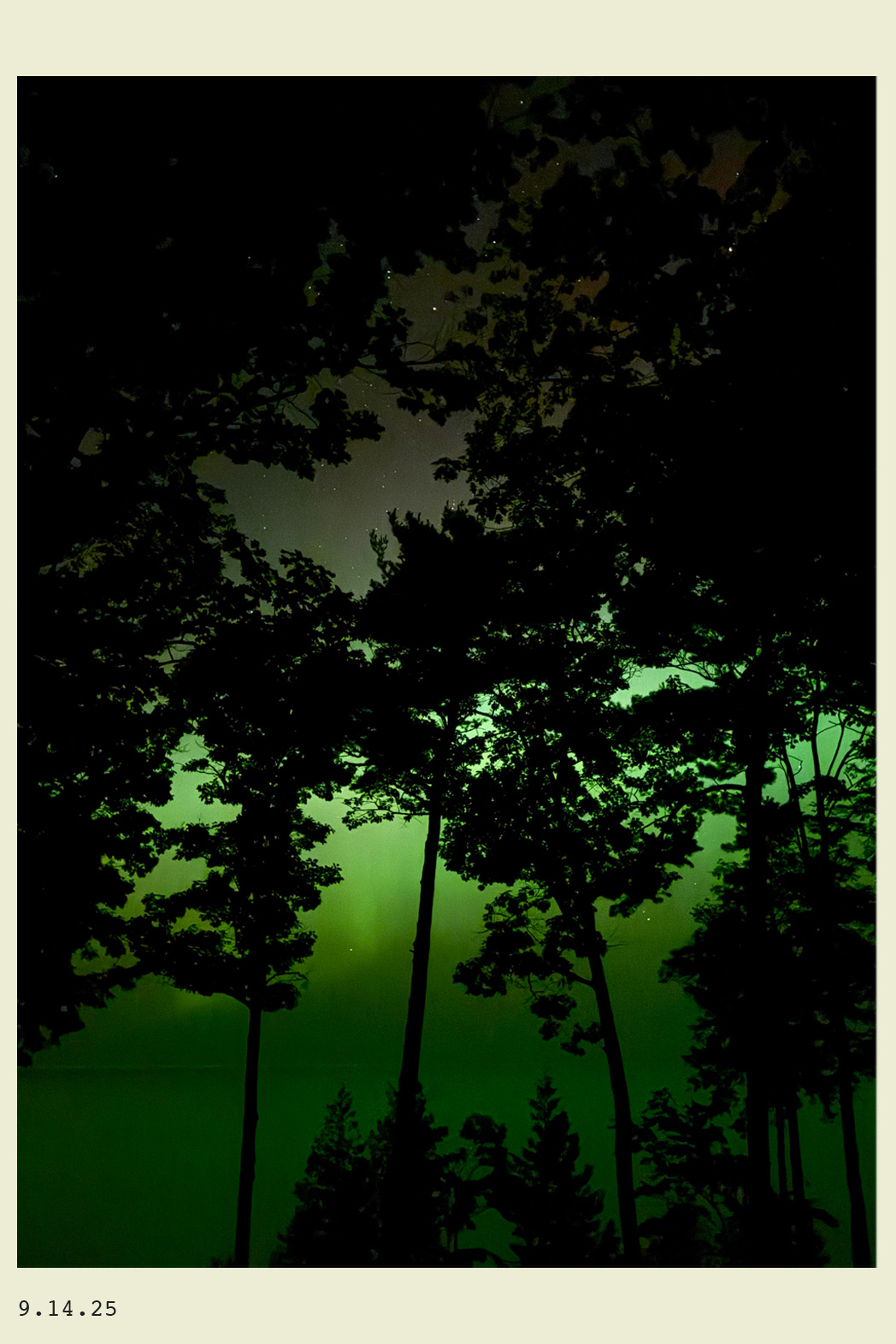
Last week after my family had fallen asleep, I slipped through the screen door and into the quiet night to catch a view of an aurora borealis. Overhead, between lacy tree limb silhouettes, the sky subtly pulsed with swaths of moving light. I peered through my phone camera lens. Its long exposure time let me see what my eyes alone could not – the northern lights in glowing green and magenta. Beyond those soaring colors, millions of stars punctured the blackness.
Around the spring and fall equinoxes, like today’s, we have a greater chance of seeing auroras from Earth. During these shifts in season, Earth’s magnetic fields are positioned perpendicularly to the sun, creating temporary openings for the sun’s charged particles to ride solar winds toward our atmosphere. A phenomenon discovered by researchers in the 1970s (named the Russell-McPherron effect), these “equinox cracks” can be gigantic. Some span a width larger than Earth itself.
Earth’s atmosphere and magnetosphere help shield us from solar winds and the resulting interaction between particles and gases creates an aurora. When we are lucky, we see this solar phenomenon from the ground – sometimes while in pajamas, stepping on fallen acorns.
To stand before an aurora is to stand before unfathomable immensity; it is hard to believe it is real, and yet, it is. It seems rare to feel this kind of wonder as an adult. But I enjoy the feeling of being dwarfed by infinite space and time. It makes my own human-sized concerns feel less important; it is humbling in the best possible way.
A similar sense of grounded awe comes through in two poems I include below: Raymond Carver’s Simple and Jane Hirshfield’s Optimism.
Simplicity and optimism are words that are challenging to keep in focus when world events are relentlessly complicated and divided, and when objective truth and science—seemingly much of what we know to be true and real—is being aggressively attacked.
Perhaps that is why I continue to return to these poems—for they wrestle with the sublime while staying solidly connected to the irrefutable: dirt, sky, tree, light, shadow, raspberries, figs. These poets remind me that the real still does exist all around in magnificent, awe-inspiring specificity. They remind me that it is crucial to stop and see: a hearty oak dropping amber leaves; a perfectly ripe brown pear waiting for me on the counter; an aurora borealis casting otherworldly hues.
Maybe this is one version of hope. It’s one version of mine, anyway.


Farm Club x Lindsay Gardner 2026 Calendars
Preorders for Farm Club 2026 Calendars benefiting Leelanau Conservancy are now available! To ensure you get the number of calendars you need, we highly recommend preordering. Farm Club will also have a small stack for sale in their market.
Each page of the monthly calendar pairs a painting of mine with a quote from the archives of Nic Theisen’s (founding farmer of Leelanau’s Loma Farm + Farm Club) CSA newsletter. The calendars are printed in full color on beautiful heavy weight, matte paper.
All proceeds go to Leelanau Conservancy’s Farmland Protection efforts, which help preserve the unique farming heritage, landscape and economy that makes the northwest corner of Michigan so special. Since I started collaborating with Farm Club and Loma on this project in 2022, calendar sales have generated $15k in donations to the Conservancy’s important work. Please consider helping continue that great momentum.

Feeeeeelings
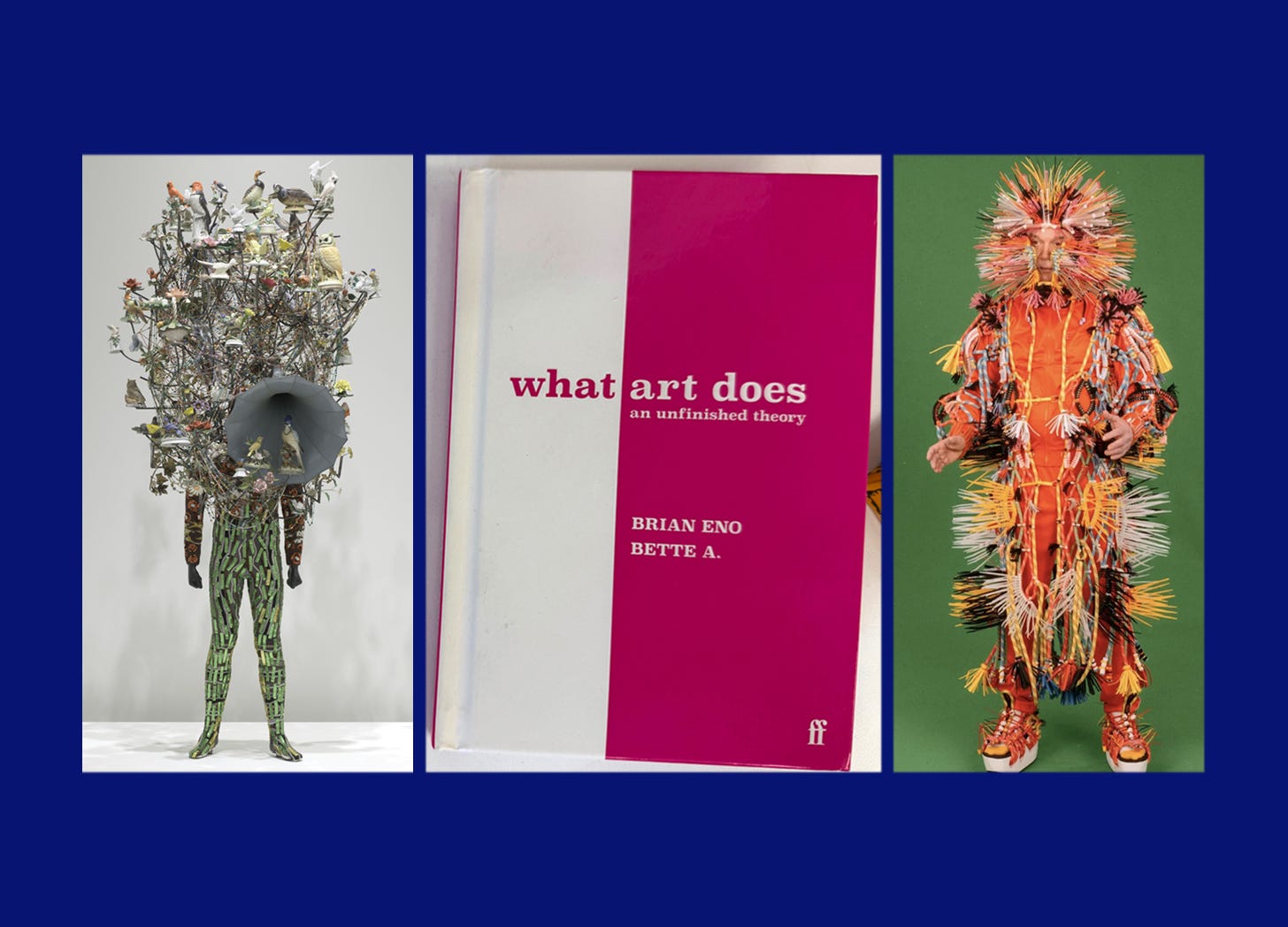
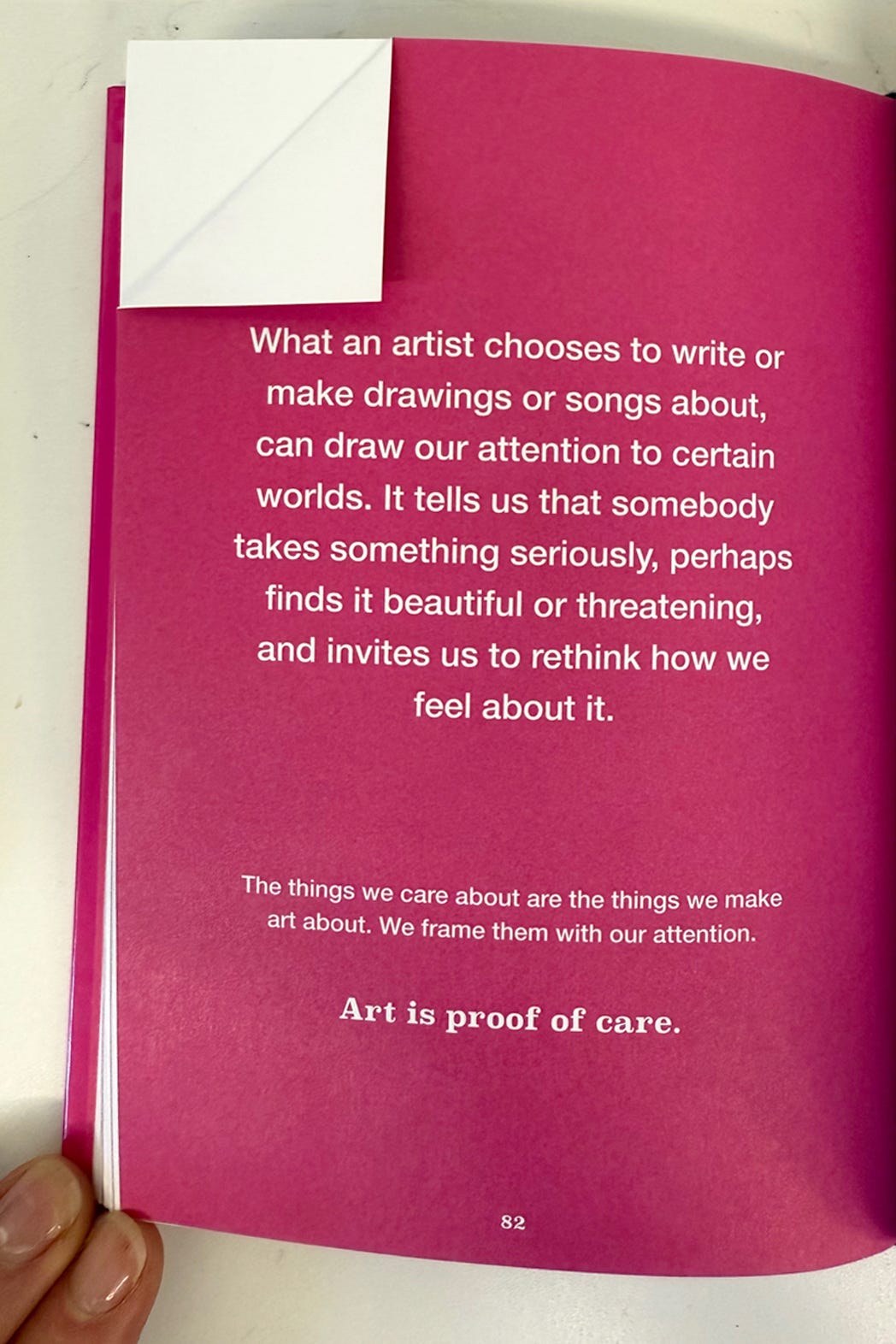
In my last newsletter, I wrote about Brian Eno’s interview with Amanda Petrusich. Since then I tracked down a copy of What Art Does (Faber, 2025). Eno’s writing is straightforward and clear as he delineates why art does something that nothing else can: express, investigate and elicit feelings.
Another one of my favorite artists, David Byrne is touring this fall with his new album, Who is the Sky. In October, we are taking our kids (almost ten and thirteen!) to their first concert to see him perform at Detroit’s historic Fox Theater. When I saw the album cover, I thought the costumes had surely been designed in collaboration with the visual artist Nick Cave (they bear a striking resemblance to his epic soundsuits). As it turns out, Byrne collaborated with Belgian fashion designer Tom Van der Borght on the costumes for the tour.
The suits are composed of everyday materials like neon ropes, zippers and tubes, transformed into psychedelic wearable pieces. Van der Borght plays with ideas that resound in Byrne’s music and performance such as protection, identity, protest and belonging, prioritizing emotional resonance over imbuing literal sense. I can’t wait to see them in motion in the show.
Byrne and Eno’s years-long collaborations famously resulted in some of the most influential music of our time. In Byrne’s sound and performance, elements of Eno’s theories of art unfurl in real time (Eno writes, “art engagement begins when the functional engagement ends.”). Art is play, Eno posits, and in play, “we research our feelings.” I think Byrne would agree. A 2022 show of his visual artwork at Pace Gallery displayed his sentiment on the subject. He wrote, “Both art and music seem to bypass the rational and logical parts of the mind — rather, they are understood by myriad parts of the brain that are connected to one another. It is a different kind of understanding. The effect of this interconnection is pleasurable, ecstatic even.”
There is a strong connection between Eno’s emphasis on art as avenue to and from feelings, Byrne’s exploration of art and music in accessing different parts of the brain, and film critic Richard Brody’s recent essay, “In Defense of the Traditional Review” (The New Yorker, 7.24.25). In it, Brody takes issue with the Times recent reassignment of four cultural critics in a move prioritizing “dynamic content” over the traditional review. Bemoaning the degradation of cultural criticism, he defends the traditional review as a stand-in for a crucial encounter: the individual’s experience with a work of art.
Brody argues that reviews are “the most inherently progressive mode of arts writing,” because they “advance the cause of art itself.” He writes:
“The heart of the review is emotion, the stirrings of the soul, receptiveness to the life-changing power of art (even commercial art); personality-centered formats rooted in reporting or in talk are art from the ego, more like homework or social capital. And, though criticism is obviously subjective, at another level it is resolutely objective—a form of reporting from within. As idiosyncratic as individual critics may be, they also have fundamental commonalities with readers—and, in expressing, with care and flair, their own feelings, they often awaken such feelings in readers, for whom these emotions had been latent or inchoate. Like any literary work, the individual critical voice finds its echoes in the world at large, in readers’ self-recognition, in a sense of community.”
Or, as Eno writes in What Art Does, “Art changes how we feel about our feelings – how we notice them, how we respond to them, how we compare them, how we make use of them.” In championing the pivotal relationship between art, feeling, and connection, Brody finds commonality with Byrne and Eno.

Ratatouille Ritual
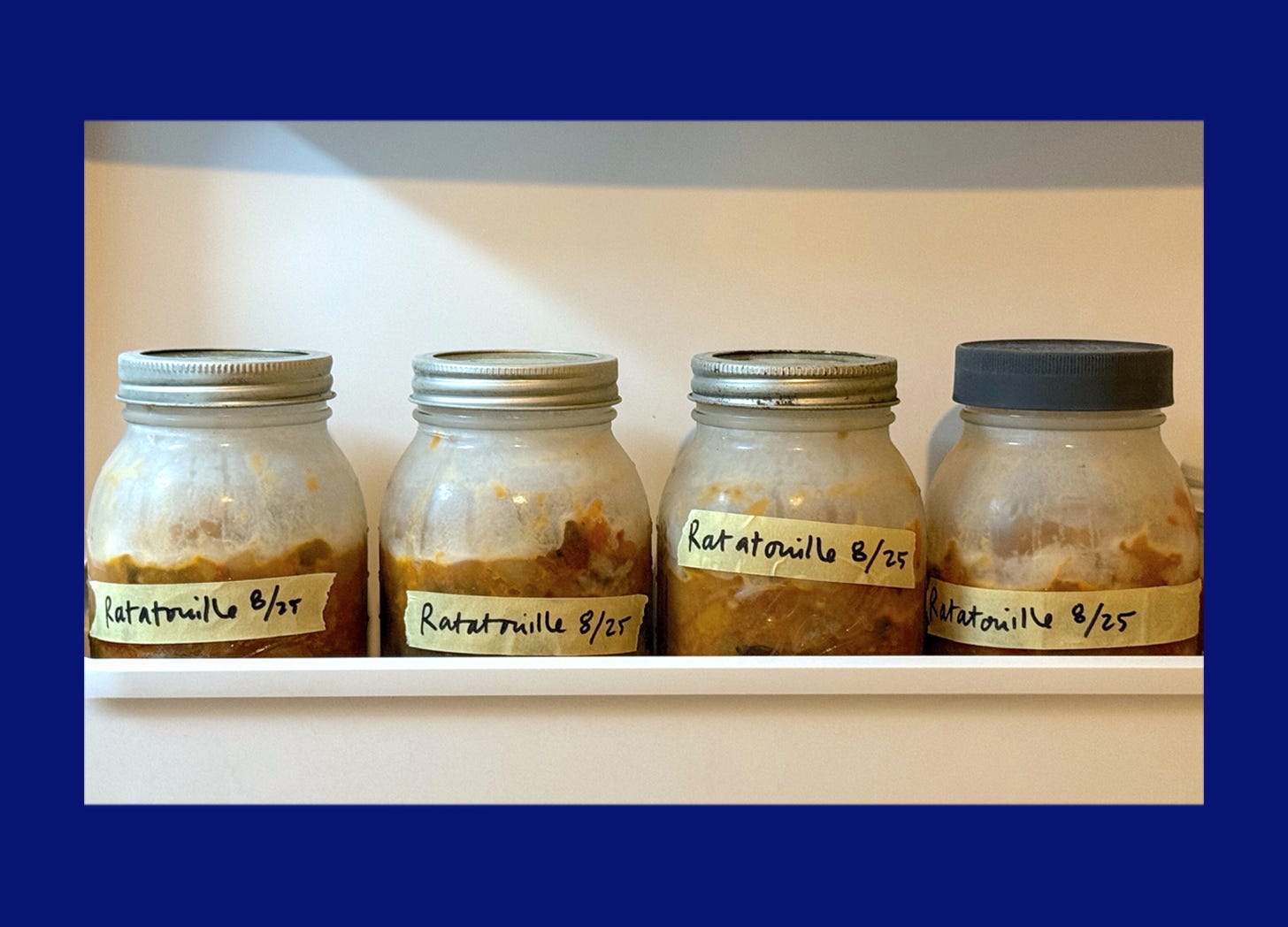
I am not one to spend my days canning preserves in the height of summer. I might make small attempts to put up fruit here and there– a bag of sliced peaches, or hulled strawberries in the freezer. Years ago, when I read Laurie Colwin describe her learning curve with canning and the anxiety the process it induced, I could identify. There is too much that I love to do outside during the summer, and not enough time to do it as it is.
But I do have one annual summer cooking ritual. Sometime toward the end of August I head to the farmer’s market for eggplants, zucchini, tomatoes, peppers, onions and garlic to make ratatouille. The haul sits on my counter, taunting me and attracting fruit flies while I procrastinate or go swimming. Finally when the late summer sun is fading around nine or ten p.m., I chop and chop until my wrists hurt; sometimes—as was the case this summer—still in my wet bathing suit, dripping from the evening’s last swim.
I layer the vegetables into a heavy pot, and cook them slowly to give the stew ample for time to simmer and reduce. I let it linger probably longer than some might, but at this point I know what I like.
This year, my ratatouille cooked until long after darkness fell. I left the pot on the counter to cool overnight. In the morning I scooped it into glass jars. Now they line the door of the freezer; they are a gift for my winter self.

Text within this block will maintain its original spacing when published
Simple
By Raymond Carver
A break in the clouds. The blue
outline of the mountains.
Dark yellow of the fields.
Black river. What am I doing here,
lonely and filled with remorse?
I go on casually eating from the bowl
of raspberries. If I were dead,
I remind myself, I wouldn’t
be eating them. It’s not so simple.
It is that simple.

Text within this block will maintain its original spacing when published
Optimism
By Jane Hirshfield
More and more I have come to admire resilience.
Not the simple resistance of a pillow, whose foam
returns over and over to the same shape, but the sinuous
tenacity of a tree: finding the light newly blocked one side,
it turns in another. A blind intelligence, true.
But out of such persistence arose turtles, rivers,
mitochondria, figs—all this resinous, unretractable earth.


Thanks for reading Constellations. If you enjoyed reading it, please share it with a friend.
Comments
Nothing yet. Say the first thing.
Sign in to join the conversation.