
I’m a proud board member of Chamber of Mothers — the largest nonpartisan nonprofit organizing everyday moms across the country to win federal paid leave, affordable childcare, and better maternal health outcomes. Here’s why I think they’re the real deal, and why you should know about them, support their work, and join the movement for change.
The gap between public support for an idea and getting actual legislation signed into law is enormous, and the only thing that consistently closes that gap is organized, sustained, on-the-ground political pressure from real people in real communities.
That’s exactly why and how Chamber of Mothers was built, and it’s why I said yes when Erin Erenberg asked me to join their board a year and half ago. She asked the question rhetorically, there is a Chamber of Commerce, where is the centralized voice for mothers? I was in, and immediately loved the name.
They are not an inside the beltway, Washington, D.C. only, think tank organization (there is lots of space and room for those too). We are 100,000 mothers in 50+ chapters in deep red states and dark blue ones, showing up, building relationships, and making noise to make the lives for moms easier.
And they just launched their own Substack, subscribe here.
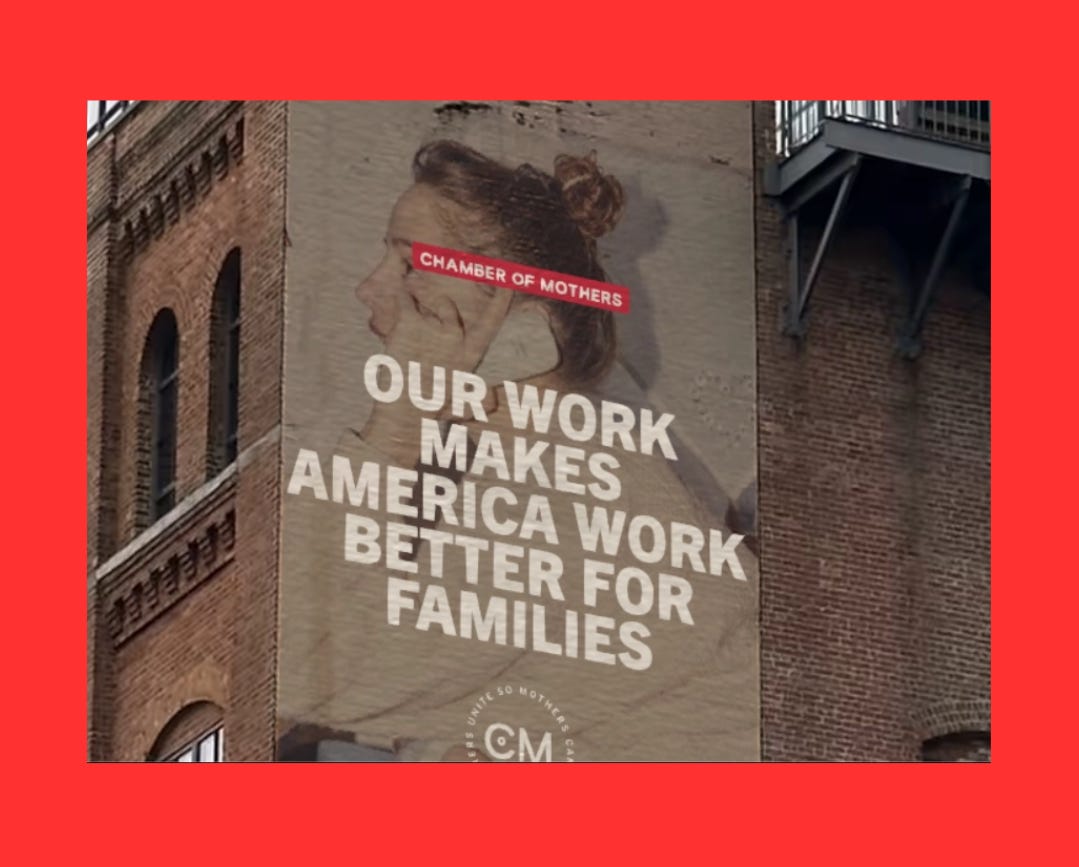
Chamber of Mothers has an origin story that anyone who follows federal policy will recognize. In 2021, after mothers had been holding the country together through a pandemic, the American Families Plan arrived in Congress with real promise: 12 weeks of paid family and medical leave. By the time the bill passed the House, that had been whittled down to four weeks. Then paid leave was cut from the package entirely.
That night, a group of co-founders asked themselves a simple question: the U.S. has roughly 85 million mothers who collectively hold between $11 and $15 trillion in annual spending power and control more than 84% of household spending decisions — so where is our organized political force? Where is the “Chamber of Mothers”?
They built it. And it grew fast.
Chamber of Mothers focuses on three interconnected crises that affect mothers across every political background, geography, and income level.
The United States is the only wealthy nation—and one of only nine countries in the entire world—without a national paid family and medical leave policy. Only 27% of U.S. workers have access to paid leave at all. That means millions of Americans, including new mothers, are forced to choose between a paycheck and caring for their families. Research consistently shows that paid leave improves both maternal and infant health and reduces infant mortality. The economic case is equally clear: the U.S. would add an estimated $775 billion to its GDP annually if women participated in the labor force at rates comparable to peer nations with stronger work-family policies.
This an economic and public health emergency hiding in plain sight.
More than half of Americans—and 60% of those in rural communities—live in childcare deserts, with no providers nearby. For families who can find care, the costs are staggering: the national average price of childcare in 2023 was $11,582 per year, representing more than 32% of a single parent’s median income. The result? Parents, mostly women, are pushed out of the workforce, costing the U.S. economy $122 billion in lost revenue and productivity each year.
As I know first hand, those of us who are raising children with special needs face even greater challenges. Balancing the income required to raise kids that need extra support, with the impossible task of finding childcare well suited to our children’s unique needs, is next to impossible. And it shouldn’t be this way, especially since the additional burden is placed on single mothers, those in lower income brackets, and diverse racial backgrounds.
The cards are stacked against us and we need to fight back.
The U.S. has the highest maternal death rate of any high-income country, and more than 80% of those deaths are preventable, according to the CDC. Maternal death rates have tripled in the South and quintupled in the Midwest over the past 20 years. Black and Indigenous women die at rates two to three times higher than white women. More than 35% of U.S. counties are maternity care deserts—1,104 counties without a single birthing facility or OB clinician.
These are all policy failures, and they are all fixable.
I’ve worked with a lot of advocacy organizations over the years. What sets Chamber of Mothers apart is the combination of grassroots depth and bipartisan credibility—which, if you’ve spent any time trying to pass federal legislation, you know is extraordinarily rare and extraordinarily necessary.
More than 80% of Americans support a federal paid leave policy, affordable childcare, and improved maternal health outcomes. Chamber of Mothers leans into that shared ground, intentionally. They travel to Washington six to eight times a year to meet with bipartisan, bicameral members of Congress. They’ve built genuine, lasting relationships on both sides of the aisle.
And they’ve already notched a first federal legislative win: the BABES Enhancement Act, which requires that breast milk be handled properly and hygienically through airport security.
Raise your hand if you’ve ever tried to get breast milk, which takes an incredible amount of energy to produce, through TSA…
Their 50+ local chapters aren’t just mailing-list holders. In the past year alone, Chamber of Mothers chapters have passed state-level bills, traveled to D.C. to meet with members of Congress, hosted advocacy days with coalition partners, worked with governors’ offices, and collected real data on childcare costs and barriers in their communities.
I write a lot in this newsletter about the policy landscape for toxic chemicals and environmental health. But the systems that fail mothers on paid leave, childcare, and maternal mortality are the same systems I’ve been fighting my whole career: federal policy that lags far behind public need, moving slowly while real families pay the price.
Chamber of Mothers reaches up to 20 million mothers monthly. They understand something that too many advocacy organizations miss—that lasting federal policy change requires organized people, not just organized arguments or social media shares.
Moms are a formidable political constituency when they’re united, and the Chamber of Mothers is doing the patient, serious work of building that unity across partisan lines.
I’m proud to be on their board. And I’d encourage you to get involved.
Sign up to join the movement here and subscribe their new Substack
Donate to the Chamber of Mothers, they are scrappy and each dollar works hard
Join Chamber of Mothers, wether its sending email actions or getting involved in a local chapter, every bit helps!
Information on toxic chemical pollution is too important to lock behind a gate. All of my content on The Environmental Health Brief is now free.
And anyone who joins the annual paid subscriptions, will receive a free copy of my book, Cleaning House: The Fight to Rid Our Homes of Toxic Chemicals.
The nuance around toxic chemicals and environmental health is already disappearing—flattened by social media, distorted by partisan politics, drowned out by wellness noise and bad-faith dismissals in equal measure.
The last thing I want to do is make credible information harder to find.
No posts
Comments
Nothing yet. Say the first thing.
Sign in to join the conversation.