
Do you struggle with student led discussion strategies? Been there! Done that! The ELA classroom is all about the exchange of ideas and the use of speaking and listening skills to process and further student learning. Yet, depending on the class, it can be like pulling teeth to get a discussion rolling.
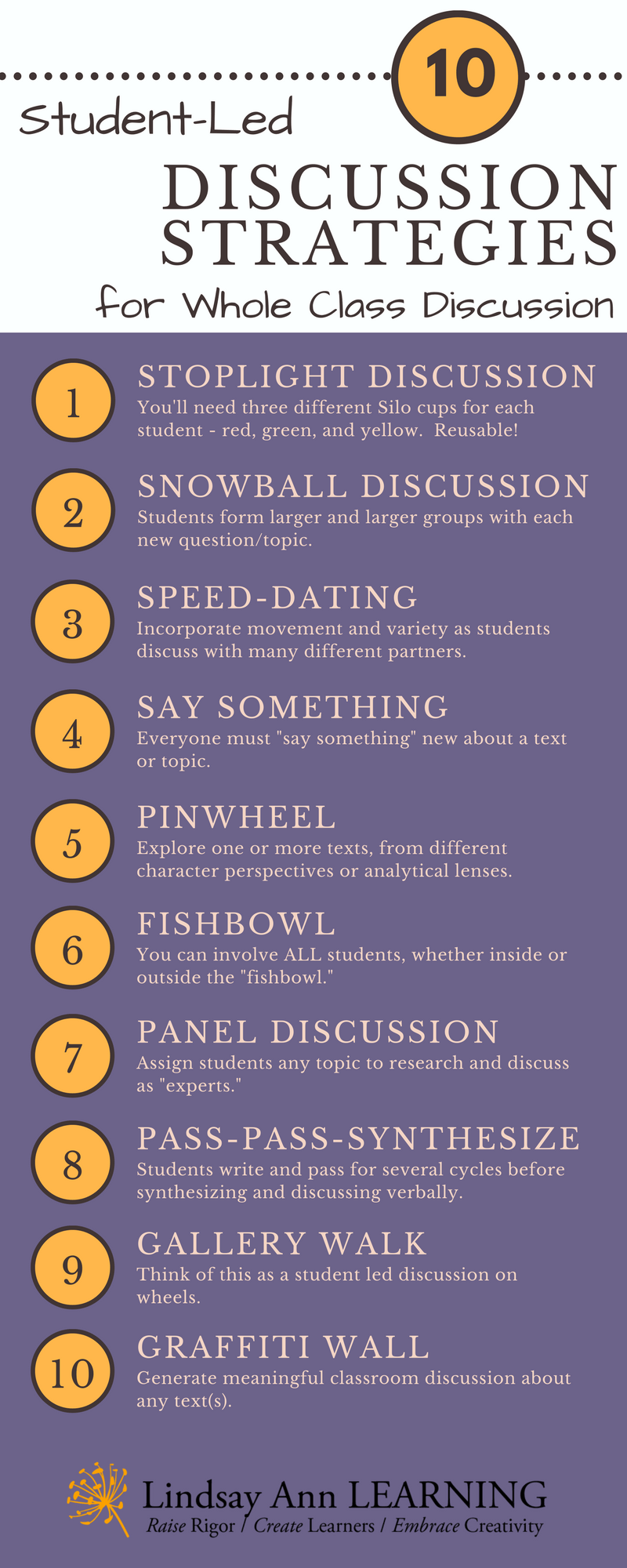
Soooo…. today I want to remind you of 10 Student Led Discussion Strategies for Spicy Discussion
The Gist: Are you looking for a way for students to run their own discussion (hello, Danielson Framework Domains 2 and 3!)? Stoplight discussion is a simple and effective discussion strategy for you! When I first started thinking purposefully about student discussion during my national board process, this one of the first teaching hacks I used.
Have students sit in a circle. Give each student three different Silo cups - red, yellow, and green. Discuss the procedure for using cups during discussion: they will invite their peers into the conversation based on the cup color displayed. Because cups signal conversation, students build a conversation with each other and not with you, the teacher.
This is a paradigm shift for many students, especially if they aren’t used to student-led discussion.
You may have to remind them that they are not looking to you for “approval” during the conversation. They should be most concerned with what their peers are saying.
What do the Student Led Discussion Cups Signal?
Red = I am processing and/or taking notes right now. Don’t call on me.
Green = I am ready to jump into the conversation. Please call on me.
Yellow = I would like to take this conversation in a new direction. Call on me to shake up a repetitive or “dead” discussion.
Tips: Have students track their own participation and reflect/goal-set after a discussion. To encourage productive student led discussion, you may also need to call on students who haven’t had an opportunity to talk. At first, your participants may not always follow the norm of equity during discussion. That’s to be expected. Students usually catch on pretty quickly after I’ve done this a few times, especially if I have clearly set norms for conversation. Hearing my voice means they are not doing their job!
A simple fix is to make sure students all know the names of other students in the class. I digress, but it is always worth it to make time for team building. In the beginning of the year. During the year. Always!
The Gist: The basic premise of a snowball discussion is that students will form larger and larger groups over time. This is great student led discussion strategy to use if you have a series of questions that build on each other or if you want students to hear a variety of different opinions while incorporating a bit of movement.
Most recently, I chose this type of discussion as a processing tool after students watched “The Danger of a Single Story“ and responded individually to some questions about Adichie’s themes and ideas. Students began with a partner, and then “snowballed” to continue the discussion with another partnership and a different question.
By the time we formed one large “snowball,” the class was warmed up and ready to discuss as a whole class. Their last and largest question focused on the big picture “so what” and personal application.
Change it Up: If you want students to practice argumentation skills and have debatable question prompts, you could purposefully select certain students to be the “devil’s advocates” in the midst of the snowball discussion.
The Gist: Speed dating is one of my favorite student led discussion tools. I love to incorporate movement and a variety of different student partnerships!
I divide the class in half and line them up on different sides of the classroom (or hallway). One of these lines stays in place. One of these lines rotates. Students move to the left or right to a new discussion partner when I direct them to do so or after a certain number of minutes. Students who get to the end of the line rotate back to the beginning of the line.
Change it Up: Have students form two concentric circles. Again, one circle rotates and the other does not. Set a time limit, and instruct students to rotate to their left or right to find their next discussion buddy.
The Gist: This is great as a warm-up, to help students process a complex topic, or to practice the skill of building a conversation. Students stand in a circle or sit on their desks. Everyone must “say something” new about a text or topic. Each student must briefly summarizing the conversation/comment that came prior to his or her comment before building the conversation, playing devil’s advocate, or continuing with a new idea.
Summarizing reinforces the idea that one’s voice in a discussion does not exist in isolation and is a part of a larger conversation. This discussion skill also challenges students to think of different perspectives and explore different angles for discussion and analysis since they cannot repeat something that has already been said.
Like all good discussion strategies, “say something” is flexible. Want to continue around the circle another time? Sure! Highlight a rock star moment to “spark” a new discussion topic for students to consider? Sure!
Tips: As a teacher, you need to be ready and willing to jump in and “flag” a comment as a repeat. You also may have to help students build a conversation at first by showing excitement, modeling effective “building” and “summarizing” comments, and asking questions. You can even give this responsibility over to students/a teacher’s assistant. Have him or her hold up a red card or wave a red flag if a comment repeats rather than extends the conversation.
The Gist: This student led discussion strategy works well when students all have read different texts and are coming together to discuss a common theme.
It also works well if you want students to explore one text, but from different character perspectives or different critical lenses. Students form lines, or sit in rows fanning out from a smaller circle of chairs/desks placed in the center of the room.
Throughout the discussion, students rotate into the center seat, seamlessly continuing the conversation.
The Gist: This tried and true student led discussion strategy is well-known, so I won’t spend a lot of time describing it. The premise of a fishbowl is that students discuss as a small group in the center of the room while the rest of the class observes. I have found that this works best when you set a purpose for the students who are not discussing.
What are they watching for or which student are they watching?
Will they write a reflection or respond to a brief question on Google Classroom afterward?
Are they going to be having their own discussion via a chat tool such as Today’s Meet?
Do you want to keep it lighthearted with by having the students play Fishbowl Bingo?
Change it Up: Assign one or two students as “coaches” to one student inside the fishbowl. Give them a whiteboard or signs to hold up in order to “coach” the fishbowl participant.
The Gist: This is student led discussion gold! Assign students any topic to research and discuss as “experts.” Panel discussion works well if you want students to “teach” the class about different topics or explore inquiry-based questions.
Change it Up: Allow students to rotate in and out of the panel. Or, allow the audience to ask questions which, in turn, direct the conversation. You could even set up dueling panels to facilitate exchange of ideas on two sides of an issue or synthesis of two related topics.
The Gist: P-P-S is a written student led discussion strategy. Students respond to a question or write about a topic for a set amount of time before “passing” the paper to a partner. This partner then writes for another set amount of time. After two rounds of response and writing, the paper is passed a third time. This time, each student has to read the two previous responses and “synthesize” them together.
You may want to provide students with sentence stems for synthesis and response. P-P-S has natural extension to share-out or a whole-class share out.
Change it Up: Trash talk! Have students wad their papers up into small balls and “throw” them into the air or to another student. Each student grabs a paper ball, responds, and then wads it up again to pass it on.
The Gist: Think of a gallery walk as a student led discussion on wheels. Students write or create something and then present it to the class by posting it on a wall or table in the room.
You may choose to divide the class and have half of the students stand by their paper or project in order to explain it to their peers as they stop by, or you may have all students circulate, taking notes to identify trends, ideas with which they agree or disagree, or leaving a sticky note comment/response for each student.
Tips: After spending time in the “gallery,” you can have students come back together to discuss what they learned, trends they observed, and extend their learning with a “big picture” application or synthesis question. You could also have students return to their posted work and categories sticky notes left by classmates, write a written reflection, or share out briefly.
The Gist: I’ve used graffiti walls to generate classroom discussion about reading homework. Students “graffiti” the board or a large sheet of paper with a meaningful quote and image to represent their reading.
Then, students look for trends and patterns to connect the quotes and images together. You can also ask students to then select a quote or image that they did not personally contribute to the graffiti wall and respond to it in writing before sharing out with a partner, small group, or the whole class.
Change it Up: You can easily create an online graffiti wall using Canva, or Padlet.
I hope you have gained a new teaching idea or two!
Sometimes the best experiences come from a slight tweak or changing of a tried-and-true discussion strategy.
Before we go, if you are ready to binge or bookmark more more discussion ideas, check out my other posts about classroom discussion here:
And for more inspiration, check out these resources for classroom discussion:


Comments
Nothing yet. Say the first thing.
Sign in to join the conversation.