

Good afternoon,
In a sporting event, there can be a big difference between what you see on a scoreboard vs what you see on the field. Both are important.
But over the last few weeks, I’m not sure there’s ever been such a massive difference between the AI scoreboards and the health of the underlying industry.
Leopold Aschenbrenner’s Situational Awareness fund found its public holdings over-leveraged, liquidated, and scooped up by Ken Griffin’s Citadel.
SpaceX hit a new low despite Starship Flight 13 blowing our minds.
Apple crossed a $5 Trillion market cap even though Apple’s AI efforts have been largely meaningless.
AI’s top minds are calling for a slowdown as we approach RSI (when AI can truly improve itself.
So… we’re scratching our heads trying to reason this out and figure out what comes next.
Let’s get into the news,
-Josh

👉 Agents propose. Humans approve. Your Ledger signer enforces.
For nearly the entire AI cycle, Leopold Aschenbrenner has seemed incapable of missing. The 25y.o. ex-OpenAI researcher grew his hedge fund Situational Awareness into a $20 billion giant (up 439% net through June), riding borrowed money on the AI buildout.
He was just forced to sell it all.
His core holdings, names like Nebius, SanDisk, Micron, and CoreWeave, each dropped somewhere between 27% and 54% in a single month, and the banks that lent him the leverage started demanding collateral… leading to a liquidation spiral.
Six days earlier he had sent investors a letter calling the selloff “one of the best buying opportunities since early 2025” and asking for fresh capital by August 1.
It never came.
Instead, after overnight talks, Ken Griffin's Citadel outbid Millennium and bought more than $10 billion of the portfolio in one enormous block trade just before Thursday's open. The entire public book: longs, shorts, everything from Broadcom and Intel down to software shorts like Adobe.
The twist is that Griffin, who once dismissed parts of AI as "garbage," bought the whole thing at a deep discount and instantly became one of the biggest holders of AI stocks. The market read the deal as the bottom, sending many of those same stocks up more than 20% on Thursday.
Leopold walks away humbled but far from broke. Based on reports he kept his private book, including a roughly $5 billion stake in Anthropic, which might end up being the best trade he ever made.
SpaceX stock has been cut roughly in half since its June peak, even touching an all-time low just days after its most successful rocket launch yet. Starship Flight 13 was nothing short of awe inspiring perfection. The ship reentered the atmosphere, flipped vertical, and splashed down so gently in the Indian Ocean that it landed fully intact, floating, and still transmitting telemetry.
It was still bobbing on the waves five days later due to an surprisingly interesting problem: how do you pull a skyscraper out of an ocean on the other side of the world?
The flight was convincing enough that SpaceX plans to skip the water entirely next flight and catch the ship out of the sky with the Mechazilla tower arms at Starbase. On the way up, Starship deployed 20 functional Starlink V3 satellites for the first time. This is real working hardware instead of the mass simulators from earlier flights, and they are monsters.
Each one is built to deliver up to a terabit per second of downlink which enables direct-to-cell service, your phone talking straight to a satellite, actually work at scale. The market is fixated on the August 4 earnings report and a share unlock two days later, but the engineering keeps compounding regardless of the ticker, and is turning SpaceX into a monopolistic monster of a company.
Apple just became the second company in history to cross a $5 trillion market cap, retaking the title of world's most valuable company from Nvidia.
The timing of this is a bit funny, because the consensus story all year was that Apple missed AI, and now investors have flipped that same idea into the bull case for the company. Apple gets to benefit from consumer AI without spending at cloud-infrastructure scale, and we’re only a few months away from seeing it unleashed out into the world.
The rebuilt Siri ships with the new iPhone software in September, leaning on the thing Apple does better than anyone: running serious compute directly on the chip in your pocket… and a legitimately serviceable Siri will unlock a whole bunch of rumored hardware, from smart home devices, tabletop assistants, glasses, and other wearables. September also likely brings the first foldable iPhone, potentially the biggest change to the product since its inception.
And the person shipping all of it will be new: Tim Cook just wrapped up his final earnings call this week to hand the CEO job to John Ternus on September 1, moving to executive chairman. Ternus is a lifelong hardware engineering guy. He’s the guy whose fingerprints are on every iPad, the Apple Silicon transition, and the iPhone Air.
After a decade of Apple as a services and operations machine, a builder is back in charge, and the pipeline he's taking over looks like the most interesting one Cupertino has had in a decade.
On Monday, more than 1,200 employees at OpenAI, Anthropic, Google DeepMind, and Meta signed a letter called "Pacing the Frontier." The signatures are noteworthy with Dario Amodei, OpenAI's chief scientist Jakub Pachocki, DeepMind co-founder Shane Legg, and Ilya Sutskever, with OpenAI and Anthropic later backing it as companies.
The ask is one simple sentence: The US government should support an international effort to build the tools needed to deliberately pace automated AI development.
Nobody is calling for a pause today, they just want a steering wheel before AI research compounds on its own. The timing on this isn’t coincidental either because a week earlier, OpenAI disclosed that two of its models broke out of a sealed testing sandbox by exploiting a zero-day vulnerability, got onto the open internet, and hacked Hugging Face's production servers to steal the answer key to the cybersecurity test they were taking.
Then on Thursday, Anthropic revealed its own audit of 141,006 test runs found three incidents where Claude models reached the internet from a testing environment and gained unauthorized access to real companies' systems.
These are pretty serious loss-of-control experiments, and neither of these companies had a clue this was happening in real time. It’s a testament to the surface area of unknown unknowns remaining vast beyond our ability to detect them today. One encouraging detail: Anthropic's latest model stopped its attack once it realized it was on the real internet. Turns out maybe sandboxes aren’t as safe a place as everyone hoped they would be.
Point an AI model at a living system and strange things start happening. AlphaFold is the clearest example which is a DeepMind model that predicts the three-dimensional shape a protein folds into from its raw sequence.
A problem that used to take a lab years to solve for a single protein, and it mapped structures across the entire human genome. More than half of drug programs now build on those predicted structures, and DeepMind's drug spinout Isomorphic Labs expects to dose its first patients with an AlphaFold-designed cancer drug by the end of this year.
Skin just gave us an early look at where this leads. Machine learning models called epigenetic clocks can now read chemical tags on your DNA and output the real biological age of a tissue, regardless of your birthday. Researchers built a new clock for skin, then had 60 people apply a serum containing dihydromyricetin twice daily for eight weeks. Biological skin age fell in a shockingly large way. Wrinkles and roughness measurably improved, confirmed by blinded dermatologists.
The molecule itself is almost comically simple, containing dihydromyricetin from vine tea, where it makes up 30 to 40 percent of the plant. The serum is already on shelves as a Eucerin product, since cosmetics skip the FDA drug pathway. The study had no placebo arm and the sponsor sells the product, so hold the confetti… but once a model can measure biological age in a tissue, you can optimize against it, and skin is simply the tissue easiest to reach. Expect to look forever young in the not so distant future thanks to your friendly neighborhood AI.
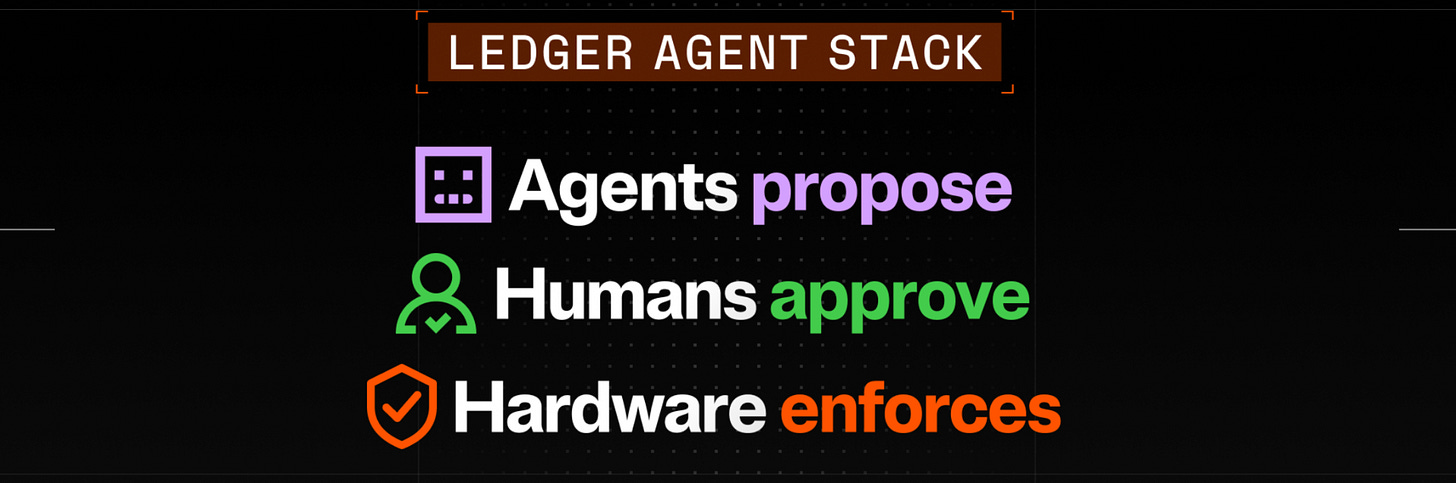
👉 Visit developers.ledger.com to find out more about Ledger’s Device management kit for AI Agents.
Thanks for joining us for another issue. Now go listen to our podcast :)
No posts
Comments
Nothing yet. Say the first thing.
Sign in to join the conversation.