
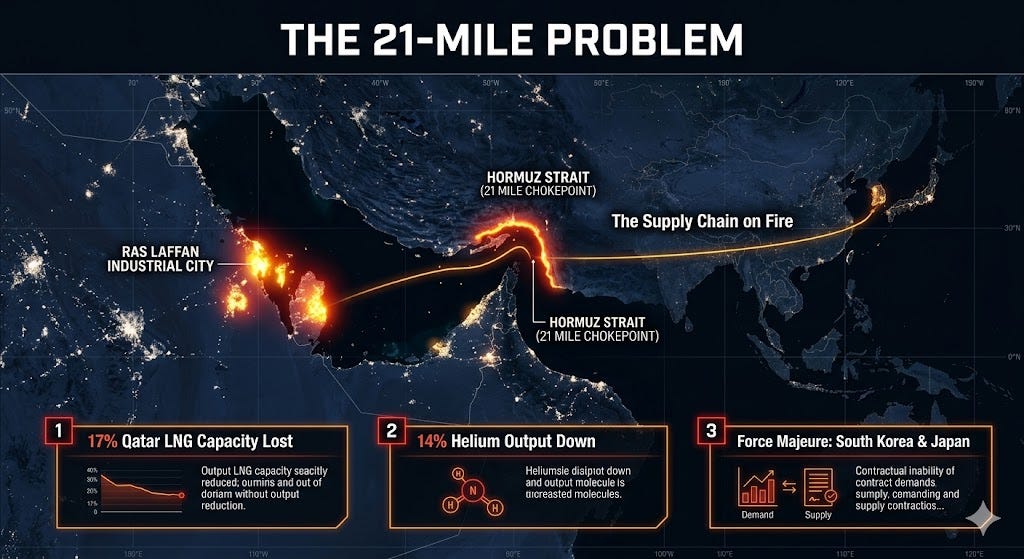
Note: I had been building a write-up mapping what was already at risk from the crisis in the Strait of Hormuz. Then the March 18th strike happened and I couldn't wait a week. What follows is that original analysis combined with the new reality on the ground.
In Part 1, we established the biggest paradox of the AI era to date: $1.5 trillion in spend for 2025 alone, 95% of enterprise deployments delivered zero measurable return, an expected increase in spend in 2026 regardless of results, and an actual bonafide technological transformation that is going on underneath it all. The divergence between investment and realized value is real and it will widen to the point that it can’t anymore. By then it will be too late to do anything. This series, at least I hope, will attempt to explore what doing something differently looks like.
There is a deeper layer to the story. The physical layer. The AI build out, the GPUs, HBM stacks, data centers, frontier models, everything requires a physical supply chain. A supply chain rife with geographic chokepoints, petrochemical dependencies, and concentration risks that were never priced into the hype.
As of two days ago, part of that supply chain is on fire. Literally.
What happened March 18th 2026
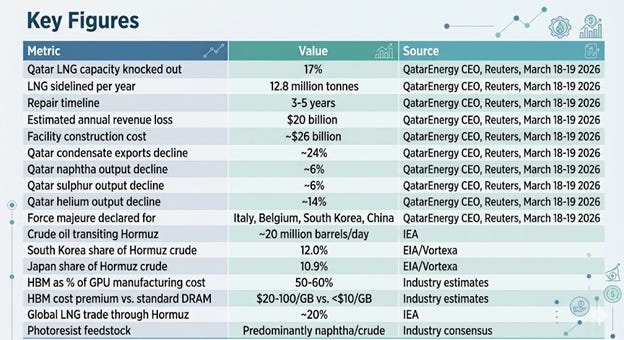
Iranian strikes on Ras Laffan Industrial City in Qatar ended up knocking out 17% of the country’s LNG (liquefied natural gas) export capacity. Saad al-Kaabi, QatarEnergy CEO, confirmed that two of the 14 LNG productions trains and one of the two gas-to-liquid facilities ended up being destroyed in the attacks. Estimates for repairs are 3-5 years, which has forced the company to declare force majeure on long-term contracts. This means they are letting customers know they cannot meet their delivery obligations due to reasons out of their control.
The revenue impact is staggering. $20 billion in lost annual revenue. The damaged facilities themselves cost about $26 billion to build. ExxonMobil, who holds 34% of one train and 30% of another, is direct casualty. The force majeure declaration will affect supplies bound for Italy, Belgium, South Korea, and China.
Now look at those last two names. Remember those. We’ll come back to them.
Beyond LNG, the breakdown of the collateral damage from QatarEnergy tells a story that some are missing entirely.
· Condensate exports down 24%
· LPG down 13%
· Helium output down 14%
· Naphtha down 6%
· Sulfur down 6%
Now, if those last two stats don’t mean anything to you, they hopefully will by the end of this. Naphtha and sulfur aren’t just energy commodities. They are some of the core feedstock for the AI hardware industry, and they just got much more harder to come by.
According to Al-Kaabi, the region has been set back 10 to 20 years, and we’re not even in sight of the end of the conflict that caused these damages.
This piece was drafted before the March 18th attack, and what was supposed to be an analysis of a dependency chain, is now acting as an almost post-mortem.
The Premise
For at least the last decade (COVID era not withstanding), the dominant narrative in enterprise tech was infinite scalability. Even more so over the last few. More servers, more data centers, more memory, more GPUS, more AI, you get the idea. Until last year, when we noticed the strain that infinite scalability brings. So we pulled back, recalculated and said hey we’re gonna be ok, it’s just going to be a little slower than anticipated.
That assumption died somewhere in a 21-mile wide waterway called the Hormuz Strait. The death was confirmed in Ras Laffan two days ago.
What’s happening in the Strait of Hormuz and the direct strike on Qatar’s production infrastructure isn’t just an energy story. It’s a sovereignty story. Covering materials and manufacturing and lots of the space between. Anyone who works in technology, from the hyperscaler architect down to the sysadmin sitting at their desk, needs to be asking themselves, “What happens when the atoms stop flowing?”
That’s where the 3Rs come in.
The 3Rs: A Quick Primer
The 3Rs framework (Recon, Repurpose, Redeploy) was developed to help navigate scarcity.
Not scarcity as a abstract, but the kind of scarcity that disorients and derails. A supply dries up. A vendor consolidates. Even say, a geopolitical event that rewrites the structure of your entire infrastructure strategy overnight.
This framework describes a pattern of adaptation to apply wherever resources become scarce, controlled, or unreliable.
· Recon: Know your dependencies. Not just the ones you think are important, all of them. Find the uncomfortable parts that got ignored.
· Repurpose: Find new utility in what you already have. Reduce the surface area of your dependency.
· Redeploy: Move toward architectures, vendors, and resource models that distribute risk
Ras Laffan provided the source for a masterclass in why this framework matters.
RECON: Mapping the Real Dependency Chain
The Petroleum-to-Pixel Pipeline
When most people thing of oil and gas, they think fuel. Something that is powering cars and heating buildings. In the world of semiconductors though, petroleum derivatives are feedstock. Raw molecular material that becomes chemicals, polymers, and resins. These materials are used in chip manufacturing.
The attack in Qatar didn’t just hit a LNG facility. It hit an upstream source of naphtha, which is a primary hydrocarbon that the semiconductor industry uses to create some of their most critical process chemicals.
Here’s the dependency chain:
Crude Oil / Condensate → Naphtha → Steam Cracking → Base Petrochemicals
Qatar’s condensate exports, which are the lightest, highest-naphtha-yield crude fractions, just dropped almost 25%. Naphtha output dropped 6%. Here are some of the uses that Naphtha has in semiconductor manufacturing:
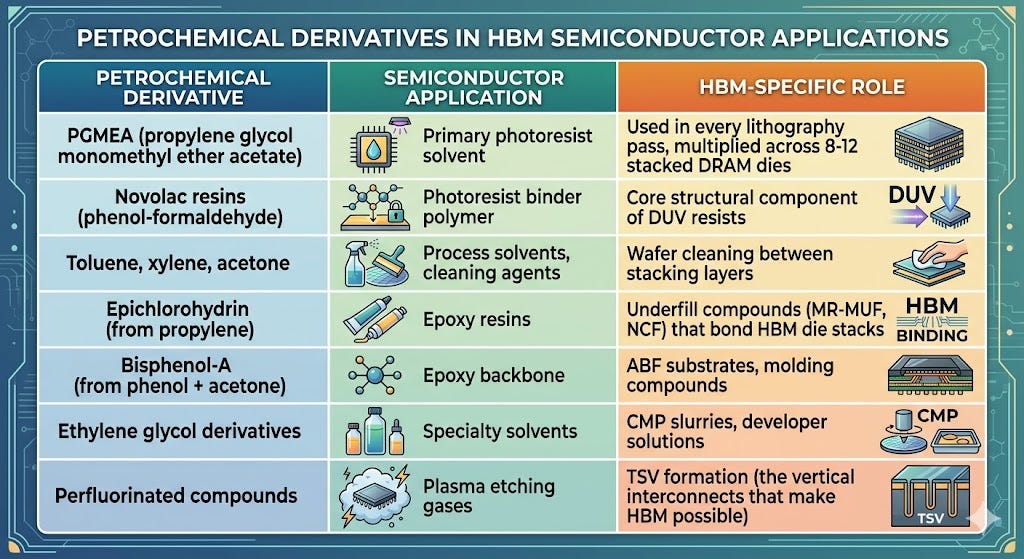
A single industrial lithography tool consumes about 70 liters of photoresist and 2,500 liters of organic solvent per month. HBM stacks require multiple lithography passes per die, where 8 to 12 are in a stack. Those photoresist chemicals trace right back to the naphtha that Qatar just stopped producing at full capacity.
The Sulfur Thread Nobody Was Watching
The sulfur output in Qatar just dropped 6%. That stat will get just a scant line in most energy coverage. It’s matters just as much as the LNG headline for semiconductor supply chains.
Sulfur is essential for refinement of the transition metals that go into the advanced semiconductor packaging. Copper fills the through-silicon vias (TSVs) that make HBM’s 3D stacking possible. Cobalt and nickel are in the micro-bumps and solder alloys that connect die layers. All of these refining processes depend on sulfuric acid derived from sulfur. A reduction in Qatar’s output joins a supply chain that’s already stressed by disruption in the strait. This is heading straight toward a packaging materials crunch that won’t show up in GPU and memory delivery forecasts for another six to twelve months.
The Helium Problem That Just Became Critical
The helium output dropped 14% due to the March 18th strikes. This should be sounding alarms all over the semiconductor industry, but it isn’t yet.
Helium isn’t optional in advanced chip manufacturing. It’s used as a carrier gas in ion implantation (this process dopes silicon to create transistors), as a cooling medium for superconducting components, and also as a purge gas in lithography environments where oxygen and moisture could destroy nanometer-scale features. There is no other substitute for helium in these applications. You either have it or you don’t make the chips.
Qatar is one of the largest producers of helium in the world, along with the US, Algeria, and Russia. South Korean chipmakers specifically depend on Qatar’s helium supply. This means SK Hynix and Samsung. They both make virtually all of the world’s HBM. That same HBM that represents 50-60% of the manufacturing costs of every NVIDIA GPU. The same HBM supply that is already in shortages due to AI demand.
A 14% reduction in helium output is a direct hit on the production capacity of the two companies that the entire AI hardware industry depends on.
The Geographic Concentration Problem
Now layer the geography onto everything above:
Who makes HBM? SK Hynix and Samsung (South Korea), Micron (US, but dependent on Asian packaging ecosystem). TSMC (Taiwan) produces base dies for HBM4.
Who was just declared force majeure on LNG contracts? South Korea and China. The fabs that run SK Hynix and Samsung’s manufacturing operations, the energy that heats the chemical baths and powers the lithography tools, runs on LNG. Qatar just told South Korea it cannot guarantee supply for up to five years.
Who makes the critical semiconductor chemicals? JSR Corporation (Japan), Tokyo Ohka Kogyo (Japan), Shin-Etsu (Japan), Sumitomo (Japan). The photoresist market is overwhelmingly Japanese, and Japan’s energy security is dependent on Middle Eastern LNG from the same region now under active bombardment.
Who depends on Hormuz crude and LNG broadly? South Korea receives 12% of all crude transiting the Strait. Japan gets 10.9%. China, 37.7%. These nations collectively produce the hardware the AI buildout runs on.
You see the problem? The countries that manufacture HBM, the chemicals that go into the HBM, and the helium that makes the fab operations possible are the same countries most exposed to this disruption. It’s the natural result of decades of optimization for cost and proximity, without any thought for the geopolitical tail risk.
The Power Nobody Accounts For
Here’s the dependency that closes the loop: LNG creates the electricity that runs the fabs.
South Korea generates roughly 27-29% of their power from LNG. An advanced semiconductor fab runs 24/7, consuming somewhere between 500 and 1000 megawatts continuously. The power draw of a small city sustained without interruption, because if a fab loses stable power, the entire production run is compromised. All of this draws from a grid that just found itself without a reliable supply for up to five years.
Japan is in a similar situation. Post-Fukushima, Japan ended up shutting down most of its nuclear capacity. They filled that gap with LNG, which accounts for about 33-36% of Japanese electricity generation. Those chemical companies that make the photoresists and specialty gases that fabs depend on run off that same grid.
When QatarEnergy declared force majeure on South Korean LNG contracts, it didn’t just threaten some of feedstock, it threatened the grid stability of the country that makes virtually all of the world’s HBM. The chain from an attack in the Gulf to production constraints at SK Hynix is four links long and every link is load-bearing.
The Recon Takeaway
The Recon phase of the 3Rs demands that we map dependencies honestly, including the ones that makes us squirm. Here’s what that looks like for AI infrastructure as of March 20, 2026.
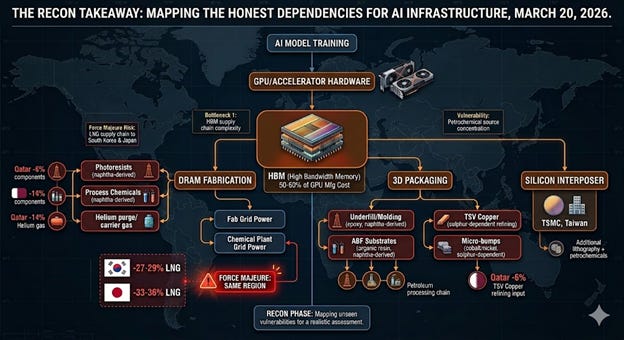
Every branch of this tree has Middle Eastern energy input somewhere in a root system that is on fire.
REPURPOSE: What Can Be Redirected Now?
This phase isn’t about optimism, but about pragmatism. If the supply of a critical resource contracts, you look at what you already have and ask yourself, “What else can this do? What can I stretch? What assumptions can I challenge?”
Existing Inventory Is Now Strategic Reserve
Every enterprise that is currently sitting on GPU infrastructure had that assets value increase dramatically this week. The gear you have now is worth more than the machines you just put on purchase order because that PO just got a lot less certain.
This changes the calculus on refreshes, workload optimization, on whether you actually fully maximize your investment on memory and compute. “Sweating the asset” is now a continuity strategy.
Practical Implications:
· Workload right-sizing becomes urgent. Running inference workloads on training hardware means you’re burning HBM capacity that is potentially not replaceable for 18-36 months.
· Model efficiency matters more. Quantization, distillation, MOE architectures, anything that reduces memory footprint immediately becomes core the conversation.
· On-prem suddenly looks different. The cloud providers will absorb the cost shock and pass it along. Own your own though and you own your options.
Repurposing the Chemical Supply Chain
Repurposing is already happening on the materials side, but not fast enough. Research is happening at places like the CEA-LETI in France, that is focused on chitosan-based (made from crustacean shells) photoresists, but these are still lab scale, not production scale.
For helium specifically, there is no near-term repurposing play. There are helium recycling systems, but they take both a long time to implement and a lot of capital. On the bright side, we do have the US Helium reserve, but there’s no telling on how that will be used, if at all.
Repurposing at the enterprise level remains the real strategic opportunity. Organizations that can diversify their semiconductor heavy vendor relationship, can maintain a buffer inventory, and invest in workload portability can survive supply shocks. Others are going to learn what concentration risk actually means.
REDEPLOY: Building for the World That’s Actually Emerging
The Redeploy phase is where strategy lives. Deliberate strategy, not reactive strategy. Repositioning so that you ensure you’re not in the same vulnerable posture when the next shock hits.
The Sovereignty Stack
I’ve always thought that data sovereignty is incomplete without considering all dependencies underneath it. You cannot have sovereign AI if your memory chips depend on oil that flows through a contested waterway, uses chemicals made by a handful of companies, fabricated in one country’s fabs, with potential stable power issues.
Sovereignty isn’t just about where you store your data. It’s about:
· Energy sovereignty: Can you power your own fabs regardless of the outside world?
· Materials sovereignty: Do you have domestic or at least close ally nation sources for all the specialty chemicals and materials your hardware requires?
· Manufacturing sovereignty: Can you create and package advanced semiconductors without depending on any single geographical locale?
The CHIPS Act was supposed to address the manufacturing piece of this, but it’s not nearly sufficient. Building fabs in the Arizona desert doesn’t help if the photoresist is still coming from Japanese companies relying on an entire supply chain from the Middle East.
The Composability Thesis Under Stress
For those who’ve been advocating for composable, modular architecture over monolithic approaches, you should feel vindicated. The organizations with the most flexibility right now are:
1. Didn’t lock into a single accelerator vendor. If you can run workloads on AMD or Intel alongside NVIDIA, you have options when one vendor has their HBM allocation get cut.
2. Built abstraction layers. If your AI workloads are coupled to specific hardware via proprietary mumbo jumbo (CUDA), your redeployment options are constrained at best. If you invested in portability ala ONNX, OpenXLA, or Triton, you’ve got options.
3. Distributed geographically. Inference at the edge, training in diversified regions, data sovereignty through architecture instead of trust in a single jurisdiction.
What Redeploy Looks Like in Practice
For the enterprise IT leader reading this:
Immediate:
· Get your hardware pipeline on paper. What’s on order, what’s contractually protected, what’s exposed.
· Identify every workload on HBM heavy hardware that could shift to CPU or FPGA-based inference.
· Contact your cloud provider. Ask about allocation guarantees and price exposure.
Short-term (0-6 months):
· Audit your model portfolio for quantization and distillation opportunities. Less parameters means less HBM.
· Evaluate alternative architectures as a primary strategy.
· Build redundant vendor relationships.
Medium to long-term (6 months+):
· Advocate for domestic semiconductor materials manufacturing. Use the same urgency that was brought to fab capacity.
· Rethink infrastructure strategy with the explicit assumption that supply shocks are going to be a recurring event.
The Bigger Picture: Scarcity as the Default
Here’s the philosophical frame that I’ve been dwelling on for a long time it feels like.
We built the AI era on an assumption of abundance. Abundance of power, compute, materials, etc. The entire economic model of foundation model training that involves throwing billions of dollars of hardware at a problem for months at a time, only works if the supply chain can deliver hardware reliably and at a predictable cost.
The crisis in in the Strait didn’t create the scarcity. Ras Laffan didn’t create the scarcity. It was always there, all snarled up in the geographic concentration of manufacturing, materials dependencies, and power supply. We didn’t pay attention because it was working.
Al-Kaabi said he never imagined Qatar would be attacked this way. Nobody imagined it. Nobody has priced this in ahead of time. Nobody built resilience because the system was working fine.
The 3Rs framework exists precisely for this moment. It’s a methodology for navigating a time where the supply of critical resources is a variable. We’ve always joked about the cloud being someone else’s computer, well that computer is vulnerable to the same supply chain we all are.
The organizations that make it through and actually thrive in this environment won’t be the ones with the biggest GPU clusters. It will be the ones that did their Recon honestly, Repurposed what they had creatively, and Redeployed toward architectures that refuse to concentrate risk.
The alarm has been buzzing in the background for a long time, we kept hitting snooze. We’ve had our big wake up call. What you do next dictates your future.
In Part 3 of The Access Wars, we follow the hardware crunch from the supply chain to your desk. The AI PC wave was supposed to democratize local intelligence. Instead memory shortages are cannibalizing the consumer silicon cycle, and the plateau is coming faster than anyone in the laptop marketing departments wants you to know.
Will Murrell is a Solutions Architect, technologist, and founder of Limited Connectivity, a media project exploring how technology, data, and society shape each other. The Access Wars is a seven-part series published from now weekly. The 3Rs framework (Recon, Repurpose, Redeploy) are part of his ongoing work on navigating resource scarcity in enterprise IT. Find him at adudeonthenet.
No posts
Comments
Nothing yet. Say the first thing.
Sign in to join the conversation.