
Of the many times I wiped, changed and fed Larry, I playback the times I was alone with him in the middle of the night most. In the nighttime silence and the occasional meowing of our neighbourhood strays, there was just me and Larry. There was no need at all to hurry. Calmly, I would prepare everything I needed - painkillers, water, waterproof sheet, face towels, wet wipes, a clean pair of shorts, diaper. Under the dim light of Hannah’s portable reading lamp, the girls asleep in the same room, I would look him in the eyes and whisper to let him know what we were about to do. Even when he could no longer respond, I whispered all the same. “Hi dear,” I would say to him with my hand on his chest, “I’ll help you change your diaper.”
In the day, Larry’s parents and I cleaned him together. Though unsaid, I was the appointed leader. “Li Ling knows how. Let her do it,” my in-laws would say in Hokkien whenever Larry’s condition deteriorated and we were faced with new challenges - feeding or washing him as he lost more physical functions. What they didn’t know, was that I, in fact, didn’t know. No layperson really knows how to care for a dying loved one. There’s no manual (though there should be), so I relied on my internal compass. I cared for Larry the way I learnt to care for children respectfully, the way I believe every human being at any stage of life deserves to be cared for. I spoke to Larry, moved slowly, and touched gently. My in-laws observed and followed. The three of us gradually worked out our different parts in this slow dance for four.
Moving slowly doesn’t come naturally to many. Most people, including the nurses at hospitals, want to get things done fast. “Why do you have to go to the toilet,” a nurse berated Larry for pressing the call button for assistance at night, “just urine in the bedpan!” A man relearning how to walk and pee a week after brain surgery is a hindrance to a busy nurse who’s short on time. This hurt Larry deeply. I was by his hospital bed, next to endlessly beeping machines, when he - beep - told me about -beep - his encounter with -beep beep - the nurse. I remember sitting next to Larry, listening to the piercing beeps that kept him awake, watching him finally nod off, only to be woken up when a nurse pricked his finger for her records. “Sorry ah…” she said to no one in particular while picking up his limp left hand. She pricked, measured his blood pressure, whipped out her phone to scan the QR code on his wrist, and mumbled, “Done.” The QR code sickened me; every patient’s identity reduced to a randomly generated square of black and white dots and lines. I missed clipboards at the foot of the bed where healthcare workers had to check, flip and write in. These days, there is no time for checking, flipping and writing, let alone gently rousing the patient from sleep before poking a needle in his finger. We’ve somehow managed to speed up processes without freeing up time. On the day of Larry’s discharge, I returned to his room with a wheelchair for him and could hardly believe my eyes. There, in the toilet, was a doctor standing next to Larry, giving him updates while Larry did his business. “When you’re in the hospital,” Larry told some relatives who visited him after he was discharged, “you have no dignity.”
While holding Larry on his hospital bed one evening, my thoughts punctuated by a cacophony of beeping from both his room and outside, I made up my mind that he would spend his final days at home, if that was what he wanted. I had no manual for caring for my dying husband, but what I lacked in knowledge, I would do my best to make up for with heart.
My care for Larry was guided by my training in respectful caregiving for infants. 8 years ago, pregnant with Hannah, I first came across articles on respectful parenting online. They radically challenged my conditioned lens of the child, and yet appealed so much to my intuition. When I enthusiastically shared my new found lens with Larry, explained how we’d talk to the baby during care moments like diaper changes, baths and mealtimes, and move slowly, he agreed readily. When the baby came, we talked to her like she understood, telling her what we were about to do before doing it. Larry was a natural. “Hi Hannah, you’re going to take a bath! Let’s take off your diaper first…”
As if by serendipity, the monk helping with Larry’s funeral rites said to me on the night that Larry died: “If you want, we can do Larry’s washing ceremony ourselves. We’ll talk to him during the ceremony to let him know what we’re doing. ‘Larry, I’m going take off your shirt now. Larry, we’ll wipe your body now.’” My eyes widened. “Do you want to do the cleaning ceremony with me?” he asked. Without hesitation, I responded, “Yes, let’s do it!” The monk broke into a sheepish smile, then explained, “To be honest, I’ve only done the ceremony once. But if you trust me, we can do it together.” “I trust you, and I trust myself,” I said resolutely. I’ve done this with Larry many times. The next morning, together with the monk, my in-laws, my mother, and my godfather, we cleaned and changed Larry one final time. Though unsaid, I was the appointed leader. “Hi dear, I’m going to wipe your face for you.”
Almost three weeks after Larry passed, the girls and I had dinner at our favourite Chinese zi char restaurant that looks like it is stuck in the 80s. Chinese paintings of birds and flowers adorn the beige walls of the restaurant. When Larry was alive, we often had dinner there, always ordering the same few dishes - sweet and sour pork, prawn paste chicken, tofu, and spinach. That night was our first time back without Larry. At the end of dinner, I stood up to pack our belongings. As I shut the notebook that Georgia had been drawing in, a mostly empty notebook I had grabbed from a stack of notebooks in case she needed something to draw on, I caught a glimpse of Larry’s handwriting on the last page. I quickly flipped it open again and found a journal entry that Larry had written about his time at the hospital. I hesitated to read it in public, but gave in to curiosity. The loud chatter of other diners seemed to fade away as I heard the words in Larry’s voice:
“Her presence kept me alive. I realise now that she saved me…pulled me out of the darkness.
I realised how much I love her and how much she loves me.
How great our love is! I felt it bursting out of my chest!”
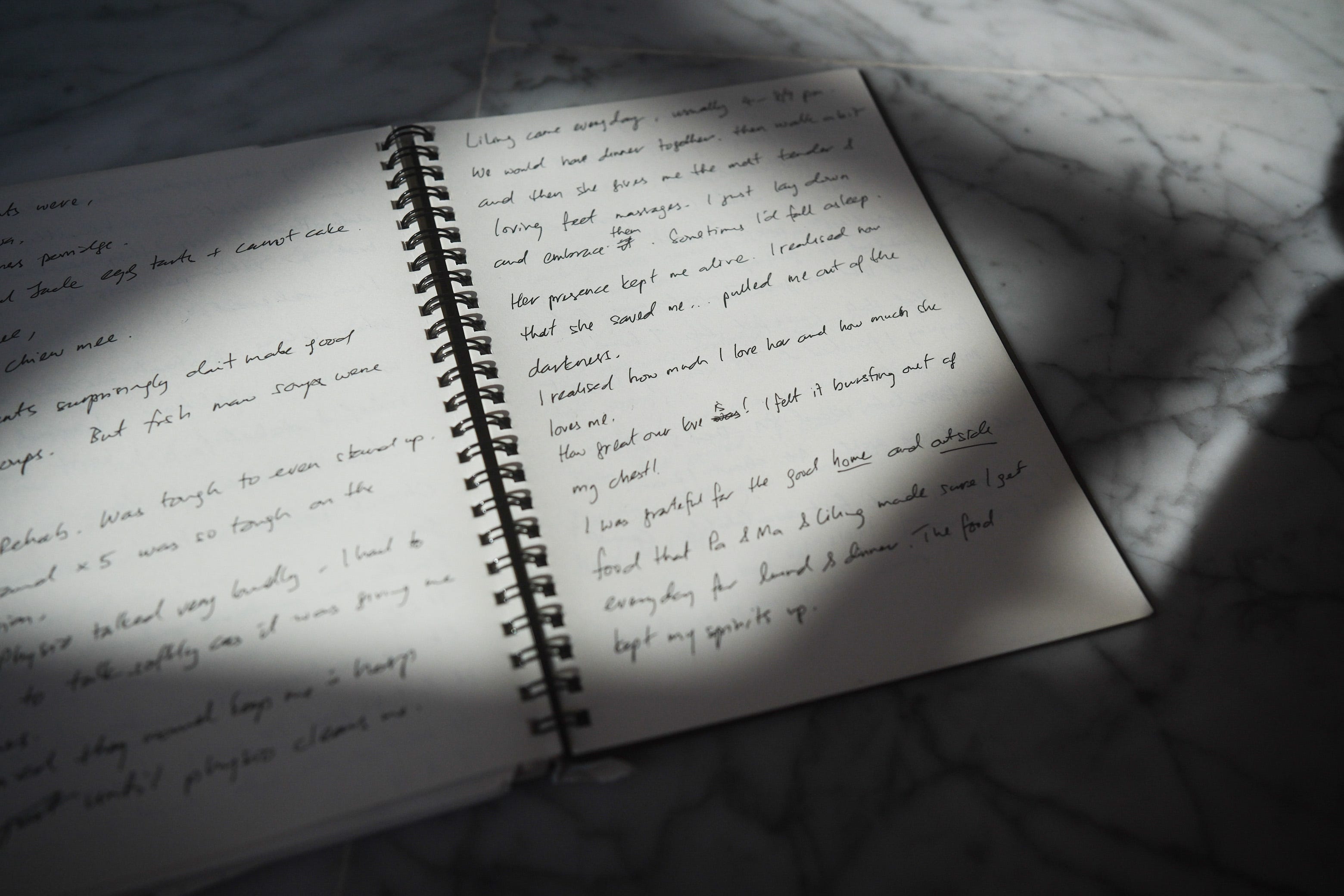
Looked on by cranes, magpies and peacocks in the Chinese paintings that have, until that day, only seen us as a family of four, I sat back down and cried into my hands.
In the end, my presence couldn’t keep him alive and neither did our medical system, traditional Chinese medicine, and other ‘miracle’ supplements. But if my full presence - each time I changed him, washed him, fed him, gave him painkillers, sat with him - filled him with love to his last breath and beyond, I am at peace.
No posts
Comments
Nothing yet. Say the first thing.
Sign in to join the conversation.