
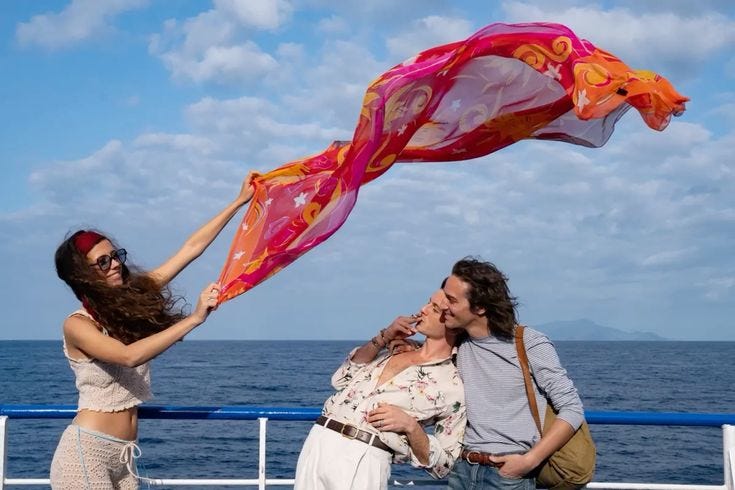
I think and talk about the concept of ghost ships a lot—probably too much. It’s a juvenile phrase to describe our shared, inescapable fate: that of making irrevocable choices.
It is always so early in here, it is before the crossroads, before the irrevocable choices. I am grateful for this life! And yet I miss the alternatives. All sketches wish to be real.
A motor far out on the water extends the horizon of the summer night. Both joy and sorrow swell in the magnifying glass of the dew. We do not actually know it, but we sense it: our life has a sister vessel which plies an entirely different route. While the sun burns behind the islands.
I really like the idea of living different lives, and I’m not sure that I’ve done it, fully, yet. I love thinking about where my friends are, the roundabout sojourns that have taken them here, beside me, and what the future might hold for them. When I hear stories of people whose success buys them another lifeline, I feel impressed and not a little bit envious. When I hear stories about those who choose to live multiple lives without the safety of money—living as a chef, a teacher, a therapist; as a nun, a nurse, a florist—I’m in awe. I think it must be one of the only ways to cheat mortality.
A friend is currently at a crossroads. Before him lie diverging roads spreading toward different horizons. I’m not sure there’s ever a right answer, at least not one that you can be absolutely certain of. Something is lost along with each phantom life, even if not in its entirety. My best advice was to follow each path as far forward as figuratively possible, imagine that life in its fullness, then consider whether you’d be fulfilled. If one life is more likely to be devoted to family, and another promises a meteoric career, which one would you be happiest with? Or, maybe, regret least? We’ll always long for something, and a part of us will ache for what we don’t choose. What would you rather be left longing for?
Not long ago, I resisted committing to celebrating Tom’s 40th in Thailand with his twin sister. We have plans for 2026—life plans—and I’m eager to begin making inroads. But a friend asked me: measured against a lifetime, what does postponing our plans for a month actually cost? It was obvious—the “he only turns forty once” and “now is the time” and “let yourself live.” And yet, it was remarkable how much clearer you can see when your decisions are no longer conduits for scarcity mind.
It’s important, I think, to be able to distinguish between choices that are truly relentless and irrevocable and those that only seem to carry weight because we conflate momentum with destiny. It’s human nature to ascribe meaning to every moment. Stories are where we find comfort; belief is how we find answers to our unanswerable questions. How much of that meaning-making is a form of coping, and in the final analysis, a delusion?
If you look closely, the horizon is often wider than we realize. Even if every decision necessitates a tradeoff, not every decision is momentous or burdened with meaning. The challenge, I think, is in holding, gently, the arc of your vision while remembering to live fully before arriving.
I told two girlfriends that my intention this year is to live: to resist valuing each moment only in terms of what it will amount to one day. The present is not a stepping stone. It doesn’t all have to add up to something. I’m learning to allow myself the pleasure of a detour. I suspect, now, that might be where the most meaning lies. Maybe life can be a collection of detours—the dogged pursuit of ships before they pass us by—and still be as worthy and as beautiful as one built toward a destination. Maybe the detours are the point. Maybe life is made of detours and we spend too much of it convincing ourselves of a grand narrative instead of allowing it to be a grand adventure.
I’ve been feeling a low-grade despair over the dehumanization that’s currently in vogue. I miss the purity of creation. I desperately want to be spared seeing or reading AI slop, even if the line between human and machine becomes indistinguishable. What unsettles me most is how often it’s used to sidestep the essential human work of processing, thinking, problem-solving, creating. It’s as a shortcut, a means to the end—output optimization, with no freedom to daydream or detour.
We spent the holidays in New York. The morning after a snow day, I walked out into the blanketed streets with my boys: Tom, Eliot, Jared. We ate smoked fish and bagels at gertrude’s, then walked to the park, our cheeks rosy from the windchill, passing families trudging through the sidewalks with off-roading strollers and babies burritoed in sleeping bags. At the park, children threw snowballs and sledded down the hill on colorful plastic sleds and flattened cardboard boxes. Eliot went sledding for the first time—on borrowed cardboard, then on a borrowed red sled. Our joy was simple, and untethered: laughter, levity, awe at the beauty of the snow-dappled trees. Afterwards, we walked to a bakery. While Jared stood in line, Tom and I took Eliot to a bar where the bartender gave me coffee in a mom mug. It was 11am but we drank dry cider and ate apple danishes and kouign amanns. For those four hours, I forgot that I owned a phone. These are the moments that will remain with me in the dusk of my life.
I think, more than anything, I want to savor my humanity as if I were discovering it for the first time—to spend as much time in the analog world as possible, to be closer to coral reefs than to computers.
What do you see when you imagine yourself in the dusk of your life? What moments will remain? What, then, will have been a life well lived for you?
No posts
Comments
Nothing yet. Say the first thing.
Sign in to join the conversation.