
Thoreau-back Thursday is my homage to Henry David Thoreau. This storied naturalist wandered the fields and forests of Concord, Massachusetts over 150 years ago; leaving a wealth of observations as his legacy. These are the same lands I now explore myself. There have been many changes in the landscape since Thoreau’s time, but there is still much to be learned from his writings.
Thoreau and the lynx
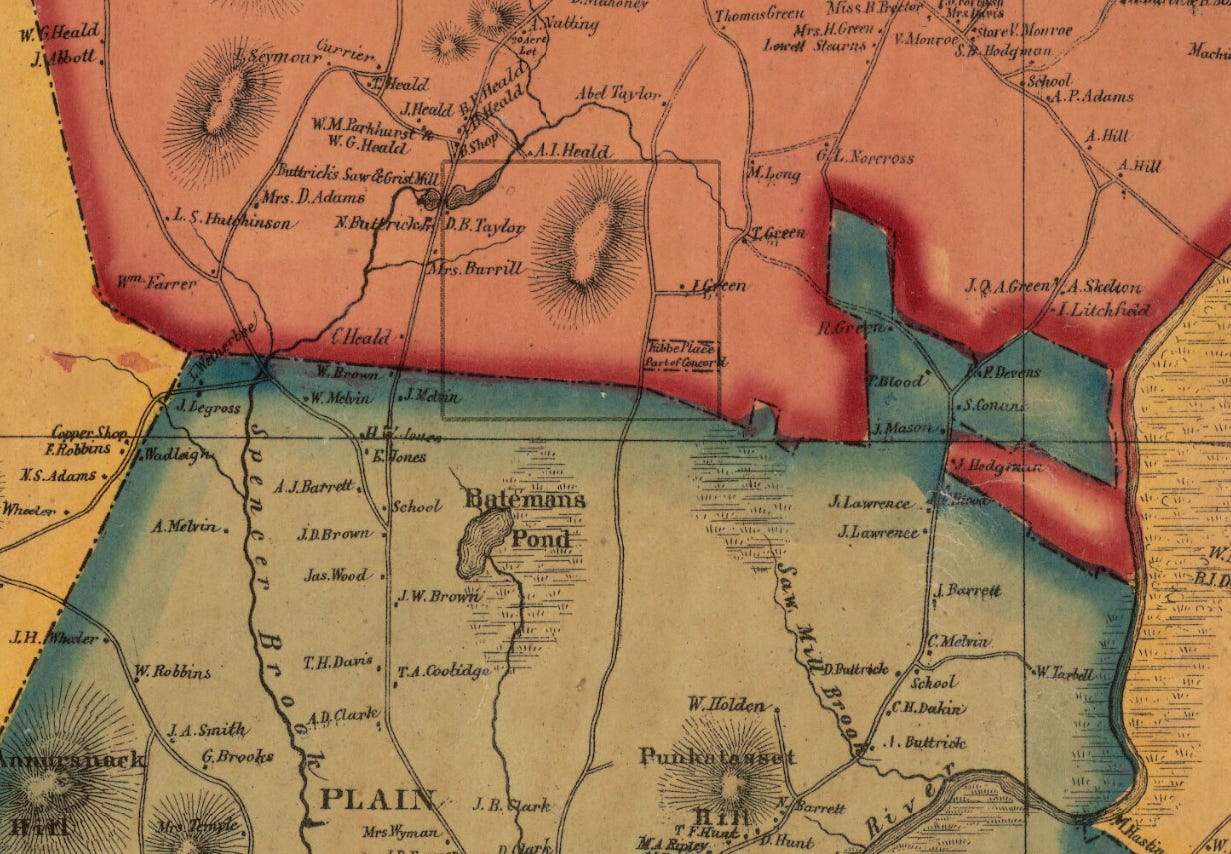
On September 9, 1860, a Canada Lynx (Lynx canadensis) was killed in Carlisle, MA by a local farmer. In his journal entry dated September 11, 1860, Thoreau writes “It was killed on Sunday morning by John Quincy Adams, who lives in Carlisle about half a mile (or less) from the Concord line, on the Carlisle road.” [1] Based on my research I have identified this location as north of the town line between what is now Lowell Rd. and Estabrook/Bellows Hill Rd. in Carlisle [2].
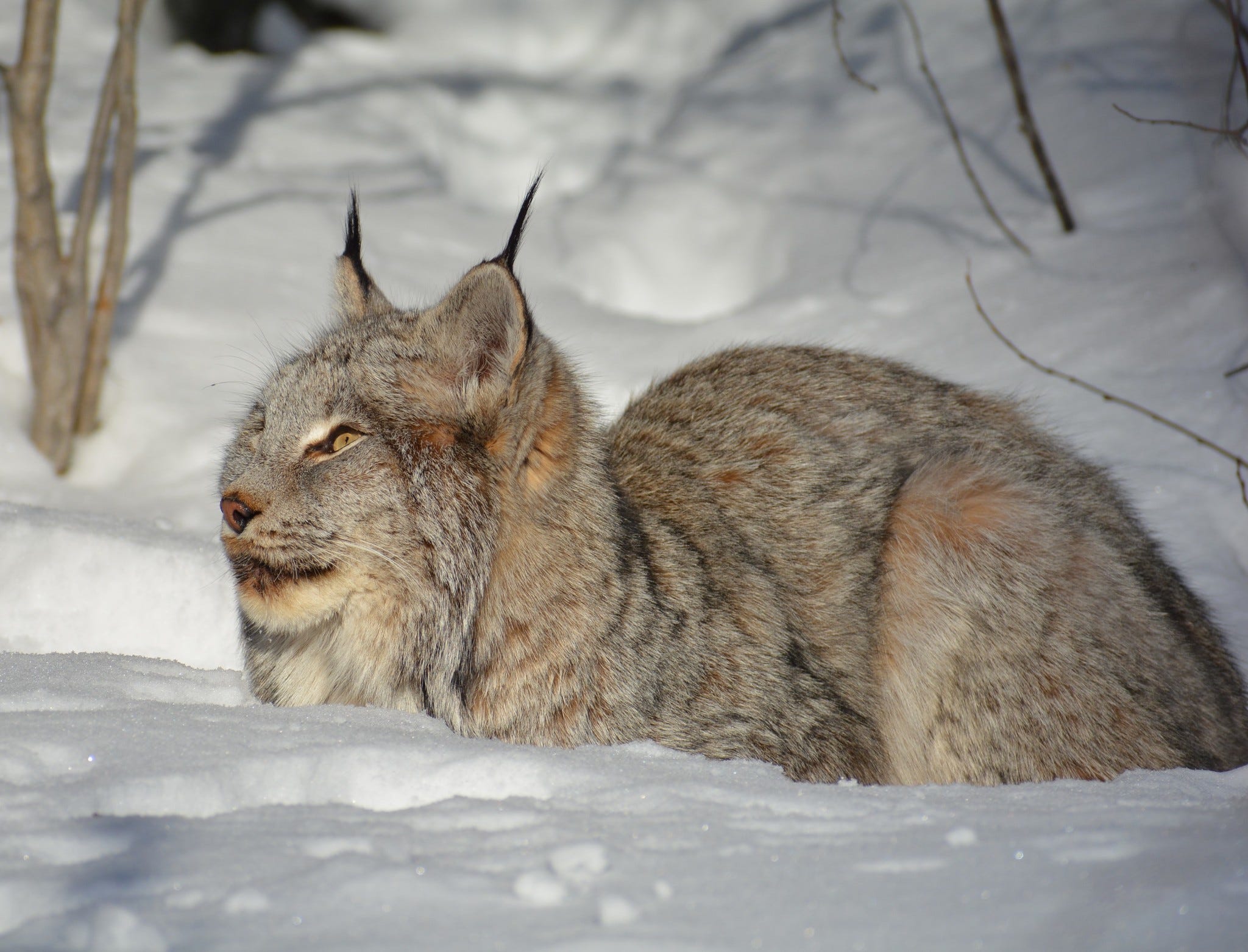
The farmer’s telling of the story (certainly embellished) is less interesting than the fact that there was a lynx in Carlisle to begin with. Thoreau makes sure to take careful measurements and notes on all the known diagnostic traits. He goes into detail in his journal, attempting to differentiate it from the more common bobcat (Lynx rufus). Thoreau believes that the animal may have originated from a rare, but present, local population. He states that he had “seen two lynxes that were killed between here and Salem since ‘27” and claims to have heard of “half a dozen within fifteen years.”
Thoreau must have been excited by this observation. A month later he writes a Dr. Samuel Kneeland, recording secretary of the Boston Society of Natural History. He is perplexed by the animal’s lack of hairy soles, which the contemporary guidebooks claim is a trait of the bobcat. He later mentions another guide describing significantly less hair around the feet when lynx are in their summer coat [3, 4].
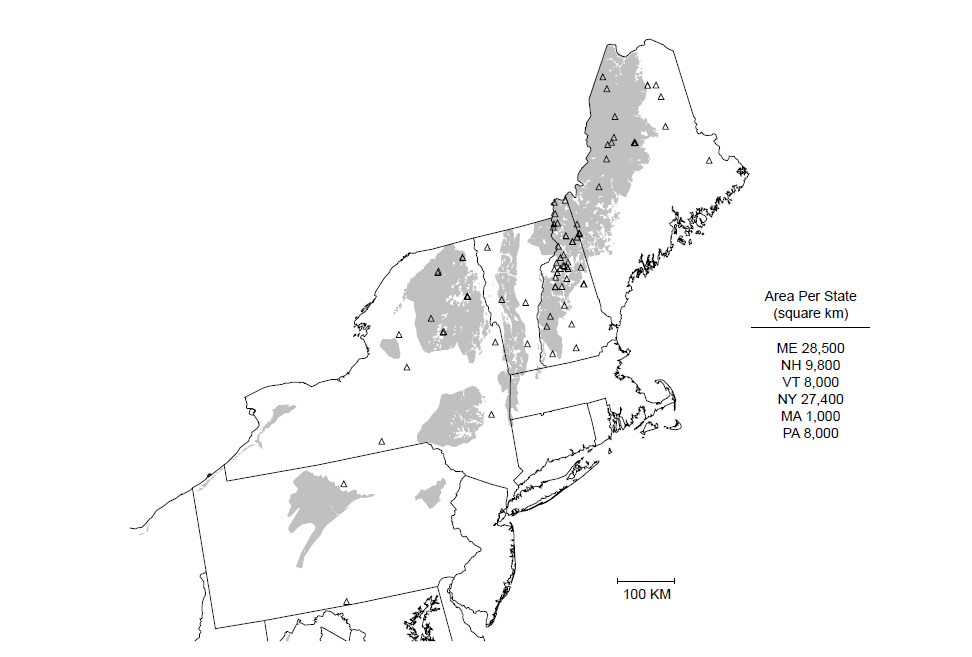
Current lynx distribution and conservation status in the northeast
In modern times you’d be hard pressed to find a lynx 200 miles from Boston, let alone 20. According to the Massachusetts Division of Fisheries and Wildlife, the Canada lynx is considered extirpated from the Commonwealth - with the last record from 1937 [5]. This and other sources point towards low abundance in the state at least since the 1800’s [6, 7]. A model of the northeast, incorporating dominant vegetation and elevation (see above), showed only a small area of western Massachusetts that could potentially meet the habitat requirements of the species [8].
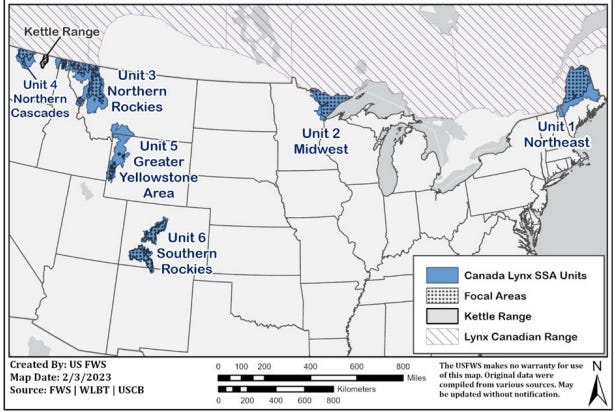
The lynx was federally listed as threatened within the contiguous United States in 2000. In the 2024 lynx Recovery Plan the U.S. Fish and Wildlife Service identified the northeast as one of six species status assessment units. This area encompasses the upper half of Maine and only the most extreme northeastern tip of New Hampshire. According to the plan, the northeast population has high resiliency and is well connected to the lynx’s core range in Canada [9]. Of course, this resiliency/connectedness is limited to the delineated area and doesn’t account for future population expansion to the southwest.
As lynx populations rebound in Maine and northern New Hampshire, one can hope they’ll find their way back home to the rest of their northeastern range. A failed reintroduction in New York’s Adirondacks in the early 1990’s exemplified the distances that these animals will disperse. Most of the lynx that were released wandered into neighboring states and provinces - some as far as 485 miles away. Unfortunately, many of these animals fell victim to road mortality in the process [10]. There is already evidence that lynx are moving west from their stronghold in Maine. Just last year a juvenile lynx was spotted in central Vermont at least 15 times between August and October [11].
Prey and habitat limitations
It is widely supported that snowshoe hare is the primary prey of lynx rangewide. Depending on location and time of year, hare can make up 33-100% of a lynx’s diet. Although other species, such as red squirrels, are also important food sources, it is thought that lynx will not occupy areas uninhabited by their main prey. This is one limit to their distribution in the northeast.
Lynx are also considered to be reliant on a mosaic of both old and young forest types. Snowshoe hares are more often found in brushier, younger forests. While lynx also need mature forests for denning and movement across the landscape [12]. It is critical that any forestry activities within lynx habitat are carefully planned to not further fragment the landscape; disturbing core forest blocks and cutting off corridors [13]. One project in particular may threaten a potential lynx recolonization in the Green Mountain National Forest. The Telephone Gap logging plan is in close proximity to the sightings confirmed last year [14]. Projects like this, and the rescinding of the 2001 Roadless Rule, threaten a connected northern forest that species like the lynx require.
A final thought…
The story of lynx in the northeast may yet have a happy ending. Although the species faces many challenges, we may still see it return to its former range. If this is to become reality, it is up to us to protect our rewilding landscape.
Please submit a public comment (click here) in opposition to the rescinding of the Roadless Rule.
[1] Ray Angelo has prepared a PDF of the complete 1906 limited edition 14 volume set of Thoreau’s Journals. Entries regarding the lynx can be found from 9/11 and 9/13/1860, p.6744-6752.
[2] I found many clues in the 1856 map of Middlesex County, MA. This in conjunction with the journal entries and vital records allowed me to narrow down the location. The map shows a JQA Green (3/28/1826 - 10/10/1907) living approx. half a mile into Carlisle in the eastern part of town (present day River Rd.). However, the only “Carlisle Road” Thoreau ever mentions (according to Ray Agnelo’s Thoreau Place Names) is the “old Carlisle road”, which is now known as Estabrook Rd. (part of which is now a trail). This is what they called the road in Concord - In Carlisle it would have been called the “old Concord road”. I found another John Quincy Adams (3/22/1826 - 9/26/1862) living in Carlisle at the time - who was listed as a farmer. I believe this is the individual in question. Although the 1856 map doesn’t show a John Quincy Adams in the area of interest, his maternal grandfather had the last name Heald, of which there are many in that part of town. It is possible that he may have been farming family land in the area after the drawing of the 1856 map. As he passed away in 1862, his name wouldn’t have been shown on the 1875 map. There are many other clues in the recorded family names. The 9/11 journal entry mentions a George Melvin - there are several Melvins in the area on the Concord side. A girl with the last name Buttrick was “huckleberrying near where the lynx was killed” - there is an N. Buttrick Jr. shown just to the west of the area. A Jacob Farmer said he “saw a strange animal at Bateman’s Pond” - the pond is just to the south of the area, as is a landmark known as “Farmers Cliff”. Lastly, it is noted that Adams’ house is next to a lot owned by Dr. Jones - there is an H.W. Jones to the southwest.
[3] Thoreau’s 10/13/1860 letter to Dr. Kneeland discusses in detail some questions he has with the identification of the animal.
[4] Thoreau’s observation can be found from a 10/17/1860 note in Volume 7 of the Proceedings of the Boston Society of Natural History (1859-1861) p.355. The Society existed from 1830-1946, of which Thoreau was a member.
[5] MassWildlife recognizes 13 lynx records from 1820 - 1937. There are two additional records from 1991 which are suspected to be from a wandering reintroduced lynx in New York’s Adirondack Park.
[6] The 1999 U.S. Forest Service report Ecology and Conservation of Lynx in the United States (Table 8.1) lists only 5 verified reports in Massachusetts from 1855 - 1918. Whether it is 13 records or 5, it can be accepted that the lynx was uncommon in the state (at least in the 19th and 20th centuries).
[7] The 1931 article Mammals of Hampshire County, Massachusetts by Jocelyn Crane quotes an 1840 report stating that lynx were “once common in the State, but appears now only in the depth of winter, and as a straggler.”
[8] Ecology and Conservation of Lynx in the United States (Figure 8.23) shows only 1,000 square km as potential suitable habitat; compared with 28,500 in Maine and 27,400 in New York.
[9] The U.S. Fish and Wildlife Service 2024 Recovery Plan for the Canada lynx shows the northeast species status assessment unit in Figure 1 and a table of resiliency metrics in Table 2.
[10] New York Department of Environmental Conservation.
[11] Vermont Fish and Wildlife Department.
[12] The U.S. Forest Service report Ecology and Conservation of Lynx in the United States gives a detailed look at lynx ecology. As it is 25 years old and written by the Forest Service (which has a mandate to “get out the cut”), I’d like to do a deeper literature review at some point.
[13] Although I don’t agree with all of their actions, the New England Forestry Foundation is at least taking lynx into consideration when planning projects in the north woods.
[14] The grassroots environmental organization Standing Trees fought the Telephone Gap project tooth and nail. Unfortunately, it looks like the logging will move forward.
No posts
Comments
Nothing yet. Say the first thing.
Sign in to join the conversation.