
On November 19th, the U.S. Fish and Wildlife Service announced a suite of rules that would threaten hundreds of plants and animals listed under the landmark Endangered Species Act (ESA) of 1973 [1, 2]. The ESA provides protection for iconic American wildlife such as the wolverine, grizzly bear, and gray wolf. In the northeast (where I live) it has helped safeguard populations of Canada lynx, bog turtle, and the small whorled pogonia [3].

A major focus of these actions is to implement Executive Order 14154, “Unleashing American Energy.” In his justification, Secretary of the Interior Doug Burgum [4] has railed against “regulatory overreach” while asserting that these rules will deliver “certainty.” In reality this is nothing more than another attempt to weaken environmental backstops. In plain terms, the goal is to extract as much as possible from the natural world at the expense of wildlife and people alike.
These four proposed rules would weaken many aspects of the ESA. Listing species would become increasingly difficult; with the possibility for economic interests to override scientific rationale. The designation of critical habitat - crucial to species recovery - would face even more roadblocks than it does today. One rule would eliminate the consideration of climate change when designating habitat and would strip the ability to identify unoccupied areas that should be protected; essentially hemming an imperiled species in on a tiny fraction of what it needs to thrive. The rules would weaken most protections for newly listed “threatened” species and give power to extractive industries to contradict the opinions of wildlife experts. These are just a sample of the erosion faced by the ESA under the proposed rules [5].

“Draconian regulatory proposals targeting the Endangered Species Act put America’s beloved wildlife at risk of extinction…Such sweeping rollbacks endanger our natural world and undermine decades of concerted bipartisan efforts to protect and restore America’s wildlife.” Andrew Bowman, Defenders of Wildlife
The ESA is a broadly popular piece of legislation; providing thousands of species a lifeline over the last half century. Defenders of Wildlife conducted a 2023 poll for the Act’s 50th birthday, finding that 84% of Americans supported this law (including 80% of Republicans) [6]. A 2025 study reaches the same conclusion; that from 1996-2025 84% of Americans support the Act [7]. The misalignment of our government’s policies with the popular opinion of everyday Americans couldn’t be more evident.
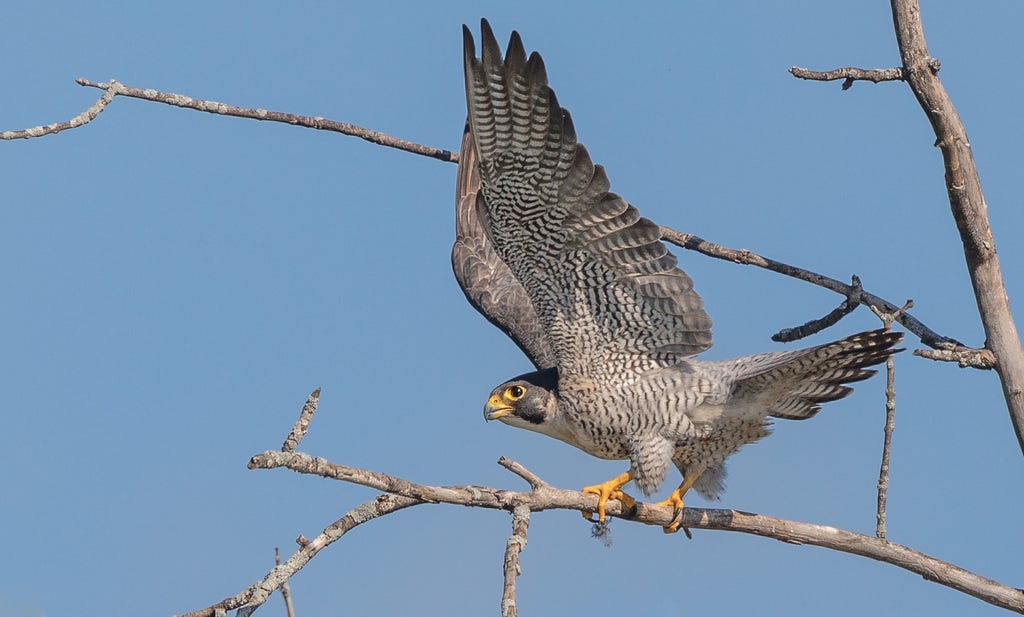
Not only is the ESA widely supported; it has proven effective. A 2019 study found that 99% of the species listed under the ESA have yet to go extinct [8]. With its help, numerous species have been brought back from the brink (e.g., California condor, black-footed ferret). If implemented correctly, the Act can do more than just provide life support. Success stories like those of the bald eagle and peregrine falcon show that with the protection of the ESA, a species can recover and thrive - eventually being removed from the list.
As with any legislation, the ESA is not perfect. But it is one of our best tools for preserving biodiversity and slowing down the rate of mass extinction we face today. Please stand up and make your voice heard - protect the Endangered Species Act!
A 30 day public comment period will open on Friday November 21st. There are four proposed rules; which adds to the intentional confusion and chaos. Click the links below to comment (button in the top left corner). I know these pages are overwhelming - I will be working on distilling some key points.
FWS–HQ–ES–2025–0039 (Section 4)
FWS–HQ–ES–2025–0044 (Section 7)
FWS–HQ–ES–2025–0029 (Section 4(d))
FWS–HQ–ES–2025–0048 (Section 4(b)(2))

[1] The U.S. Department of the Interior press release can be found here.
[2] As of this writing, over 1,500 species of plants and animals are protected under the ESA. A full list can be found here.
[3] The Center for Biological Diversity has created an interactive map which identifies listed species by county.
[4] Burgum was previously Governor of North Dakota. He is a venture capitalist, software entrepreneur, and previous McKinsey consultant worth over $100 million. Here is his Wikipedia page.
[5] Press releases from various groups outline key points from the proposed rules: Center for Biological Diversity; Wilderness Watch; Wild Earth Guardians.
[6] Results of the poll can be found here.
[7] Vucetich et al. 2025. Support for the U.S. Endangered Species Act Is High and Steady Over the Past Three Decades.
[8] Greenwald et al. 2019. Extinction and the U.S. Endangered Species Act.
No posts
Comments
Nothing yet. Say the first thing.
Sign in to join the conversation.