
Welcome to the latest edition of the Lightning Lab 🧪newsletter! 2025 started off with a bang as Tether announced they are bringing USDT to bitcoin, and the outlook for the Lightning Network has only gotten stronger as the summer has gotten hotter. In this edition, we cover how Lightning has 1000xd in volume terms over the last several years, and how stablecoins will be the catalyst behind its next phase of exponential growth.

Earlier this summer, Lightning Labs CEO Elizabeth Stark spoke at the Bitcoin Conference in Vegas, and said:
“A couple of years ago… Lightning annually was doing tens of millions [of USD] in volume… today we’re doing tens of billions, and soon we’re going to be at tens of trillions. We 1000xd in a matter of a couple of years.”
That comes as no surprise to those of us who have been building out the technology and onboarding users these last several years, and who believe in the network effects of the Lightning Network. And with the advent of vibe coding, more people can build Lightning apps democratizing adoption worldwide, including Lightning Labs board member Brian Murray!
Today, Lightning has grown into the default payment rail for bitcoin, as evidenced by the recent launch of bitcoin payments from the popular American franchise Steak ‘N Shake only supporting Lightning instead of including an on-chain payment option. Their CEO shared the reason why at Bitcoin Vegas: after launching Lightning payments at over 400 restaurants worldwide, they’re saving 50% in processing fees by accepting bitcoin over Lightning, with settlement times much faster than credit cards. And just this past Friday, they attributed 10.7% Q2 growth in same-store sales to the addition of Lightning payments!
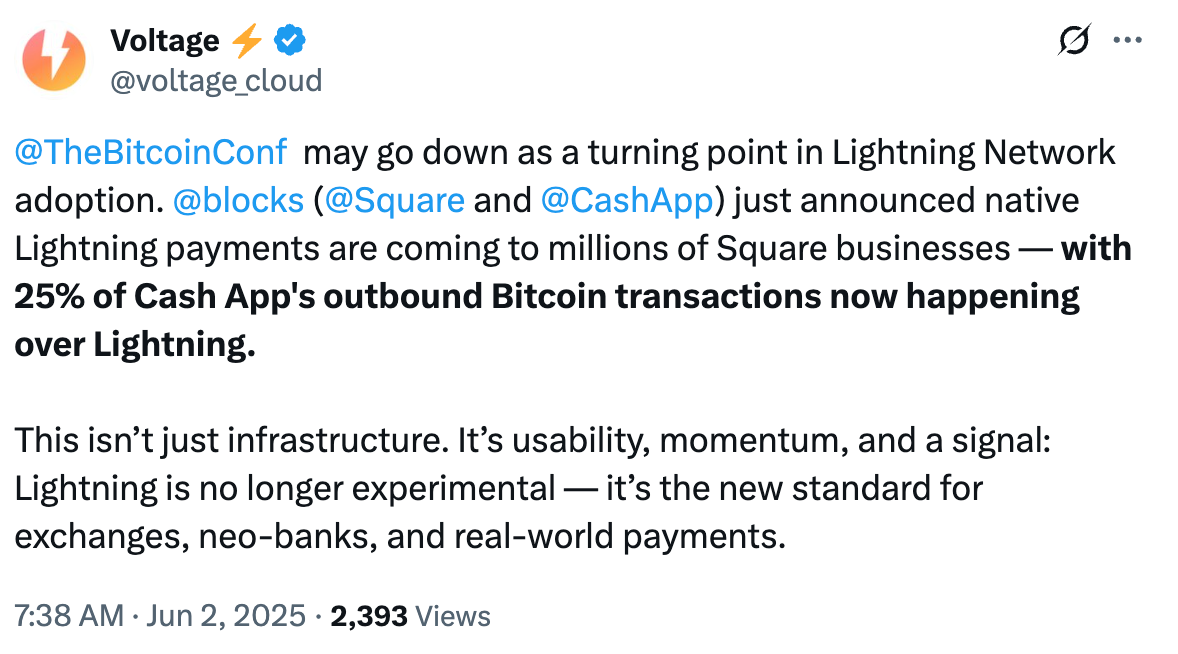
Not to be outdone, Block announced at Bitcoin Vegas that not only are 25% of Cash App’s outbound bitcoin transactions now happening over Lightning, but they’re bringing Lightning payments to all 4M Square merchant Point-of-Sale terminals after piloting the Lightning payments acceptance tool at The Bitcoin Conference all week. By the end of July, according to Block’s Head of Business Owen Jennings, they had already begun onboarding Square merchants to Lightning payments! This is enormous news for merchant adoption, as it will allow Square PoS users to increase their margins without changing their operations, simply by cutting out the fees of rent-seeking middlemen card networks.
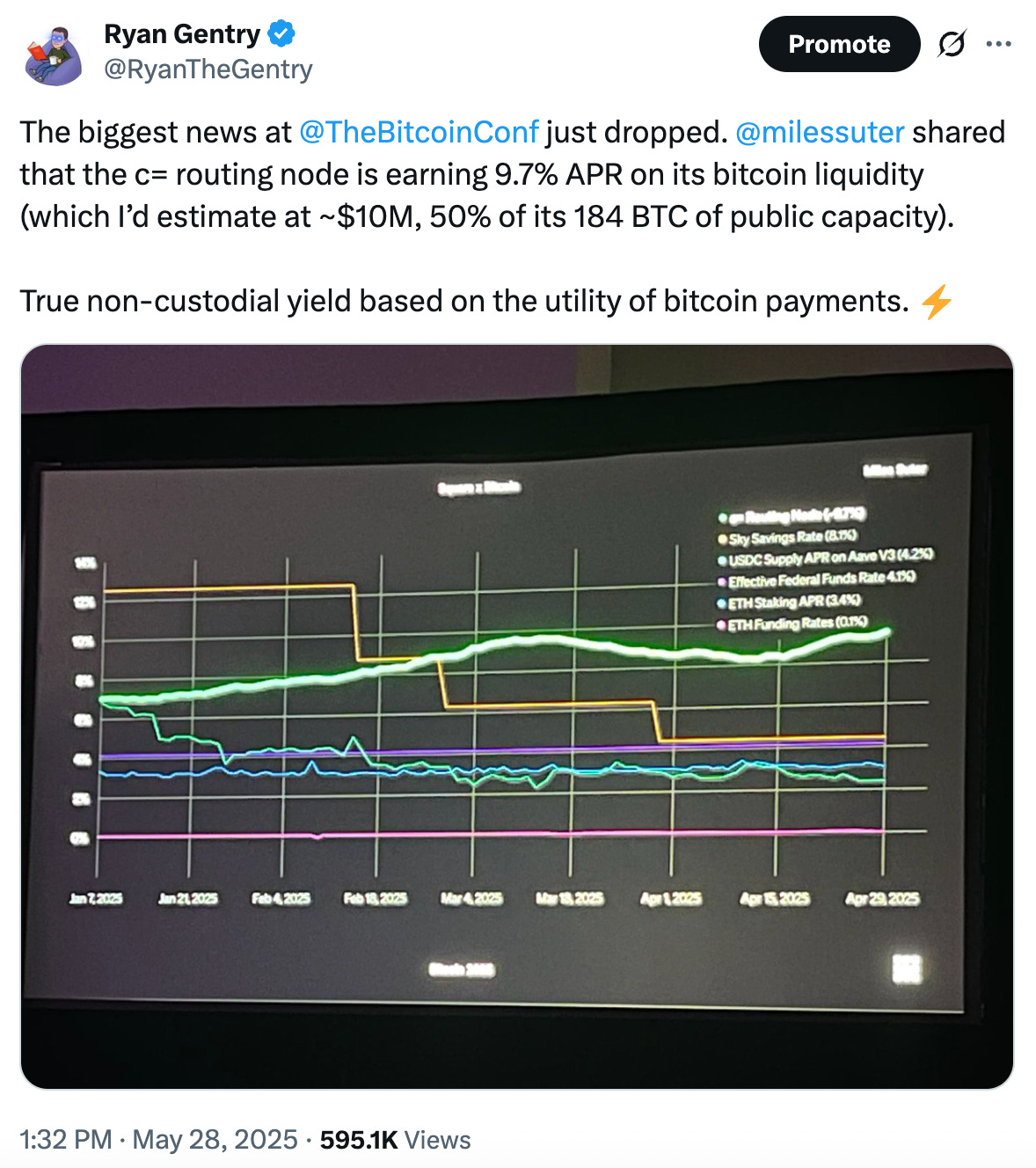
Block also shared that their Lightning routing node, c=, is earning 9.7% annual yield on millions of dollars of bitcoin liquidity. Importantly, this is non-custodial yield in native bitcoin, which does not come with the substantial, compounding risk of yield products on other chains that involve custodians wrapping bitcoin into non-native environments and smart contract risk for the yield protocols themselves. This may be the biggest proving point to the market that the demand for Lightning payments is outpacing the supply of bitcoin liquidity currently allocated to the network.
And of course, once Tether issues USDT on Taproot Assets, they’ll be bringing as much as $10T in annual volume to the Lightning Network. Read on for more thoughts on that… 💸
Voltage onboarded a host of new companies to the Lightning Network: BitGo, the enterprise-grade multi-sig custodian, Unbank, the bitcoin ATM company with 40k locations in Walgreens and CVS stores, Alt Sigma, a Canadian exchange and payments processor, Amber App, the Australian dollar cost averaging app, Blockware Solutions, who runs a marketplace for bitcoin mining equipment, and finally Taxbit, to offer a Lightning payments solution with full tax + accounting compliance built-in.
Speed officially launched bridged USDC on Taproot Assets for their merchant and wallet users and launched Lightning Address integration for USDT for their Taproot Assets LN users.
Botanix, LNFi Network, and Astra Labs launched a trust-minimized bridge from the Botanix spiderchain to the Lightning Network. With Botanix's recent mainnet launch, users can easily interface with a myriad of Lightning applications, demonstrating the importance of bitcoin interoperability.
DFX Swiss announced that 30 SPAR supermarkets across Switzerland and Liechtenstein are now live with LN payments! SPAR was founded in 1932 and has grown to become the world's largest food retail chain, with over 13,900 stores across 48 countries, bullish!
Braavos Wallet, a self-custodial Starknet wallet, announced their integration of the Lightning Network as an interoperability layer via Atomiq Labs as a swap provider.
Neutron announced that Cobo, the popular digital asset custodian, will use them to integrate LN payments to “power all of Asia”, after separately announcing new support for off-ramping to Chinese bank accounts.
Xverse announced they’ll be integrating LN into their self-custodial bitcoin wallet via Sati and Ibex.
PayPerQ, an AI <> LN startup founded by Matt Ahlborg, announced a $500k fundraise from Initial Capital and Fulgur Ventures to leverage LN to lower the barrier to entry for premium AI. Lightning News later interviewed Matt about PPQ, and how LN enables global, cost effective access to the top AI models.
Amboss launched their Rails product, a self-custodial bitcoin yield service that earns liquidity providers a return on their bitcoin for routing LN payments after releasing a new Liquidity Subscriptions product that allows node operators to pay for automated liquidity provisioning via a monthly subscription, instead of per-use.
📊 Coincorner shared that 30% of their Bitcoin transactions in 2024 were on Lightning, with an increase to 37% so far in 2025.
🚀 Coinbase reported that 15% of their bitcoin transactions are now made through the Lightning Network, doubling in the past year!
🏃🏼♂️➡️ LN Markets has officially crossed $10B in cumulative lifetime volume on their LN-native exchange!
💹 Wallet of Satoshi officially processed their 21 millionth payment! The custodial Lightning wallet celebrated by giving away sats to lucky users.
🎊 River announced that their public Lightning nodes officially routed their 7 millionth transaction since first adding support in 2019.
⛏️ Braiins Mining Pool announced that, less than a year after integrating with Voltage, they’ve reached 1,000 Lightning payouts per day — totaling 150,000 payouts and more than 13 BTC paid to miners over LN.
📈 River released a report titled “What’s Driving Bitcoin Adoption?” that included an update on Lightning growth since their last report in 2023. They estimate public Lightning volume was up at least 266% from Aug 2023 to Nov 2024.
📶 LNVPN shared that 82% of their payments by count and 74% of their payments by volume are occurring over the Lightning Network.
💌 Satograms hit their 2 millionth payment, helping users send messages to the entire Lightning Network!
🎟️ Adopting Bitcoin published that 51% of ticket sales at Adopting Bitcoin 2024 were on Lightning, with 57% of ticket sales on Lightning so far for 2025… and 100% of all onsite sales to vendors were on Lightning as well.
🔌 Voltage shared Lightning success metrics from a selection of customers: Braiins Mining is processing 1,112+ LN txs/day, Geyser is seeing 98% of BTC transactions via LN, a major wallet is seeing 100% BTC via LN, and a major exchange is processing 30%+ tx via LN.
🌋 Geyser Co-founder Stelios Rammos published that their popular bitcoin crowdfunding site receives 75% of their contributions volume over LN, double the rate in 2022!
🐵 Primal Wallet hit their 1.5 millionth Lightning transaction in their bitcoin wallet and Nostr-based social media app.
🔟 Lightning Labs Lightning Protocol Engineer Yong Yu opened the 10,000th issue in the LND repo, what a milestone for the open source project!

The GENIUS ACT became US federal law this summer, establishing a legal framework for stablecoins and stablecoin issuers. There are over $263B of stablecoins issued today, with Tether ($164B) and Circle ($63B) comprising the vast majority of the supply, demonstrating the natural demand around the world for these assets. Now that the GENIUS ACT is law, news is already coming out about other domestic entities looking to join the stablecoin race.

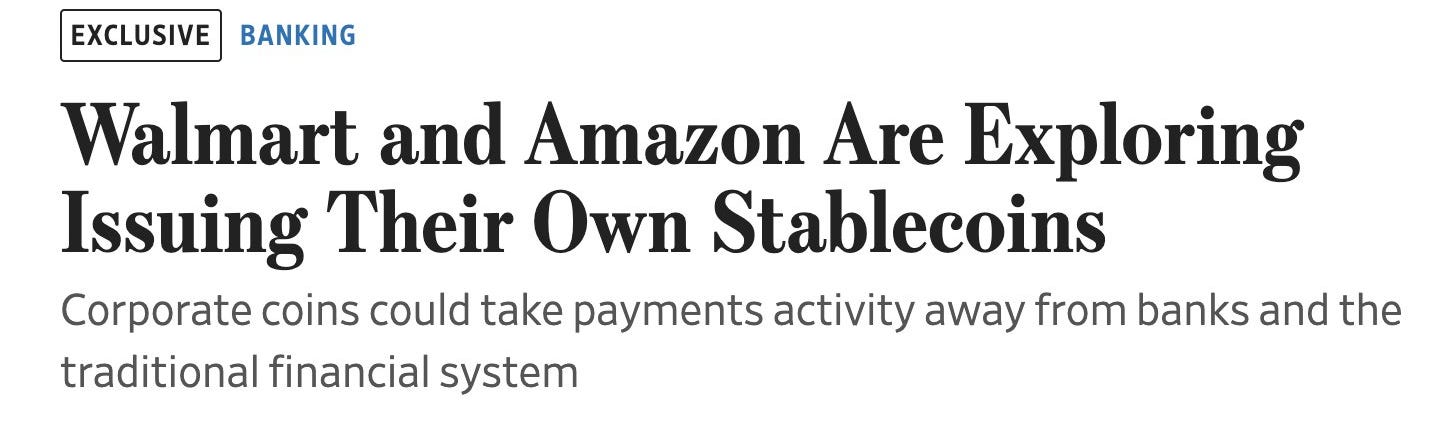
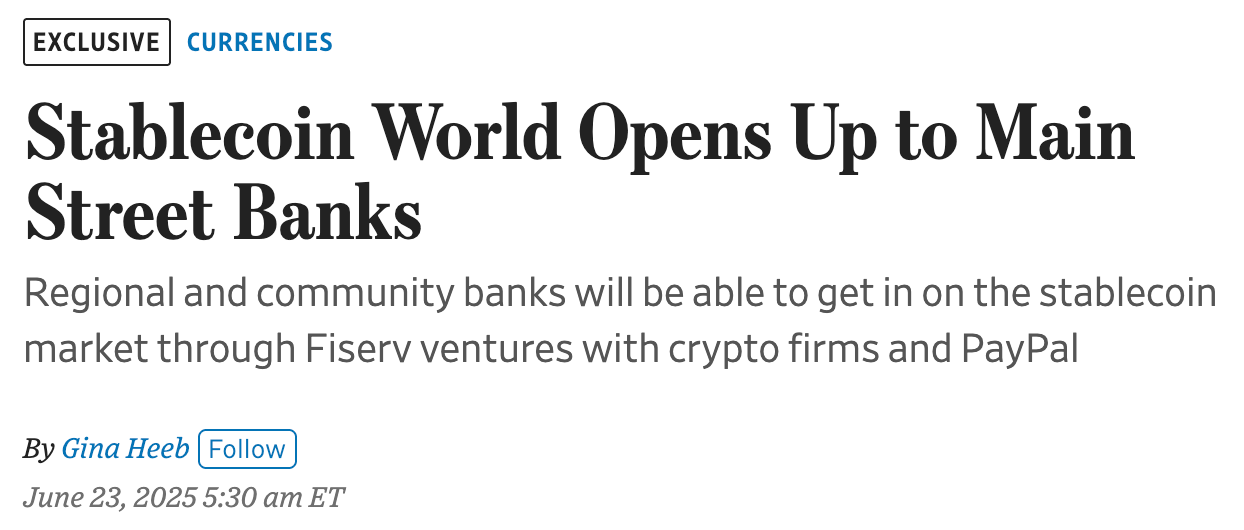
The economic incentive for these additional issuers to get into the market is clear: Tether is likely the most profitable company per employee on the planet, and Circle’s recent IPO performed very well, showing strong public market demand for stablecoins. More USD-denominated stablecoins entering the market from credible issuers does present a UX issue for developers and users however: which USD should they support? In a perfect world, all of these stablecoins would natively interoperate behind the scenes, but on the blockchains people are using today both sender and receiver must trust the same issuer when transacting. In other words, if Alice is paying Bob, she cannot send USDT and have him receive USDC in the same transaction.
Thankfully a better architecture is possible: Taproot Assets on Lightning. With Taproot Assets, all multi-hop Lightning transactions route through bitcoin as the global routing currency, making Lightning a decentralized FX layer for stablecoins on bitcoin. This means that by default, users can spend USDT and the merchant can receive BTC, all natively interoperating within the network, as evidenced by the below Steak ‘n Shake payment:

This will allow more issuers to compete for end users without harming the end user experience. With Square turning on Lightning acceptance for all 4M of their Point-of-Sale terminals, they are also turning on the ability for users to pay with USDT, USDC, JPMcoin, Wal-Martcoin, or any other stablecoin issued on the Taproot Assets protocol… no integration work for Square required! It also means that non-USD stablecoins can leverage the existing bitcoin liquidity in the Lightning Network to be treated as first class citizens, which Lightning Labs Technical Content Lead Leo Weese first wrote about nearly three years ago, and Lightning Labs Head of Product Growth Michael Levin illustrated perfectly earlier this year.
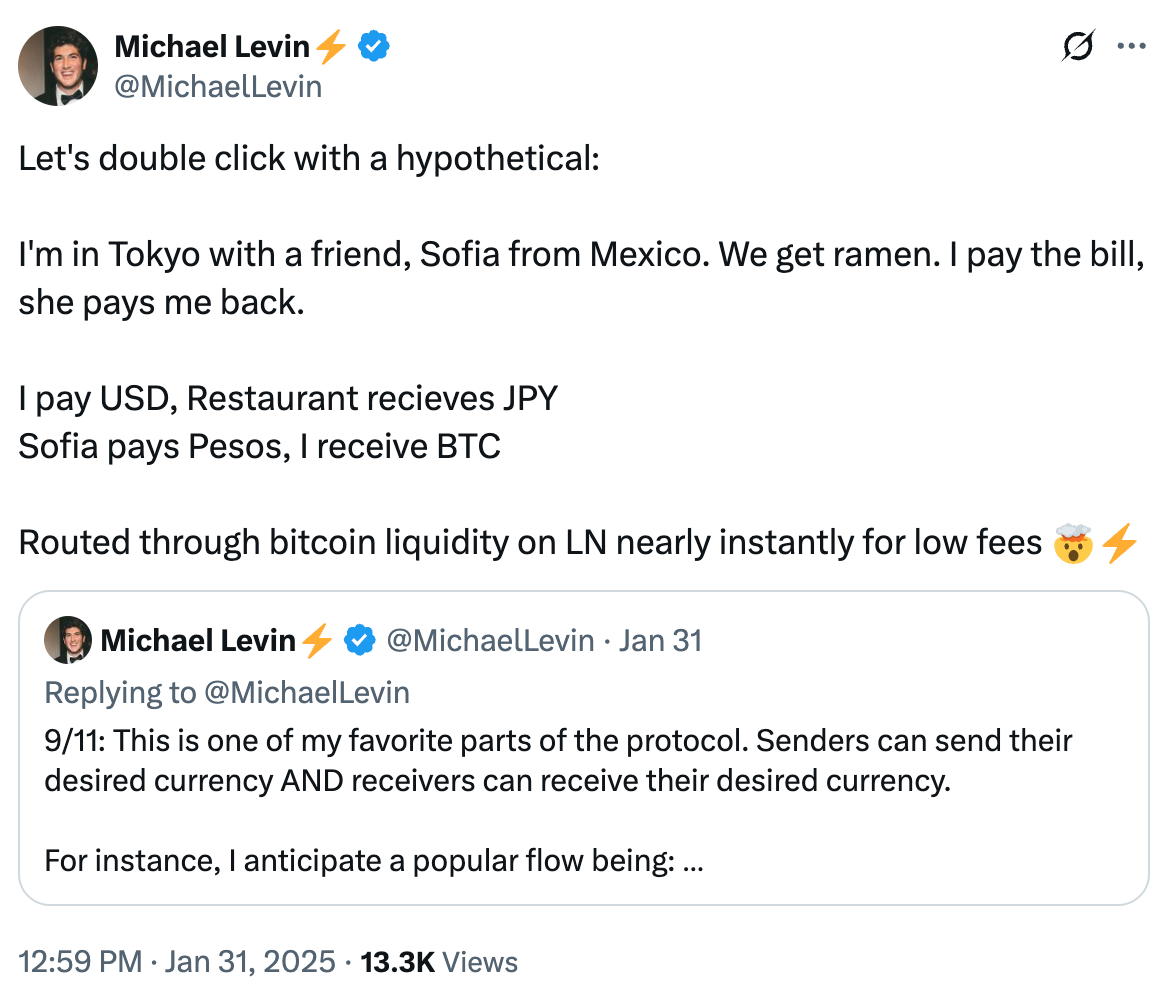
This native interoperability feature of the multi-asset Lightning Network will be a cheat code for adoption. Issuers will value it because it will let their asset compete in the marketplace from an even footing. Users will value it because they won’t be forced by liquidity network effects to trust an issuer they don’t like. Wallets and merchants will value it because they won’t have to integrate hundreds and hundreds of different stablecoins. And Lightning Network routing node operators will value it because they will see their routing fee earnings increase as stablecoins bring LN volume from the billions to trillions. ⚡
💯 Tether CEO Paolo Ardoino highlighted the importance of why USDT is coming to LN at the Bitcoin Vegas conference, stating that altchain L2s are not scalable and that channel‑based architectures like Bitcoin’s Lightning Network are the correct approach. He also joined the Wolf of All Streets podcast and said that USDT on LN scales and checks all the boxes to meet the demand for a truly decentralized and global payments network, quoting a video of the conversation with "Natural evolution".
🔌 Voltage wrote a report alongside Fidelity Digital Assets revealing how LN is delivering on bitcoin's promise for low fees, instant settlement, and growing adoption, with Bitcoin Magazine, The Block, and others providing coverage. They launched the new Voltage Platform, adding a simple, custodial credit-based LN payment option for developers to their LN infrastructure offering. They also (re-)onboarded Unocoin to LN, hosted a webinar with Taxbit to discuss institutional adoption of LN and stablecoins on bitcoin, and wrote that 2025 is The Year Every Wallet Integrates Lightning and Stablecoins, highlighting how "the fusion of Bitcoin's security, Lightning's speed, and stablecoins' stability is the biggest breakthrough in crypto payments".
💥 Juan S. Galt wrote a Bitcoin Magazine article titled “Bitcoin Tech Booms: Lightning Data Defies Digital Gold Narrative”, highlighting LN’s success and growth through data points like c= 9.7% APY and LNM’s $1.5B/mo trading volume.
🇧🇴 Bloomberg wrote an article about the proliferation of bitcoin and stablecoin usage in Bolivia, highlighting Christopher Salas who sells coffee for satoshis over Lightning in La Paz using Blink.
📝 Ark Labs installed their Ark implementation on BTCPayServer and used it to process hundreds of mainnet payments for the first time at Baltic Honeybadger 2025 in Riga. They also published a technical blog post and proof-of-concept code for a Taproot Assets integration into the Ark protocol, covering the full lifecycle from asset issuance to offchain token management to unilateral exit.
🥷 Mullvad.net, the popular VPN, now accepts LN payments with LND, even offering a 10% discount over fiat!
📊 Voltage walked through the L402 protocol in a workshop, discussed the Digital Assets Lightning Network report with Fidelity, hosted a webinar with Anchorage and Joltz to discuss the impact of stablecoins on Lightning Payments and wrote about why exchanges are moving to LN: improved UX, better margins, and staying competitive.
📺 Voltage CEO Graham Krizek appeared on NYSE TV to discuss the report, joined Fintech TV to share insights on USDT coming to LN and the impacts of bitcoin and stablecoins on financial markets, joined Ticker TV to discuss the huge growth expected from USDT coming to LN, and joined Anthony Pompliano on a webinar to discuss how stablecoins and LN are transforming real time payments.
🦡 MoneyBadger, the South African payments provider which provides the systems Pick n Pay uses to accept Bitcoin, has closed a pre-seed funding round.
📰 Bitcoin Magazine and LNFi Network co-hosted a Twitter Space discussing "USDT on Lightning: Faster, Cheaper, Better" with guests from Tether, Lightning Labs, Amboss, and Breez discussing stablecoins on LN.
🖥️ LNNode, LNFi's managed self-custodial node offering, has successfully completed support for the latest version of Taproot Assets. LNFI also conducted an AMA in Chinese discussing AI and USDT on LN with Waterdrip Capital, Hashkey Capital, ElizaOS, OKX and Nervos participating.
🏁 Amboss highlighted how Lightning's fundamentals will ensure it wins the global stablecoin race using Taproot Assets now that USDT transactions on Tron are expensive.
💸 Breez CEO Roy Sheinfeld wrote about USDT coming to Lightning for Bitcoin Magazine, highlighting the bull case of bringing many new users and their volume to the network while also remaining curious about how edge node operations will unfold.
🆕 Joltz onboarded a new customer to their Taproot Assets SDK: ALEX Lab, a Stacks-based DeFi protocol excited about integrating native USDT on bitcoin. They released the Javascript wrapper of their Taproot Assets SDK into public beta, including a signet faucet to make it easy for devs to get started! They shipped a crucial new feature for their mobile self-custodial Taproot Assets wallet: trustless on-chain asset swaps! Users holding assets can swap them for bitcoin via the PSBT standard. They also hosted a Twitter Space to discuss why stablecoins are booming and why all roads lead back to bitcoin and Lightning.
🇧🇷 Eulen has successfully integrated Lightning transactions with DePix, the BRL stablecoin issued on Taproot Assets, into their Telegram bot for p2p transactions.
📚 Lemniscap, the Hong Kong-based crypto venture firm, published a report titled Tokenization on Bitcoin which focused on Bitcoin's evolution into a multi-asset platform via the Taproot Assets and Lightning protocols.
🎉 Astra Labs shared that they have now facilitated $2M of stablecoin payments over LN from Base and BNBChain, with much more to come. They enabled USDT holders on BNB Chain to pay Lightning invoices via their cross-chain submarine swap service.
💸 Neutronpay announced a partnership with AliX Pay wherein they provide fiat off-ramping services for bitcoin and USDT across many chains, with Lightning and Taproot Assets support coming as soon as USDT is issued! They also shared a customer story of Justin Young, a former Vietnamese national team basketball player, accepting payments from international customers for his business over LN.
📠 Bitrefill processed their first fully autonomous Lightning payment, with Cursor's Sonnet 3.7 agent finding a product, generating a Lightning invoice via Bitrefill's store Model Context Protocol (MCP), and automatically paying it using ZBD's wallet MCP.
🎮 ZBD launched a new MCP server that empowers any LLM client with bitcoin and Lightning Network capabilities.
🍎 ZBD co-founder Christian Moss announced that Apple finally approved Sarutobi, his mobile game with bitcoin payments, after first being rejected in 2013. Micropayments are coming to mobile.
🐝 Alby released the Alby MCP Server, a tool for enabling bitcoin payments for AI agents powered by Lightning, Nostr Wallet Connect, and Alby Hub. Building on that, they also launched PaidMCP, the easiest way to build paid Model Context Protocol (MCP) servers, leveraging Lightning and Nostr Wallet Connect (NWC).
🕹️ D++ demoed her latest LN game at the Lightning Fair at the new Tokyo Bitcoin Base: Mario Kart Double Sats!
🛠️ Fewsats released an MCP integration for their AI Agent Lightning payments tools, allowing developers to purchase domains directly from the Cursor IDE, and released a new demo of their L402 libraries designed for AI Agents based on MCP: deploying a weather app in Replit, that's paywalled with fewsats, and accessed from Anthropic's Claude desktop app.
🏆 Fewsats CEO Jordi Montes won the Paypal Dev Days hackathon by creating a way for data publishers to charge AI agents when they access content, using the L402 protocol + PayPal.
🌳 Magnolia, a new regulated bitcoin custodian, broker, and on/off-ramp, has completed their LN implementation and will support instant off-chain payments from day one!
📲 Opago Pay launched an Android app to enable acquirers and payment service providers to easily offer merchants Bitcoin and stablecoin payments via the Lightning Network.
🇪🇺 Bringin added Lightning Address support to their European payments platform, making them the first vIBAN to support the popular Lightning payments schema.
📧 Flash wrote an overview of the Nostr Wallet Connect (NWC) ecosystem, highlighting their preferred tool for connecting wallets with apps for bitcoin payments, and an explainer on Lightning Addresses, the email-like system for bitcoin payments.
🧵 MoneyDevKit founder Nick Slaney wrote a thread about where all the LN yield is coming from, and how to identify popular destinations on the network to provide liquidity to (i.e. Loop).
🗄️ Alsa, a new Lightning startup focused on AI agent payments, built a demo connecting Claude 3.5 to their LNPay.ai wallet via MCP to purchase financial datasets over Lightning.
🌸 Serendipity AI launched a new markdown-to-pdf tool for AI agents based on MCP and L402.
🔧 LNBits, the popular Lightning node management tool, is adding support for Taproot Assets thanks to open source contributor Eric Chennells. They released v1 of their popular suite of bitcoin developer tools after five years of open source building!
🏴 Eric Chennells released v0.1.0 of his Taproot Assets extension for LNBits, supporting sending and receiving over LN as well as the RFQ process for asset swaps via edge nodes.
🌿 Botanix co-founder Alisia Painter highlighted the value of LN and stablecoins on a panel at the Bitcoin Renaissance side event at ETH Denver.
🥃 Botanix CEO Willem Schroe potentially made the first stablecoin payment at Pubkey, using LNFi's Astra Bridge to bridge USDC on Base to LN.
💻 Musqet, the UK-based LN payments company, showed off their superb ePOS terminal at Cheat Code Conference in Bedford UK with seamless bitcoin and LN integration alongside other payment methods.
💳 Musqet CEO David Parkinson shared a slick UI for bitcoin payments alongside Apple and Google Pay buttons, highlighting their ability to natively integrate bitcoin into eCommerce gateways.
🏅 NostrPIX won the bitcoin++ hackathon with an LN-fiat bridge that allows any LN user to pay anyone in Brazil over the PIX network, with automatic top-ups via NWC included.
🐻 Polar added the following new node releases to the popular rapid prototyping tool for LN developers: v0.19.1-beta, tapd v0.6.0-alpha, and litd v0.15.0-alpha.
⚡ Zeus released v0.11.0 of their self-custodial mobile LN wallet, including features like an experimental Cashu ecash wallet, LN ↔ on-chain swaps, import and export wallet configs, and UTXO labeling, after shipping v0.10.0 which featured the ability to renew channel leases, spin up multiple embedded wallets, Nostr Wallet Connect client support, and more.
☀️ Tether is installing kiosks in Africa, with solar panels on top to recharge hundreds of high performance batteries, offering monthly subscriptions to the local community (payable in local currency, Bitcoin LN or USDt).
🚢 Blixt Wallet shipped v0.8.0 of their self-custodial mobile LN wallet, migrating the app to a new React Native architecture and including a host of performance improvements and bug fixes.
👩💻 Lightning Labs Developer Advocate Hannah Rosenberg upgraded one of her mainnet litd nodes to enable Autofees and Auto Opens, highlighting her guide for transitioning an lnd node to a litd node in the process!
🦅 Starkware released a Rust implementation of an L402 server alongside a demo frontend allowing users that are paying via Lightning to query details of the latest bitcoin block.
🏛️ Fedimint Project Lead Eric Sirion built a Lightning Address Server lnaddr.org, where any user can provide an LNURL-pay string from their wallet, tie it to a Lightning Address, and get all payments redirected from the Server to their wallet.
🦡 MoneyBadger CEO Carel Van Wyk joined the Connect the World podcast to discuss growing bitcoin adoption in South Africa.
🏞️ K1 El Salvador discussed their LN-based bitcoin ATM solution on the Connect the World podcast.
🎪 Viva Bitcoin co-founder jos3 vibe-coded a Duolingo-inspired language app that pays users with sats for completing lessons, powered by the ZBD API.
💶 Elenpay presented how they transform bitcoin into a tool for everyday payments at the Barcelona Finance conference.
📰 Lightning News detailed the 21 best ways to accept bitcoin payments, including BTCPayServer, Zaprite, OpagoPay, and more!
🙋 Stacker News hosted an AMA with new Value 4 Value artist Kathryn Stearns, who has published two songs to the Fountain app and is Nostr-first as a marketing strategy.
🎓 Fanis Michalakis gave a deep dive session on the Lightning Network for Plan B Labs.
🏫 Node Nation El Salvador is teaching local students how to leverage the Lightning Network, setting up nodes with Polar and connecting them to apps like Alby and Zeus to make payments.
🎒 Node Nation SV published a video from their ongoing LN lectures, teaching students how to connect their Zeus or Alby wallet to their self-hosted node, and about liquidity, channels, HTLCs, and more!
🌍 Africa Free Routing hosted their Kaduna Lightning Bootcamps in May and June, continuing to grow the Nigerian bitcoin and LN developer community, completed their five day Lightning Developer Bootcamp in Cotonou, Benin, and then hosted another bootcamp in August in Lusaka, Zambia!
🏦 Mavapay joined the Lightning Developer Bootcamp in Kaduna, Nigeria, teaching builders how to create and pay LN invoices, and integrate on/off-ramp solutions with their APIs.
🇮🇹 Fornelli, Italy is becoming a Bitcoin Village, with 1800 residents and 25 merchants accepting bitcoin. They hosted a monument to Satoshi and Bitcoin on May 1.
🇻🇳 The Bitcoin Learning Center Chiang Mai will be running a pop-up Bitcoin Lightning Market in Chiang Mai November 1st and 2nd, featuring a board game competition and more!
💼 Sats Ventures hosted a Twitter Space titled "Bitcoin: Now a Global Foreign Exchange" featuring guests from Joltz and UTXO Management discussing Taproot Assets LN.
💎 Karl Alomar, an investor at M13, discussed the unique value proposition of Bitcoin compared to the sea of memecoins and cryptoassets with no long term value at the Fintech Americas conference.
In June, we released Taproot Assets Daemon v0.6 which included enhancements and usability improvements to deliver on the promise of making the Lightning Network a decentralized foreign exchange network for Bitcoin. Namely, we enhanced the request for quote (RFQ) feature, which allows for the receiver of the payment to ask the node providing liquidity on Taproot Assets for a time-limited price quote between the relevant asset and bitcoin, to handle larger payments more reliably. This functionality is enabled by allowing receivers to combine the inbound liquidity of multiple edge nodes. Additionally, in this release, developers can use group_key Lightning flows like funding channels, sending, or receiving payments.
Further, we also released the latest major version of LND with v0.19 along with the follow up minor release v0.19.1, which included optimizations for improved LND start time, increased payment reliability, and improvements to the flexibility of co-operative close flows.
Finally, the Lightning Terminal (litd) daemon was updated to include the latest client releases of LND, tapd, and Loop. As always, we encourage builders to update to the latest software versions.
Lightning Labs CEO Elizabeth Stark spoke at the Bitcoin Conference about how stablecoins and vibe coding with AI will drive bitcoin adoption, and also said at the Proof of Talk conference in Paris that the Lightning Network will process over ten trillion of dollars of annual volume in the future.
Lightning Labs CTO Roasbeef spoke about preparing bitcoin for quantum computing at the Presidio Bitcoin Quantum Summit, and teamed up with Lightning Labs Full Stack Engineer Jason Brill to win the Presidio Bitcoin Hackathon 2025 with Autonomous-Rekt - a tool combining LLM-powered fuzzing with LN. He also sat down with Stephan Livera to dive into all things Bitcoin, Lightning Network and scalability at the Plan B Forum in El Salvador.
Lightning Labs Head of LN Liquidity Alex Bosworth spoke on a panel at the Web3 Festival in Hong Kong about the next chapter of the Lightning Network.
LL Head of BD Ryan Gentry closed out OPNEXT 2025 with a panel discussing “Where do we go from here?” alongside Casa CTO Jameson Loop, and Foundry Digital’s Jay Beddict. He also joined a Twitter Space with Botanix and LNFi to discuss Lightning as an interoperability layer.
Lightning Labs Head of Product Growth Michael Levin highlighted Lightning Labs’s automated node stack - Auto-Open, Auto-Fees, and Auto-Loop - that helps node operators focus their time and energy on building, instead of managing their node.
Lightning Labs Developer Advocate Hannah Rosenberg spoke on a panel about Blockchains as a Pillar of the New (Financial) Infrastructure at Fintech Summit Americas in Mexico City. She also released an article in Bitcoin Magazine’s physical Lightning Issue magazine.
Are you passionate about bringing bitcoin to billions? Does building the internet of money with incredibly talented people excite you? We are hiring for a number of roles across the company.
These roles include Senior Security Engineer, Assets Protocol Engineer, Cryptographic Protocol Engineer, Lightning Infrastructure Engineer, and more.
Join us in making magic internet money a reality! 🧙♂️
Want to get involved? Join the LND Developer Community on Slack.
No posts
Comments
Nothing yet. Say the first thing.
Sign in to join the conversation.