
Welcome to the latest edition of the Lightning Lab 🧪, a newsletter filled with Lightning Network updates, community coverage, and, of course, memes! Recently we've seen the political world wake up to bitcoin, with politicians seeking to court the bitcoin vote. And the bitcoin builder community has been as ever focused on building open source solutions to help ordinary people join the global, permissionless market powered by magic internet money. This newsletter is full of technical updates making the Lightning Network more accessible, more usable, and more powerful as the global, interoperable Layer 2.

On July 23, we announced the release of Taproot Assets on Lightning, the first multi-asset Lightning protocol on mainnet. With this release, assets can be minted on bitcoin and sent via the Lightning Network instantly for low fees. As such, we now have the ability to make bitcoin and Lightning multi-asset networks in a scalable manner anchored in bitcoin's security and decentralization. This step forward will give users access to the world's currencies on an open, interoperable payments network while routing through bitcoin liquidity, making bitcoin the global routing network for the internet of money. Together we are bitcoinizing the dollar, and the world's financial assets. The release was covered by outlets like the Block and Bitcoin Magazine, with Alex Bergeron quoting CEO Elizabeth Stark, “As we’ve seen an explosion of creativity in the developer community, the need for a global, scalable, interoperable protocol for transferring bitcoin and assets to on bitcoin has only increased in importance”.

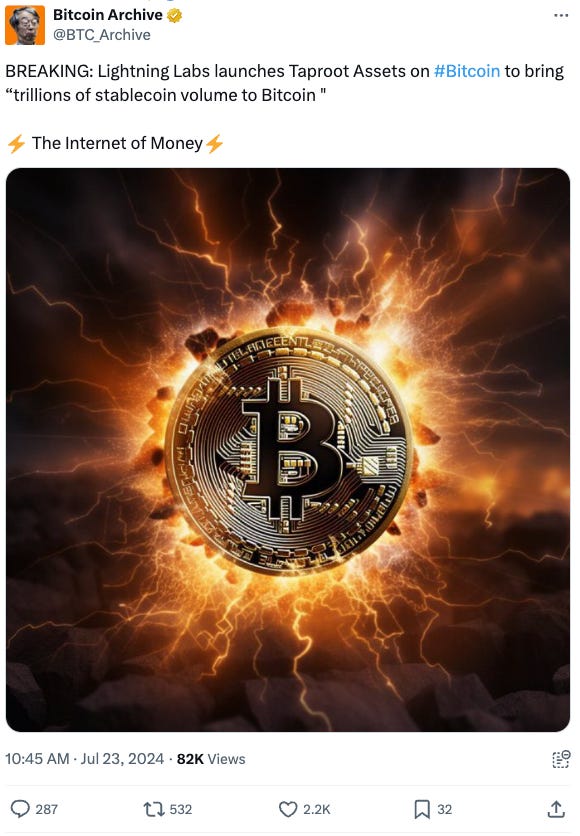
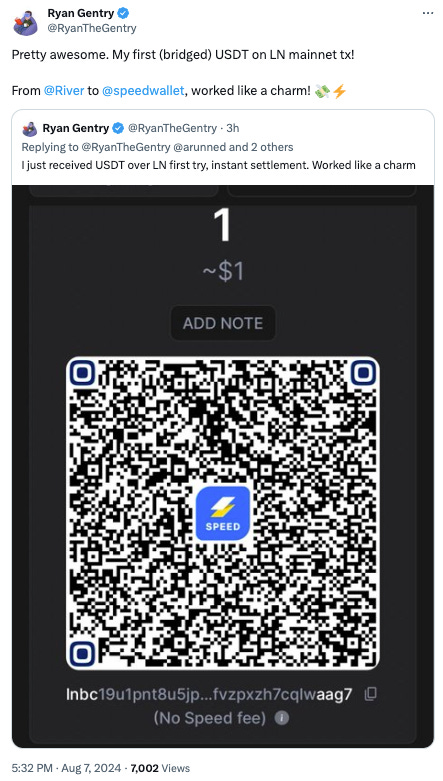
In the short time since this pivotal release, the developer community has been incredibly busy shipping a variety of new products built on this new release. Speed Wallet has led the way by bridging USDT from Ethereum over to Taproot Assets and integrating it into their custodial Lightning wallet. Lnfi Network (formerly known as Nostr Assets) has announced that they will be launching a similar bridge to integrate bridged USDT into their LN-based exchange. The community has also launched edge nodes for routing Taproot Assets Lightning payments, price oracle services to help edge nodes determine exchange rates, and we expect to see more bridges and wallets going live soon. We of course knew the community was ready for these new capabilities, but the rapid response has blown us away! The Lightning Network is growing into a world-class, multi-asset payments network as we speak, and soon the $30T of annual stablecoin volume projected for 2024 by K33 Research (after $11T in 2023) on alternate blockchains will flow back to bitcoin. 😎
While the builders have been building, of course, the talkers have also been talking. Two of the three major United States Presidential candidates spoke at the Bitcoin Conference in Nashville and discussed their plans for creating a Strategic Bitcoin Reserve. Politicians also discussed a vision to integrate bitcoin, the US dollar, and stablecoins into the global economy to “extend the dominance of the U.S. dollar to new frontiers all around the world.” Tether, the world’s largest stablecoin issuer, is demonstrating today exactly what this model looks like in a company: backing $114B of stablecoin issuance with $97.5B in US Treasuries (greater than Germany, the UAE, and Australia, ranking 18th in the world!), and $4.7B in bitcoin, in addition to reverse repo agreements, money market funds, and gold. We’re excited to see major stablecoins issued on Taproot Assets and transferred over the Lightning Network for instant, low fee, global settlement. Coming 🔜.

Speed, developers of a custodial Lightning wallet and payment processing platform, launched the first mainnet stablecoin on Taproot Assets, and have already integrated it into their wallet. They have bridged USDT from Ethereum over to bitcoin, calling the Taproot Assets version USDT-L, and are already processing stablecoin payments at the speed of Lightning!

Fedi announced the official launch of the Fedi App, a superapp targeting communities globally which is based in federated e-cash and interoperable with the Lightning Network. The company also announced the beginning of the process to make Fedi open-source.

Lightspark is doing a great job onboarding the last cohort of major exchanges that were not yet part of the Lightning Network. Recently, Coinbase added full support for Lightning deposits and withdrawals, as well as Xapo Bank and Zero Hash. Additionally, Lightspark announced that the largest fintech bank in Latin America (and possibly the world), Nubank, is working on their Lightning integration, along with Bitso, a major cryptocurrency exchange in Latin America.

Bitget, a cryptocurrency exchange based in Singapore, announced the integration of the Lightning Network for faster and lower-cost bitcoin transfers.
Bitybank, a Brazilian fintech company, has integrated Lightning Network capabilities for deposits and withdrawals on their mobile digital bank and on their exchange, Bitypreço.
🌎 OKX reported that approximately 70,000 cumulative users from 179 countries are actively using the Lightning Network on their platform, averaging four transactions per month. The platform had a 4x increase in both monthly user and transaction counts over the past year.
🎉 Geyser has totaled 452k contributions across 1,500+ projects, with 335 of them pushing forward Bitcoin education.
📈 Coingate reported that Lightning payments have more than doubled as a percentage of bitcoin transactions over the past two years, with a 75% increase in orders since 2022.
⛏️ Nicehash, the cloud mining marketplace, can now do Lightning payouts for all miners, confirming the LN <> Mining convergence.
🇦🇷Ripio users can now send and receive bitcoin using Lightning Addresses.
🧑💻 Joltz launched a browser-based, non-custodial Taproot Assets wallet. They also released a wallet SDK supporting bitcoin and Taproot Assets (with Lightning coming soon), empowering other developers to easily build non-custodial solutions. Additionally, they launched a Zapier integration, enabling users of 6,000 apps and services to earn rewards in sats.
🗄️Fewsats has launched their Storage Service, enabling users to upload and host files behind a paywall, accessible globally through an L402-compatible client. They also introduced Sherlock Domains, the first product powered by their platform, which allows for registering internet domains. Fewsats also demonstrated an advanced application by integrating the LlamaIndex agent with the FewsatsCLI, enabling the agent to natively handle paywalled content using L402. Additionally, they launched Pay With Hub, a service that enables access to L402 endpoints using a credit card.
💬 OpenAgents launched their AI agent swarm, capable of recursive daily improvement through crowdsourcing and bitcoin incentives. They also introduced the agent store, an AI agent marketplace with revenue sharing paid daily in bitcoin through the Lightning Network.
💡 Sulu Solutions released an open-source JavaScript and Python L402 client, enabling querying of various models for a minimal Lightning payment. They've updated Sparkwall, which now supports individual endpoint pricing, testnet/regtest Lightning wallets, and API for programmatic access, among other features. Additionally, their API hub, Sparkhub, is now live in beta, with over 30 API providers offering their data and monetizing it through L402.
👩💼 Alyse Killeen discussed technologies and startups driving bitcoin's adoption and price on Bloomberg TV's VC Spotlight, highlighting the Lightning Network, Taproot Assets, L402, and others. She was also joined by Cathie Wood at Bitcoin 2024 in Nashville where they talked about the unique investment opportunities created by how bitcoin and Lightning merge technology, a monetary system, and a new asset class.
👁️ Megalithic launched their Taproot Assets explorer, providing tools to navigate the world of assets issued on Bitcoin.
💸 Neutronpay raised a $1.5M bridge round led by Axiom Capital. They recently started doing business in Malaysia, Indonesia, Thailand, the Philippines, and South Korea. They have released a new version of their mobile app featuring full bitcoin and Lightning Network wallet capabilities, as well as the ability to convert to and from local currencies in several Asian markets.
🏆 ZapConf, a virtual conference focused on hacking and learning about the Lightning Network and Nostr, is scheduled for September 21-22. The event is organized by Santos Hernandez (ZBD/Emeralize), who also recently launched the Global Hackathon League, a platform where developers can team up and compete in hackathons.
🧊 Cubo+, in El Salvador, announced Devs Generation 2024, a new cohort of their Bitcoin and Lightning dev training program.
⚡ Zeus released several new versions of their self-custodial mobile Lightning app that include enhancements such as LSP support for LND REST connections, on-chain transaction coin control, improved LNC connection, signet support, UI improvements, and more. Their new Olympus LSPS1 web portal allows users to purchase channels for any node on the network.
🎳 Strike is expanding fast. They launched Strike Africa, expanding their full suite of Bitcoin and Lightning services into Gabon, Ivory Coast, Malawi, Nigeria, South Africa, Uganda, and Zambia. Additionally, Strike has extended its services to Europe and the UK, further broadening its global footprint. Their plug-and-play suite of products and tools, Strike Black, is now available for all developers, combining the Strike API, widget and OAuth Connect.
📬 The Bitcoin Company launched their remittances API, supporting transfers to Brazil and Mexico.
🌍 Noones has enabled Lightning deposits for all their users, thereby expanding access to Lightning for users of their peer-to-peer marketplace in emerging markets.
📻 Fountain introduced Fountain Radio, a community station that allows users to directly support artists through the Lightning Network.
🏧 GettingCrypto announced their first Lightning ATM in Canada, located at Time Out Cafe in Downtown Vancouver.
📱 Paxful integrated Lightning deposits and withdrawals into their mobile app, broadening payment options for users.
🔦 Flash introduced Bitcoin subscription plans, partnering with Geyser as their first collaborator to facilitate regular monthly contributions via Nostr Wallet Connect.
🎁 Bitcoinlink.app is a self-custodial and open source alternative to River Link, using Nostr Wallet Connect to create Bitcoin gift links.
🔌 Voltage released a redesigned dashboard, a team collaboration feature, and updated their pricing tiers.
🤝 Bitwave, an enterprise accounting platform for crypto, partnered with Voltage to offer their users the ability to track, manage, and account for their entire on-chain and off-chain financial activity.
🌉 Calle built a Cashu gateway that allows any Cashu user with a Lightning node to act as a bridge using ecash HTLCs. Additionally, he leveraged MPP to create Multinut Payments, allowing a single Lightning invoice to be settled using Ecash balances from multiple Cashu mints.
🏦 Mavapay is a new app that allows Nigerians to receive Naira directly into their bank accounts through Lightning Network payments.
🧾 Wallet of Satoshi optimized their POS app with an item selection tab, local transaction history, and optional printed receipts.
🕷️ The SpiderHack 2024 first place winner was the Botanix EVM Lightning Network Trustless Bridge, solidifying the Lightning Network as the connective tissue between different Bitcoin sidechains and layer-twos.
⛈️ Storm.pub is a new platform that allows users to watch any video from YouTube and send sats directly to the content creator’s Lightning wallet.
🍴 Cräveble partnered with Joltz to offer rewards in sats for every fresh local meal purchased on their delivery app.
🚀 BTCPay Server announced the release of v1.13.0, a major release with server branding, new employee and manager role, new POS keypad item, better Bitcoin QR support, along with new integrations and plugins. Recently, they integrated with self-hosted invoicing and billing platform Invoice Ninja.
➕ D++ released the LNURL invoice retriever, a tool which allows a user to grab an invoice from a LNURL or Lightning Address to pay from a Lightning wallet that doesn’t support the standard. She also built Lightning Server to help users host their own Lightning Address. The server sends email and push notifications anytime the user receives a payment and integrates with Nostr for Zap notifications.
🐝 Alby launched an open-source, self-custodial Lightning wallet, Alby Hub, with an integrated node. Hosted by Alby or self-hosted, it supports various Lightning backends including LND. They also introduced the Alby Wallet API Community SDKs, allowing apps to send and receive payments, get podcasting 2.0 details, create invoices, retrieve user's incoming and outgoing payments, and make Lightning payments on behalf of users.
🤖 PayPerQ is a website offering a GPT-4 experience that operates on a per-query model, facilitated by Lightning micropayments.
🔗 Bringin launched their Pay Lightning Invoice feature, combining SEPA instant and a Euro to Lightning bridge.
🌊 Geyser introduced Goals, a new way for donors to engage with projects they’d like to fund, where they can select specific goals they want to prioritize when donating. They also announced the Bitcoin Beach Grants, a new set of grants to support emerging Bitcoin circular economies.
🎧 Wavlake introduced Ticketbot, a new way to buy and sell tickets across the web using Lightning and Nostr. They also enabled Lightning Address support for artists earnings.
🚄 Speed introduced Speed Rewards, their new loyalty program. They also launched a Bubble plugin, allowing users of the no-code platform to integrate Lightning into their applications.
🔑 Amboss announced MiBanco.app closed beta, a wallet using the same architecture as Aqua Wallet, with users holding balances on Liquid and swapping it for Lightning payments.
📲 Hivetalk is a new application for browser-based video calls with Lightning integration for Zaps.
🎟️ Bit_social is an app that allows users to organize events and sell tickets via the Lightning Network, and is supported from within the Fedi app.
🇧🇷 Bipa enabled NIP57 on their Lightning Address, allowing Nostr users to use it for receiving Zaps.
🇬🇹 Osmo Wallet users can now send payments in real time to any bank account in Mexico thanks to their Lightning integration.
🇳🇿 Lightning Pay NZ is a new startup that allows you to pay a fiat bill in New Zealand using the Lightning Network
💼 Clams released an open beta for their new Bitcoin-focused accounting app, that allows users to connect their Lightning nodes through Lightning Node Connect (LNC) or Nostr Wallet Connect (NWC).
🥮 Tiramisu Wallet unveiled a new design to enhance user experience.
Last week’s public launch of the Fedi app, a Chaumian ecash-focused wallet with native connectivity to the Lightning Network, underscored a theme we’ve been highlighting all year: Lightning will connect all efforts to scale bitcoin off-chain. By integrating with Lightning, Fedi users immediately gain instant, low-fee interoperability with all existing Lightning wallets, all the exchanges that support Lightning, and all the future sidechains, rollups, and additional off-chain projects that are coming to market.

As Ryan Gentry wrote in Bitcoin Magazine yesterday, there are several new categories of protocols coming to market that improve user onboarding to bitcoin with Lightning as the interoperability layer:
Channel Factories: this native to Lightning design will of course interoperate with today’s Lightning Network out of the box. For user experience, imagine onboarding to a non-custodial Lightning wallet without needing to wait for an on-chain confirmation or paying a fee to open a new channel. This could be accomplished by the channel factory operators making channel-related operations off-chain and confirming them in massive batches on-chain when convenient and economically rational. Channel factories will be greatly improved by covenants.
Chaumian Ecash Mints: wallets like Fedi and Cashu.me can onboard users without needing to interact with the bitcoin blockchain, and with low cost off-chain payments. However, these users are holding ecash, not bitcoin, and must trust the wallet operators not to steal their funds. Covenants can help provide better trust guarantees regarding auditability for the total ecash supply.
Sidechains: wallets like Aqua Wallet and Amboss’s MiBanco App have recently launched where users hold funds on sidechains, but can send and receive over the Lightning Network. This is exciting because there is strong developer energy going into new sidechains, with people building BitVM-based bridges, more decentralized approaches like Botanix’s spiderchain (which already has Lightning support!), and zero-knowledge proof systems like Alpen Labs and Starknet. Sidechains provide a very similar user experience to federated ecash mints with essentially the same trust assumptions today. Covenants promise to improve these assumptions by allowing users “unilateral exit” from a sidechain, i.e. even if the sidechain operators disappear or try to steal from their users, their users can always withdraw to the main bitcoin chain.
Ark: a relatively new proposal for transacting bitcoin off-chain in a self-custodial manner. Its design depends on a trust-minimized Ark Service Provider (ASP) accepting deposits (either on-chain or via the Lightning Network) from users, processing their transactions off-chain, and allowing unilateral exit on-chain. The ASP handles all liquidity constraints, allowing users to receive off-chain without first needing direct inbound liquidity, and periodically refreshes the state of the system by making just a single on-chain transaction. This is an exciting new direction as it allows for unilateral exit out of the box, but without covenants the user experience will not be on par with custodial Lightning.
These new developments are incredibly bullish for the Lightning Network as Taproot Assets brings stablecoins and stablecoin users back to bitcoin. Those users will have a thriving marketplace of onboarding options from which they could transact, depending on their desired trust model. They of course could use one of the non-custodial wallets, or they could trust a custodian, or they could use one of the newer BitVM or ZK-based sidechain options once those come to market. The important thing is that all of these options are available, and all will interoperate using the Lightning Network.
As Roy Sheinfeld, CEO of Breez, wrote earlier this summer, “Lightning is emerging as the common language of the bitcoin economy.” Lightning’s existing network effects have already hit critical mass, and its inherent trustless nature as a protocol make it safe for developers to integrate. We wrote in a previous newsletter that Lightning was “Reaching the Tipping Point” in terms of adoption as a network technology, which is defined as when the benefits of joining said network outweigh the costs of doing so. Since then, the benefits of joining the Lightning Network have only increased while the costs have decreased. New developers are taking note, as Fedi, BTC Sessions, and Breez recently highlighted. Watch this space, as we expect multi-asset Lightning to start bringing new users and devs very soon.
In late July, as highlighted above, we released Taproot Assets on Lightning, the first multi-asset Lightning protocol on mainnet. Now, the developer community can mint assets on the bitcoin blockchain and send those assets over the Lightning Network instantly with low fees. In the build up to launch and after the release, the developer community has been testing and building with the Taproot Assets software to mint assets, run edge nodes, and build wallets, explorers, and more. To learn more about this release and get started building with Taproot Assets, developers can download the release, check out the API docs, and read the getting started guide. Further, the Taproot Assets channel functionality is also available in the latest Lightning Polar release, a one-click Bitcoin Lightning network for local app development, so developers can test using that local testing environment.
Additionally, we released LND v0.18 (along with minor releases v0.18.1 and v0.18.2), which improved UTXO sweeping for more efficiency on-chain operations, SQL schema for invoices for more scalable node operations, inbound fees for more performant routing operations, and more. As always, we recommend upgrading to the latest version of LND to ensure the most performant operations.
For Lightning Loop, a service that allows users to replenish inbound liquidity (Loop Out) or outbound liquidity (Loop In) on the Lightning Network, with release v0.28 and beyond, users can now perform Instant Loop Outs. Instant Loop Outs allow users to swap off-chain to on-chain funds immediately without waiting for on-chain confirmations through the use of a pre-configured reservation in the form of an on-chain commitment. If you are interested in using the Instant Loop Out functionality, read our guide and reach out to us.
CEO Elizabeth Stark spoke with Namcios at Bitcoin Asia in Hong Kong on the future of Lightning and Taproot Assets, and how all roads lead to the Lightning Network for interoperability between different off-chain protocols. She also joined Ayelen Osorio at the Oslo Freedom Forum to discuss bitcoin and the Lightning Network’s impact on global human rights.
Head of Business Development Ryan Gentry explored the role of Lightning as an interoperability layer connecting different attempts of scaling Bitcoin on a panel at Bitcoin 2024 in Nashville. He also talked about making Lightning a multi-asset network with Taproot Assets and joined a panel about the state of Lightning at the Tuscany Lightning Summit. Finally, Ryan was on the TFTC podcast with Dhruv Bansal and Allen Farrington talking about how the bitcoin stack is built on layers of simple modular markets that enable more complex applications.
CTO Olaoluwa Osuntokun spoke about validating metaprotocols (like Taproot Assets) in Bitcoin Script with Covenants at bitcoin++ ATX script edition. He also discussed “Bitcoin Layer 2” and “Understanding Bitcoin Development” on panels at the Bitcoin Seoul Conference.
Protocol Engineer Keagan McClelland explored covenants and the various opcodes being proposed by bitcoin developers at the MIT Bitcoin Expo.
Protocol Engineer Jonathan Harvey-Buschel gave a talk about assets on bitcoin and Lightning through client-side validation at the MIT Bitcoin Expo. He also joined a panel on Lightning Applications at the same event.
Infrastructure Engineer Yong Yu was interviewed by the 1sat podcast (in Mandarin) about building Lightning and how it’s an integral part of Bitcoin. He also discussed bitcoin ecosystem trends on a panel in Northeast Asia.
Head of Lightning Liquidity Alex Bosworth joined the Bitcoin Optech Twitter Spaces to discuss the lnd 0.18 release and Infrastructure Engineer Elle Mouton joined another episode to discuss implementing blinded paths in BOLT11 invoices.
Developer Advocate Hannah Rosenberg gave two talks about Taproot Assets on Lightning at Bitcoin 2024 and the Bitcoin Builders Conference. She explained the mechanics of how stablecoins will move across the Lightning Network, the role of edge nodes in this process, and the trustless on-chain swaps enabled by Taproot Assets.
Want to join us in making magic internet money a reality? 🧙♂️
We are hiring for:
Senior Engineering Manager, Lightning Infrastructure Engineer, Assets Protocol Engineer, Lightning Protocol Engineer
Want to get involved? Join the LND Developer Community on Slack.

No posts
Comments
Nothing yet. Say the first thing.
Sign in to join the conversation.