
Welcome to the latest edition of the Lightning Lab, a newsletter filled with Lightning Network updates, community coverage, and, of course, memes! In this issue, we discuss how Taro decentralizes the global FX market, how bitcoin renders “cross-border” payments obsolete, how Lightning has continued to grow throughout the bear market, and as always highlight a host of exciting community updates!
In April, we announced Taro, a new Taproot-powered protocol for issuing assets on the bitcoin blockchain that can be sent over the Lightning Network for instant, high volume, low fee transactions. Since then, we have received lots of useful community feedback, which we incorporated into the draft Bitcoin Improvement Proposals (BIPs) specifying the protocol, and have been hard at work implementing Taro as a standalone daemon.
After talking about Taro with the community, one thing has become very clear: in a world of omnipresent communications connectivity, nobody says “cross-border messaging” anymore. Taro promises to do the same thing to “cross-border payments” by decentralizing the entire global FX market into a protocol that can run on a Raspberry Pi by anyone, anywhere. 🤯

elizabeth stark 🍠@starkness
@arcbtc @LeoAW The end goal is to make #bitcoin the means through which we route all the world's currencies, obviously. :)
3:56 PM · Aug 6, 2022
2 Reposts · 14 Likes
At a high level, Taro makes Bitcoin and Lightning multi-asset networks. Users will be able to open up Taro channels that plug in at the edges and interoperate with the existing bitcoin channels that make up the Lightning Network today. That means instead of starting from scratch and bootstrapping a new ecosystem of nodes and liquidity, Taro will leverage the existing network effects of both the infrastructure that’s been built out over the last several years plus the 4000+ BTC allocated to the network today as a global routing currency.

The implications of this are profound. As depicted in the slide above (from our CTO Laolu Osuntokun’s excellent Bitcoin 2022 presentation), every Taro transaction on the Lightning Network will be converted into BTC by the first hop (Bob), routed across the network as BTC, and then converted back into a Taro asset by the last hop before the destination (Carol). Transactions can be sent and received in the same asset such as L-USD above, or converted into different assets such as USD to EUR or USD to BTC. This has the potential to be industry-shattering for foreign exchange markets, and opens up enormous opportunities for fintech founders (especially in emerging markets), routing node operators, and all businesses connected to the Lightning Network. Few have understood this as well as Bitrefill CEO Sergej Kotliar.
Sergej Kotliar@ziggamon
In conclusion: I think Taro can achieve even more for Lightning than ERC20 did for Ethereum. It would be fair to call it Lightning 2.0. All this of course depends on many factors, in a chaotic world, not least getting all this to work, and into the hands of the reckless crowd.
1:08 PM · Jun 28, 2022
2 Reposts · 70 Likes
By integrating with Taro, Bob and Carol have turned their Lightning nodes into “edge nodes” which will now process an instantaneous conversion from L-USD into BTC or vice versa, for a small fee. Prior to this, only centralized exchanges could offer this experience to users. But now, Taro decentralizes this service and distributes its earnings across all the nodes on the Lightning Network that opt in to Taro. This is a brand new market for liquidity provisioning and market making, and each new entrant to the market makes the Lightning Network more efficient and improves the payments experience for everybody.
Of course, Taro is not just restricted to USD stablecoins. Fast forward a few years, and we expect to see major currencies such as EUR, JPY, or GBP issued on Taro and transferred across the Lightning Network. We are also excited to see more localized and emerging market currencies flourish on Taro. A community bank could issue a local stablecoin on Taro and it would only need a handful of nodes or liquidity providers to make a market between the local currency and the BTC core of the Lightning Network to be connected to a global community of buyers and sellers. No permissioning required!
When Alice goes to pay Dave in the example above, Dave will include an L-USD/BTC conversion rate in the invoice presented to Alice. Alice’s software will then look for a route like it would for any BTC payment, and try to find the most reliable path to Dave charging the lowest fees (with L-USD/BTC conversion fees treated as routing fees). Once she sends the payment, each edge node (Bob and Carol) converts L-USD into BTC, or vice versa, at the pre-agreed rate Dave included in the invoice regardless of price volatility while the payment is in flight.
Because edge nodes have opted into converting the assets in question, they therefore charge routing fees for doing so, which could also cover unexpected volatility. We expect those fees to stay low because Lightning payments take seconds or less to complete, so the price volatility that can occur while a payment is in-flight would likely be minimal. Plus, any edge node that starts charging conversion fees that are too high compared to the rest of the market can be undercut by competition at any time…just like how Lightning works today!
The opportunity provided by Taro bringing assets like stablecoins to the Lightning Network is clearly enormous. Every year, businesses and consumers pay $1.9 trillion in fees (2% of global GDP) for the right to pay each other. Visa’s 65% operating margin is one of the highest of all the companies in the S&P 500 index, and this margin is Lightning and Taro’s opportunity. They’ll never see it coming. 👀
André Neves ✪@andreneves
Thrilled to announce that @zebedeeio has raised our Series B round led by Kingsway Capital, and joined by The Raine Group, and Square Enix! We're bringing #Bitcoin to the masses through gaming⚡️ Stay tuned for really exciting news in the coming weeks!
venturebeat.com
Zebedee raised $35M from investors including Square Enix for blockchain game payments

10:25 AM · Jul 20, 2022
28 Reposts · 145 Likes
ZEBEDEE announced their Series B round led by Kingsway Capital. They raised $35M and had Square Enix, the AAA game studio behind Final Fantasy, Dragon Quest and Kingdom Hearts, join the round. Bullish for gaming + Lightning!
Fedi raised a seed round of $4.2M to provide a user interface for Fedimint, an open-source protocol that leverages federated Chaumian Ecash mints to decentralize bitcoin custody and allow for privacy-friendly interoperability with the Lightning Network.
Galoy announced that they raised $4M to further develop their bitcoin-native banking infrastructure, most famous for supporting the Bitcoin Beach community in El Salvador. Alongside the fundraise, they also announced a new product “Stablesats” which allow users to hold a synthetic dollar position within their wallets. We love to see the emerging markets focus!
Stacker News raised a $1.25M seed round led by Max Webster. Founded by Keyan Kousha, Stacker News aims to become the next Reddit, powered by the Lightning Network.
Lemon Cash, an Argentinian digital wallet and cryptocurrency broker, integrated Lightning deposits and withdrawals for their 1M+ customers using OpenNode’s API.
Danny Scott ⚡@CoinCornerDanny
#Bitcoin Lightning vs Mastercard Contactless payment race ⚡
3:22 PM · Jul 25, 2022
678 Reposts · 2.46K Likes
Joe Hall, a reporter from Coindesk, filmed a “contactless payments race” where he tested which NFC payment completed faster: Coincorner’s Bolt card over the Lightning Network, or a standard Mastercard. Spoiler alert: Lightning wins! ⚡️
🐂 LN Markets routed a daily all time high (ATH) of 4 BTC with their Lightning node and achieved a monthly ATH of 40 BTC routed in June. They’ve also reached an aggregate trading volume of $500M. Congrats LNM on such steady growth!
🎧 Podcasting 2.0 has now been enabled by over 8,000 podcasts. More than 1,000 podcasts started receiving value-for-value payments through the Lightning Network in June alone.
📈 Kollider forwarded 36 BTC with their 8 BTC capacity routing node during the month of June.
🌋 Amboss shared that 192 unique nodes have sold channels though Magma, their liquidity marketplace, adding 28.22 BTC of liquidity to the Lightning Network.
🦘 Wallet of Satoshi took 26+ months to do their first 1M Lightning payments, but only around six months to go from 2M to 3M payments, and about 4 months to hit 4M. Lightning adoption is accelerating!
Yassine Elmandjra@yassineARK
4/ Despite the bear market, LN capacity has reached an all time high. LN capacity growth seems to accelerate during bear markets, marking a shift in sentiment from exuberance and speculation to testing and building long-term solutions for bitcoin.

1:54 PM · Aug 3, 2022
30 Reposts · 176 Likes
🛠 Yassine Elmandjra, an analyst at ARK Investment Management LLC, noted that Lightning Network capacity appears to accelerate during bearish market activity. Bear markets are for builders, especially in this community. 💪
👜 Purse, the OG escrow service that connects users with bitcoin to users with Amazon gift cards, launched Lightning Network support. Now their users can buy goods from Amazon with 15% discounts thanks to the fast and cheap LN rails.
🦊 Foxbit is now supporting Lightning Network payments in their Point of Sale product Foxbit Pay. Now Brazilian merchants will be able to receive lightning-fast Bitcoin adding payments and cash it out to BRL.
🎙️ RSS.com partnered with Alby to become the first podcasting hosting company to enable Value 4 Value payments, allowing their creators to receive Lightning donations. Go Podcasting 2.0!
💬 Machankura allows Africans to send Lightning payments using USSD (interactive text menus for basic cellphones) on their phones, totally offline. It’s as easy as sending an SMS. The service is available in Ghana, Kenya, Malawi, Nigeria, South Africa, and Uganda.
💶 The European Central Bank published a research paper written by its director of general market operations with an entire section exploring Bitcoin and Lightning as the potential holy grail for cross-border payments. Just wait until they hear about Taro!
💵 The Federal Reserve Bank of Cleveland also published a paper, specifically focused on the Lightning Network, looking at the association between LN adoption and reduced blockchain congestion, pointing out that Lightning is “turning Bitcoin into money.”
🦁 Paolo Ardoino, CTO of Bitfinex, spoke about building stablecoins on the Lightning Network on the Bitcoin Standard podcast. He discussed Taro's potential and his conviction that Lightning as a technology is much more suitable decentralized value transfer than centralized blockchains.
🗞️ Stacker News released upgrades to their web of trust algorithm, daily rewards, user notifications, and launched a new product called LNCal that allows people to share their public calendar and have people pay them sats to book their time.
🐣 Keet is a new P2P video and chat app built with Lightning Network micropayments. The app uses the new Holepunch SDK/Framework, which is basically torrent for datastreams web content, and will be open-sourced by December 2022.
📖 Magic Internet Money: A Book About Bitcoin is now a Lightning-powered book, thanks to Mash’s Lightning integration tools. The re-release of the original manuscript showcases a new way to monetize written content based on usage.
📖 The Bitcoin Adventure hosted a educational weekend festival for families in Kent, UK with speakers, workshops, music, camping, and a veranda where attendees could buy beer and food with Sats over Lightning, powered by Coincorner!
🏦 Messari wrote an article on how to earn yield on Bitcoin with the Lightning Network, generated from routing transactions and selling liquidity.
🏞️ River added a description of Taro and other related terms to their River Learn glossary.
🎓 Summer of Bitcoin, a global, online summer internship program focused on bitcoin open-source development, is coming to a close. The program has produced amazing projects including Dhananjay Purohit’s content distribution proxy implementing the Lightning Service Authentication Token (LSAT) standard for password-free authentication and Priyansh Rastogi's contributions to LND.
📦 Satbox.tv just launched a new version of their pay-sats-as-you-view video streaming service that introduces credits, an LSAT implementation. Users purchase Credits up front for 1 sat and spend them by adding videos to the queue or continuing the current video.
🎮 ZEBEDEE integrated their Gamertags into a VR-based game. Gamers can now play Beatsaber in their Oculus Quest 2 and stream sats to their ZEBEDEE wallet.
👾 Gamertron launched Sats-Man, a Pac-Man-like game in which you can earn sats over Lightning. A 10 year old developer built this using ZEBEDEE’s SDK, is there a better example of how easy it is to build on Lightning?
🕹️ Viker Games just enabled play-to-earn bitcoin rewards on three classic video games. Solitaire, Sudoku, and Missing Letters will all provide bitcoin rewards on the Lightning Network through ZEBEDEE’s mobile application.
🎳 Strike expanded its Point-of-Sale beta testing to include Poynt by GoDaddy, and have also released their API documentation and Dashboard to the public. Developers can now generate API keys with custom key permissions through the dashboard and build their Lightning apps!
🇮🇱 Pleb TLV is cultivating the next generation of Bitcoin and Lightning startups in Tel-Aviv. They are helping entrepreneurs ideate, build their products, and develop a marketing strategy. The organization will offer access to their vast network of Bitcoin and Lightning companies, and investors. Selected ventures will receive office space and initial capital.
🇹🇭 LN Marketplace Thailand is a Thai language community on Facebook with more than 11k members where merchants and other businesses in Thailand promote their products and services using Lightning payments.
⛲ Fountain users can now receive Lightning payments for listening to podcasts. Earning sats in a podcast app is a great incentive to scale Value for Value, since now users can tip their favorite creators without first needing to purchase Bitcoin. Their latest release also includes faster boosts, ability to send replies, offline listening support, and much more.
🍾 Bottlepay launched version 2.0 of their app with Single Euro Payment Transfers (SEPA) integration enabling instant EUR transfers, and much more. They also added support for stateless invoices to Lightning Multiplexer, an open source infrastructure for multi-node scaling, allowing invoices to be generated without impacting disk growth.
🦁 Bitfinex added LNURL payments support to their mobile app.
💎 Diamond Hands, the largest LN community in Japan, partnered with a top real estate firm in Tokyo for a joint-research project to further adoption.
🤖 RoboSats users can now receive their sats directly on their cold storage, through on-the-fly submarine swaps, a similar protocol used by Lightning Loop to swap on-chain and off-chain funds.
📊 Bolt.Observer recently released their Explorer product, which enables users to drill down into the Lightning Network’s graph data, explore nodes close and afar, find the next node they want to open a channel to, or just learn something interesting about the Lightning Network and its participants.
🔌Voltage added an easy one-click feature for their users to claim 500,000 sats of inbound liquidity. They also wrote a great article on how brands and their identity can be established on the Lightning Network. Running a node creates a compounding effect of trust.
🌊 Geyser launched Geyser Grants, a platform where any Bitcoin creator, educator, or creative can apply to bootstrap their initiatives.
🪐 Ringtools is a Ring of Fire coordination app built by the Satoshi Radio community (the same doing the Connect the World podcast). They have also integrated lnc-web for allowing their users to more easily connect their nodes!
💰 Zaprite, the Bitcoin invoicing, project management, and expense tracking platform integrated LND.
📏 Exponential Layers is a new Lightning Network explorer, where you can customize your node and see node details, setup custom reports and notifications, analyze network capacity, node categories, and more.
🏷 René Aaron wrote a guide on how to setup a Lightning NFC tag so you can easily onboard your friends to Bitcoin.
💸 LNBits PoS system now supports tips. Merchants can choose a percentage option and have the tips going automatically to their employees. Another interesting addition was the ability to write LNURL withdrawal link onto a NFC device (card, wristband, etc).
🧊 Cold Sats, a popular Lightning node, open sourced the tool they use to create the beautiful charts they share with their routing data statistics.
🩺 Amboss released a new feature called Healthchecks, where node operators can display their online status and uptime performance in their page.
💵 BTCPay has a new release with a Lightning dashboard, invoice receipts, LNURL-withdraw support for payouts and refunds.
🏜️ Tatacoa is a new custodial Lightning wallet and POS from Colombia. They’ve been doing local meetups and educating the local community about Bitcoin and Lightning.
🔥 Bolt.Fun introduced a new feature, Stories, a Lightning powered interaction that uses WebLN to tip content creators with sats.
🍠 Atlanta BitDevs is hosting a Taro reading group. Each session will be focused in one of the five BIPs with Bryan Nonni from LibertyX leading the initial discussion. The second reading group happened last Tuesday August 2nd, and the third is scheduled for Tuesday August 16th.!
👨💻 The bitcoin++ hackathon in Austin, Texas produced many interesting projects detailed in a blog post by Thriller Bitcoin. We particularly liked team Zaploy, a collaboration enabling web-hooks on Galoy for Zaprite for easier Lightning business accounting, and TransLnd, allowing nodes to generate new Lightning public keys for each new LN invoice to improve privacy.
✨ Spark Wallet (not to be confused with Shesek’s Spark Wallet) is a new custodial Lightning wallet with focus on UX, ability to purchase gift cards and lots of rewards.
The last two years have brought an explosion of growth to the Lightning Network, particularly in emerging markets like LATAM (e.g. El Salvador, Guatemala, Argentina, Brazil), West Africa (e.g. Nigeria, Ghana), and SE Asia (e.g. Vietnam, Philippines).
Bernard ‘berlin’ Parah ⚡️@bernard_parah
@andreneves Like they currently are on L1s, stablecoins will be good for onboarding in emerging markets. I understand where we’re heading to (out of fiat) but stablecoins do a great job of onboarding. Same reason why bitcoin was put on lightning
12:42 PM · Dec 8, 2021
1 Repost · 29 Likes
As this growth phase progressed, we heard a common theme from entrepreneurs (like Bernard Parah, Bitnob CEO) and community members (like Alex Gladstein, Human Rights Foundation CSO) on the ground: users enjoyed the instant settlement and low fee experience of transacting over the Lightning Network, but really needed the stability of the dollar in order to adopt LN full time.
Alex Gladstein 🌋 ⚡@gladstein
Tech platforms are trying to “go crypto” for international payments. But what if dollar accounts connected by Lightning are superior to complicated stablecoin schemes? Harder to rent-seek and censor, but otherwise… who says no?
6:27 AM · Oct 20, 2021
12 Reposts · 181 Likes
For emerging market users, the usage of bitcoin the asset, comes with difficulties due to volatility and their day-to-day costs. But, bitcoin the network provides a superior payments system vs. the existing banking rails in these areas. Enter Taro, and the new capability for stablecoin issuers to mint assets on the Bitcoin blockchain that natively interoperate with the Lightning Network, leveraging the existing bitcoin liquidity as a routing core. Fiat-backed stablecoins are one of the only applications with undeniable product-market fit in the broader crypto ecosystem today: according to Coinmetrics, since the start of 2020 the total supply of fiat-backed stablecoins has grown to nearly equal the market cap of ETH.
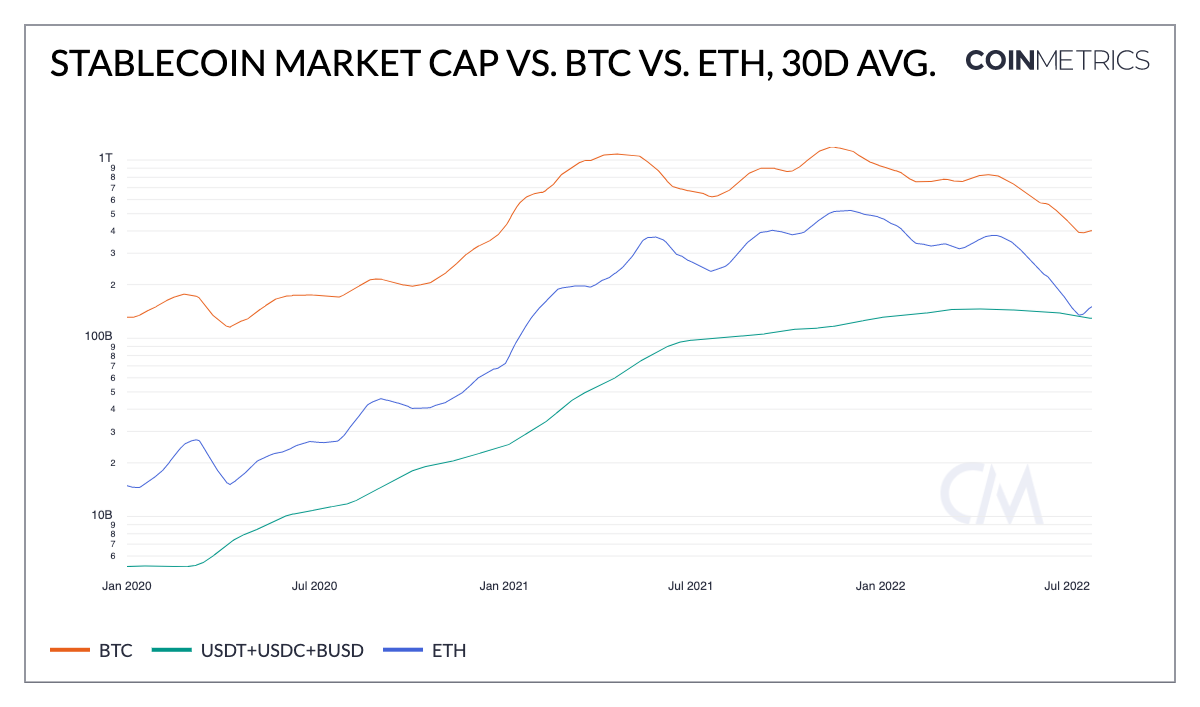
Additionally, the same fiat-backed stablecoins actually flipped ETH (!) in terms of active addresses (a proxy for daily active users) in April 2022 and have retained a lead of ~100k active addresses over the last several months.

Combining the unmatched payments experience of the Lightning Network with stablecoins, one of the only crypto assets outside of BTC with evidence of product-market fit, is an incredibly potent combination. We expect that bringing Taro to market and making Lightning a multi-asset network will dramatically expand the Total Addressable Market for those building Lightning applications. Alex Leishman, CEO of River Financial, understands this better than almost anybody.
Alexander Leishman 🇺🇸@Leishman
We have been running Lightning nodes at @river since 2019 and have only seen a consistent, steadily accelerating increase in reliability, volume, and network functionality. When we extrapolate out this compounded growth we get very excited.
8:14 PM · Aug 2, 2022
34 Reposts · 298 Likes
How dramatically? In 2021, Visa processed $13T of total volume and Mastercard processed $7.7T of total volume for a total of $20.7T across the two major card networks. Arcane Research estimates that in 2021 the Lightning Network as a whole processed a total of ~$200M of total volume. So as we stay focused on building the best network we can, builders and routing node operators on the Lightning Network have a potential 100,000x in transaction volume to look forward to over the next several years! 😱
In June, we launched lnd 0.15, including some of the most advanced production quality Taproot features like multiple script signing paths and experimental MuSig2 API support. This Taproot work lays the foundation for Taro assets on Lightning. Further, lnd 0.15 also incorporates one of the most user requested features in that redundant data has been removed from the revocation log bucket in order to reduce the db size and improve node performance. Initial testing shows that users can expect around 95% reduction in disk space consumed by new channel updates, a huge improvement! You can read more about the lnd 0.15 release in our blog post.
We’ve also been working on improving the Loop experience on Terminal. Specifically, we’ve heard from users about the need for liquidity automation and the complexity of using Autoloop through the command line interface. So, we launched Autoloop on Lightning Terminal to help node operators manage their liquidity in a more efficient, automated way.
Further, to help make node management easier anywhere at any time, we optimized the Terminal experience for mobile devices. So now, node operators can easily open channels, manage liquidity, and monitor their node on the go! 📱
Finally, to help builders create magical non-custodial Lightning experiences, we released an alpha version of Lightning Node Connect (LNC) for the web. LNC allows for the secure and private connection of Lightning Nodes to web experiences like Terminal. For more information, check out this video from the Bolt.fun hackathon explaining LNC in detail. We can’t wait to see what the community builds with this game changing developer tool! 🚀
Two months ago, we started LND PR Review Club, where developers can learn our codebase by performing pull request reviews guided by Lightning Labs team members and other frequent contributors. We've hosted five meetings led by different developers thus far, and attendance and feedback has been great. If you missed these previous meetings, the notes, questions, and logs from the discussions can be found at lnd.reviews.
The Review Club happens every two weeks on Thursdays at 10am PT / 1pm ET in the lnd slack channel #review-club. We welcome suggestions for PRs and volunteers for hosting sessions.
CEO Elizabeth Stark sat down for a fireside chat with Sarah Satoshi at the MIT Bitcoin Expo where they talked about the Bitcoin and the Lightning Network, its impact on emerging markets and on human rights, and about stablecoins on Lightning through Taro.
Director of Business Development Ryan Gentry gave an interview about Taro for the LN Markets newsletter.
Software Engineer Evan Kaloudis did a workshop at Bolt.Fun on LNC-web, a package built to help web developers get up and running building Lightning enabled web applications by connecting them directly with user’s Lightning nodes.
Developer Advocate Hannah Rosenberg was also at Bolt.Fun, giving a workshop on LSATs and Aperture. LSATs offer developers both authentication, as well as a payment mechanism for paid APIs, and Aperture is a HTTP 402 reverse proxy using LSATs.
Are you an experienced software engineer who embraces the DevOps mindset and wants to improve the Lightning developer experience? We are hiring for a Platform Engineer!
Other roles include:
Lightning Infrastructure Engineer, Senior Engineering Manager, Cryptographic Protocol Engineer, Technical Product Manager, People and Business Operations
Join us in making magic internet money a reality! 🧙♂️
Want to get involved? Join the LND Developer Community on Slack.
JohnOttar@johnottar
@gladstein @LynAldenContact Amazing thread on lightning. Funfact: «Lyn» means «Lightning» in Norwegian. :)
3:33 AM · Aug 7, 2022
1 Repost · 49 Likes
Thanks for reading!
No posts
Comments
Nothing yet. Say the first thing.
Sign in to join the conversation.